Tool discovery

What type of AI tool
are you looking for?

Search the active catalog with LambdaBase AI Search, or keep browsing the popularity-ordered directory below.

Submitted search queries and interaction metrics may be analyzed to improve result quality. Do not include personal or confidential information

Browse popular tools.

Screenshot of DALL-E 2
DALL-E 2
Art Generation Unknown

DALL·E 2 is a generative AI system developed by OpenAI that creates realistic images and art from natural language descriptions. It uses a modified GLIDE model architecture, building on the original DALL·E, to produce high-resolution images (1024x1024) that are often indistinguishable from photographs or human-created art. The model can combine diverse concepts, attributes, and artistic styles, enabling the generation of novel scenes like 'an astronaut riding a horse in a photorealistic style' or 'a bowl of soup that looks like a monster'. DALL·E 2 understands complex relationships between objects and actions, and it has significantly improved caption matching and photorealism compared to its predecessor, with human evaluators preferring it 71.7% and 88.8% of the time, respectively. It was released initially as a research preview and later made widely available through an API, integration into ChatGPT, and a dedicated web interface at labs.openai.com. The system incorporates safety mitigations including filtering of training data to remove explicit content, rejection of harmful prompt categories, and monitoring to prevent misuse. DALL·E 2 has been used by artists, designers, and businesses to streamline creative workflows, prototype ideas, and generate marketing content.

Solves

Content creators, designers, and businesses often struggle to produce custom, high-quality visual content quickly and affordably. DALL·E 2 solves this by generating unique images from simple text descriptions, eliminating the need for manual illustration or photography. It enables rapid prototyping of concepts, creative exploration, and the production of tailored visuals for various applications, reducing time and cost barriers.
Screenshot of denchclaw
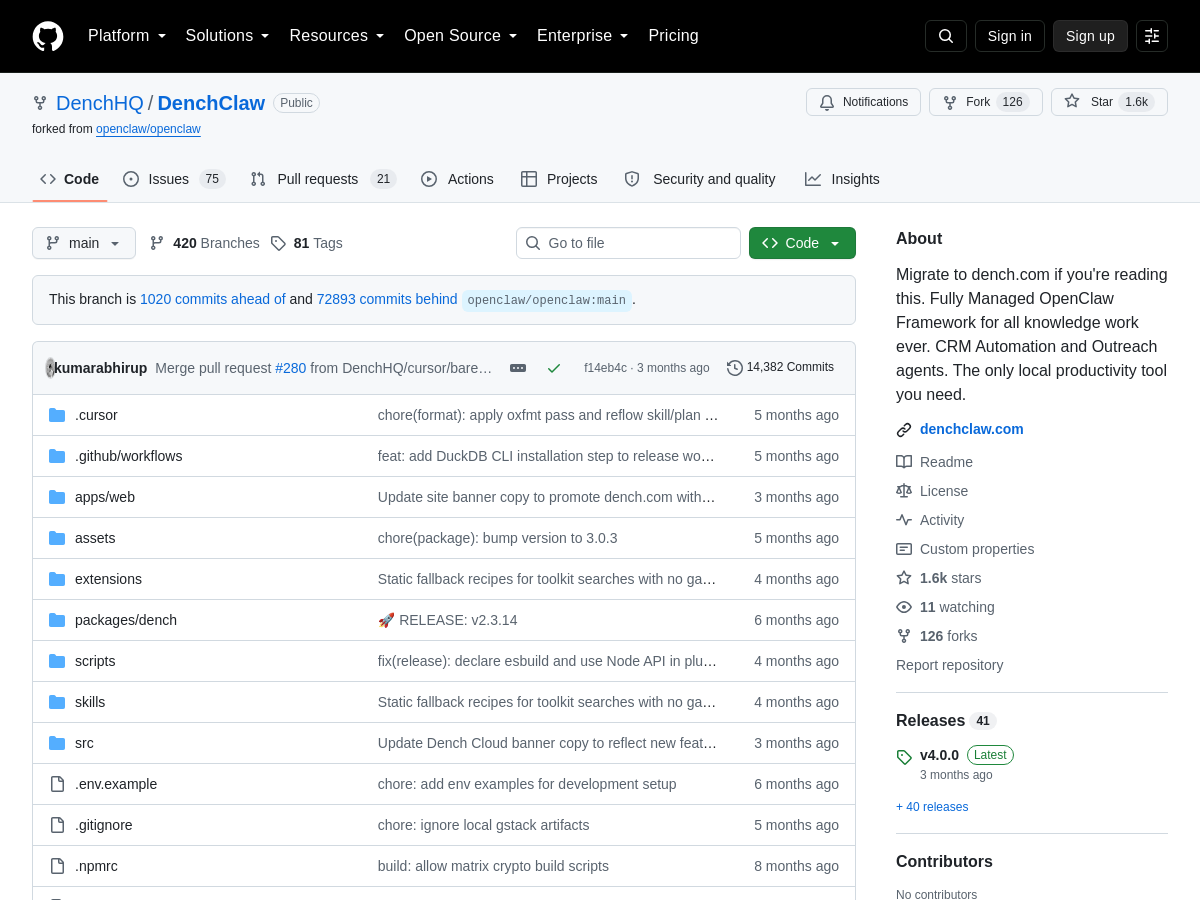
denchclaw
AI Agents Open Source

DenchClaw is a managed open-source fork of the OpenClaw framework, specifically tailored for CRM, sales automation, and outreach agents. It provides a comprehensive platform for building, deploying, and managing AI agents that automate customer relationship management tasks, sales processes, and personalized outreach campaigns. The framework includes a modular architecture with extensible skills, a web-based management UI, and integration capabilities with popular CRM systems. It enables teams to create agents that handle lead qualification, email sequencing, CRM data entry, and real-time chat interactions, all orchestrated through a centralized system. DenchClaw leverages the OpenClaw core for agent execution while adding managed services, predefined skills for sales and marketing, and a user-friendly interface to customize workflows without deep technical expertise. The project is actively maintained with a growing community, extensive documentation, and a rich set of extensions to adapt to various business needs.

Solves

Sales and marketing teams often struggle with manual, time-consuming processes such as lead follow-up, CRM updates, and personalized outreach at scale. DenchClaw automates these workflows using AI agents, reducing manual effort, improving response times, and enabling consistent engagement with prospects and customers. It addresses the need for an integrated, open-source solution that combines agent orchestration with CRM and sales automation, allowing businesses to streamline operations without being locked into proprietary SaaS tools.

Screenshot of CueCue
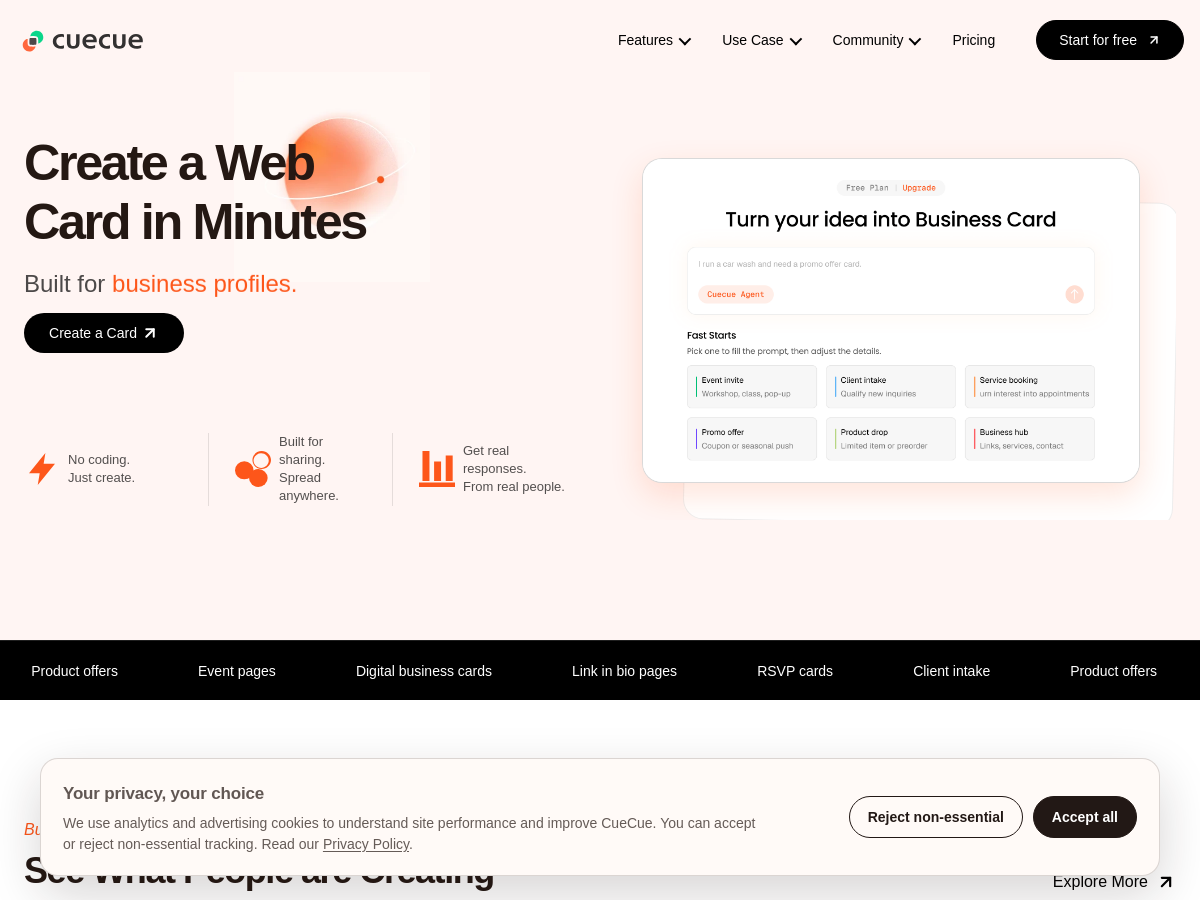
CueCue
AI Business Card Generator Unknown

CueCue is a no-code platform that allows users to create interactive digital business cards, link-in-bio pages, and event RSVP cards. Leveraging artificial intelligence, CueCue simplifies the design process by offering smart templates, auto-generated layouts, and content suggestions tailored to the user's profession or brand. The platform focuses on interactivity, enabling features such as clickable contact details, social media integrations, and dynamic animations. Users can customize their cards with branding, images, videos, and links, then share via a unique URL or QR code. The AI engine analyzes user input, such as name, title, and industry, to recommend color schemes, fonts, and layouts that align with best practices in design. It can also generate compelling taglines or bio text. The no-code editor provides drag-and-drop functionality, making it accessible to anyone without design or technical skills. In addition to static information, CueCue cards can include interactive elements like appointment booking, payment links, or feedback forms, turning a simple business card into a mini-website. CueCue serves as a versatile tool for professionals across various fields. Freelancers and consultants can use it as a dynamic portfolio link, while small businesses can create contact cards that showcase services and enable direct inquiries. The RSVP feature allows event organizers to design invitation cards that collect responses, integrate with calendars, and provide event details. The link-in-bio functionality consolidates multiple links for social media profiles, making it a centralized hub for personal branding. With analytics tracking, users can monitor card views, click-through rates, and engagement, helping to optimize their networking efforts. CueCue also supports team features for consistent branding across an organization. The cards are mobile-optimized, ensuring a seamless experience for recipients across devices. By combining AI-driven design, interactivity, and multi-purpose utility, CueCue positions itself as a next-generation digital identity platform.

Solves

Traditional paper business cards are static, easily lost, and limited in the information they can convey. Digital alternatives often require design skills or multiple tools. CueCue solves this by offering an all-in-one no-code platform where AI assists in creating interactive digital cards that serve as business cards, link-in-bio pages, and event RSVPs. This eliminates the need for printed cards, streamlines contact sharing, and provides a richer, trackable networking experience for professionals and businesses.

Screenshot of Premation
Premation
AI Animation Generator Unknown

Premation is a free, open-source desktop motion-graphics editor designed as an After Effects alternative. It combines a familiar layer-based timeline with After Effects-style keyboard shortcuts and a graph editor, allowing users to create complex animations with ease. The application is GPU-accelerated and runs the same rendering engine in both the viewport and the exporter, ensuring WYSIWYG output. It supports a wide range of formats including SVG, Lottie, MP4/H.264, WebM/VP9 with alpha, MOV/ProRes 4444, PNG sequences, GIFs, and WAV audio, making it a versatile tool for motion design and video production. The editor includes six major areas of functionality: animation, 2.5D/3D space, type, rigging, vector, and particles. Users can work with flat layers in real 3D space using the classic 3D model with Z position, X/Y rotation, one- and two-node cameras with depth of field, lights that cast shadows, and bevelled extrusion for shapes and text. The timeline supports trimming, markers, and RAM caching for smooth playback. It also includes 36 of After Effects' 38 blend modes and 154 built-in effects, providing a powerful compositing environment. Premation introduces an AI assistant that writes keyframes, not video, by calling the same 61 tools available in the UI. This means everything generated is a normal layer that can be edited, re-eased, or undone. Users can bring their own API key, avoiding credits or subscription costs. The project is in public beta 0.4 for macOS and Windows, with source code available on GitHub. It is designed for users who want full control, local rendering, and a motion-graphics tool they truly own.

Solves

Premation solves the problem of expensive, subscription-based motion-graphics software by providing a free, open-source desktop editor that runs entirely on the GPU. It gives designers and animators professional-grade tools such as After Effects shortcuts, a graph editor, and 2.5D/3D compositing, while ensuring output matches the viewport exactly through a unified rendering engine.

Screenshot of trisAino
trisAino
AI Trip Planner Unknown

trisAino is an AI-powered trip planner designed for international visitors to [ADDRESS] (China). It combines a day-by-day itinerary builder, practical on-the-ground guides, and human concierge support to reduce the friction of traveling in a country with different payment systems, transport apps, and local customs. The platform offers three modules: Planner, Guide, and Concierge, each addressing different parts of the travel experience. Users can start with a free Light tier, upgrade to Pro for $9.99, or purchase Premium at $10/day for comprehensive support. The service also features curated experiences such as healthcare coordination through United Family Healthcare and EV test drives in Shanghai, making it more than a standard itinerary tool. trisAino is positioned as a practical companion for travelers who want to arrive prepared and navigate China smoothly.

Solves

International travelers to China often struggle with practical logistics like payments, transport, eSIM setup, and emergency services, which can overshadow the excitement of the trip. trisAino solves this by providing structured itineraries, pre-departure guides, and access to human help when users are stuck, enabling travelers to focus on enjoying their journey.

Screenshot of Carve
Carve
AI Interior Design Unknown

Carve is an AI-powered render studio that converts sketches, CAD files, and other design inputs into photorealistic 3D visuals instantly. It leverages deep learning algorithms to understand room geometry, lighting, and materials, enabling users to generate high-quality renderings without the need for manual 3D modeling or rendering expertise. The platform supports a wide range of input formats, including hand-drawn sketches, floor plans, and digital CAD files, and allows users to customize materials, lighting, and camera angles. At its core, Carve uses generative adversarial networks (GANs) and neural rendering techniques to produce lifelike images that accurately represent the intended design. Users can upload a rough sketch or a DWG/DXF file, and the AI interprets the layout, identifies walls, windows, doors, and furniture, and then applies realistic textures and lighting. The tool offers a library of materials and furniture styles, or users can define their own. Additionally, it can render in different lighting conditions, such as daytime, nighttime, or specific artificial lighting setups. One of Carve's standout features is its speed. What traditionally took hours or days of manual rendering can now be accomplished in seconds. This allows interior designers, architects, and real estate professionals to iterate quickly and present multiple design options to clients without delay. The platform also includes collaboration features, enabling teams to work together on projects, share renderings, and gather feedback in real time. Carve is designed to integrate into existing design workflows. It offers plugins for popular design software like AutoCAD, SketchUp, and Revit, as well as a standalone web application. The resulting renders can be exported in high resolution for print or web, and can be used for marketing materials, client presentations, or virtual staging. Carve is suitable for both professionals and beginners, thanks to its intuitive interface and AI-guided assistance.

Solves

Interior designers, architects, and real estate professionals face the time-consuming and costly process of creating photorealistic renderings from sketches or CAD files. Traditional rendering requires specialized skills, expensive software, and hours of work per image. Carve solves this problem by using AI to automatically generate high-quality, photorealistic visuals in seconds from simple inputs, dramatically reducing the time and cost while enabling rapid iteration and client communication.

Screenshot of Copilot
Copilot
The Chatbot Verse Unknown

Microsoft Copilot is an artificial intelligence chatbot developed by Microsoft, designed to assist users across various Microsoft products. It is deeply integrated into the Windows operating system, the Microsoft Edge browser, and the Microsoft 365 suite of applications. Copilot leverages advanced large language models, similar to those behind ChatGPT, to understand and generate human-like text, enabling a wide range of tasks from answering questions to generating creative content. The tool functions as a conversational AI that can be summoned through a dedicated button or sidebar, providing instant access to AI capabilities without leaving the current context. Users can type natural language prompts to get assistance with writing emails, summarizing documents, creating presentations, analyzing data, or simply engaging in dialogue. Copilot also integrates with web search capabilities to pull in real-time information, and it can generate images using DALL-E technology, making it a multimodal assistant. Beyond simple chat, Copilot offers contextual help within specific applications. For example, in Microsoft Word, it can help draft or improve documents; in Excel, it can analyze data and generate charts; in PowerPoint, it can create slides from outlines. In Windows, it can adjust system settings, launch apps, or troubleshoot issues via voice or text. Additionally, Copilot respects user privacy and enterprise compliance, offering secure data handling for business environments. Overall, Microsoft Copilot aims to be a universal AI assistant that boosts productivity by seamlessly blending into the Microsoft ecosystem, making advanced AI capabilities accessible to both everyday users and professionals.

Solves

Many users face information overload, repetitive tasks, and steep learning curves with software. Copilot solves this by providing an AI assistant that can quickly answer questions, automate routine tasks, and help users create content within the apps they already use, reducing the need to switch between tools and lowering the barrier to using complex features.

Screenshot of CodexMonitor
CodexMonitor
AI Agents Open Source

CodexMonitor is an open-source desktop application built with Tauri that serves as a multi-agent orchestration platform for AI coding assistants based on Codex. It allows developers to run and manage multiple Codex agents concurrently across different local workspaces from a single graphical interface. The tool provides a system tray menu for quick access to recent threads and workspace sections, enabling users to launch, monitor, and control agent tasks without juggling multiple terminals. With its workspace-oriented design, users can define separate environments for different projects, assign specific tasks to individual agents, and track progress in real time. The application leverages local execution to ensure data privacy and low latency, while its cross-platform nature (macOS, Windows, Linux) makes it accessible to a wide range of developers. CodexMonitor supports advanced orchestration features such as sequential or parallel task dispatch, inter-agent communication protocols, and customizable agent configurations. It includes a rich set of tools for debugging, logging, and performance analysis, helping developers optimize complex multi-agent workflows. The project is actively maintained with frequent updates, as evidenced by its 4,000+ stars and active community contributions.

Solves

Developers leveraging AI coding agents like Codex often face challenges when scaling their usage to handle multiple tasks simultaneously. Manually spawning and monitoring numerous agent sessions across different project directories is inefficient and error-prone. CodexMonitor addresses this by providing a centralized desktop application that orchestrates multiple Codex agents, streamlining the launch, coordination, and supervision of these agents. This reduces cognitive load and lets developers focus on higher-level goals while the tool manages the parallel execution of code generation, refactoring, or analysis tasks.

Screenshot of constellagent
constellagent
AI Agents Open Source

constellagent is an open-source macOS application that provides a unified workspace for running multiple AI coding agents in parallel. Each agent operates in its own isolated environment, featuring a dedicated terminal, integrated code editor, and a separate git worktree to avoid conflicts. This allows developers to assign different coding tasks to multiple agents simultaneously, such as bug fixes, feature implementations, or code reviews, and manage them from a single graphical interface. The app is built with Electron and TypeScript, incorporating a Monaco-based editor and a diff pane for reviewing changes. It aims to boost productivity by enabling true parallel development with AI assistance, while maintaining clean isolation through git worktrees. The interface includes a file tree for navigating code, and the app manages agent sessions, terminal sessions, and git operations seamlessly.

Solves

Software developers often need to handle multiple coding tasks concurrently, such as fixing bugs while implementing features, but managing several AI coding agents manually is cumbersome and error-prone. constellagent addresses this by providing a macOS desktop application that runs multiple AI agents simultaneously, each in its own isolated git worktree with a dedicated terminal and editor, preventing cross-task interference and streamlining parallel development workflows.

Screenshot of Consensus AI
Consensus AI
Search Engines Research Unknown

Consensus is an AI-powered academic search engine that allows researchers to find and analyze peer-reviewed literature efficiently. It indexes over 250 million research papers, including licensed full-text content from leading publishers. The platform features Deep Search, which automates the literature review process by building comprehensive search strategies, expanding key terms, identifying conflicting arguments, and exploring citation graphs. Users can specify filters in natural language to refine results by timeframes, populations, study designs, and more. Consensus offers a specialized Medical mode that narrows results to the highest-quality medical sources: approximately 50,000 clinical guidelines and 8 million articles from the top 1,000 medical journals, enabling quick and trusted clinical answers. For yes/no research questions, the 'Consensus Meter' provides an instant visual gauge of how much the evidence agrees or disagrees, helping users quickly assess the state of research on a topic. Used by over 170 university libraries and 10 million researchers, students, and clinicians, Consensus is trusted by top research institutions worldwide. It accelerates literature reviews without sacrificing academic rigor, turning days of manual search into minutes of automated, precise discovery.

Solves

Researchers, students, and clinicians often spend excessive time manually searching through vast amounts of academic literature, trying to identify relevant studies, understand conflicting evidence, and assess research consensus. Consensus solves this problem by using AI to instantly search millions of peer-reviewed papers, apply natural language filters, and visually summarize agreement/disagreement among studies, thereby drastically reducing the time and effort required for evidence synthesis.

Screenshot of CliniQueue
CliniQueue
AI Healthcare Unknown

CliniQueue is an AI-powered clinical ticket classification platform designed specifically for healthcare organizations. It leverages natural language processing and machine learning to automatically categorize inbound clinical support tickets—such as those related to medication, billing, or IT issues—while simultaneously scanning for protected health information (PHI) and potential HIPAA compliance risks. By integrating with existing ticketing systems like ServiceNow or Jira, CliniQueue analyzes ticket content in real time to identify sensitive data, assess breach likelihood, and route tickets to the appropriate teams. This reduces manual triage efforts and accelerates response times, allowing healthcare staff to focus on patient care rather than administrative overhead. The platform continuously learns from new ticket patterns to improve classification accuracy and adapt to evolving healthcare workflows. Key features include real-time PHI detection with configurable rules to flag exposed data elements such as patient names, medical record numbers, and diagnosis codes. The risk dashboard provides an at-a-glance view of compliance posture, highlighting tickets with elevated breach potential. Automated tagging and prioritization help ensure that critical issues are addressed promptly, while detailed logging and reporting support HIPAA audit requirements. CliniQueue also offers integration APIs for custom workflows, ensuring seamless compatibility with electronic health records (EHR) and other clinical systems. CliniQueue addresses the growing challenge of managing high-volume clinical support ticket environments where manual processes often fail to keep pace with regulatory demands. By automating classification and PHI monitoring, it significantly reduces the likelihood of accidental data exposure and non-compliance penalties. The platform’s intuitive interface allows compliance officers and IT administrators to set policies, review alerts, and generate proof-of-compliance documentation without requiring deep technical expertise. In addition to risk mitigation, CliniQueue enhances operational efficiency by uncovering ticket trends and bottlenecks. Its analytics engine provides insights into common issue categories, department performance, and compliance readiness, enabling continuous improvement in healthcare service delivery. While primarily a cloud-based SaaS solution, CliniQueue supports on-premise deployment for organizations with strict data residency requirements, ensuring flexibility for diverse healthcare environments.

Solves

Healthcare organizations grapple with massive volumes of clinical support tickets that frequently contain PHI. Manual triage is slow, error-prone, and dangerously permeable to HIPAA violations, exposing institutions to regulatory fines and reputational harm. CliniQueue solves this by applying AI to instantly classify tickets and detect PHI, automatically flagging potential breaches and routing sensitive items to authorized personnel, thus safeguarding patient privacy while dramatically improving operational efficiency.

Screenshot of Agent AFK
Agent AFK
AI Agent Free

Agent AFK is an open-source runtime designed for running coding agents without constant supervision. It is fully local-first, free forever under the Apache-2.0 license, and works with any model provider, including local models. Once installed via npm, users can start a coding task and walk away; the agent performs the work, verifies its own results, and sends a notification via Telegram when finished. The user returns to a detailed receipt showing every step, decision, and any pending items, so nothing is left to guesswork. The architecture is built around the six common failure modes of autonomous coding agents: linear tunnel vision, fake done, context rot, subagent drift, bad handoff, and the babysitting tax. Each failure mode is addressed by a structural design element, such as parallel hypothesis generation via /diagnose, adversarial verification via /shadow-verify, local trace history under ~/.afk/, centralized subagent tree management with a single interrupt, explicit terminal states (done, blocked, asking, interrupted), and remote supervision with reversibility gates. This makes the system robust when no developer is actively watching. Operationally, Agent AFK offers subagent orchestration, prompt and skill routing, full tool call visibility, and verification workflows. It is reversibility-aware, moving quickly on safe edits in isolated worktrees and being more cautious on git pushes, commits, deletes, or external calls. Traces, plans, and session state persist on disk, allowing users to inspect, resume, or roll back previous runs. With 35,000 downloads last month and a simple npm install command, Agent AFK aims to provide the first coding agent experience that truly does not require a babysitter.

Solves

Coding agents often require constant supervision and may report completion without proper verification, leading to untrusted results and unmanageable long-running processes. Agent AFK solves this by providing a runtime that lets developers delegate tasks and step away, with automated verification, remote supervision, and comprehensive traceability. Users get notified when work is done or blocked, and can review a full receipt of actions, making autonomous coding safe and practical.

Screenshot of Mentionry
Mentionry
AI SEO Tools Unknown

Mentionry is an AI SEO platform designed to help brands understand and improve their visibility in AI-generated search answers. It continuously monitors how large language models such as ChatGPT, Google AI Mode, Gemini, Perplexity, Claude, Microsoft Copilot, and Grok respond to questions relevant to a user's domain. The tool reads these answers daily, extracts every cited source, and classifies each one by whether it is owned, operated, or earned. This gives users a clear picture of where they appear and which citations are realistically obtainable. Beyond tracking, Mentionry surfaces actionable opportunities to earn citations. It identifies questions being asked right now, submission registries, companies that already know the user, and pages with broken links that a user's content could replace. Each opportunity is checked for reachability and comes with a pre-written email, sent from the user's own mailbox, making the outreach process practical and scalable. The platform builds on the idea that the most valuable citations are editorial mentions on authoritative publications that AI engines trust. The product positions itself against black-hat link selling, emphasizing a white-hat approach that focuses on earned media and genuine relationships. It measures every figure directly from its product data, ensuring transparency between the dashboard and billing. Targeted at SEO professionals, marketers, and brand owners, Mentionry aims to replace guesswork with systematic tracking and outreach for the emerging reality of AI-driven search.

Solves

Mentionry solves the problem of brands having no visibility into how they are cited in AI-generated answers, and no systematic way to earn more citations from sources these engines trust. It turns unknown AI mentions into a clear dashboard of cited domains and actionable email outreach pitches.

Screenshot of ChatGPT
ChatGPT
Leading AI Assistants Freemium

ChatGPT is an advanced conversational AI assistant developed by OpenAI, built on the GPT (Generative Pre-trained Transformer) architecture. It is designed to understand and generate human-like text across a wide range of topics and tasks, making it a versatile tool for both personal and professional use. Users interact with ChatGPT through a clean, intuitive web interface or mobile apps, typing or speaking prompts and receiving coherent, context-aware responses. The underlying large language models are trained on a diverse corpus of internet text, enabling ChatGPT to assist with answering questions, drafting documents, writing code, brainstorming ideas, learning new subjects, and more. As of 2026, ChatGPT supports multimodal inputs including text and voice, and can process images and files in some tiers, providing a rich interactive experience. ChatGPT operates on a freemium model, with a free tier offering basic access and a paid subscription (ChatGPT Plus) providing benefits like faster response times, priority access during peak hours, and early access to new features. OpenAI also offers API access for developers to integrate ChatGPT's capabilities into their own applications, enabling custom implementations and automations. The assistant continuously improves through user feedback and periodic model updates, enhancing its accuracy, reasoning, and safety features. Key features include natural language understanding and generation, context retention within conversations, the ability to follow complex instructions, and a broad knowledge base up to its last training update. ChatGPT can also perform specific tasks like text summarization, translation, sentiment analysis, and creative writing. Advanced capabilities such as web browsing (in some versions), code interpretation, and data analysis through plugins or built-in tools extend its utility for technical and research tasks. Its user-friendly design and accessibility make it a go-to AI assistant for millions worldwide.

Solves

Many individuals and organizations face challenges in quickly accessing information, generating high-quality text, and automating routine cognitive tasks. Traditional search engines require sifting through multiple links, and crafting polished content can be time-consuming. ChatGPT solves these problems by providing an instant, conversational interface that can understand queries in natural language and generate precise, relevant responses. Whether it's drafting a business email, debugging code, explaining a scientific concept, or creating a story, ChatGPT acts as a knowledgeable assistant, reducing the time and effort needed to complete diverse tasks, thereby boosting productivity and creativity.

Screenshot of BeePOP
BeePOP
AI Product Photography Unknown

BeePOP is an AI-powered platform designed to revolutionize product photography and Amazon A+ content creation for e-commerce sellers. By leveraging advanced generative AI, BeePOP enables users to transform basic product images into professional, high-converting visual assets within minutes. The platform automates the entire creative workflow, from background removal and scene generation to the assembly of Amazon-compliant A+ content modules.

Solves

E-commerce sellers, especially those on Amazon, often face high costs and significant time investments in producing professional product photography and A+ content. Without design expertise, creating lifestyle images, infographics, and comparison charts that meet Amazon's guidelines is a major barrier. BeePOP solves this problem by providing an intuitive AI tool that automates image generation, reducing the need for expensive photoshoots and specialized designers, thereby enabling sellers to quickly enhance their listings and increase conversion rates.

Screenshot of ClawWork
ClawWork
AI Agents Open Source

ClawWork is an open-source orchestration platform designed to run multiple AI coding agents in parallel, effectively acting as a coworker for developers. Built around the concept of OpenClaw—an open-source AI coding assistant—ClawWork enables users to deploy and manage concurrent instances of AI agents, each tasked with different coding assignments. The platform provides a unified interface to monitor agent progress, manage outputs, and ensure secure execution through integrated sandbox environments like E2B. By leveraging parallel execution, ClawWork significantly accelerates software development workflows. Teams can distribute large-scale coding tasks, such as implementing features, fixing bugs, or reviewing code, across a fleet of autonomous agents. The system supports popular AI coding models and tools, allowing seamless integration with existing development ecosystems. Its architecture is designed for scalability, making it suitable for both small projects and enterprise-grade applications. The platform includes a frontend dashboard for real-time tracking of agent activities, evaluation modules for assessing agent performance, and robust integration capabilities with various sandbox providers. ClawWork's open-source nature encourages community contributions and customization, ensuring it can adapt to diverse development needs. With a growing set of features and active development, it aims to redefine collaborative software engineering by turning AI agents into productive team members. Overall, ClawWork addresses the need for an orchestration layer that transforms individual coding agents into a coordinated, parallel workforce, enhancing productivity and enabling developers to focus on higher-level design and problem-solving.

Solves

Developers often face bottlenecks when relying on a single AI coding agent to handle multiple tasks sequentially. This limits throughput and fails to leverage the full potential of AI in accelerating software development. ClawWork solves this problem by orchestrating multiple AI coding agents to work in parallel on discrete tasks, each isolated in its own sandbox. This approach drastically reduces overall project time, enables concurrent handling of independent tasks like feature implementation, code review, and testing, and ensures secure execution without cross-task interference.

Screenshot of ClickUp
ClickUp
Productivity Unknown

ClickUp is an all-in-one productivity platform designed to replace fragmented work tools by consolidating project management, team chat, documentation, whiteboards, goals, and AI-powered assistants into a single workspace. It aims to eliminate work sprawl and context loss by providing a centralized hub where teams can manage tasks, collaborate in real time, and automate workflows. The platform is built around a converged AI layer called ClickUp Brain, which includes features like AI Q&A, AI Writer, and autonomous AI agents (Super Agents) that can perform complex tasks, assign work, and update project statuses without human intervention. ClickUp offers over 100 customizable features including multiple views (List, Board, Gantt, Calendar), time tracking, sprint management, custom fields, and integrations with various third-party tools. Its free tier provides core functionalities for unlimited users, making it accessible for teams of all sizes. The platform is available via web, desktop, and mobile applications, supporting both online and offline workflows. With the introduction of ClickUp 4.0, the platform emphasizes a more connected experience where AI agents operate with 'infinite memory' across all apps and workflows, aiming to boost productivity by 400%. It positions itself as a complete operating system for work, enabling users to replace tools like project management software, chat apps, document editors, and more with one unified solution.

Solves

Modern teams face 'work sprawl'—the use of multiple disconnected tools for tasks, chat, documentation, and tracking—leading to context loss, duplicated efforts, and reduced productivity. Studies suggest 60% of work time is lost switching between apps and searching for information. ClickUp solves this by providing a single, converged platform that integrates all essential work functions, enhanced by AI that understands and maintains context across projects, conversations, and documents. This reduces tool fragmentation, improves visibility, and allows teams to work more efficiently from one place.

Screenshot of ChatGPT (OpenAI)
ChatGPT (OpenAI)
The Chatbot Verse Unknown

ChatGPT is a conversational AI service developed by OpenAI that provides a user-friendly chat interface to interact with large language models. It allows users to ask questions, receive detailed answers, and generate creative or technical content across a wide range of domains. The platform supports text-based conversations and has evolved to include multi-modal capabilities, such as image generation and file analysis, depending on the model version. ChatGPT is designed to assist with writing, learning, problem-solving, and idea generation, making advanced AI accessible to a broad audience through a simple web interface and mobile apps. The underlying models are fine-tuned from the GPT (Generative Pre-trained Transformer) family, leveraging deep learning to produce coherent and contextually relevant responses. Users can choose from different model variants (e.g., GPT-4, GPT-4o) that offer varying performance, speed, and features. The service is regularly updated with improvements in reasoning, factual accuracy, and safety. ChatGPT also supports plugins and a code interpreter (Advanced Data Analysis) for specialized tasks, though these features may not be detailed on the minimal homepage. ChatGPT is available both as a free service with basic functionality and through subscription plans (ChatGPT Plus, Team, Enterprise) that provide priority access, faster responses, and advanced models. The platform emphasizes simplicity, requiring only a login to start interacting, and serves millions of users worldwide for personal, educational, and professional use cases. Its versatility and continual development have made it a leading tool in the consumer AI chatbot space.

Solves

Many individuals and professionals face challenges in quickly obtaining accurate information, generating high-quality written content, or solving complex problems. ChatGPT addresses this by providing an intuitive conversational interface that delivers instant, detailed, and context-aware responses, reducing the time and effort required for tasks like research, writing, coding, and learning.

Screenshot of Claude AI
Claude AI
Leading AI Assistants Paid

Claude is a family of large language models developed by Anthropic, designed to be helpful, harmless, and honest. It is trained using Constitutional AI to align with human values, aiming to provide safe and reliable conversational assistance. Claude can assist with a wide range of tasks including writing, coding, analysis, math, and creative brainstorming, with a focus on nuanced reasoning and instruction following. Claude is accessible through the claude.ai web interface and the Anthropic API. The web interface offers a chat-based interface with file upload support for documents and images, conversation history, and team collaboration. The API provides programmatic access to various model versions such as Claude 3.5 Sonnet, Claude 3 Opus, and Claude 3 Haiku, allowing developers to integrate Claude's capabilities into applications. Key features include a large 200K token context window, vision capabilities for processing images, tool use (function calling), and structured output generation. Pricing is token-based, with paid plans for higher usage limits. Claude emphasizes safety and alignment, with built-in safeguards against harmful, unethical, or dangerous outputs. It is suitable for both personal productivity and enterprise use, with enterprise-grade security and data handling. Anthropic continuously updates Claude with improved reasoning, domain knowledge, and multilingual support. The model's ability to understand and generate human-like text makes it a versatile tool for knowledge work, creative tasks, and automation.

Solves

Claude AI addresses the need for an intelligent, safe, and trustworthy AI assistant that can handle complex, multi-step tasks involving natural language understanding, generation, reasoning, and coding. It helps individuals and organizations automate and enhance workflows that require deep comprehension, summarization, content creation, and data analysis, while adhering to high ethical standards.

Screenshot of claudecodebridge
claudecodebridge
AI Agents Open Source

claudecodebridge is an open-source command-line tool that enables real-time collaboration among multiple AI coding agents, particularly those based on Claude Code. It acts as a bridge that allows developers to spawn and manage several AI agents in parallel, facilitating task delegation, context sharing, and synchronized communication. The tool provides a shared workspace where agents can collectively work on a codebase, each handling different aspects of a project, such as writing code, reviewing changes, or running tests. It includes features like a session manager to keep track of agent states, a message-passing system for inter-agent communication, and a delegation protocol to assign subtasks. Users can configure the behavior of agents, inherit skills across sessions, and extend functionality via custom scripts and plugins. The interface is terminal-based, with optional UI components like a sidebar for monitoring agent activity. claudecodebridge is designed to amplify the productivity of developers who rely on AI assistants, allowing them to tackle complex, multi-step coding challenges by distributing the workload across a team of specialized AI agents.

Solves

Developers using AI coding assistants often encounter limitations when a single agent cannot efficiently handle large-scale or multi-disciplinary tasks. Manually coordinating multiple agents to work on different parts of a project is tedious and error-prone. claudecodebridge solves this by providing a unified orchestration layer that automatically manages agent collaboration, ensuring they share context, avoid conflicts, and combine outputs. This allows developers to scale their AI-assisted workflows, tackling complex software projects that would be impractical for a single AI agent alone.

Screenshot of Claude Engineer
Claude Engineer
AI Agents Open Source

Claude Engineer is an interactive command-line interface (CLI) tool that harnesses Anthropic's Claude-3.5-Sonnet model to assist with a wide range of software development tasks. It allows developers to converse with the AI directly in the terminal, generating code, modifying files, debugging errors, and executing complex development workflows. The tool provides a seamless experience for creating and editing project files through natural language prompts, supporting diff-based editing to precisely apply changes without overwriting existing code. It also includes a code interpreter that can run generated code, test scripts, and validate outputs in real-time, making it a powerful assistant for prototyping and troubleshooting. A built-in web interface offers an alternative way to interact with the assistant, providing a visual environment for those who prefer a browser-based experience. The project is actively maintained on GitHub, with community contributions enhancing its capabilities.

Solves

Developers often face repetitive and time-consuming tasks such as writing boilerplate code, refactoring legacy systems, debugging complex issues, and generating documentation. Claude Engineer addresses these pain points by integrating a state-of-the-art language model into the developer's workflow directly from the command line, enabling rapid code generation, intelligent file manipulation, and contextual assistance without leaving the terminal.

Screenshot of ChatDev
ChatDev
AI Agents Open Source

ChatDev is an open-source framework that simulates a virtual software company powered by large language models (LLMs). Inspired by the waterfall model, it orchestrates multiple AI agents, each assigned to specific roles such as CEO, CTO, designer, programmer, and tester. These agents communicate through natural language chat to collaboratively transform a user’s high-level requirement into a complete software product, including source code, user documentation, and test cases. The entire development process is broken into sequential phases—analysis, design, coding, testing, and documentation—mirroring real-world software engineering practices. The framework is highly customizable, allowing users to define agent roles, communication protocols, and phase-specific workflows. It integrates with Git for version control and features a persistent memory module (Mem0) that enables agents to retain context across sessions and projects. A built-in web interface provides real-time visualization of agent interactions and workflow progress. ChatDev is designed to be LLM-agnostic, supporting multiple providers through a simple configuration file. Implemented in Python, it can be deployed locally or on a server, making it accessible for both individual experimentation and team environments. ChatDev represents a significant exploration into automated software development, demonstrating how multi-agent collaboration can mitigate the limitations of single-agent coding tools. It is particularly adept at rapid prototyping, educational demonstrations, and academic research on LLM-based software generation. Maintained by the OpenBMB community, the project sees active development with frequent updates, an expanding set of agent skills, and a growing ecosystem of community contributions.

Solves

Software development often requires translating complex human requirements into code, a process that is time-consuming, error-prone, and inaccessible to non-experts. ChatDev addresses this challenge by automating the entire software creation lifecycle through multi-agent collaboration. Users simply describe their desired software in natural language, and the AI agents collectively handle requirement analysis, system design, coding, testing, and documentation. This dramatically lowers the barrier to software creation, accelerates prototyping, and reduces the manual effort needed for small to medium-sized projects.

Screenshot of cashclaw
cashclaw
AI Agents Open Source

CashClaw is an autonomous AI agent designed to operate on the Moltlaunch marketplace. It takes on freelance work, evaluates task requirements, quotes a price, and then uses large language models (LLMs) to complete the work. After submitting deliverables, it collects ratings and feedback to improve its future performance through a self-learning mechanism. The agent runs a multi-turn LLM loop and supports multiple LLM providers including Anthropic, OpenAI, and OpenRouter, communicating via raw fetch without relying on external SDKs. It features a React-based dashboard at localhost:3777 for monitoring, a setup wizard for easy onboarding, and integration with AgentCash for paid API access.

Solves

Freelancers and developers often spend significant time searching for, evaluating, and executing repetitive tasks on gig platforms. CashClaw automates this entire workflow by autonomously discovering work opportunities, assessing their feasibility, completing them using AI, and continuously learning from outcomes to improve efficiency and earnings on the Moltlaunch marketplace.

Screenshot of Canva AI
Canva AI
Slide Decks Unknown

Canva AI's Magic Design is a generative AI feature within the Canva platform that enables users to create professional designs effortlessly. By simply describing an idea in text or uploading media, users can generate custom, on-brand social posts, presentations, videos, and more. The AI is powered by leading generative AI technology and has been trained and reviewed by Canva's designers, ensuring high-quality outputs that require minimal editing. It supports a range of design types, including promotional graphics, pitch decks, and short videos, making design accessible to anyone without coding or advanced design skills. For presentations, Magic Design for Presentations drafts complete slide decks with topic outlines and sample content from a single prompt, accelerating pitch creation. Magic Design for Video allows users to combine clips and images into polished short videos, automatically recommending soundtracks to enhance engagement. All generated designs can be further customized by tweaking text, colors, and layouts, or by applying brand assets through Canva's Brand Kit. The tool aims to eliminate the blank page problem by generating relevant, inspiring templates that fit the user's specific needs. It lets users start much closer to the end of the design process, refining visions even when the final idea isn't fully formed. Integrated seamlessly into Canva's suite, Magic Design leverages the platform's extensive library of assets, fonts, and collaboration features, making it a powerful addition for both occasional and frequent creators. Currently, Magic Design is available only in English, and certain advanced features like the Brand Kit require a Canva Pro subscription. However, its ability to automate and simplify design tasks makes it a valuable tool for marketing, social media, and personal projects.

Solves

Many individuals and businesses struggle with creating visually appealing designs because they lack professional design skills, time, or resources. Starting from a blank canvas is intimidating, and generic templates often fail to meet specific branding needs. Canva AI's Magic Design solves this by allowing users to describe their ideas in plain language or upload reference media, then instantly generating polished, customizable designs. This drastically reduces the time and effort required to produce high-quality visual content, democratizes design, and ensures brand consistency with minimal manual intervention.

Screenshot of Cal.com core team
Cal.com core team
AI Agents Open Source

Cal.com core team builds the open-source scheduling infrastructure Cal.com, which includes AI-powered agent capabilities for automated meeting coordination. The platform enables users to deploy a self-hosted or cloud-based scheduling system that leverages AI agents to handle complex scheduling tasks, such as finding mutually available times, managing time zones, and integrating with multiple calendar services. The AI agents can understand natural language requests, making scheduling as simple as chatting with a bot. The system is built with a modular architecture, providing APIs and an extensible plugin ecosystem. The AI agents are designed to work within the Cal.com ecosystem, enhancing productivity by reducing the manual back-and-forth typically involved in setting up meetings. Users can configure the agents to follow specific rules, priorities, and availability preferences, ensuring that scheduling aligns with individual or team policies. Key features include: AI-driven meeting scheduling via conversational interfaces, integration with popular calendars (Google, Outlook, etc.), video conferencing links, team round-robin and collective scheduling, routing forms, and workflow automation. The platform supports multiple languages and is accessible to both technical and non-technical users, with a user-friendly dashboard and admin controls.

Solves

Scheduling meetings manually involves endless email chains and time wasted on finding common free slots. Cal.com's AI agent automates this process by intelligently suggesting times, handling rescheduling, and managing calendar conflicts, freeing users to focus on productive work.

Screenshot of cafferychen777/ChatSpatial
cafferychen777/ChatSpatial
Developer Tools Open Source

ChatSpatial is an open-source MCP (Model Context Protocol) server that provides a conversational interface to over 60 integrated methods for spatial transcriptomics analysis. It allows researchers and bioinformaticians to interact with complex analysis workflows using natural language through AI assistants like ChatGPT. The server acts as a bridge, translating user prompts into function calls to established computational methods for cell annotation, deconvolution, spatial statistics, and visualization. By enforcing a schema-driven orchestration, it ensures valid parameter combinations and captures errors gracefully, reducing the cognitive load on the user. Under the hood, ChatSpatial leverages a curated collection of Python libraries and tools commonly used in the spatial omics field, such as those for preprocessing, dimensionality reduction, clustering, and spatial pattern detection. It handles data I/O, method execution, and result formatting automatically, presenting outputs in a compact, human-readable manner. The server can be deployed locally or in a containerized environment, making it accessible across platforms. It supports common spatial transcriptomics data formats and can generate visualizations like SVGs for spatial plots. Key features include: over 60 analysis methods covering a broad range of tasks; integration with the MCP ecosystem for seamless AI assistant interaction; schema-validated tool calls to prevent erroneous analysis; support for multiple species (e.g., human, mouse) and data types; and reproducible environments via Docker. The tool is designed to be extensible, allowing addition of new methods as the field evolves.

Solves

Spatial transcriptomics researchers face a fragmented landscape of analysis tools, each with its own interface, dependencies, and parameter requirements. This leads to steep learning curves, inefficient workflows, and barriers to multi-method analyses. ChatSpatial solves this by providing a unified, natural language interface that abstracts away complexity, enabling researchers to execute sophisticated analyses without needing to recall exact command syntax or method-specific quirks. It democratizes access to advanced spatial analysis by letting users simply describe what they want to do in plain English.

Screenshot of Caddie
Caddie
AI Sales Assistant Unknown

Caddie is an AI sales copilot that integrates with live sales calls, such as those on Zoom, Microsoft Teams, or Google Meet. During a call, Caddie actively listens to the conversation, leveraging natural language processing and large language models to understand context and intent. It then performs real-time research by connecting to internal knowledge bases, CRM systems, product documentation, and external data sources to retrieve relevant information. When a sales representative faces a question or needs supporting data, Caddie provides instant, in-call suggestions, answers, and insights through a discreet interface. This enables sales professionals to handle objections, provide accurate product details, and tailor their pitch without breaking the flow of conversation. Beyond live assistance, Caddie may also generate post-call summaries, highlight key moments, and log interaction data for follow-up, acting as an always-available AI team member that enhances sales effectiveness.

Solves

Sales representatives often struggle to access the right information during live customer calls, leading to missed opportunities, delayed responses, or lost credibility. Manually searching for product specs, competitive comparisons, pricing, or customer history disrupts the conversation and can frustrate prospects. Caddie solves this by acting as an always-on, AI-powered research assistant that listens to the call in real time and instantly supplies the salesperson with the exact information needed, enabling smoother conversations, faster objection handling, and higher close rates.

Screenshot of Buyer24 free quote comparison
Buyer24 free quote comparison
AI Documents Generator Unknown

Buyer24 free quote comparison is an AI-powered software-as-a-service platform that streamlines the procurement process by automating supplier quote comparison. The tool ingests quotes from multiple suppliers in various formats—such as PDFs, emails, and spreadsheets—and uses artificial intelligence to extract and standardize line-item details including product descriptions, quantities, unit prices, and total costs. It then presents the data in a side-by-side comparison view, highlighting price differences, delivery terms, and other key parameters to help procurement professionals make informed decisions quickly. The platform is designed for businesses of all sizes that regularly source goods or services and need an efficient way to manage multiple bids. Beyond basic comparison, Buyer24 may offer features like real-time collaboration, approval workflows, and the ability to generate purchase orders or summary reports. Its AI document generation capabilities enable the automatic creation of standardized procurement documents, reducing manual paperwork and accelerating the purchase cycle. The tool aims to replace manual, error-prone spreadsheet comparisons with an intelligent, automated system that saves time, cuts costs, and improves procurement transparency. Users can upload quotes directly, and the system handles data normalization across currencies, units, and supplier-specific formats. By centralizing quote data and providing analytics, Buyer24 empowers businesses to negotiate better deals and enforce procurement policies consistently.

Solves

Procurement teams and business owners often struggle with the manual, time-consuming task of comparing supplier quotes that arrive in inconsistent formats. They must extract, normalize, and collate data from multiple documents—a process prone to human error and delays. Buyer24 free quote comparison solves this by using AI to automatically parse and standardize quotes from any source, instantly creating a unified comparison table. This eliminates tedious data entry, reduces mistakes, and accelerates vendor selection, enabling businesses to save money and focus on strategic sourcing rather than administrative overhead.

Screenshot of bumpgen
bumpgen
AI Agents Open Source

BumpGen is an AI-powered tool that automates the process of keeping npm dependencies up-to-date. It leverages large language models to intelligently determine the appropriate version bumps for packages, reducing the need for manual intervention. The tool can be used as a command-line interface (CLI) or integrated into CI/CD pipelines via a GitHub Action, making it easy to incorporate into existing workflows. By analyzing the project's dependency graph and understanding semantic versioning, BumpGen generates pull requests that update package.json and lock files, ensuring that dependencies remain current while minimizing breaking changes. Under the hood, BumpGen utilizes a graph-based approach to understand the interconnectedness of dependencies. It employs AI models to evaluate the impact of updating each package, considering factors like changelogs, release notes, and compatibility. The tool is built with a modular architecture, with a core library (bumpgen-core) that handles the logic, a CLI for local usage, and a GitHub Action for seamless automation. This architecture allows developers to customize the update process and integrate BumpGen into various environments. Key features include automatic detection of outdated dependencies, intelligent version selection, PR generation with detailed commit messages, and support for monorepos. BumpGen also provides evaluation scripts to measure the performance of the AI model in selecting safe updates, enabling continuous improvement of its recommendations.

Solves

Software development teams often struggle with keeping their npm dependencies up-to-date. Manually checking for updates, reading changelogs, and verifying compatibility is time-consuming and error-prone. BumpGen solves this by automating the entire process using AI, enabling teams to stay secure and leverage the latest features without spending excessive time on dependency maintenance.

Screenshot of BullVPN
BullVPN
Vpn Client Unknown

BullVPN is a virtual private network (VPN) service designed to provide users with secure, private, and unrestricted internet access. By establishing an encrypted tunnel between the user's device and BullVPN's servers, it masks the user's IP address and encrypts all internet traffic, preventing interception by third parties such as ISPs, governments, or cybercriminals. This ensures online activities remain anonymous and sensitive data is protected, especially on public Wi-Fi networks. BullVPN offers a global network of servers in multiple countries, allowing users to bypass geographic restrictions on content by making it appear as though they are browsing from a different location. This enables access to streaming platforms, news sites, and social media that may be censored or unavailable in their region. The service supports multiple VPN protocols, including OpenVPN and IKEv2, to balance speed and security. Key features include a kill switch that automatically blocks internet traffic if the VPN connection drops, preventing accidental data leaks; a strict no-logs policy to ensure no user activity is recorded; and user-friendly apps for Windows, macOS, iOS, Android, and browser extensions. BullVPN aims to provide a seamless experience with one-click connection and unlimited bandwidth.

Solves

In an era of increasing digital surveillance, data breaches, and geo-restricted content, individuals and businesses face the challenge of keeping their online activities private while accessing a free and open internet. BullVPN solves this by encrypting internet traffic, hiding the user's real IP address, and routing connections through remote servers worldwide. This protects sensitive information from eavesdropping, allows bypassing of censorship and geo-blocks, and ensures anonymity online.

Screenshot of Branda.co
Branda.co
AI Logo Generator Unknown

Branda.co is an AI-powered brand identity platform designed to help individuals and businesses create professional logos and comprehensive brand identities effortlessly. By leveraging advanced artificial intelligence algorithms, the tool generates logo designs based on simple user inputs such as the business name, industry, and preferred styles. Users can then customize colors, fonts, icons, and layouts to align with their vision, all within a user-friendly interface that requires no prior design experience. Beyond logo creation, Branda.co offers a suite of brand management features. It allows users to develop full brand identities including color palettes, typography sets, and visual assets for various media. The platform likely provides templates for business cards, social media graphics, letterheads, and other marketing materials, ensuring brand consistency across all touchpoints. Users can store, access, and manage all their brand assets in one centralized location, making it easy to update and download files in multiple formats. The platform emphasizes a fun and engaging user experience, with interactive tools that make the design process enjoyable. AI-driven suggestions help users explore creative possibilities, and instant previews show how logos will appear on real-world items like merchandise, websites, and mobile apps. Branda.co is accessible via web browsers, requiring no software installation, and typically offers both free and premium subscription plans, with high-resolution downloads and additional features available for paid users. Overall, Branda.co democratizes brand design by lowering the barrier to entry for entrepreneurs, small business owners, freelancers, and content creators. It combines the speed and convenience of AI with the flexibility to personalize designs, offering a cost-effective alternative to hiring professional designers or agencies.

Solves

Many entrepreneurs, small business owners, and freelancers struggle to create a professional brand identity due to limited design skills, time, and budget. Branda.co solves this problem by providing an AI-driven platform that generates high-quality logos and brand assets in minutes, eliminating the need for expensive design software or professional designers. It empowers users to establish a cohesive brand presence quickly and affordably.

Screenshot of blockrunai/blockrun-mcp
blockrunai/blockrun-mcp
Developer Tools Open Source

blockrun-mcp is an open-source Model Context Protocol (MCP) server that provides AI assistants with unified, pay-per-use access to over 30 cutting-edge AI models from providers like OpenAI (GPT-5), Anthropic (Claude), Google (Gemini), xAI (Grok), and DeepSeek. Instead of managing multiple API keys, users connect a single USDC wallet on the Base blockchain to handle micropayments via the x402 protocol, automatically routing each request through the BlockRun gateway for billing and execution. The server acts as a proxy that can be integrated into any MCP-compatible client (such as Claude Code), enabling on-demand use of chat completions, image generation, video generation (e.g., Seedance), and search tools without per-provider credentials. Key features include a dynamic model tiering system (balanced, cheap, best) that automatically selects appropriate models based on task requirements, ensuring optimal cost-performance trade-offs. The server exposes a suite of tools beyond plain chat: it supports web research with Exa, prediction market queries, and video creation via Seedance models, all accessible through a consistent MCP interface. Pricing is transparent and per-request, with costs estimated before execution, and users can top up their wallet in USDC to pay only for what they use. The installation is straightforward, typically via npm, and configuration requires minimal setup—just a wallet address. The server runs locally, handling secure communication with the BlockRun gateway, and includes built-in caching and model fallback chains for reliability. It is designed for developers who want to experiment with or deploy multiple AI models in their workflows without the overhead of managing subscriptions or complex billing. With over 130 commits, 14 tagged releases, and a growing community (471 stars), blockrun-mcp is actively maintained, with frequent updates to add new models, optimize routing, and calibrate pricing. It represents a novel approach to AI model consumption by combining the versatility of MCP with decentralized micropayments, making cutting-edge AI accessible to a broader audience.

Solves

Developers and AI enthusiasts face friction when trying to use multiple state-of-the-art language and generative models due to the need to sign up for, manage, and pay for separate API accounts across providers. blockrun-mcp eliminates this hassle by acting as a single gateway that requires only a USDC-funded wallet, allowing users to access over 30 models on a pay-per-use basis without individual API keys, thus lowering the barrier to experimentation and integration in development environments.

Screenshot of BookTranslator
BookTranslator
AI Translate Unknown

BookTranslator is an AI-powered platform designed for translating entire books and documents with high accuracy and speed. It supports a wide range of file formats including EPUB, PDF, DOCX, MOBI, TXT, SRT, and others, allowing users to upload their documents and receive translated versions in minutes. The tool leverages state-of-the-art neural machine translation models to ensure that the translated text is fluent and contextually appropriate. One of its standout features is its ability to preserve the original layout and formatting of the document, including tables, images, footnotes, and styles, which is crucial for maintaining the readability of complex publications. The platform is particularly useful for self-publishing authors, publishers, and businesses that need to localize content quickly. Users can simply drag and drop their files, select the target language, and the system automatically processes the translation while retaining the structural integrity. BookTranslator also offers batch processing, enabling the translation of multiple files at once, and supports a large number of language pairs. The AI engine is optimized for long-form content, ensuring consistency in terminology and style throughout the document. Additionally, it may provide post-editing tools that allow users to fine-tune translations manually. BookTranslator addresses the common pain points of traditional translation services, such as high costs, long turnaround times, and formatting issues. By automating the translation with AI, it dramatically reduces the time and expense involved, making it accessible to individuals and small businesses. The service is cloud-based, meaning no software installation is required, and translations can be accessed from any device with internet connectivity. Security and privacy are also prioritized, with files being encrypted and automatically deleted after processing.

Solves

Traditional book and document translation is often time-consuming, expensive, and frequently disrupts the original formatting, leading to additional editing costs. BookTranslator solves this by providing a fast, AI-driven translation service that preserves layout, reduces turnaround to minutes, and supports a multitude of file formats, making it ideal for authors, businesses, and researchers who need to localize their content efficiently without sacrificing quality or design.

Screenshot of Boogu Image
Boogu Image
AI Image Generator Unknown

Boogu Image is an AI-powered image generation and editing platform that specializes in bilingual text rendering. Unlike many generic AI image generators that struggle with producing legible, correctly spelled text, Boogu Image focuses on accurately incorporating text into images, supporting multiple languages, particularly bilingual combinations such as English and Chinese. Users can input descriptive prompts or upload base images, and the tool uses advanced generative models to create high-quality visuals with embedded text that looks natural and readable. The platform offers a range of editing capabilities, including background removal, object inpainting, style transfer, and text placement, making it a versatile choice for creating marketing materials, social media graphics, and product mockups.

Solves

Many businesses and content creators need to include text in their generated images for branding, advertising, or educational purposes, but popular AI image generators often produce garbled, misspelled, or incorrectly placed text. Boogu Image solves this problem by specializing in accurate, high-fidelity text rendering, particularly for bilingual or multilingual contexts, ensuring that the final images convey the intended message clearly and professionally.

Screenshot of Backenly
Backenly
AI Code Generator Unknown

Backenly is an autonomous self-healing backend platform that leverages AI code generation to build and manage server infrastructure automatically. By abstracting the complex layers of backend development, it empowers developers to define their requirements using natural language or simple configurations, and the platform generates production-ready code, sets up databases, APIs, authentication, and deploys everything seamlessly. Its core innovation lies in the self-healing mechanism: the system continuously monitors the backend for anomalies, performance bottlenecks, or failures, and automatically applies fixes, restarts services, or reconfigures resources without human intervention. This makes Backenly ideal for teams that want reliable, scalable backends without deep DevOps expertise. The platform supports multi-cloud environments, integrates with popular front-end frameworks via REST and GraphQL, and includes built-in security, logging, and monitoring. As an AI-driven tool, it learns from usage patterns to optimize resource allocation and code over time. Backenly is positioned as a solution for startups needing rapid MVP development, as well as enterprises seeking to reduce operational overhead and accelerate time-to-market. Its intuitive dashboard simplifies management, while its API-first approach ensures extensibility. Ultimately, Backenly transforms backend engineering into a declarative, low-code experience, where the infrastructure is not just generated but actively maintained by AI.

Solves

Developers and startups often spend significant time and resources on backend development, including server setup, database management, API creation, and ongoing maintenance. This process is error-prone, requires specialized DevOps knowledge, and can lead to downtime or scalability issues. Backenly solves this by providing an autonomous platform that uses AI to generate, deploy, and manage the entire backend infrastructure. Users simply describe what they need, and the platform handles the rest, continuously monitoring and healing the system to ensure uptime and performance. This allows teams to ship products faster and focus on core features rather than infrastructure plumbing.

Screenshot of BeeBot
BeeBot
AI Agents Open Source

BeeBot is an early-stage open-source autonomous AI agent project designed to handle a wide range of tasks by decomposing complex goals into manageable subtasks and executing them automatically. The system appears to use a multi-agent architecture, as indicated by commit messages referencing 'task decomposition and multi-agents,' and supports oversight mechanisms to monitor and guide agent actions. Built primarily in Python, BeeBot leverages large language models (LLMs) like GPT-3.5-turbo and GPT-4, with fallback models ensuring robustness. It integrates with the agbenchmark framework for evaluating agent performance, suggesting a focus on reliability and benchmarking. The project includes Docker support for easy deployment, and configuration via environment variables (e.g., .env.example) to connect to external APIs. Currently, the repository indicates the project is on hold, with the last significant commit in October 2023, so it may not be actively maintained.

Solves

Individuals and teams often struggle with automating complex, multi-step tasks that require reasoning, tool use, and decision-making. BeeBot aims to solve this by providing an autonomous agent that can accept high-level natural language goals, break them down into actionable steps, and execute those steps using available tools and APIs, reducing manual effort and enabling users to focus on higher-level priorities.

Screenshot of BambooAI
BambooAI
AI Agents Open Source

BambooAI is an open-source Python library that enables natural language data exploration and analysis for non-programmers. It leverages large language models (LLMs) to translate user questions into executable Python code, performs the analysis on provided datasets, and returns insights in plain English. The tool supports multiple LLM providers, including OpenAI, MiniMax, and others, via a configurable backend. Users can interact with BambooAI through a simple interface, asking questions about CSV, Parquet, or other structured data files. The framework is designed to be self-hosted, with options to run locally, inside a Docker container, or via a remote code execution API for security and scalability. Recent enhancements include support for auxiliary datasets (allowing up to three additional datasets to be merged or joined as needed), generic ontologies to describe custom data schemas, and improved UI handling for attaching datasets and ontologies. BambooAI is ideal for business analysts, researchers, and citizen data scientists who need quick answers from data without writing code.

Solves

Non-technical users often struggle to extract insights from datasets because they lack programming skills to write SQL queries or Python scripts. BambooAI solves this by providing a natural language interface that translates plain-English questions into data analysis operations, executes them automatically, and returns easy-to-understand results, democratizing data access for everyone.

Screenshot of Automata
Automata
AI Agents Open Source

Automata is an AI-powered code generation tool designed to understand the full context of a software project and produce relevant code modifications. It leverages large language models (LLMs) to analyze existing codebases, including dependencies, architecture, and coding patterns, and then generates new code that aligns with the project's style and requirements. The tool can be used to create entire modules, refactor existing code, write tests, or add documentation, all while maintaining consistency with the surrounding codebase. Automata works by indexing the project's source files, creating an internal representation that captures semantic relationships. When a user provides a prompt in natural language, Automata uses this context to guide the LLM, producing outputs that are not only syntactically correct but also contextually appropriate. It supports multiple programming languages and frameworks, making it versatile for various development environments. The tool is implemented as a Python library and can be installed via pip. It also offers a command-line interface for quick interactions. Users can configure different LLM backends, such as OpenAI's models, and can fine-tune the generation parameters. Automata is open source under a permissive license, encouraging community contributions and customization. Despite its promise, the original repository is now archived and no longer actively maintained. However, the codebase and concepts remain valuable for understanding context-aware code generation and for building similar tools.

Solves

Developers often spend significant time writing repetitive boilerplate code, switching contexts to understand existing project architecture, or manually refactoring large codebases. Automata solves this by using AI to automatically generate code that fits seamlessly into an existing project, reducing manual effort, minimizing errors, and accelerating the development cycle.

Screenshot of BabyElfAGI
BabyElfAGI
AI Agents Unknown

BabyElfAGI is an experimental evolution of the original BabyAGI autonomous agent framework, created by Yohei Nakajima. It represents a significant architectural update, with the codebase refactored into multiple files (totaling 895 lines) for improved organization and extensibility. The project introduces a Skills Class that simplifies the creation and integration of new capabilities, allowing developers to modularly plug in custom functions. A Dynamic Task List subsystem leverages vector search to prioritize and manage tasks more intelligently, moving beyond simple list-based execution. A key innovation is the inclusion of a Beta Reflection Agent, which enables the system to introspect on its own actions and improve its strategies over time. Perhaps most notably, BabyElfAGI can read and modify its own source code, empowering it to write new skills and even update its task handling logic autonomously. This self-modifying capability pushes the boundaries of agent customization and learning, though it remains experimental and requires careful oversight. The project is designed for developers and researchers exploring the frontier of AI agency, blending LLM-based decision making with practical autonomy and code generation.

Solves

Traditional autonomous AI agent frameworks often lack modularity, making it difficult for developers to extend their capabilities without rewriting core logic. BabyElfAGI addresses this by introducing a Skills Class for easy plugin creation and a dynamic task management system that uses vector search to prioritize work efficiently. Additionally, many agents cannot introspect or improve their own code, limiting their ability to adapt to new tasks without manual intervention. BabyElfAGI's Reflection Agent and self-modifying code features allow it to learn from its own execution and even expand its skill set autonomously, providing a more flexible and self-improving agent architecture suitable for research and rapid prototyping.

Screenshot of BabyDeerAGI
BabyDeerAGI
AI Agents Unknown

BabyDeerAGI is a compact, open-source modification of the original BabyAGI autonomous agent framework. Designed for efficiency and accessibility, it reduces the codebase to approximately 350 lines of Python, making it exceptionally easy to understand, customize, and integrate into various projects. Unlike the original BabyAGI, which often required the more expensive and capable GPT-4 model for complex reasoning, BabyDeerAGI operates solely on OpenAI's GPT-3.5-turbo. This shift significantly lowers the barrier to entry by reducing API costs and eliminating the need for GPT-4 access. The modification introduces several key enhancements: parallel task execution to speed up agent operations, a user input tool that allows human intervention during the agent's execution loop, a query rewrite feature that optimizes web search queries for better information retrieval, and a result-saving mechanism to persist completed task outcomes. Despite its minimal size, BabyDeerAGI retains the core autonomous task management capabilities, making it a practical choice for rapid prototyping and lightweight deployment.

Solves

BabyDeerAGI addresses the complexity, cost, and performance limitations of early autonomous AI agents like BabyAGI. The original framework often relied on GPT-4 for its reasoning engine, making it expensive and sometimes inaccessible to users without GPT-4 API access. Additionally, its sequential task execution could be slow for multi-step objectives. BabyDeerAGI solves these issues by running entirely on GPT-3.5-turbo, enabling parallel task processing, and simplifying the codebase to just 350 lines. This makes autonomous task management more affordable, faster, and easier to modify for developers and hobbyists.

Screenshot of AstroWord
AstroWord
Ai Chatbots Unknown

AstroWord is an AI-powered platform that brings personalized Vedic astrology readings to users via an intuitive chatbot interface. By analyzing birth charts with advanced algorithms, AstroWord provides detailed interpretations of planetary positions, houses, and aspects, offering users a nuanced understanding of their astrological profile. The platform combines classical Vedic astrology principles with generative AI to deliver conversational, interactive sessions that adapt to user queries in real time. Users can ask specific questions about their career, relationships, health, or life path, and receive context-aware answers based on their unique birth chart. The system is designed to simulate a discussion with a knowledgeable astrologer, making deep astrological knowledge accessible without the need for extensive study or expensive consultations. It also provides ongoing insights such as daily horoscopes, transit updates, and dashā predictions, all tailored to the individual. AstroWord stands out by offering a seamless blend of tradition and technology, ensuring that the rich heritage of Vedic astrology is preserved while leveraging AI to deliver precision and convenience.

Solves

Many individuals seek meaningful guidance from Vedic astrology but encounter barriers such as the high cost of personal consultations, the generic nature of free horoscopes, or the complexity of self-study. AstroWord solves this by providing an AI-driven platform that generates precise, personalized birth chart analyses and real-time answers to astrological questions. It democratizes access to profound astrological insights, empowering users to make informed decisions without the expense or hassle of traditional appointments.

Screenshot of aizen
aizen
AI Agents Open Source

aizen is an open-source macOS workspace manager designed to streamline the use of AI coding agents by integrating git worktree management with parallel agent sessions. It provides a native desktop environment where developers can create, manage, and monitor isolated worktrees—each linked to a different branch—while running multiple AI agent tasks concurrently. This approach ensures that agent activities remain sandboxed, preventing cross-branch interference and enabling experimentation at scale. aizen's architecture includes a graphical user interface for visual oversight, a command-line interface for power users, and a web dashboard for remote access and analytics, making it a versatile hub for AI-driven development workflows. Built with Swift and leveraging Xcode, aizen takes full advantage of macOS-native technologies to deliver a responsive and intuitive experience. The application allows users to spawn and control AI agents across multiple worktrees, track progress in real time, and orchestrate complex multi-step tasks. It supports integration with popular AI coding tools and agents through a flexible plugin system or CLI hooks, enabling it to fit into existing developer toolchains. The worktree model eliminates the need for manual branch switching or stashing, and the session manager keeps state synchronized across concurrent operations. Under the hood, aizen handles the heavy lifting of git operations—creating, updating, and deleting worktrees—while providing a unified interface to interact with AI agents. It includes features such as task queues, agent output diffing, and automatic cleanup of stale worktrees. The web component, built separately, offers team-level visibility, allowing project leads to monitor multiple developers' agent sessions from a browser. Additionally, aizen ships with a CLI tool that can be used in scripts or CI/CD pipelines, further extending its utility. As an open-source project with a growing community, aizen aims to become the go-to workspace boss for developers heavily utilizing AI coding assistants. Its modular design encourages contributions, and the roadmap includes deeper integration with more agent frameworks, enhanced collaboration features, and support for remote worktree storage. By focusing on a clean, macOS-native experience, aizen reduces the cognitive load of managing parallel AI tasks, letting developers concentrate on building software.

Solves

Software developers and AI/ML engineers often need to run multiple AI coding agents on different branches or variations of a codebase simultaneously, but manually juggling git branches and isolated environments is error-prone, time-consuming, and lacks unified monitoring. aizen solves this by providing a dedicated macOS workspace that leverages git worktrees to create lightweight, isolated copies of a repository for each agent session. This allows parallel, conflict-free agent execution, centralized progress tracking, and easy cleanup, thereby boosting productivity and reducing context-switching overhead.

Screenshot of askbudi/roundtable
askbudi/roundtable
Developer Tools Open Source

Roundtable is a meta-MCP server designed to unify multiple AI coding assistants into a single, coherent development environment. It implements the Model Context Protocol (MCP) to allow assistants like OpenAI Codex, Anthropic Claude Code, Cursor, and Google Gemini to discover each other and share context, tools, and tasks. The server acts as a central hub, automatically detecting running assistants and providing a standardized interface for them to communicate, eliminating the need for manual configuration or custom integrations. By acting as an intermediary, Roundtable enables seamless collaboration between different AI tools, allowing developers to leverage the strengths of each assistant without friction. Roundtable includes core components such as the `roundtable_mcp_server` for managing connections and a helper module for integration with Claude Code. The project evolved from a task runner named budi-cli/juno-task and retains utility features like terminal user interfaces for input handling. It is built in Python and is distributed as an open-source package, encouraging community contributions and extensions. The server can be deployed locally or on shared infrastructure, making it suitable for both individual developers and teams seeking to standardize their AI-powered coding workflows. A key feature is intelligent auto-discovery, where Roundtable scans the environment for running MCP-compatible assistants and onboards them without manual setup. It also provides a unified logging system and supports multiple simultaneous sessions, ensuring that context and conversation history are preserved across assistants. Designed with extensibility in mind, Roundtable allows developers to add custom assistants or tool integrations by implementing simple MCP handlers, fostering an ecosystem of inter-operable AI tools.

Solves

Modern developers often juggle multiple AI coding assistants, each with unique strengths but isolated interfaces, leading to context fragmentation and redundant work. Roundtable solves this by providing a meta-MCP server that automatically discovers and connects these assistants, enabling them to share a common context and collaborate on tasks. This eliminates the need to manually copy-paste code or switch between tools, streamlining the development process and allowing teams to use the best assistant for each task without sacrificing cohesion.

Screenshot of arXiv preprint
arXiv preprint
AI Agents Unknown

data-to-paper is an automation platform that orchestrates multiple LLM agents to conduct an end-to-end scientific research process, starting from raw annotated data and culminating in a human-verifiable research paper. The platform mimics human scientific workflows: agents systematically raise hypotheses, design research plans, write and debug analysis code, generate and interpret results, and finally compose a complete manuscript with traceable information flow. A key innovation is the programmatic back-tracing of every step, ensuring that all results, methods, and data are chained together for full transparency and verifiability. The system operates in two modes: a fully autonomous ‘autopilot’ mode, where user input is limited to providing the initial annotated dataset, and a ‘co-pilot’ mode that allows human oversight and intervention at critical junctures. In autopilot mode, data-to-paper can autonomously generate de novo quantitative insights and produce a complete paper that, for simple research goals, recapitulates peer-reviewed publications without major errors in about 80-90% of cases. As the complexity of the research goal increases, human co-piloting becomes essential to ensure accuracy and relevance. Beyond the generation process, the resulting manuscripts are inherently verifiable. The platform’s information-tracing capabilities allow readers, reviewers, and automated systems to programmatically verify the chain from data to conclusions, enhancing rather than compromising scientific integrity. This approach demonstrates a viable path toward AI-driven acceleration of scientific discovery while upholding core scientific values such as transparency, traceability, and verifiability.

Solves

Researchers spend substantial time manually transforming raw data into publishable papers, involving hypothesis generation, code writing, statistical analysis, and manuscript drafting—a process that is slow, error-prone, and often lacks full reproducibility. data-to-paper addresses this by automating the entire pipeline from data to human-verifiable paper, accelerating discovery while enforcing traceability and transparency. It enables scientists to rapidly produce initial drafts and verify analytical pathways, thus freeing them to focus on higher-level interpretation and novel insights.

Screenshot of Arnis
Arnis
3d Animation Unknown

Arnis is a tool that transforms real-world geographic data into fully playable Minecraft worlds. It leverages geospatial data sources such as OpenStreetMap to generate terrain, buildings, roads, rivers, and other features with high accuracy. Users can select any location on Earth and generate a detailed recreation, scaled to fit Minecraft's block-based world. The tool automates the complex process of mapping real-world topography, including elevation, vegetation, and urban structures, into corresponding Minecraft blocks and entities. It aims to provide an immersive and authentic representation of real places, enabling users to explore familiar environments in a sandbox game. The core functionality involves fetching geospatial data from public datasets, processing it to extract relevant features, and converting them into Minecraft-compatible schematics or world save files. Arnis likely supports various generation parameters such as scale, detail level, and biome mapping, allowing users to customize the output. It may include pre-built templates for common landmarks and automatic placement of trees and water bodies based on satellite imagery or map labels. The output is a standard Minecraft world save that can be directly loaded into the game (Java or Bedrock edition). This enables educational projects, virtual tourism, urban planning simulations, and creative building. The tool reduces the manual effort of constructing large-scale real-world maps from scratch, making sophisticated world creation accessible to players without advanced building or programming skills. As an open-source project, it encourages community contributions and modding, potentially integrating with other Minecraft tools and servers.

Solves

Minecraft enthusiasts, educators, and creators often want to build detailed replicas of real-world locations but face the daunting task of manually placing blocks to match geography, roads, and structures. This process can take hundreds of hours and requires artistic and technical expertise. Arnis solves this by automatically generating an entire Minecraft world from real-world geospatial data, instantly converting OpenStreetMap and elevation datasets into a playable map. It eliminates the tedious manual labor, enabling users to quickly experience and interact with any place on Earth inside Minecraft.

Screenshot of ariana
ariana
AI Agents Open Source

Ariana is an open-source, AI-native integrated development environment (IDE) designed to augment software development through intelligent code assistance and multi-agent orchestration. It integrates large language models, such as Anthropic's Claude, to enable features like context-aware code generation, smart autocompletion, and autonomous task execution by AI agents. The IDE supports running multiple AI agents in parallel, allowing developers to simultaneously tackle different coding tasks, with a centralized dashboard for monitoring and managing agent workflows. Built with a modular web-based architecture comprising a backend for AI model interactions and agent logic, a frontend user interface, and a dashboard for observability, Ariana can be self-hosted locally or on a server using Docker. The project aims to reduce manual coding overhead, accelerate development cycles, and provide a collaborative, AI-driven experience for individual developers and teams.

Solves

Developers spend significant time on routine coding tasks, context switching between tools, and manually iterating on code. Ariana addresses this by providing an AI-native IDE where intelligent agents understand project context, generate code from natural language prompts, and autonomously handle repetitive or parallelizable work, thereby reducing manual effort, minimizing errors, and accelerating the development process.

Screenshot of Allyhub
Allyhub
AI Research Tool Unknown

Allyhub is an AI-powered platform that acts as an evolving digital ally to assist with a wide range of everyday tasks. By leveraging advanced machine learning models, it learns from user interactions to provide personalized assistance over time. The platform integrates seamlessly with common tools and services, allowing users to delegate tasks such as scheduling, research, content creation, and data management through a natural language interface. Its adaptive nature means that the more it is used, the better it understands individual preferences and workflows, making it an increasingly indispensable aid.

Solves

Modern professionals often struggle with tool fragmentation and information overload, spending excessive time on repetitive administrative tasks. Allyhub addresses this by providing a centralized, intelligent assistant that automates routine activities, surfaces relevant information proactively, and simplifies complex workflows, thereby freeing up time for high-value work.

Screenshot of Areza
Areza
AI Website Builder Unknown

Areza is an AI-native B2B growth agency that specializes in creating high-conversion websites and building agentic workflows for businesses. The agency leverages advanced artificial intelligence to design, develop, and optimize websites that are tailored to drive business growth. Their process combines generative AI for rapid design concepts, AI-driven copywriting to maximize conversion rates, and intelligent automation to create agentic workflows that can handle tasks like lead nurturing, customer onboarding, and data analysis. By integrating AI into every stage of the website lifecycle, Areza aims to deliver not just aesthetically pleasing sites, but performance-optimized platforms that evolve with business needs. They serve B2B companies across various industries, providing end-to-end services from strategy to deployment, with a focus on measurable results and scalable solutions.

Solves

Many B2B companies struggle to build websites that not only look professional but also effectively convert visitors into leads and customers. Traditional web development is time-consuming, expensive, and often lacks data-driven optimization. Areza solves this by using AI to create high-conversion websites quickly and cost-effectively, while also implementing agentic workflows to automate lead generation and customer engagement processes, thereby accelerating business growth.