Tool discovery

What type of AI tool
are you looking for?

Search the active catalog with LambdaBase AI Search, or keep browsing the popularity-ordered directory below.

Submitted search queries and interaction metrics may be analyzed to improve result quality. Do not include personal or confidential information

Browse popular tools.

Screenshot of Aripsy
Aripsy
AI Assistant Unknown

Aripsy is an AI-powered study assistant designed to transform any textbook, set of notes, or PDF into exam-ready study materials. It targets students preparing for high-stakes exams such as GCSE, A-Level, IB, SAT, AP, and university-level courses. The tool allows users to paste text or upload PDFs, then generates structured notes, smart flashcards, multiple-choice questions (MCQs), and mock exam questions automatically. It emphasizes active recall and understanding over passive reading, aiming to reduce study friction and help learners move quickly from information consumption to self-testing. Beyond basic generation, Aripsy provides a suite of specialized features: a PDF processor that can handle 500+ page textbooks with search and instant analysis, an MCQ generator with immediate feedback and answer explanations, and mock exam question generators for short-answer and essay practice. All materials are designed to be verification-friendly, allowing students to cross-reference generated content against their source material. The Pro plan unlocks PDF uploads up to 15MB, export options to Anki, PDF, and Markdown, unlimited collections, and sharing capabilities. Aripsy positions itself as an ethical, student-built tool that rejects dark patterns and stress-inducing gamification. Its interface is clean and focused, aiming to support genuine understanding rather than rote memorization. The tool supports a wide range of curricula and exam boards, with specific generators for A-Level, SAT, IB, GCSE, AP, and general high school and college revision. It is trusted by over 50,000 students worldwide, and offers a free tier with 50 AI generations per month and a 5,000-word input limit, making it accessible for casual users, while the Pro plan at $4.99/month caters to serious exam candidates with 300 generations per month.

Solves

Students often face an overwhelming amount of text in textbooks and study notes, leading to inefficient re-reading and poor retention. Aripsy solves this by automatically converting any uploaded text or PDF into organized, exam-focused notes, flashcards, and practice questions. This shifts study time from passive reading to active recall, directly addressing the need for efficient, targeted revision that helps students identify and fill knowledge gaps before their exams.

Screenshot of llamagen
llamagen
AI Comic Generator Free

Llamagen is an AI-powered platform that enables users to create comics, manga, webtoons, and manhwa with no drawing skills required. It uses advanced AI algorithms to generate consistent characters and scenes from text prompts, character descriptions, or even images. The platform offers a variety of styles, including pixel art and Pixar-style, and can produce 4K visuals. The tool focuses on character consistency across panels, which is a common challenge in AI-generated art. Users can define characters once and have them appear in multiple panels with the same appearance. It also supports multi-format conversion, allowing exported comics to be turned into storyboards, fiction text, videos, and audio, integrating with social platforms like Facebook, YouTube, Line, and Pixiv. With over 500,000 active users and millions of comics generated, Llamagen caters to a growing community of content creators, hobbyists, and aspiring manga artists. The interface is designed to be intuitive, making comic creation as simple as entering a story idea and letting the AI do the rest. Users can also explore creations from others, fostering a collaborative and inspirational environment. The platform is free to start, offering unlimited comic generation. It features a next-generation comic strip maker with tools for customization, such as adjusting panels, characters, and styles. The technology represents a significant step in democratizing comic creation, breaking down barriers for those without artistic training.

Solves

Many aspiring comic creators and content enthusiasts lack the drawing skills or time to produce professional-looking comics. Llamagen solves this by providing an AI-driven generator that creates consistent characters and scenes from simple text prompts, enabling anyone to turn stories into visually appealing comics quickly and at no cost.

Screenshot of Tamadoggo
Tamadoggo
AI Notes Generator Free

Tamadoggo is an AI-powered digital journal and interactive timeline designed specifically for dogs and cats. It transforms everyday moments—walks, vet visits, meal changes, naps—into a living story, using artificial intelligence to quietly surface patterns, extract key details from receipts, and compose warm monthly letters that summarize the year so far. The app offers a chronological timeline where users can log entries across 12 predefined categories including vet records, vaccines, weight, food, medications, walks, milestones, and funny moments, with support for up to three photos per entry. At the heart of the experience is the 'Crib,' a Tamagotchi-inspired illustrated room where each object (such as the scrapbook, calendar, food bowl, and medical bag) represents a distinct feature, making navigation intuitive and playful. The timeline provides a beautiful, uncluttered view of the pet's life, with weight trends and walk frequency shown in simple teal charts—never with red alerts or clinical overtones. AI quietly works in the background to detect meaningful patterns and generate a monthly letter, delivering insights without causing unnecessary alarm. The app supports multiple pets, allowing users to switch between profiles with a single tap. Dog avatars come with 16 distinct personalities, while cat avatars have 6, each with unique artwork. Version 1.1 introduced full cat support, though breed detection remains limited to dogs for now. Tamadoggo is free to use and currently available on iOS, with a web presence for account management, and it emphasizes creating a warm, emotionally resonant record of a pet’s life that feels like a scrapbook rather than a spreadsheet.

Solves

Pet owners often struggle to keep a comprehensive, organized, and emotionally meaningful record of their pet’s life, health milestones, and funny moments without using tools that feel clinical, overwhelming, or impersonal. Tamadoggo solves this by offering a warm, AI-assisted journal that automatically extracts vet information from receipts, surfaces behavioral patterns, and composes personal monthly retrospectives, all while presenting everything in a playful, non-alarming timeline that turns pet keeping into a beautiful, living story.

Screenshot of Deepfake AI Generator
Deepfake AI Generator
NSFW Unknown

Deepfake AI Generator by SweetAI.tools is a free, unrestricted online platform that leverages advanced machine learning models to create realistic adult deepfake videos and images. Users can upload a photo, choose from a variety of animation styles or transformation templates, and the AI processes the image in seconds to produce high-quality NSFW content. The tool supports face swapping, deepnude generation, and full image-to-video animation, offering both subtle movements and elaborate video transformations. The platform emphasizes user privacy with AES-256 encryption, isolated container processing, and an auto-delete policy that removes uploaded and generated content within 24 hours. No technical skills are required, as the entire workflow is streamlined into three simple steps: upload, style selection, and generation. The service offers a free tier with core functionalities and premium upgrades that unlock HD downloads, additional styles, and faster rendering speeds. Deepfake AI Generator also provides related tools like AI Girlfriend, Undress AI, and AI Influencer Generator within the same ecosystem, catering to a wide range of adult content creation needs.

Solves

This tool solves the problem for adults who want to easily create high-quality, realistic deepfake or transformation-based NSFW content without facing technical barriers or privacy risks. Traditional deepfake creation requires complex software, technical expertise, and often poses data security concerns. Deepfake AI Generator simplifies the process into a user-friendly web interface, while implementing strong encryption and automatic deletion to protect user data, thus enabling safe, fast, and accessible adult content generation.

Screenshot of Peec AI
Peec AI
AI SEO Tools Unknown

Peec AI is an AI search analytics platform designed for marketing teams to track, analyze, and improve brand performance across AI-powered search platforms like ChatGPT, Perplexity, and other LLMs. The platform focuses on three core metrics: Visibility (share of chats where the brand is mentioned), Position (ranking within AI-generated results), and Sentiment (how the brand is perceived by AI). These metrics help teams understand how their brand appears in AI conversations and identify opportunities for optimization. The tool provides a visual dashboard where users can monitor trends over time, compare performance against competitors, and drill down into specific prompt responses. It allows marketers to set up and organize custom prompts that matter to their brand, leveraging AI-suggested prompts and search volume data to focus on high-impact queries. Peec AI also supports tagging prompts, tracking across multiple countries and models, and exporting data for reporting. Trusted by over 2,000 marketing teams and agencies, it aims to turn AI search insights into actionable strategies that drive customer acquisition.

Solves

As AI-powered search and chat interfaces become primary sources of information for consumers, marketing teams struggle to understand how their brands are being represented in these environments. Traditional SEO tools do not capture AI-generated responses, leaving a blind spot in brand visibility and sentiment. Peec AI addresses this gap by providing dedicated analytics for AI search platforms, enabling marketers to track their brand's presence, benchmark against competitors, and optimize their prompts and content to improve visibility and perception in LLM outputs.

Screenshot of LibTV
LibTV
AI Video Generator Unknown

LibTV is a professional AI-assisted video creation platform that enables users to produce a wide variety of video content using advanced generative AI models, including the latest Seedance 2.0 engine. The platform offers an intuitive web-based interface where creators can access tools for generating, editing, and enhancing videos for applications ranging from professional film and short dramas to commercial advertising, anime, gaming, and educational content. Users can start from scratch or leverage pre-built canvases and community templates to streamline their workflow. LibTV features a curated showcase of user-generated AI videos, allowing creators to gain inspiration and even examine the creation process behind each project. The platform includes a comprehensive TV toolbox with specialized utilities for different video genres. It supports collaborative and iterative creation, enabling users to refine their outputs with AI assistance. The platform categorizes content into sections like Professional Film & TV, Short Drama & Comics, Commercial Ads, Anime & Games, and Education & Lifestyle, catering to diverse creative needs. With its focus on democratizing video production, LibTV reduces the time and technical expertise required to produce high-quality videos. Its AI capabilities likely include text-to-video generation, style transfer, motion synthesis, and automated editing features, although detailed technical specifications are not publicly disclosed. The platform emphasizes ease of use, with quick-start options and a community-driven approach to sharing knowledge and inspiration. LibTV appears to combine a powerful AI backend with a user-friendly frontend, making it suitable for both professional content creators and hobbyists. By hosting a gallery of exemplary works, it fosters a creative community and provides transparency into the AI-assisted creation process, setting it apart from many black-box AI video generators.

Solves

Traditional video production is often costly, time-consuming, and requires specialized skills in filming, editing, and post-production. This barrier prevents many individuals and small businesses from creating professional-grade videos for marketing, education, or entertainment. LibTV solves this by providing an AI-assisted platform that automates and simplifies the video creation process, enabling users to generate high-quality video content quickly without the need for expensive equipment or deep technical knowledge.

Screenshot of Slashspace
Slashspace
AI Knowledge Graph Free

Slashspace is an intelligent, local-first infinite canvas designed to orchestrate multi-agent AI chat and deep research workflows. Unlike traditional chat interfaces that trap conversations in isolated tabs, Slashspace brings AI models, tools, and data sources onto a single spatial workspace where users can branch, connect, and visually organize their thought processes. The canvas stores all context locally on the device, ensuring privacy and offline availability. Users can run multiple AI models simultaneously, including the latest frontier models like GPT-5, Claude 4, and Gemini 3, and connect to over 1000 external tools such as email, Slack, and calendar through Model Context Protocol (MCP) servers. The platform supports deep research agents that synthesize information from dozens of sources, image generation directly on the canvas, and integration with coding agents like Cursor for software development tasks. Everything is stored locally, and users can pick up right where they left off, eliminating the need to re-establish context. Slashspace is available on macOS, Windows, and Linux, and offers both subscription and one-time purchase options for individuals and teams who demand a persistent, visually structured environment for complex AI-driven work.

Solves

Power AI users currently suffer from context collapse as they juggle multiple browser tabs, chat threads, and applications, constantly copying and pasting prompts and responses. This fragmented workflow degrades both personal focus and the AI's ability to deliver coherent, long-running assistance. Slashspace solves this by providing a local-first infinite canvas where all AI interactions, tools, and research materials coexist spatially, preserving full session context and enabling users to build complex, branching investigations without losing track of their progress.

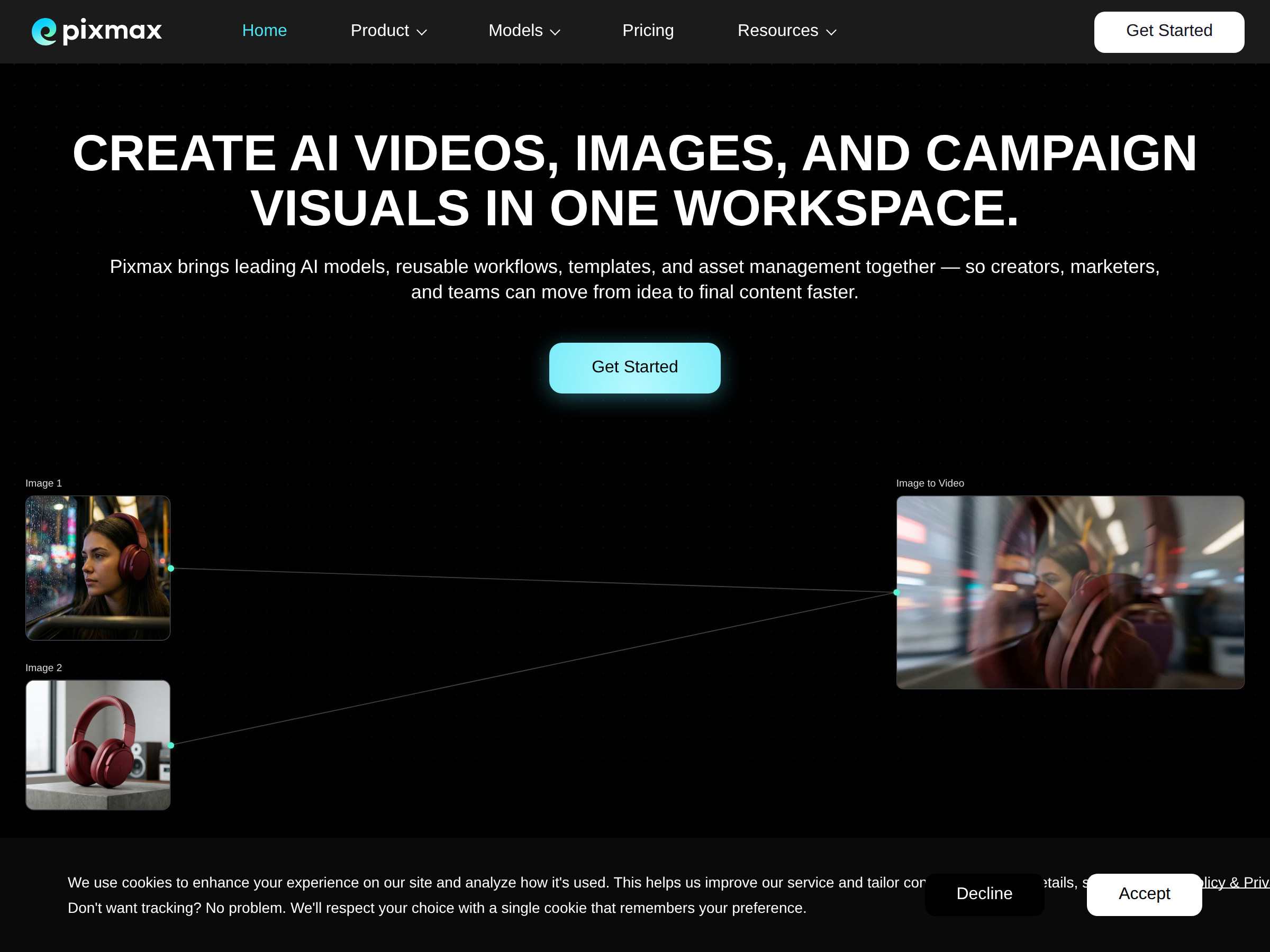
Screenshot of Pixmax.ai
Pixmax.ai
AI Video Generator Unknown

Pixmax.ai is an all-in-one AI creative workspace that consolidates video, image, text, and audio generation models into a single platform. Users can access leading models such as Kling, VEO, Vidu, Hailuo, Wan, Pika, and others for cinematic video creation, alongside image models like Banana, Dreamina, and Midjourney for product shots, posters, and campaign visuals. Text models like Gemini and Doubao assist with scriptwriting and captioning, while ElevenLabs and Minimax provide voiceovers, narration, and music. The platform eliminates the need for multiple subscriptions and fragmented workflows by offering an integrated environment where creators can prompt, compare, and refine outputs from different engines side by side. Beyond model access, Pixmax introduces an Infinite Canvas for planning scenes and experimenting with variations, film-grade project management for organizing storyboards and production progress, and professional asset management for categorizing and reusing generated content. Templates tailored for animation, live-action shorts, product ads, and game animation help users kickstart projects quickly. Collaboration features enable teams to work together on shared canvases and media libraries. Pixmax bridges the gap between ideation and final content by keeping all assets and workflows in one organized workspace, making high-quality AI production accessible to creators, marketers, and studios.

Solves

Creative professionals, marketers, and production teams often struggle with juggling multiple AI tools for different media types, each with its own subscription, credit system, and interface. This fragmentation slows down workflows and complicates asset management. Pixmax solves this by providing a unified platform where users can access top-tier video, image, text, and audio models in one place, plan projects on an infinite canvas, and keep all generated assets organized and reusable. This significantly reduces time-to-content and operational overhead, enabling faster iteration from concept to polished final output.

Screenshot of ProxyTrust
ProxyTrust
Website Analytics Unknown

ProxyTrust is an independent benchmarking and comparison platform for proxy services. It conducts real-world testing of proxy providers by sending over 500,000 live requests against challenging targets protected by Cloudflare, DataDome, and Akamai. The platform evaluates success rates, latency, IP pool sizes, and pricing, then assigns a Trust Score to each provider based on objective criteria. Users can compare providers side-by-side, read detailed reviews updated quarterly, and access exclusive discount coupons. The service aims to help businesses and individuals choose reliable proxies for web scraping, sneaker copping, social media automation, and other use cases without relying solely on vendor marketing claims.

Solves

Choosing a proxy provider is difficult because vendors often make unverifiable claims about performance and IP quality. This leads to wasted money on blocked IPs and unreliable connections. ProxyTrust addresses this by providing independently verified performance data, including success rates against anti-bot protections, latency measurements, and transparent pricing comparisons, enabling users to make informed decisions and select proxies that actually work for their specific needs.

Screenshot of VPSRated
VPSRated
Web Hosting Services Unknown

VPSRated is a comprehensive hosting comparison platform designed to help developers and businesses find the right hosting solution. It aggregates and reviews over 81 hosting providers across seven distinct categories: Virtual Private Servers (VPS), Virtual Dedicated Servers (VDS), Windows Remote Desktop (RDP), Dedicated Servers, GPU Cloud Servers, VPN services, and Proxy providers. Each provider is independently ranked based on user reviews, performance metrics, and feature sets, with detailed breakdowns of plans, pricing, uptime SLAs, and specifications. The platform features 954+ verified reviews and 292+ indexed plans, enabling users to filter by category, price, location, and technical requirements. The platform addresses the fragmented hosting market where developers often encounter biased recommendations and marketing hype. VPSRated provides a transparent, data-driven approach by offering verified user reviews, editor's picks, and side-by-side comparisons. It highlights active deals and coupons, making it easier to find cost-effective options. Key capabilities include detailed provider profiles with full root access options, NVMe SSD storage, instant setup, and snapshot features. The platform also tracks uptime SLAs, such as 99.95% for Kamatera and 99.99% for Hetzner, helping users gauge reliability. For specialized needs like trading bots and automation, it lists Windows RDP providers with low latency and full admin access. VPSRated supports providers in 23 countries and continuously updates its database to reflect the latest offerings. The platform also fosters a community-driven review system, allowing developers to share their experiences with specific providers. It is freely accessible, requiring only a sign-up for personalized features like saving comparisons. With its structured categories and rigorous curation, VPSRated serves as a go-to resource for anyone navigating the complex hosting landscape, cutting through marketing fluff and providing actionable insights for deployment decisions.

Solves

Developers hunting for hosting services face a crowded market with conflicting claims and generic advice, making it difficult to objectively compare options. VPSRated solves this by curating a directory of hosting providers, offering independent rankings, verified user reviews, and detailed comparisons across multiple hosting categories. It eliminates guesswork and reduces time spent researching, helping users select hosting plans that align with their specific workloads and budgets.

Screenshot of BestResidentialProxies
BestResidentialProxies
Security Software Unknown

BestResidentialProxies is an independent review and comparison platform dedicated to helping users find the most suitable proxy providers. It aggregates, benchmarks, and ranks residential, datacenter, mobile, ISP, SOCKS5, IPv4, and IPv6 proxy networks from dozens of vendors. The site publishes real-world speed tests, transparent pricing, and side-by-side comparisons, all curated by experts who claim to accept no paid placement, ensuring vendor-neutral advice. A 2026 Edition tag signals frequent updates, and the platform boasts over 250,000 monthly readers. The platform features a Power Ranking that scores providers on an editor’s 10-point scale, highlighting key metrics like IP pool size, response time, geographic coverage, and supported protocols. Each listing includes exclusive reader coupons (e.g., 25% off RapidProxy with code ATBKU256W) and clear calls to action to visit the provider or read an in-depth review. Users can filter by proxy type (residential, datacenter, mobile, SOCKS5, sneaker) or use case (scraping, SEO tools, social media), making it easy to narrow down options. Beyond the rankings, the site offers detailed individual reviews that cover the history, reputation, and technical performance of each provider. It claims to have benchmarked millions of IPs across 195+ countries and supports auto-rotation and sticky session testing. RockHoster web hosting ads appear prominently, suggesting the site may be owned by or affiliated with that hosting company, but the proxy reviews remain separate. The monetization model relies on affiliate commissions when users click through and purchase with the provided coupons, yet the editorial team asserts independence from vendor influence. BestResidentialProxies serves as a one-stop resource for anyone needing fast, private, undetectable proxies. It saves users the hassle of individually researching dozens of providers by consolidating verified performance data, real user feedback, and active promo codes. The platform’s commitment to daily updates and transparent methodology positions it as a trustworthy starting point in the crowded proxy market.

Solves

Individuals and businesses searching for proxy services often struggle with an overwhelming number of providers, opaque pricing, and inconsistent performance claims. BestResidentialProxies solves this by delivering curated, independent benchmarks, genuine user reviews, and real-time price comparisons. It eliminates guesswork by providing objective speed data, editor scores, and exclusive discounts, enabling users to quickly identify the most reliable, cost-effective proxy for their specific needs—be it web scraping, sneaker copping, or ad verification.

Screenshot of trpc-agent-go
trpc-agent-go
AI Agents Open Source

trpc-agent-go is an open-source Go framework designed for building production-grade AI agent systems. It provides a comprehensive set of building blocks that enable developers to create agents capable of executing complex, multi-step workflows using graph-based orchestration. The framework natively supports tool integration, allowing agents to call external APIs and services, and includes memory modules for maintaining state across interactions. One of its key strengths is its focus on production readiness, with built-in observability, evaluation, and monitoring capabilities. It implements modern protocols such as Agent-to-Agent (A2A) communication, the AG-UI interface for user interactions, and the Model Context Protocol (MCP) for standardizing tool and context management. These features make it suitable for deploying agents at scale in real-world applications. As part of the tRPC ecosystem, trpc-agent-go leverages the performance and simplicity of Go, making it an ideal choice for backend engineering teams. The framework is actively maintained with a growing community, as evidenced by its GitHub activity and star count. It aims to accelerate the development of agentic applications by providing a robust, opinionated foundation that handles the complexities of agent orchestration, state management, and service integration.

Solves

Building and deploying AI agents in production environments presents significant challenges: managing state, orchestrating multi-step tasks, integrating with external tools, and ensuring reliability and observability. trpc-agent-go solves these problems by offering a cohesive Go framework that bundles graph workflows, memory, tool calling, A2A communication, and built-in evaluation and monitoring. It reduces the boilerplate and infrastructure effort required to move from a prototype to a scalable, maintainable agent system.

Screenshot of BuildCheck
BuildCheck
AI/ML Free

BuildCheck is an AI-driven decision-support tool that helps individuals and teams determine the most appropriate technical approach for automating a given workflow. By simply describing the desired process in natural language, users receive a tailored recommendation on whether they should build a custom application, design an AI agent, or merely craft a well-engineered prompt for an existing large language model. This pre-development analysis saves time and resources by preventing over-engineering and ensuring that the chosen solution aligns with the actual complexity and requirements of the task. The tool leverages AI to dissect the described workflow into its core components—evaluating factors like data inputs, required integrations, decision logic, and the need for statefulness or user interfaces. It then compares these against the capabilities and limitations of prompt-based solutions, agent frameworks, and full-stack development. BuildCheck outputs a clear recommendation along with a rationale, empowering users to make informed decisions without needing deep technical expertise. BuildCheck is designed for a wide range of users, from startup founders validating an MVP idea to seasoned developers deciding on automation architecture. The interface is minimal and focused: a single input field and an "Analyse" button. After processing, the tool presents the suggestion, but always emphasizes that the user has the final say. Its free access removes financial barriers, making it an invaluable first step in the ideation phase of any project.

Solves

Many product builders, startup founders, and developers face the dilemma of how to best automate a process. They may waste weeks building custom software when a simple prompt to ChatGPT could achieve the same result, or underestimate complexity and end up with an unreliable agent. BuildCheck solves this by analyzing the described workflow and providing a data-driven recommendation on the appropriate implementation method, helping users make informed decisions quickly and avoid common pitfalls.

Screenshot of takopi
takopi
AI Agents Open Source

Takopi is an open-source Telegram bridge that connects popular AI coding assistants such as OpenAI Codex, Anthropic Claude Code, OpenCode, and Pi directly to the Telegram messaging platform. It acts as a middleware bot, allowing developers and engineers to interact with these powerful AI tools through a familiar chat interface without needing direct terminal access or proprietary integrations. Users can configure Takopi to route messages to one or more AI backends, send coding queries, request code explanations, refactor code, or even manage projects, all from a mobile or desktop Telegram client. Under the hood, Takopi runs as a self-hosted service written in Python, leveraging the Telegram Bot API to listen for messages and events. When a user sends a command or message, Takopi processes the request, invokes the selected AI coding agent with the appropriate context and parameters, and returns the generated response back to the Telegram chat. It supports rich messaging, including code blocks, formatting, and potentially inline actions, though the exact feature set depends on the backend capabilities. The project is actively maintained with frequent releases and a growing community, as evidenced by its 1k+ GitHub stars and 40+ tags. Takopi is designed to be extensible, supporting multiple AI backends through a unified interface. Users can switch between different agents or even run them in parallel, though the primary use case is to provide a convenient remote control for AI coding tools. Configuration is handled through environment variables or a Justfile, making it deployable on any server or local machine that can run Python. It is ideal for teams that want to integrate AI coding assistance into their Telegram-based workflows or for individual developers who prefer managing coding tasks from their mobile devices. While the primary backends include Codex, Claude Code, OpenCode, and Pi, the architecture likely allows adding more AI coding agents in the future. Takopi emphasizes simplicity and reliability, providing a direct bridge without unnecessary abstraction. It does not replace the native capabilities of these AI tools but extends their accessibility, making them available wherever Telegram is used.

Solves

Developers and engineers who use AI coding assistants often need to interact with these tools from their development environment via command line or specific IDEs. This limits accessibility when away from their workstation or when they prefer a more mobile and chat-oriented interaction. Takopi solves this by providing a Telegram bridge that allows users to send coding requests, receive AI-generated code, and manage coding tasks through a Telegram bot, enabling remote and asynchronous collaboration with AI coding tools.

Screenshot of Agent Teams
Agent Teams
AI Agents Open Source

Agent Teams is a desktop application that enables users to issue high-level commands to autonomous teams of AI coding agents. The app orchestrates multiple agents simultaneously, each leveraging different back-end AI coding tools such as Claude Code, Codex, and OpenCode. Agents collaborate through inter-agent messaging, automatically plan and decompose tasks, and track progress using an integrated Kanban board. The application provides a user-friendly interface where you can set goals, monitor agent activities, and intervene if necessary, while the agents handle the implementation details. Built with modern web technologies (Electron, TypeScript), it is open source and runs locally, giving you full control over your agent workflows.

Solves

Developers and engineers often face complex, multi-step coding projects that require significant manual effort and coordination. Commanding a single AI coding assistant can be limiting when tasks need to be parallelized or involve multiple technologies. Agent Teams solves this by allowing a user to delegate high-level objectives to a team of AI agents that independently divide work, communicate, and execute tasks concurrently, reducing the developer's oversight burden and accelerating project completion.

Screenshot of zeroclaw
zeroclaw
AI Agents Open Source

zeroclaw is an open-source infrastructure for building and running fast, small, fully autonomous AI assistants. Written in Rust for maximum performance and minimal resource usage, it provides a modular architecture that allows developers to create AI agents capable of independent operation. The project includes a plugin system for extensibility, memory management for long-running agents, and integrations with major AI models such as Claude and Gemini. It supports deployment on Kubernetes for scalability and includes firmware components for edge or IoT scenarios. With over 31,000 GitHub stars and active development, zeroclaw emphasizes reliability through built-in fuzz testing and benchmarking. The repository contains example applications, deployment configurations, and scripts to streamline the development of autonomous AI solutions across cloud and edge environments.

Solves

Developers and organizations need to deploy autonomous AI agents that are fast, lightweight, and reliable, but existing frameworks are often resource-heavy, complex, or lack direct integration with leading AI models. zeroclaw solves this by providing a high-performance, modular infrastructure that enables the creation of efficient AI assistants that can run anywhere from cloud servers to edge devices, simplifying the development and deployment of fully autonomous systems.

Screenshot of rho
rho
AI Agents Open Source

Rho is an open-source AI agent designed for persistent, autonomous operation. Unlike many conversational agents that reset context after each session, Rho maintains continuous memory across interactions, allowing it to build long-term understanding of user preferences, tasks, and schedules. It features a modular architecture with a brain module for memory storage, a CLI, a web interface, and mobile apps, enabling it to run as a background service that can proactively check in with users and perform tasks without constant prompting. The agent is built to be extensible, with support for skills and extensions that enable it to integrate with external APIs, tools, and services. It can manage tasks, set reminders, and even self-monitor its own operations, restarting or adjusting as needed. The project is containerized with Docker for easy deployment, and it includes options for running on desktop, server, or mobile devices. The community-driven development is active, with frequent commits and growing adoption. Rho's memory system allows it to retain information across long periods, making it suitable for personal assistant roles where context over weeks or months matters. It can learn from past interactions to anticipate needs, and its proactive check-in feature means it can initiate conversations to request updates or deliver reports, rather than waiting for user input. This positions it as a persistent digital companion rather than a simple query-response bot. As an open-source tool, Rho gives users full control over their data and the agent's behavior, avoiding privacy concerns associated with cloud-based AI assistants. It is still evolving, with ongoing work on stability, documentation, and ecosystem integrations, but its core concept of a memory-empowered, self-running agent offers a glimpse into the future of autonomous personal AI.

Solves

Most AI assistants operate statelessly, losing all context between sessions and requiring users to re-explain tasks repeatedly. Rho solves this by maintaining persistent memory and running continuously, enabling it to serve as a long-term personal agent that remembers past interactions and proactively assists users over time without losing context.

Screenshot of picoclaw
picoclaw
AI Agents Open Source

picoclaw is an ultra-efficient, open-source AI assistant designed for local and edge deployment. It provides fast, low-latency AI interactions without relying on cloud services, making it ideal for developers and hobbyists who value privacy and performance. The tool is built with Go, ensuring minimal resource consumption and cross-platform compatibility via static binaries or Docker containers. Its command-line interface (CLI) supports custom OpenAI-compatible endpoints, allowing users to connect to various large language models (LLMs) either locally or remotely. Additionally, picoclaw integrates web search capabilities (e.g., native Kagi web search) to fetch real-time information, and its agent module handles tasks, tools, and skills, enabling extensible AI-powered automation.

Solves

Many AI assistants require heavy cloud infrastructure or offer limited customization, making them unsuitable for resource-constrained environments or users concerned about data privacy. picoclaw solves this by providing a lightweight, self-hostable AI assistant that runs efficiently on local machines or edge devices, giving users full control over their data and model choices without sacrificing performance.

Screenshot of piclaw
piclaw
AI Agents Open Source

piclaw is an open-source, general-purpose AI agent framework designed to run efficiently on resource-constrained devices such as the Raspberry Pi. It provides a modular runtime environment where users can define autonomous agents with access to a variety of tools including shell command execution, terminal multiplexing, web browsing, and external APIs. The agent architecture includes a supervisor module for orchestrating multi-step tasks and managing tool use, ensuring that agents can handle complex workflows with configurable limits on tool invocations per turn. piclaw supports extensions that allow integration with popular services like GitHub Copilot through OAuth authentication, enabling code generation workflows. The project is written in TypeScript and optimized for the Bun runtime, offering fast startup and low memory overhead. With its emphasis on portability and edge deployment, piclaw brings autonomous agent capabilities to devices that cannot support conventional cloud-based AI infrastructure.

Solves

Developers and hobbyists who want to build autonomous AI agents often face the challenge of deploying resource-heavy frameworks on low-power hardware like the Raspberry Pi. piclaw solves this by providing a lightweight, self-hosted agent runtime that can run entirely on a single-board computer. This enables private, offline-capable automation without reliance on cloud services, making it ideal for home labs, IoT projects, and edge computing scenarios where privacy and low latency are critical.

Screenshot of nanoclaw
nanoclaw
AI Agents Open Source

Nanoclaw is a lightweight, open-source command-line tool for orchestrating AI coding agents with a strong emphasis on security and minimal overhead. Designed as a streamlined alternative to OpenClaw, it allows developers to run multiple AI-powered coding tasks inside isolated Apple containers, ensuring that agent operations are sandboxed and cannot affect the host system. Nanoclaw integrates with large language models such as Claude to perform autonomous code generation, refactoring, testing, and other development tasks. The tool features a simple setup process via a shell script (nanoclaw.sh), a custom terminal splash screen, and a versioning system with automated release management. With a focus on performance, it supports large context windows and token limits (e.g., 185k tokens at 92% context), making it suitable for complex codebases. Nanoclaw is actively maintained, with over 1,700 commits and a growing community, and it accepts contributions through GitHub. Its architecture leverages pnpm and modern JavaScript/TypeScript tooling, and it ships with a Husky pre-commit hook for code quality.

Solves

Developers often need to automate coding tasks using AI agents, but existing solutions like OpenClaw can be resource-intensive or expose the host system to potential risks. Nanoclaw solves this by providing a lightweight, containerized alternative that runs AI agents in Apple sandboxes, ensuring system integrity and reducing resource consumption. It enables safe, parallel execution of AI-driven code modifications, testing, and debugging locally without sacrificing performance or security.

Screenshot of nullclaw
nullclaw
AI Agents Open Source

nullclaw is an open-source infrastructure for building and deploying fully autonomous AI assistants, designed to be the fastest and smallest solution available. Written in the Zig programming language for maximum performance and minimal overhead, it enables developers to create AI agents that can operate independently on a variety of tasks without constant human intervention. The project emphasizes efficiency, utilizing SQLite for embedded data management and offering a lightweight runtime that can run on low-resource environments. At its core, nullclaw provides a flexible agent framework that supports multiple large language model (LLM) providers through an OpenAI-compatible interface, allowing seamless switching between different AI backends. It includes advanced features such as tool integration with intelligent filtering based on groups, enabling agents to use the right set of tools for each task. The system prompt is dynamically generated to include relevant tools, ensuring agents have the context they need without overwhelming the model. The infrastructure is designed for extensibility, with a plugin-like provider system that can be expanded to support new LLM services. It includes built-in support for popular providers and can be easily adapted to custom endpoints. nullclaw also prioritizes security, with local web authentication hardening and environment variable hooks for encrypted configuration loaders, making it suitable for production deployments. nullclaw is actively maintained with a growing community, evidenced by over 2,700 commits, 7.7k stars, and 900+ forks. It is distributed as open source, encouraging contributions and allowing users to inspect and modify the code. The project includes documentation, examples, and a specification to guide users in integrating it into their workflows.

Solves

Developers and organizations seeking to deploy AI assistants often face challenges with heavy frameworks that consume significant resources and introduce latency. nullclaw solves this by providing a minimalist, high-performance infrastructure that enables the creation of autonomous AI agents that are both fast and resource-efficient, suitable for everything from personal assistants to enterprise task automation without the bloat of conventional solutions.

Screenshot of NemoClaw
NemoClaw
AI Agents Open Source

NemoClaw is an open-source plugin developed by NVIDIA that provides a secure and streamlined installation process for OpenClaw, a framework for orchestrating AI agents. Designed to integrate with the OpenClaw ecosystem, NemoClaw focuses on ensuring that the deployment of agent-based systems meets enterprise-grade security standards while simplifying the setup process. By automating critical security configurations and dependency handling, NemoClaw allows developers to quickly deploy OpenClaw environments without compromising on safety. The plugin leverages NVIDIA's expertise in AI and secure computing to offer a robust solution that includes features such as verified package integrity, secure communication channels, and access control mechanisms. NemoClaw is actively maintained with frequent updates, as evidenced by its numerous branches and commits on GitHub, and it supports a community-driven development model where contributions help enhance its capabilities. The repository also includes a directory structure hinting at integration with agent skills, suggesting that it may facilitate the secure installation of specific agent capabilities or extensions. NemoClaw is particularly useful for developers and organizations looking to adopt OpenClaw in sensitive environments, such as production systems or research labs, where security is paramount. It abstracts away the complexities of manual setup, offering a consistent and repeatable installation process. The plugin is built to be compatible with NVIDIA hardware and software stacks, potentially enabling optimizations for GPU-accelerated agent workloads.

Solves

Organizations and developers who want to use OpenClaw for building and orchestrating AI agents often face challenges with securely installing and configuring the framework, especially in production environments. Without a dedicated tool, the process may expose vulnerabilities, require manual security hardening, and lack consistency across deployments. NemoClaw solves this by providing a dedicated plugin that automates the secure installation of OpenClaw, ensuring that best practices are applied and reducing the risk of misconfigurations.

Screenshot of lobsterai
lobsterai
AI Agents Open Source

LobsterAI is an open-source, all-scenario AI agent developed by NetEase Youdao, designed to autonomously handle a wide range of tasks around the clock. It provides a versatile, self-hosted platform for deploying intelligent agents capable of integrating with various services and tools. The agent is highly extensible through a modular SKILLs system, allowing developers to create custom skills, and leverages the openclaw-extensions architecture for additional functionality. It supports voice interaction, enabling hands-free communication, and includes built-in integrations for image generation models like Banana Pro and Canvas 2.0, making it suitable for creative and media-related tasks. LobsterAI's core framework supports parallel task execution, allowing multiple agents or processes to run concurrently for increased efficiency. It incorporates a token-based billing system for paid external services, enabling precise usage tracking and credit management. The platform is actively maintained, with over 2,600 commits, frequent updates, and a growing community reflected by 5,300 GitHub stars and 800 forks. Its architecture emphasizes reliability, designed for 24/7 operation with automatic recovery mechanisms. Key features include a rich interface for task management, integration with services like Youdao Note, voice command support, an extensible skill marketplace, and enterprise-ready access controls using OpenID for internal model restrictions. LobsterAI aims to be a comprehensive automation solution, reducing repetitive manual work for individuals and teams. Its open-source nature allows full customization, data privacy, and community-driven innovation.

Solves

Many individuals and businesses waste significant time on repetitive digital tasks such as scheduling, data retrieval, content generation, and cross-service workflows. Existing automation tools are often domain-specific, require extensive coding, or lack 24/7 availability. LobsterAI solves this by providing a persistent, all-in-one AI agent that can be deployed locally or on a server. It autonomously handles diverse tasks, operates continuously without human fatigue, and frees users to focus on higher-value work while ensuring reliability and privacy through self-hosting.

Screenshot of MetaClaw
MetaClaw
AI Agents Open Source

MetaClaw is an open-source AI agent framework that lets users interact with an intelligent agent using natural language, with the agent continuously learning and evolving from those interactions. It provides a persistent conversational interface where the agent can execute tasks, answer questions, and adapt its behavior over time. The core philosophy is simplicity: just talk to your agent, and it gets smarter with every exchange. The framework includes key components such as a long-term memory manager that captures and organizes conversation history, a sidecar service for asynchronous processing, and a benchmarking suite to measure performance improvements. Recent updates highlight incremental memory ingestion, where the agent can buffer and flush turns efficiently, reducing the overhead of re-sending full history and enabling near-real-time learning. MetaClaw is designed to be extensible, with a plugin architecture and proxy routing for integrating additional services. The benchmark system allows users to define tasks and compare agent performance across different configurations, making it suitable for both experimentation and production use. It is built with Python and supports tools commonly used in AI agent development. While still in early release (v0.4.1), MetaClaw has gained community interest, as shown by its 3.4k stars, and is backed by a research lab (aiming-lab). The project targets developers who want a self-hosted, learning-capable agent that can be tailored to specific domains without relying on external APIs.

Solves

Developers and researchers often need an AI assistant that can maintain context across sessions and improve its responses based on past interactions, but most agent frameworks either lack long-term memory or require complex setup. MetaClaw solves this by providing a self-hosted, open-source agent that naturally learns from conversation, eliminating the need to constantly re-prompt or manually manage context. It is ideal for users who want an evolving, persistent agent without the overhead of building memory systems from scratch.

Screenshot of LionClaw
LionClaw
AI Agents Open Source

LionClaw is a secure-first, local AI assistant that runs entirely on your machine, ensuring privacy and data sovereignty. It features durable sessions that persist across restarts, allowing you to pick up conversations and tasks seamlessly. The assistant is extensible through installable skills, which can be added to tailor its capabilities—from coding to research to automation. Built with performance in mind, LionClaw leverages a Rust core for speed and safety, and supports containerized deployment for easy setup. Its open-source nature allows full customization and auditing, making it suitable for developers and privacy-conscious users who want a powerful AI assistant without sacrificing control over their data.

Solves

Users often need an AI assistant but are concerned about privacy, data security, and vendor lock-in. LionClaw solves this by providing a completely local AI assistant that does not phone home, keeping all interactions and data on the user's hardware. It also addresses the need for persistent context with durable sessions, so users don't lose their workflow between sessions. Additionally, the skills system allows the assistant to be extended for various domain-specific tasks, making it versatile without relying on cloud services.

Screenshot of ghostclaw
ghostclaw
AI Agents Open Source

Ghostclaw is an open-source AI agent that runs locally on your computer and can be controlled via Telegram. It leverages Anthropic's Claude models to understand and execute tasks directly on your file system, command-line environment, and other local resources. The agent is designed around a dual-mode operation: a fast-path for simple queries that uses a lightweight API call to Claude Sonnet without spawning a full agent process, and a full agent mode for complex, multi-step tasks that require tools and state. This architecture keeps costs low for casual interactions while retaining the power to handle complex workflows. At its core, Ghostclaw is a Node.js application that listens for Telegram messages and dispatches them to either the fast path or a spawned agent process. The fast path uses the Anthropic SDK to generate quick answers and returns a HANDOFF signal if tools are needed, falling through to spawn a full agent. The full agent, built on the Claude Agent SDK, can interact with the user's environment, execute code, read and write files, and use custom skills. Skills are modular extensions that can be added to the agent, with templates for integrating services like Discord, Slack, and more. Usage and costs are tracked in a local SQLite database, and a daily budget cap enforced by the orchestrator prevents runaway spending. Ghostclaw provides a suite of Telegram slash commands for management, including /model to choose between Claude models (Sonnet, Opus, Haiku), /budget to set or check spending limits, and status reporting. It is designed to be a persistent, always-on assistant that lives on your computer, combining the convenience of a chat interface with the power of direct local access. The project is actively maintained, with regular updates focusing on performance, cost control, and simplicity.

Solves

Ghostclaw addresses the need for a personal, always-available AI assistant that can directly interact with your computer without relying on cloud services that have limited local access. Many users want to automate tasks, manage files, run scripts, and get quick answers through a chat interface, but existing solutions often require manual context switching or are entirely cloud-based. Ghostclaw solves this by running locally, giving it full access to the user's environment, while offering a familiar Telegram interface. It balances cost and capability by using a fast path for trivial requests and a full agent only when necessary, making it practical for daily use without excessive API fees.

Screenshot of mercury
mercury
AI Agents Open Source

Mercury is an open-source, self-hosted personal AI assistant designed to live on your own infrastructure and integrate into the messaging apps you already use. It functions as a persistent chatbot agent that can perform tasks, answer questions, and manage multiple conversation contexts through a concept of workspaces. The project provides a full suite of tools including a CLI for management, a Docker container for the agent core, and APIs for extension. Built with a focus on privacy and control, Mercury ensures all data and interactions remain on your machines. The assistant supports advanced multi-tenancy with workspaces, allowing a single deployment to serve multiple isolated projects, teams, or personal contexts. Each workspace has its own configuration, environment variables, and trigger rules, and is accessed via pairing codes—making it easy to onboard new users securely. An admin role can be granted through pairing, and the system includes features like group management, media handling, and built-in tracing with OpenTelemetry for observability. Mercury was actively developed up until March 2026, reaching version 0.5.0-experimental, but the repository has since been archived, meaning no further updates are expected from the original author. Nonetheless, the codebase remains available for forking and self-deployment, and can serve as a foundation for anyone looking to build a private AI assistant. Given its experimental state and archival, Mercury is best suited for technically proficient users who are comfortable with Docker, command-line tools, and potential troubleshooting. It offers a unique blend of chat-native AI assistance with enterprise-grade workspace separation, making it a compelling choice for small teams or individuals who value data sovereignty over convenience.

Solves

Many individuals and small teams want the convenience of an AI assistant but are concerned about data privacy, vendor lock-in, and the limitations of cloud-based bots. They desire an assistant that lives inside their existing chat platforms (like Slack, Discord, Telegram) and can handle context-switching between different projects or personal tasks. Mercury solves this by providing a self-hostable agent that runs on one's own servers, integrates with popular messaging apps, and supports multiple isolated workspaces—all while keeping conversations and data under the user's full control.

Screenshot of lettabot
lettabot
AI Agents Open Source

lettabot is an open-source personal AI assistant designed to remember everything, providing a persistent and context-aware conversational experience. Built on the Letta framework, it leverages advanced memory management to retain information across multiple sessions, ensuring that it learns from past interactions and user preferences. The bot is self-hosted, giving users full control over their data and privacy. It includes a skills system for extending functionality, and supports deployment via Docker for easy setup. Although the repository has been archived and is no longer actively maintained, lettabot served as a demonstration of how AI agents can maintain long-term context and deliver personalized assistance. It is written in TypeScript and Node.js, making it accessible for developers to customize and integrate with various messaging platforms.

Solves

Many AI assistants treat each conversation as isolated, requiring users to repeatedly provide context. lettabot solves this by implementing persistent memory, so it can recall user preferences, past conversations, and important details over time, creating a more natural and effective assistant experience. It is ideal for individuals or teams who need a reliable, self-hosted AI assistant that grows smarter with each interaction.

Screenshot of lemon
lemon
AI Agents Open Source

lemon is a local-first assistant and coding agent system that runs entirely on the user's machine, ensuring privacy and offline capability. It orchestrates multiple AI agents to handle complex software development tasks such as code generation, refactoring, debugging, and testing. The system includes a benchmarking framework (lemon_sim) with vending bench arenas to evaluate agent performance on coding challenges. It features a modular architecture with directories for apps, skills (including Claude integration), memory management, and client interfaces, suggesting extensibility and support for various frontends. Development is active, with frequent commits and a focus on simulation and UI improvements as of mid-2026.

Solves

Developers often need assistance with repetitive or complex coding tasks but may be constrained by cloud-dependency, latency, or privacy concerns. lemon provides a fully local, open-source solution that automates coding workflows, supports multi-agent coordination, and benchmarks agent performance, all without sending code to external servers.

Screenshot of CoPaw
CoPaw
AI Agents Open Source

CoPaw is an open-source personal AI assistant platform that provides a comprehensive console for interaction, allowing users to run and manage their own AI agents locally. It features a plugin extension infrastructure that enables customization and integration with external tools via the Model Context Protocol (MCP). The platform includes built-in skills like file preview and batch tag downloads, with a focus on security by restricting file access to the working directory. CoPaw supports end-to-end testing and continuous integration, ensuring reliability and ease of deployment. It is designed to be self-hosted, giving users full control over their data and assistant behavior. The active development community continuously adds new features and improvements, making it a versatile solution for building personalized AI assistants.

Solves

Many users seek a customizable, privacy-preserving AI assistant that can run locally and be tailored to specific workflows without relying on cloud services. CoPaw solves this by providing an open-source, self-hosted platform that allows individuals and teams to deploy a personal AI assistant with extensible plugins and skills, ensuring data remains on their own infrastructure while offering a user-friendly console for interaction.

Screenshot of ironclaw
ironclaw
AI Agents Open Source

Ironclaw is an open-source AI agent framework written in Rust, inspired by the OpenClaw project and emphasizing privacy and security. It provides a high-performance, modular runtime for building, orchestrating, and managing autonomous agents. The framework is designed with a security-first architecture, leveraging Rust’s memory safety guarantees and cryptographic primitives to ensure that agents operate in a trusted environment. The repository includes a rich set of components such as `crates` for modular Rust libraries, `channels-src` for agent communication protocols, `registry` for agent and plugin discovery, `skills` for pre-built agent capabilities, and `tools-src` for integration tools. A Docker-based deployment setup and a web UI (`webui` mentioned in commits) allow for both cloud and on-premise operation. The project is actively maintained with a large community (over 12k stars, 1.4k forks) and supports multi-agent coordination, skills marketplace, and cryptographic agent identity.

Solves

Developers and organizations seeking to deploy AI agents often face security and privacy risks, especially when handling sensitive data. Most existing agent frameworks are written in memory-unsafe languages or lack built-in privacy safeguards. Ironclaw solves this by providing a Rust-based, OpenClaw-inspired framework that runs agents in a secure, sandboxed environment with encryption and identity verification. It enables the creation of agents that can be trusted with private information, making it suitable for enterprise and personal use where data protection is critical.

Screenshot of assistant
assistant
AI Agents Open Source

Assistant is an open-source, panel-based personal assistant designed for productivity workflows. It features a plugin architecture that allows users to extend its functionality with custom modules, making it highly adaptable to individual needs. The tool provides a web-based interface (the 'panel') where users can interact with various plugins, manage notifications, execute agent-driven skills, and monitor tasks. The core includes a notification system with file-based server storage, a 500-notification cap with oldest-read pruning, and real-time updates via panel events. The project is actively developed, as evidenced by recent commits adding features like global search, list management, and mobile layout fixes. Assistant integrates with AI agents, such as Claude Opus, to automate complex workflows like code review and task orchestration. It is built with a modular structure, separating concerns into agents/skills, plans, and build services, indicating a focus on developer-centric customization and server-side management. The plugin ecosystem includes bundled plugins like the notifications panel with card/compact display modes, read/unread filtering, and bulk actions, all controllable through the web UI. Overall, Assistant aims to be a unified, programmable hub for personal productivity, bridging the gap between standalone tools and a cohesive workspace.

Solves

Many professionals and developers struggle with fragmented productivity tools—notifications scattered across email, messaging, and project management platforms; repetitive manual tasks that consume time; and a lack of centralized control over automated workflows. Assistant addresses this by offering a single, extensible panel where users can consolidate notifications, create custom plugins for automation, and leverage AI agents to execute complex tasks, all without juggling multiple disjointed applications.

Screenshot of accomplish
accomplish
AI Agents Open Source

Accomplish is an open-source AI coworker that operates as a persistent desktop application, designed to assist with everyday computer tasks through natural language interaction. It leverages advanced language models to understand instructions and autonomously execute actions on the user's machine, such as file management, coding, running terminal commands, and integrating with various software tools. The application runs as a background daemon with a user-friendly desktop interface, enabling continuous assistance without interrupting the user's workflow. Built with modularity and extensibility in mind, Accomplish uses an agent-based architecture that allows plugging in different AI models and tools. Its codebase is structured into core components: an agent-core for reasoning and task execution, a daemon for persistent background operation, and a desktop shell built with Electron for cross-platform compatibility. The project emphasizes developer productivity, offering features like natural language code generation, automated PRs, project scaffolding, and seamless integration with code editors and terminals. Accomplish is actively developed with a focus on safe execution of untrusted code and user permissions. It uses OpenCode, a code-generation engine, to produce and apply changes reliably. The tool aims to reduce context switching and automate repetitive development and operational tasks, making it a valuable companion for developers, data scientists, and technical users who want an intelligent assistant that truly understands their environment. The open-source nature encourages community contributions and customizations. With over 10,000 stars on GitHub and frequent updates, Accomplish is evolving rapidly, driven by a vision of creating a universally accessible AI collaborator that respects user privacy by running locally and optionally connecting to cloud AI services.

Solves

Developers and power users often face high cognitive load from juggling multiple tools, repetitive tasks, and context switching between coding, command-line operations, and file management. Accomplish solves this by providing a local AI assistant that can understand high-level goals expressed in natural language and autonomously execute complex multi-step workflows directly on the user's desktop, freeing the user to focus on creative and strategic work.

Screenshot of tutti
tutti
AI Agents Open Source

tutti is an open-source command-line tool for orchestrating multiple AI coding agents in parallel, designed with a config-driven approach. Its core mechanism uses declarative configuration files (e.g., TOML) to define agent workflows, enabling reproducible multi-agent executions. The tool leverages git worktree isolation to create separate, conflict-free workspaces for each agent, allowing safe parallel operation on a shared codebase. A typed artifact flow system ensures that outputs from one agent can be consumed by others with explicit type contracts, reducing integration errors. Built in Rust, it emphasizes performance and reliability, and includes integrations with popular AI coding assistants like Claude Code and Codex, along with extensible skills and dashboards for monitoring.

Solves

Developers building complex software need to coordinate multiple AI coding agents to tackle different aspects of a problem simultaneously, but manual orchestration leads to context bleeding, workspace conflicts, and fragile inter-agent communication. tuttisolves this by providing a unified CLI that automates parallel agent execution with isolated git worktrees and a typed artifact pipeline, ensuring each agent operates in a sandboxed environment while seamlessly sharing structured outputs.

Screenshot of tmux-ide
tmux-ide
AI Agents Open Source

tmux-ide is a terminal-based integrated development environment built on top of tmux. It allows developers to define custom IDE layouts using a simple YAML configuration file (ide.yml), splitting the terminal into panes and windows for code editing, command execution, log viewing, and more. A standout feature is its support for agent-team templates, which enable users to set up multiple AI coding agents (specifically integrated with Claude Code) that operate in parallel within a single tmux session. These agents can be assigned different roles, such as writing code, reviewing changes, or running tests, enabling automated and collaborative AI-assisted software development. The tool also includes a dashboard, custom skill definitions for agents, and extensible scripts, making it a comprehensive hub for orchestrating AI-driven coding workflows directly in the terminal. tmux-ide is open source, highly customizable, and aims to streamline the process of leveraging multiple AI agents for complex programming tasks without leaving the command line.

Solves

Developers and AI practitioners often need to manage multiple AI coding agent sessions simultaneously, switching between contexts and manually coordinating tasks. tmux-ide solves this by providing a tmux-powered IDE where teams of AI agents (integrated with Claude Code) can be configured, launched, and monitored in a structured terminal layout. This eliminates the overhead of juggling separate terminals and enables efficient parallel execution of agent tasks such as coding, debugging, and code review.

Screenshot of vibecraft
vibecraft
AI Agents Open Source

Vibecraft is an open-source, RTS (Real-Time Strategy)-style workspace designed to manage and orchestrate multiple AI coding agents. It transforms the often complex process of coordinating autonomous coding agents into an intuitive, game-like experience, where each agent is represented as a controllable entity on a dynamic canvas. Inspired by real-time strategy games, the interface allows developers to deploy, monitor, and interact with agents visually, providing immediate feedback on their actions and progress. This approach makes it easier to oversee parallel tasks, allocate resources, and resolve conflicts between agents in a natural, engaging manner. Built with Electron for cross-platform desktop compatibility (Windows, macOS, Linux), Vibecraft emphasizes visual clarity and real-time control. Users can spawn new agents, assign them to specific codebases or tasks, and watch as they write, refactor, or debug code live. The workspace likely includes features such as agent grouping, task queues, status indicators, and performance dashboards. By centralizing agent management, Vibecraft reduces the cognitive load of tracking multiple concurrent AI processes and enables developers to act as strategic commanders of their AI ‘army’. Under the hood, Vibecraft is architected to be extensible, supporting custom agent integrations and various AI models. Its open-source nature encourages community contributions, and its modular design (evident from the repository structure with separate directories for source, tests, user docs, and technical docs) suggests a focus on maintainability and adaptability. Whether used for solo prototyping or team-based software development, Vibecraft aims to make AI-assisted coding not only more productive but also more enjoyable.

Solves

Developers and teams increasingly rely on AI coding agents to automate software tasks, but managing multiple agents—especially when they operate concurrently—can quickly become chaotic. Without a centralized orchestration tool, it is difficult to track agent progress, prevent conflicting edits, and optimize task distribution. Vibecraft addresses this challenge by providing a visual, RTS-style command center where users can launch, monitor, and coordinate AI agents like units in a strategy game, bringing order and oversight to multi-agent coding workflows.

Screenshot of vibe-tree
vibe-tree
AI Agents Open Source

Vibe-tree is a desktop application that lets developers run multiple Claude Code sessions simultaneously, each in its own isolated git worktree. It provides a graphical interface to create, manage, and monitor parallel AI coding tasks, so you can work on several features, bug fixes, or experiments at the same time without them interfering with each other. The tool automatically handles git worktree creation linking each to a branch or commit, launches Claude Code in each worktree with task-specific prompts, and tracks progress across all sessions. Once completed, changes remain in separate branches for review, testing, and merging. Vibe-tree streamlines the workflow of AI-assisted development by turning serial Claude Code interactions into a concurrent, high-throughput process. It includes features like project grouping, conflict detection, resource usage monitoring, and easy cleanup of completed worktrees.

Solves

Developers using Claude Code often face a bottleneck: they can only start one task at a time, and switching contexts or waiting for long-running prompts slows down overall progress. Vibe-tree solves this by enabling true parallel AI coding. Using git worktrees as lightweight, isolated environments, it runs many Claude Code instances concurrently on different branches. This means developers can spin up multiple feature implementations, bug investigations, or refactors at once, dramatically accelerating the development cycle.

Screenshot of vibe-kanban
vibe-kanban
AI Agents Open Source

Vibe Kanban is an open-source Kanban board tailored for managing AI coding agents. It provides a visual interface to organize, track, and assign tasks to multiple AI agents, making it easier to oversee automated coding workflows. The tool is built with a focus on performance and real-time updates, likely using a Rust backend for efficiency. It supports drag-and-drop task management, customizable columns, and agent assignment, allowing teams to monitor agent progress at a glance. As AI coding assistants become more prevalent, Vibe Kanban addresses the need for coordination and visibility into agent activities, ensuring tasks are completed in an orderly manner. The project is actively maintained with a growing community, as evidenced by its high star count and frequent commits.

Solves

Development teams using AI coding agents struggle to manage multiple concurrent tasks, lack visibility into agent progress, and face challenges in prioritizing and assigning work. Vibe Kanban solves this by offering a dedicated Kanban board that visually organizes agent tasks, enabling efficient tracking, assignment, and oversight.

Screenshot of supacode
supacode
AI Agents Open Source

supacode is a native macOS application designed to orchestrate multiple AI coding agents from a single desktop interface. It provides a unified workspace where developers can launch, monitor, and coordinate specialized coding agents to work on different tasks simultaneously. Built specifically for macOS, supacode takes advantage of native system features such as keyboard shortcuts, notifications, and efficient window management to deliver a seamless experience. The tool allows users to configure and run various agent frameworks in parallel, making it ideal for complex software development workflows where multiple agents need to handle distinct aspects like code generation, refactoring, testing, or debugging concurrently. By running agents locally on the user's machine, supacode ensures that sensitive codebases remain private and available for offline work. The application focuses on reducing context switching by consolidating agent management into a cohesive environment. As an open-source project, supacode is community-driven and actively maintained, with frequent updates that introduce new capabilities and refinements. The current release (v0.10.2) demonstrates ongoing progress toward a stable and feature-rich orchestrator. It is particularly useful for developers who prefer a native macOS tool over web-based or command-line alternatives, offering tight integration with the operating system’s look and feel. supacode’s architecture supports modular agent skills and configurations, enabling users to tailor agent behaviors to specific project requirements. By centralizing agent coordination, it helps streamline the adoption of AI-assisted coding practices, making it accessible to both individual developers and teams looking to boost productivity without compromising on control or privacy.

Solves

Developers increasingly rely on AI coding agents to automate parts of their workflow, but managing multiple agents often involves juggling separate terminal windows, web interfaces, or command-line tools. This fragmentation leads to context switching, reduced productivity, and a lack of native integration on macOS. supacode solves this by providing a dedicated, native macOS orchestrator that brings all agent management into a single desktop application, allowing developers to run, monitor, and coordinate agents efficiently while leveraging native system capabilities.

Screenshot of subtask
subtask
AI Agents Open Source

subtask is a Claude Skill (plugin) for Anthropic's Claude Code that enables parallel execution of AI coding agents using isolated git worktrees. It allows developers to break down complex tasks into smaller subtasks, which are then executed concurrently by multiple subagents, each operating in its own dedicated worktree. This parallelism significantly accelerates development workflows by eliminating the sequential bottleneck of traditional agent execution. The plugin integrates directly with Claude Code, extending its command set to manage subagents. When a task is initiated, subtask orchestrates the creation of git worktrees from the current repository, spawns Claude-powered subagents, and distributes the subtasks among them. The worktrees provide isolated filesystem environments, preventing conflicts and enabling safe concurrent modifications. After completion, the plugin handles cleanup, merging results back if needed, and tearing down the worktrees. Key features include support for configurable concurrency, robust error handling with automatic revert on failure, interactive release flows with version bumping (including beta channels), and seamless integration with Claude Code's plugin architecture. The tool is written in Go and is fully open source, encouraging community contributions and extensions. subtask is particularly valuable for tasks like parallel code reviews, simultaneous feature development, multi-branch testing, and large-scale refactoring. By harnessing the power of parallel AI agents, it transforms how developers leverage AI coding assistants, making them faster and more efficient for complex, multi-faceted projects.

Solves

Developers often waste time waiting for a single AI coding agent to complete sequential tasks when many tasks are independent and could run in parallel. subtask solves this by allowing multiple Claude Code agents to work simultaneously on different parts of a project, each in its own isolated git worktree, dramatically reducing total execution time while avoiding code conflicts.

Screenshot of t3code
t3code
AI Agents Open Source

t3code is a minimal web-based GUI designed for interacting with AI-powered coding agents. It provides a streamlined interface that allows developers to connect to various AI models and agent frameworks from the browser, centralizing the interaction with coding assistants. Instead of relying on terminal-based or IDE-embedded tools, t3code offers a dedicated dashboard where users can submit coding tasks, view agent responses, manage conversation threads, and configure provider settings. The tool emphasizes simplicity and ease of use, with a clean UI that includes a configurable sidebar for thread previews and intuitive controls for switching between different model backends. Under the hood, t3code is built with modern web technologies and is fully open source, allowing self-hosting and customization. The project is actively maintained, with frequent commits addressing UI improvements, provider integrations, and user experience enhancements.

Solves

Developers and engineering teams often juggle multiple AI coding agents or models to accelerate software development, but interacting with these agents through command-line interfaces or disparate IDE plugins can be cumbersome and disjointed. t3code solves this by providing a unified, browser-based graphical interface that simplifies managing AI coding assistants. It reduces context switching, offers a consistent experience across different AI providers, and enables easy configuration, making it accessible even to those who prefer not to work solely in a terminal or IDE.

Screenshot of parallel-code
parallel-code
AI Agents Open Source

Parallel Code is a desktop application that enables developers to orchestrate multiple AI coding agents simultaneously within isolated git worktrees. It supports popular coding agents such as Claude Code, Codex CLI, and Gemini CLI, allowing users to run several agents in parallel on different coding tasks. The app provides a unified interface to launch, monitor, and manage these agents, each operating in its own git worktree to avoid conflicts. A built-in diff viewer allows users to compare the outputs side-by-side, and a one-click merge feature simplifies integrating changes into the main codebase. The application includes a coordinator UI and an MCP orchestration backend, facilitating communication and coordination between agents. It is built with Electron, works across major operating systems, and supports features like audio-input for voice commands and clipboard integration.

Solves

Software developers often face bottlenecks when using a single AI coding agent, as iterative task execution can be slow and limited by the agent's context window. Running multiple agents in parallel can speed up development, but managing isolated environments, comparing results, and merging changes is complex and error-prone. Parallel Code solves this by automating the parallel execution of multiple coding agents in separate git worktrees, providing a visual diff tool and one-click merging, thus enabling developers to harness collective AI power efficiently without manual overhead.

Screenshot of sortie
sortie
AI Agents Open Source

sortie is an open-source, self-contained tool that bridges issue trackers and AI coding agents, enabling autonomous resolution of software development tasks. It works by connecting to popular issue tracking systems, fetching tickets, and spawning an agent session that processes the ticket, writes code, and can optionally create pull requests. Designed to be agent-agnostic, it can work with any coding agent that can be invoked via command line or API, including those powered by LLMs like Claude, GPT, or local models. Similarly, it is tracker-agnostic, supporting multiple issue trackers through a pluggable interface. The entire tool is distributed as a single Go binary, making deployment trivial—just download and run. It uses SQLite for persistence, storing session state, task logs, and configuration, so no external database is required. sortie aims to automate the mundane cycle of reading issues, understanding codebases, implementing changes, and updating trackers, freeing developers to focus on higher-level design and review.

Solves

Development teams often spend significant time manually picking up issues from trackers, understanding the codebase, and implementing fixes or features. This repetitive context-switching reduces productivity. sortie solves this by automatically converting issue tracker tickets into autonomous coding agent sessions, allowing AI to handle the grunt work of code changes while humans review and approve. It eliminates the manual toil of issue-to-code translation, accelerating development cycles.

Screenshot of lalph
lalph
AI Agents Open Source

lalph is an open-source orchestrator for LLM-based agents that operates by pulling issues from a configurable source—such as a GitHub repository, a project management board, or a custom issue tracker—and distributing them to AI agents for resolution. It is designed to automate software development and task management workflows by interpreting issue descriptions, spawn agents with appropriate context, and managing their execution in parallel. The framework provides a flexible, self-hosted runtime where agents can be defined with custom capabilities, LLM backends, and tool integrations. It supports parallel agent runners, enabling multiple tasks to be processed concurrently, which significantly reduces cycle time for issue resolution. Configuration is driven by a chosen issue source, making it adaptable to existing development pipelines without requiring changes to the issue tracking system. lalph is built with a modular architecture, allowing developers to extend its behavior, integrate new issue sources, and customize agent logic. It aims to simplify the adoption of AI coding agents by providing a structured way to turn issues into actionable agent tasks, monitor progress, and collect results. While still in active development, it showcases the potential of issue-driven agent orchestration to boost engineering productivity.

Solves

Software teams and developers face inefficiencies in addressing bugs, feature requests, and documentation tasks manually. They need a way to leverage AI agents to automate these repetitive coding tasks but struggle with coordination and task assignment. lalph solves this by providing an orchestrator that takes a live stream of issues from existing trackers and autonomously assigns them to specialized LLM agents, manages their execution, and returns results—reducing manual overhead and accelerating development cycles.

Screenshot of openkanban
openkanban
AI Agents Open Source

Openkanban is a terminal user interface (TUI) kanban board application for orchestrating AI coding agents. It enables developers to visually manage multiple AI agents that assist with software development tasks directly from the command line. The tool presents a kanban board with customizable columns, where each card represents a task assigned to an AI agent, such as code generation, bug fixing, or refactoring. Users can create, move, and track tasks across stages like To Do, In Progress, and Done, all through keyboard-driven navigation. Openkanban integrates with various AI coding agent backends, including opencode and Claude Code, allowing seamless spawning and monitoring of agents within the terminal. It is built in Go, making it fast, portable, and easy to install. The application emphasizes clarity and control, providing real-time status updates and logs for each agent task. Additional features include configurable default agents, graceful handling of missing binaries, and on-demand server startup to avoid crashes. The project is open source under the MIT license and follows modern software practices with comprehensive testing and CI/CD workflows. Developers can use Openkanban to parallelize their AI coding workflows, ensuring efficient use of AI assistance without losing track of what each agent is doing.

Solves

Developers increasingly rely on AI coding agents to automate software tasks, but managing multiple agents simultaneously becomes chaotic without a centralized coordination system. Openkanban solves this problem by providing an intuitive kanban board interface in the terminal, where developers can break down complex coding efforts into discrete tasks, assign them to different AI agents, and monitor progress in real time. It eliminates the friction of context switching and overlapping agent operations, giving developers a single pane of glass to orchestrate their AI-powered development pipeline.

Screenshot of multica
multica
AI Agents Open Source

Multica is an open-source, agent-first kanban board designed to orchestrate multiple AI coding agents across various runtimes. It provides a visual workspace where users can create tasks, assign them to different agents, and monitor progress in a card-based interface. The platform supports a leader-worker model, allowing a central 'leader' agent to decompose complex projects into sub-tasks and delegate them to specialized worker agents, each potentially running on different underlying language models and runtimes such as Claude Code, Codex, or Gemini CLI. Built for extensibility, Multica enables users to define custom agent skills (e.g., web design guidelines) and attach relevant context or files to tasks. It includes robust attachment handling with secure download endpoints, support for self-hosted S3-compatible object storage, and configurable download modes for private deployments. All interactions and transcripts are timestamped, providing a detailed audit trail of agent activities. Multica is designed to be self-hosted, with Docker Compose files and extensive environment variable configuration available. It features a Go backend, React/TypeScript frontend, and CLI/desktop/mobile client interfaces, ensuring accessibility from multiple environments. The system emphasizes agent identity management, task queuing, and real-time updates via WebSockets, making it suitable for teams that need a private, customizable agent orchestration layer. Key features include a drag-and-drop kanban board, multi-runtime agent execution, skill integration, user management, and fine-grained control over how agents interact with file storage. Its active development community (over 36k GitHub stars and 3.5k commits) continuously expands capabilities like improved transcript visibility and multi-platform client support.

Solves

Development teams and individuals leveraging AI coding agents face difficulty coordinating multiple agents working on concurrent or interdependent tasks. Without a centralized management layer, tracking progress, sharing context, and ensuring consistent outputs becomes chaotic. Multica solves this by providing a visual kanban board where tasks can be created, assigned to specific agents (each with its own runtime and skills), and moved through custom workflows. It centralizes agent communication, attachments, and transcripts, enabling teams to orchestrate complex coding projects efficiently while maintaining full control over their data through self-hosting.

Screenshot of humanlayer
humanlayer
AI Agents Open Source

HumanLayer is an open-source orchestration platform for AI coding agents, designed to tackle complex tasks in large codebases. It enables human-in-the-loop workflows where developers can guide and approve agent actions, deterministic workflow execution to ensure reliable outcomes, and parallel agent execution to speed up development. The platform provides a web UI, CLI tools, and SDKs in Python and JavaScript/TypeScript to integrate with existing development environments. With support for tools like Claude Code, HumanLayer helps developers manage, monitor, and control multiple AI agents across projects, ensuring safe and efficient code generation, refactoring, and bug fixing.

Solves

Developers and teams using AI coding agents for complex, multi-step tasks in large or legacy codebases often face issues where agents produce unreliable outputs, require extensive oversight, or lack coordination. HumanLayer addresses this by providing structured, human-guided workflows, deterministic execution, and the ability to run multiple agents in parallel, enabling safe and scalable adoption of AI for software engineering.

Screenshot of mux
mux
AI Agents Open Source

Mux is a desktop application developed by Coder for isolated, parallel agentic development. It enables developers to run multiple AI-powered coding agents simultaneously in separate, sandboxed environments, facilitating efficient task parallelism. The app provides a visual interface for spawning and managing agent sessions, each potentially configured with different skills and models, and allows users to monitor their progress side-by-side. Mux integrates with Claude (Anthropic) and includes features such as agent skill management, chat components for interaction, and mobile support. Being open source, it encourages community contributions and customization. Under the hood, Mux likely leverages container or process isolation technologies to create independent workspaces, preventing interference between agents. It appears to include a task distribution mechanism to handle parallel execution, and may offer resource management to avoid system overload. The project structure reveals directories for chat components, VS Code integration, and mobile platforms, indicating broad platform support and a focus on developer experience. Active development is evidenced by frequent commits and a high number of branches and tags on GitHub. Mux addresses the challenge of running multiple autonomous coding agents without conflicts or performance bottlenecks. It is designed to streamline complex AI-assisted workflows, such as simultaneously generating code, refactoring, or testing across multiple codebases. The tool's extensible skills architecture allows users to define custom agent behaviors, and its desktop nature offers a centralized control panel. With 1.8k stars and an active community, Mux is positioned as a practical solution for developers looking to harness parallel AI agents in their software development lifecycle.

Solves

Developers seeking to accelerate software development with AI agents often face slow sequential execution and potential conflicts when running multiple agents concurrently. Mux solves this by providing a desktop app that runs multiple AI agents in isolated, parallel environments, enabling faster task completion without cross-agent interference, and centralizing agent management.