Tool discovery

What type of AI tool
are you looking for?

Search the active catalog with LambdaBase AI Search, or keep browsing the popularity-ordered directory below.

Submitted search queries and interaction metrics may be analyzed to improve result quality. Do not include personal or confidential information

Browse popular tools.

Screenshot of hcom
hcom
AI Agents Open Source

hcom is an open-source command-line interface tool that lets AI agents message, watch, and spawn each other across terminal sessions. It integrates with popular terminal-based AI coding assistants such as Claude Code, Gemini CLI, Codex, and OpenCode, providing a unified TUI (Text User Interface) for managing multiple agent instances. The tool enables inter-agent communication, allowing agents to exchange messages, monitor each other's outputs, and spawn new agents on demand. Built in Rust, hcom offers a fast and reliable terminal experience with features like headless modes, standardized prompt handling, orphan recovery, and a plugin system (including a Claude plugin). .cargo and skills directories suggest an extensible architecture with support for custom agent skills and configuration. The project is actively developed with regular releases, the latest being v0.6.21 which introduced OpenCode integration and schema v16.

Solves

Terminal-based AI agents like Claude Code and Gemini CLI typically operate in isolation, each running in its own session without the ability to communicate or coordinate with others. This limits complex workflows where one agent's output could inform another's input or where multiple agents need to collaborate on a task. hcom solves this by providing a communication layer and process management that enables AI agents to message each other directly, watch each other's activities, and spawn new agent processes. It standardizes prompt passing and session handling across different tools, making it possible to build multi-agent systems entirely within the terminal environment.

Screenshot of ConnectOnion
ConnectOnion
AI Agents Open Source

ConnectOnion is a simple Python framework designed for building production-ready AI agents. It emphasizes developer experience with a two-line agent creation syntax, allowing you to define agents quickly without boilerplate. Core features include the ability to register any Python function as a tool for agents to invoke, a rich set of 12 lifecycle hooks to intercept and customize agent behavior at different stages (e.g., pre-call, post-call, error handling), a flexible plugin system for extending functionality, and built-in multi-agent networking with trust mechanisms. The networking layer enables secure, collaborative communication between multiple agents, facilitating complex, distributed agent workflows. ConnectOnion is open source and aims to lower the barrier to deploying reliable, scalable AI agents in real-world applications.

Solves

Developers and teams building AI agents often face complexity in integrating LLMs with tools, managing agent lifecycles, and ensuring reliability in production. Starting from scratch involves repetitive coding for tool registration, state management, error handling, and inter-agent communication. ConnectOnion solves this by providing a lightweight, opinionated framework that abstracts these concerns. It allows developers to focus on defining agent logic and tools while the framework handles lifecycle hooks, plugin extensibility, and secure multi-agent networking with trust, thereby accelerating development and reducing the risk of production failures.

Screenshot of Agentset
Agentset
AI Agents Open Source

Agentset is an open-source platform designed to build production-ready retrieval-augmented generation (RAG) applications with built-in agentic reasoning capabilities. It enables developers to create intelligent systems that can retrieve relevant information from large document stores and reason over that information using large language models. The platform features hybrid search, combining traditional keyword-based search with modern vector-based semantic search, to ensure high accuracy and recall. Additionally, Agentset supports multimodal data, allowing users to index and query not only text but also images and other media, making it suitable for a wide range of use cases. The platform is built with a focus on scalability and reliability for production environments. It provides a comprehensive set of tools for document ingestion, embedding generation, vector storage, and query processing. The agentic reasoning layer allows the system to handle complex, multi-step queries by breaking them down into subtasks and using tools or external APIs as needed. Agentset is designed to be modular and extensible, supporting integration with various LLMs and vector databases. Its open-source nature ensures transparency and flexibility, allowing organizations to self-host the platform and customize it to their specific needs.

Solves

Organizations and developers often struggle to build RAG systems that can handle complex, multi-faceted queries that require reasoning and tool use. Existing RAG solutions may lack agentic capabilities, limited search methods, or multimodal support, and many commercial platforms are closed-source and expensive. Agentset solves this by providing an open-source, production-ready RAG platform with built-in agentic reasoning, hybrid search, and multimodal support, enabling the development of sophisticated retrieval-augmented agents that can understand and answer complex queries by retrieving and reasoning over diverse data sources.

Screenshot of AgentField
AgentField
AI Agents Open Source

AgentField is an open-source infrastructure platform for building production-ready AI backends. It provides a robust foundation that integrates Kubernetes for container orchestration and Okta for identity and access management, ensuring enterprise-grade scalability and security from the start. The platform allows developers to define and deploy AI agent services using a declarative 'skill spec' via a simple HTTP API, abstracting away the complexity of managing the underlying infrastructure. AgentField's developer experience emphasizes rapid prototyping and deployment through a prompt-driven workflow: users can install the platform with a curl command and immediately create agents by posting skill specifications. The platform automatically handles service discovery, scaling, and identity management, leveraging Kubernetes to run agents as pods or deployments. It ships with SDKs for multiple languages, including TypeScript, Python, and Go, enabling seamless integration with existing codebases. The project follows a release early, release often philosophy, with frequent updates and a clear versioning scheme (v0.1.89 at the time of analysis). Its architecture is modular, separating a control plane web interface from the core agent runtime. Although still in early development, it has garnered community interest (over 2.1k GitHub stars) and aims to become a standard backend layer for AI-driven applications, analogous to how Kubernetes standardized container orchestration. By combining infrastructure management, identity federation, and a developer-friendly API, AgentField targets teams that need to deploy AI agents reliably in production without hand-rolling boilerplate for authentication, scaling, or monitoring. It is fully self-hosted, giving users complete control over their data and deployments.

Solves

Building and deploying AI agents in production involves significant infrastructure complexity: container orchestration, service discovery, identity management, and scaling. Developers often spend excessive time wiring up these non-functional requirements instead of focusing on the agent logic. AgentField solves this by offering a turnkey, open-source platform that bundles Kubernetes orchestration and Okta-based identity into a single, easy-to-consume backend. Teams can go from a concept to a production-grade AI service with minimal infrastructure code, accelerating delivery while maintaining enterprise standards.

Screenshot of Cortex Memory
Cortex Memory
AI Agents Open Source

Cortex Memory is a comprehensive memory system designed for AI agents. It handles the entire lifecycle of agent memory, from extracting important information from conversations and documents to indexing in a vector database for fast retrieval, and automatically optimizing memory storage and retrieval over time. The project provides out-of-the-box interfaces including a REST API, an MCP (Model Context Protocol) server, a command-line interface (CLI), and an insights dashboard for monitoring and managing memory. Built with Rust, it integrates with Qdrant as the underlying vector store and uses gRPC for efficient communication. The system aims to be a drop-in memory solution that enables any AI agent to persist context, remember user preferences, and learn from past interactions.

Solves

AI agents often lack persistent memory, leading to loss of context between sessions or conversations. This limits their ability to provide personalized, consistent, and context-aware interactions. Cortex Memory solves this by providing a dedicated memory layer that extracts meaningful information from agent conversations, stores it as vector embeddings for semantic search, and retrieves relevant memories on demand. It automates memory management, ensuring that agents can remember past decisions, user preferences, and key facts, thereby improving long-term interaction quality.

Screenshot of Pipecat
Pipecat
AI Agents Open Source

Pipecat is an open-source Python framework designed to simplify the development of real-time voice and multimodal conversational AI agents. It provides a modular pipeline architecture that handles audio and video input/output, speech recognition, language model integration, and speech synthesis, allowing developers to focus on agent logic rather than low-level media processing. The framework abstracts away transport protocols, supporting telephony (e.g., Twilio), WebRTC (e.g., Daily), and other real-time communication channels, making it easy to deploy agents across phone calls, web browsers, and messaging platforms. At its core, Pipecat orchestrates a streaming pipeline of services that process frames of audio, video, and data in real time. Developers can compose agents by connecting pre-built components—such as wake word detectors, speech-to-text engines, LLMs, and text-to-speech converters—or by creating custom processors. The framework manages threading, buffering, and backpressure to maintain low latency, which is critical for natural, interruptible conversations. It also includes utilities for handling interruptions, barge-in, and dynamic responses. Pipecat emphasizes extensibility and community contribution, with a growing ecosystem of plugins for various AI backends (e.g., OpenAI, Anthropic, Deepgram, ElevenLabs) and transport providers. The project maintains active development with frequent updates, guided by a public changelog and issue tracker. It targets developers who want to build production-grade voice agents without reinventing the wheel, offering both a high-level API for quick prototyping and low-level hooks for custom integrations.

Solves

Building conversational AI agents that interact via voice and multimodal inputs in real time is complex, requiring handling of audio streaming, voice activity detection, speech recognition, LLM integration, text-to-speech, and interruption management—all with low latency. Pipecat solves this by providing a unified pipeline framework that orchestrates these components, abstracts away transport and media protocols, and offers pre-built modules, so developers can create sophisticated voice agents without deep expertise in each subsystem.

Screenshot of PraisonAI
PraisonAI
AI Agents Open Source

PraisonAI is a production-ready multi-agent AI framework designed for building and orchestrating autonomous AI agents. It offers ultra-fast agent instantiation (as low as 3.77 microseconds) and supports over 100 language models, enabling developers to create complex, self-reflective agent systems. The framework includes built-in memory management, workflow orchestration, and integration with the Model Context Protocol (MCP) for tool use, making it suitable for enterprise-grade applications. The framework provides both Python and JavaScript SDKs, allowing seamless integration into existing software stacks. Its self-reflection capability enables agents to evaluate and improve their own outputs, enhancing reliability in critical tasks. PraisonAI's architecture supports multi-agent collaboration, where multiple specialized agents can work together on a problem, coordinated via the central framework. PraisonAI includes a CLI and a UI gateway for managing agent deployments, along with advanced features like L3 dashboard pages for monitoring workflow runs and bot health. It is actively maintained with frequent updates and a growing community, as evidenced by its 8,000+ GitHub stars and active development branches. Under the hood, PraisonAI leverages a high-performance runtime and a flexible plugin system for connecting to various LLM providers. It is designed to scale from small prototype agents to large production systems, with features like streaming, tool resolution, and interactive runtime lifecycle management.

Solves

Developers and AI engineers need a fast, reliable, and extensible framework to build autonomous agents and multi-agent systems that can reason, reflect, and use tools. Existing solutions often suffer from high latency, limited LLM support, or lack of production-grade features like memory, workflows, and monitoring. PraisonAI solves this by providing an ultra-fast, all-in-one framework that simplifies agent development while delivering enterprise-ready capabilities out of the box.

Screenshot of Astron
Astron
AI Agents Open Source

Astron is an open-source agentic workflow platform designed for building and orchestrating next-generation AI agents, termed 'SuperAgents'. Developed by iFlytek, it provides an enterprise-grade, commercial-friendly environment for constructing complex, multi-step autonomous workflows. The platform includes a core engine for agent logic, a management console for monitoring and control, and built-in support for containerized deployments via Docker and Kubernetes (Helm charts). It emphasizes scalability, reliability, and extensibility, making it suitable for production environments in large organizations. Astron likely features a modular architecture where agents can cooperate, delegate tasks, and integrate with external tools and APIs. It supports the creation of agent teams (SuperTeams) that can handle intricate tasks requiring reasoning, planning, and execution. With over 8,500 GitHub stars and active community contributions, Astron is positioned as a robust alternative to other agent frameworks, with a focus on enterprise compliance and commercial usage. Its key differentiator is the commercial-friendly license, encouraging adoption in business products without restrictive open-source clauses. The platform also offers a console UI for visualizing agent activities, managing configurations, and debugging workflows. Docker and Helm deployment options simplify scaling across cloud or on-premises environments. In summary, Astron empowers developers and organizations to build, deploy, and manage sophisticated AI agent systems at scale, bridging the gap between experimental agent prototypes and production-ready enterprise solutions.

Solves

Building and orchestrating complex, multi-agent AI workflows is challenging for enterprises due to scalability, reliability, and licensing concerns. Astron solves this by providing a production-ready, open-source platform with enterprise features and a commercial-friendly license, enabling teams to create, manage, and scale collaborative AI agents for various business processes.

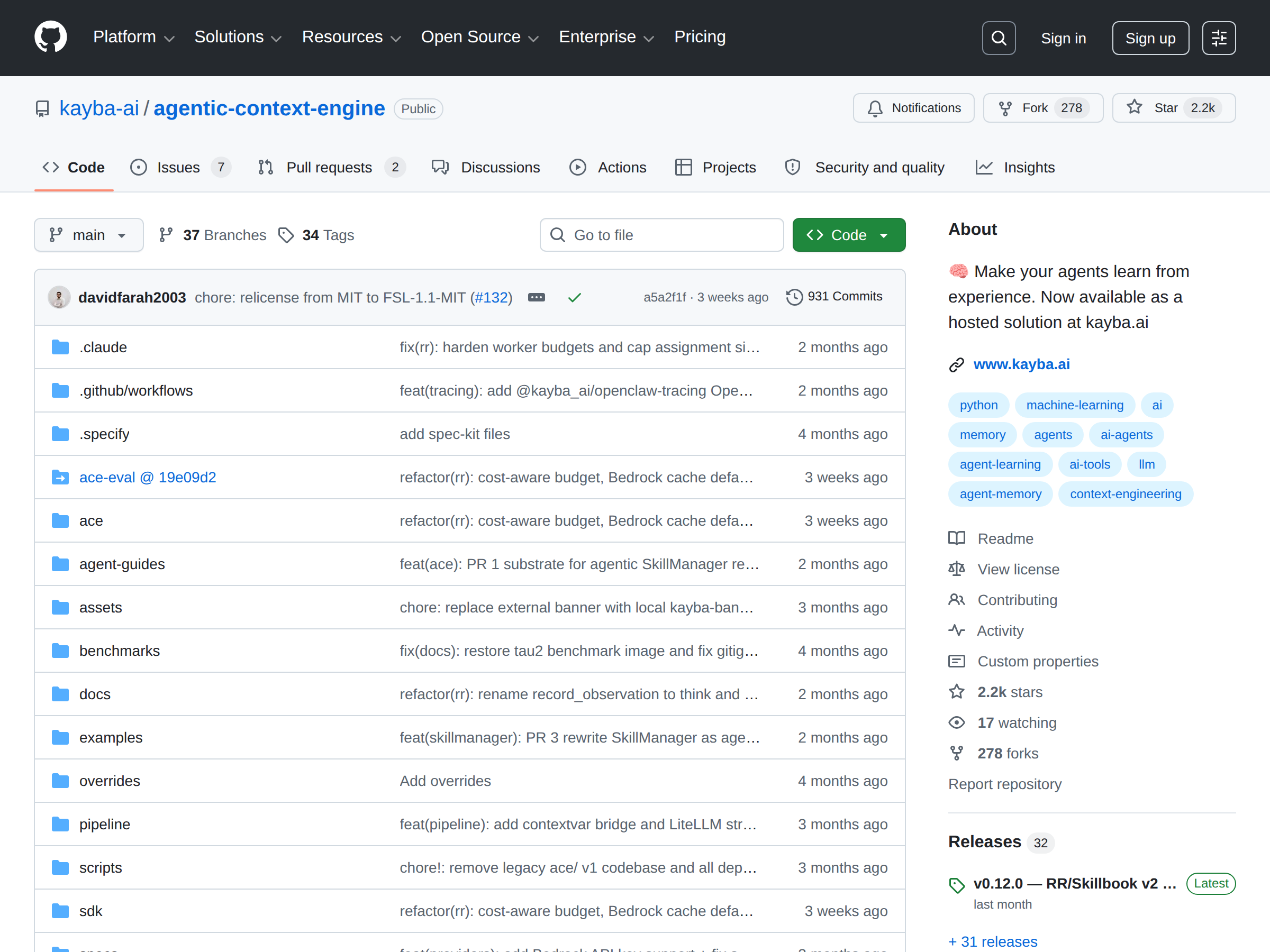
Screenshot of Agentic Context Engine
Agentic Context Engine
AI Agents Open Source

Agentic Context Engine is an open-source library for building self-improving AI agents that learn from execution feedback. It integrates with LangChain to enable agents to dynamically curate and refine their own context through iterative interaction with LLMs. The engine treats context as a living, evolving artifact that agents can expand, prune, and adjust based on past successes and failures. A key feature is its recursive reasoning architecture, allowing agents to break down complex tasks into subtasks and manage budgets for cost and calls. The system includes cost-aware token accounting, support for caching (e.g., Amazon Bedrock), and a tracing plugin for observability. The project aims to reduce the overhead of manual prompt engineering by letting agents discover and maintain their own effective reasoning patterns over time. Built in Python, the engine provides modular components for context retrieval, reflection, and multi-step reasoning.

Solves

Developers building autonomous AI agents often face challenges with context management: agents forget important details, repeat mistakes, and require extensive hand-crafted prompts to perform well on complex tasks. Agentic Context Engine addresses this by enabling agents to self-improve through feedback loops. It automatically curates relevant context from previous interactions, learns which strategies work, and adjusts its internal state to achieve better outcomes, thereby reducing the need for manual intervention and improving reliability over time.

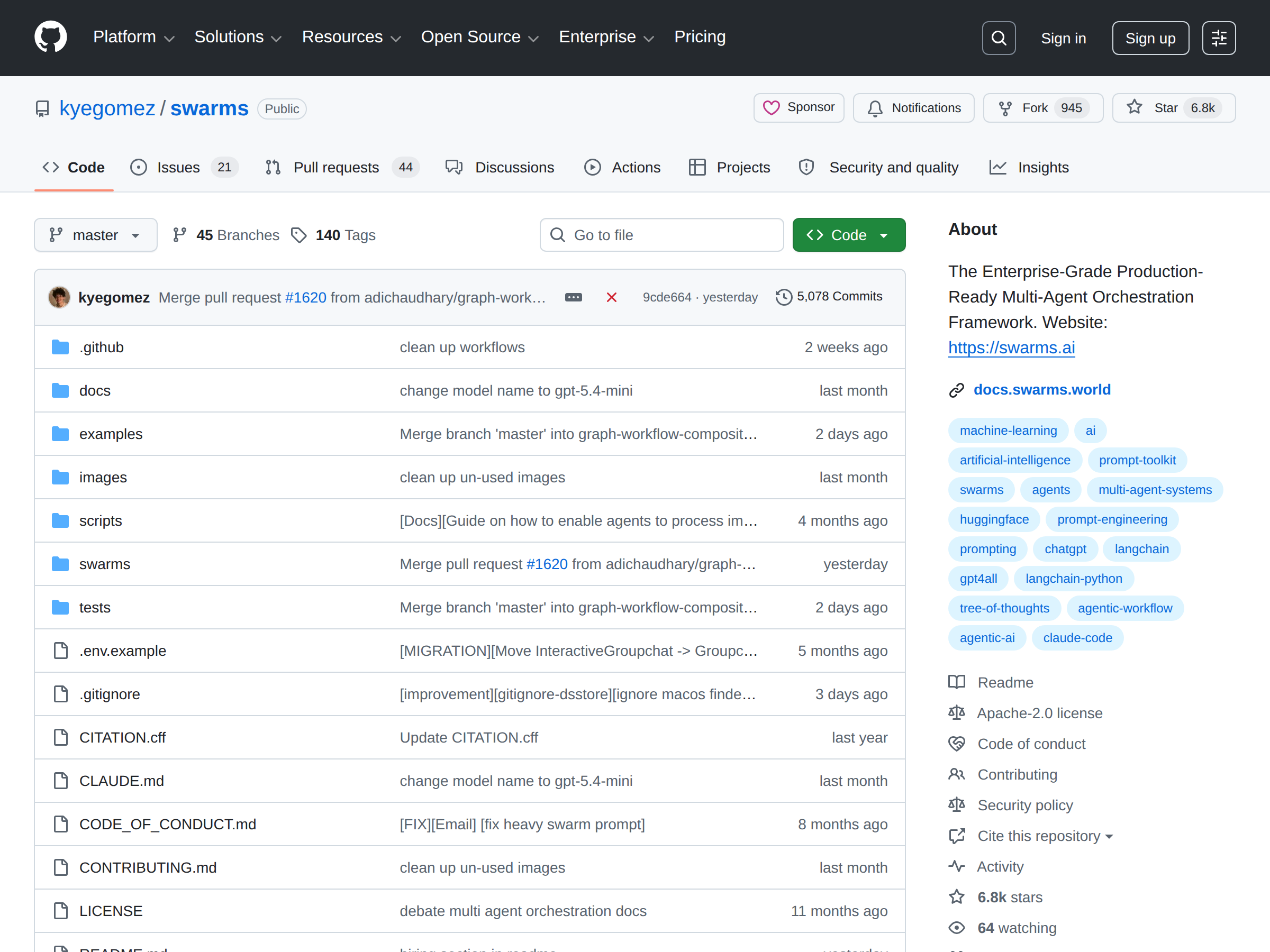
Screenshot of Swarms Framework
Swarms Framework
AI Agents Open Source

Swarms Framework is an open-source, bleeding-edge multi-agent orchestration framework designed for enterprise applications. It enables developers to create, manage, and coordinate swarms of AI agents that collaborate to solve complex tasks. The framework is built in Python and provides a flexible architecture for defining agent behaviors, communication protocols, and workflow logic. Key features include graph-based workflow composition, allowing users to design intricate agent interaction topologies. It supports sub-workflow composition, enabling modular and reusable agent pipelines. Agents can communicate via group chat mechanisms and process multimodal inputs, such as images encoded in base64. The framework integrates with state-of-the-art language models, including OpenAI's GPT series, to power agent reasoning and generation. Swarms is actively maintained with frequent contributions, as evidenced by thousands of commits and a growing community. It aims to provide enterprise-grade reliability and scalability, making it suitable for production deployments. The framework includes telemetry and monitoring capabilities to track agent performance and system health. With its emphasis on multi-agent orchestration, Swarms allows enterprises to automate workflows that require distributed problem-solving, adaptive reasoning, and parallel task execution. Its modular design supports both simple agent chains and complex hierarchical swarms, catering to a wide range of automation needs from research to customer-facing applications.

Solves

Many enterprise automation tasks are too complex for a single AI agent to handle effectively. They require coordination among multiple specialized agents, dynamic task allocation, and robust error handling. Swarms Framework solves this by providing a structured, programmable environment to define, deploy, and manage swarms of collaborative agents that can break down complex problems, work in parallel, and aggregate results, thereby increasing efficiency and accuracy in automated workflows.

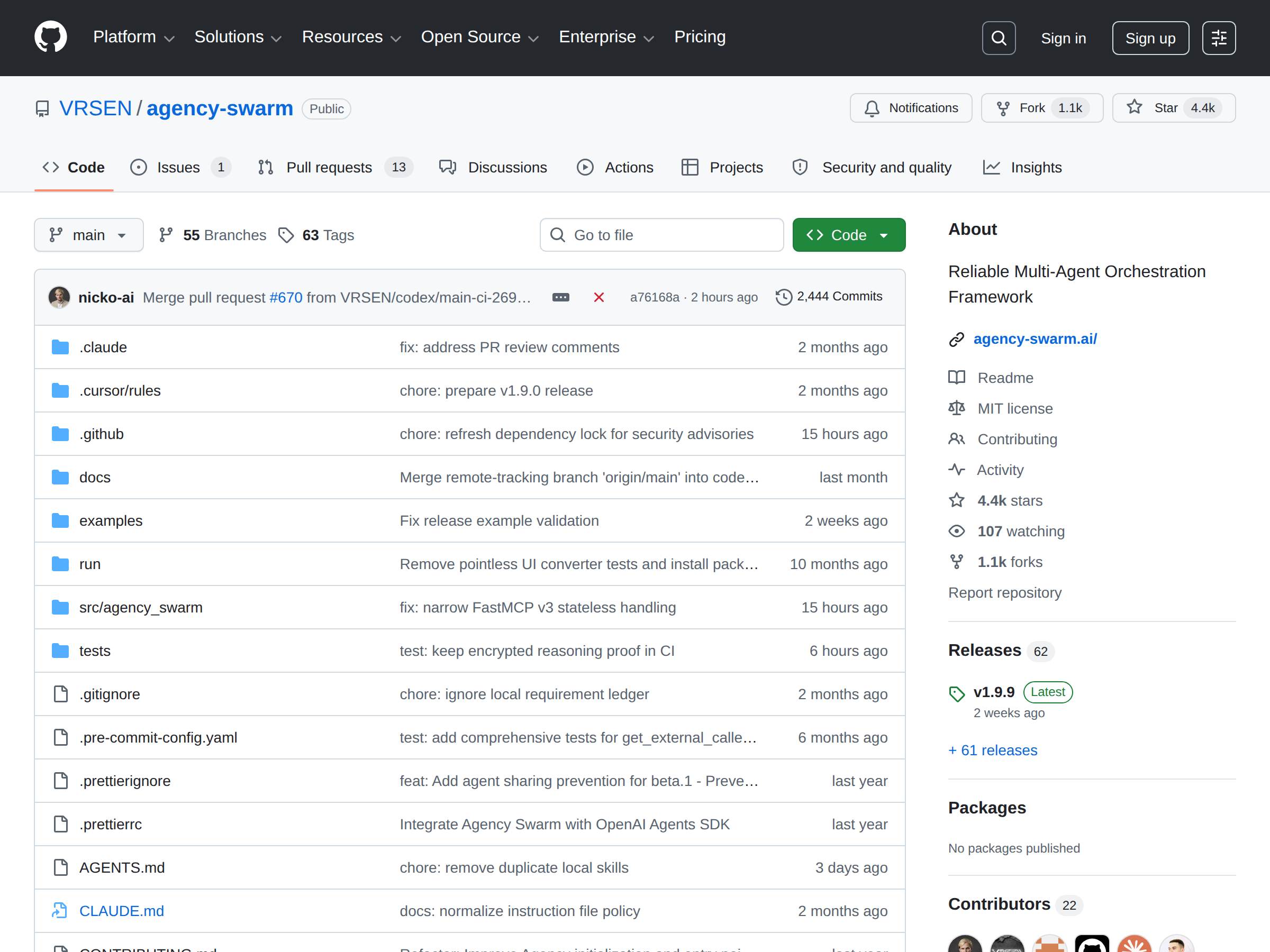
Screenshot of agency-swarm
agency-swarm
AI Agents Open Source

Agency Swarm is an open-source Python framework designed to simplify the creation of reliable AI agents using OpenAI's Assistants API. It provides a structured way to define agents with specific roles, capabilities, and tools, enabling seamless collaboration in multi-agent systems. Built with a focus on reliability and ease of use, Agency Swarm abstracts away the complexities of managing OpenAI API calls, state, and tool integrations, allowing developers to focus on agent logic. Key features include support for the latest OpenAI features like reasoning models, function calling, and code interpreter. The framework likely leverages FastMCP (Model Context Protocol) for stateless agent interactions, ensuring scalability and consistency. With a modular architecture, Agency Swarm can be extended with custom tools and integrations. The project is actively maintained, with frequent commits and a growing community. It provides examples and documentation to help users get started quickly. Developers can build complex agent workflows, from simple chatbots to sophisticated multi-agent systems for tasks like automation, data analysis, and content generation.

Solves

Developers often struggle to build robust AI agents that reliably interact with OpenAI's APIs, handle state, and coordinate multiple agents. Agency Swarm solves this by providing a battle-tested framework that handles the underlying API management, tool execution, and agent orchestration, enabling faster development of reliable agent-based applications.

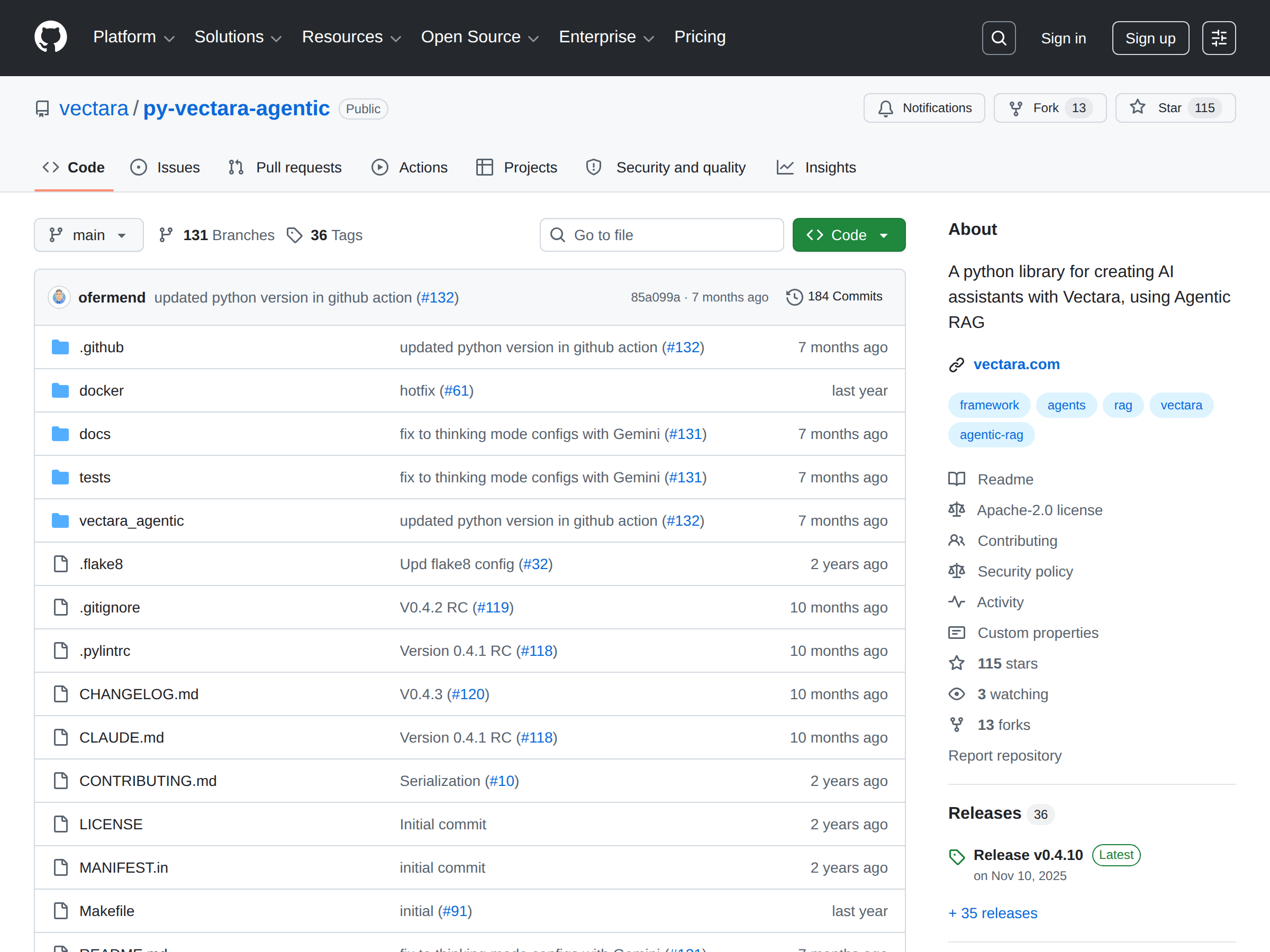
Screenshot of Vectara-agentic
Vectara-agentic
AI Agents Open Source

Vectara-agentic is an open-source Python framework designed to accelerate the development of AI assistants and autonomous agents powered by Vectara's retrieval augmented generation (RAG) platform. It provides high-level abstractions for building conversational agents that can retrieve relevant information from Vectara corpuses, generate accurate and grounded responses, and perform actions through tool integration. The framework leverages state-of-the-art language models and supports multi-turn interactions with memory, enabling sophisticated agent behaviors such as function calling, planning, and multi-step reasoning. With built-in support for Docker deployment and seamless integration with the Vectara API, developers can quickly prototype, test, and deploy agentic applications for a variety of use cases. Vectara-agentic abstracts away the complexities of retrieval and generation, allowing users to focus on defining agent logic and custom tools. It is built on top of popular libraries like LlamaIndex, providing flexibility in choosing LLM backends and customizing agent workflows.

Solves

Organizations struggle to build AI assistants that provide accurate, fact-based answers by grounding responses in their own data. Vectara-agentic solves this by providing a framework that tightly integrates with Vectara's RAG platform, ensuring that agents retrieve and use relevant, contextual information from ingested data to generate reliable, hallucination-reduced responses. This eliminates the need for complex pipeline engineering and enables rapid development of trustworthy AI assistants.

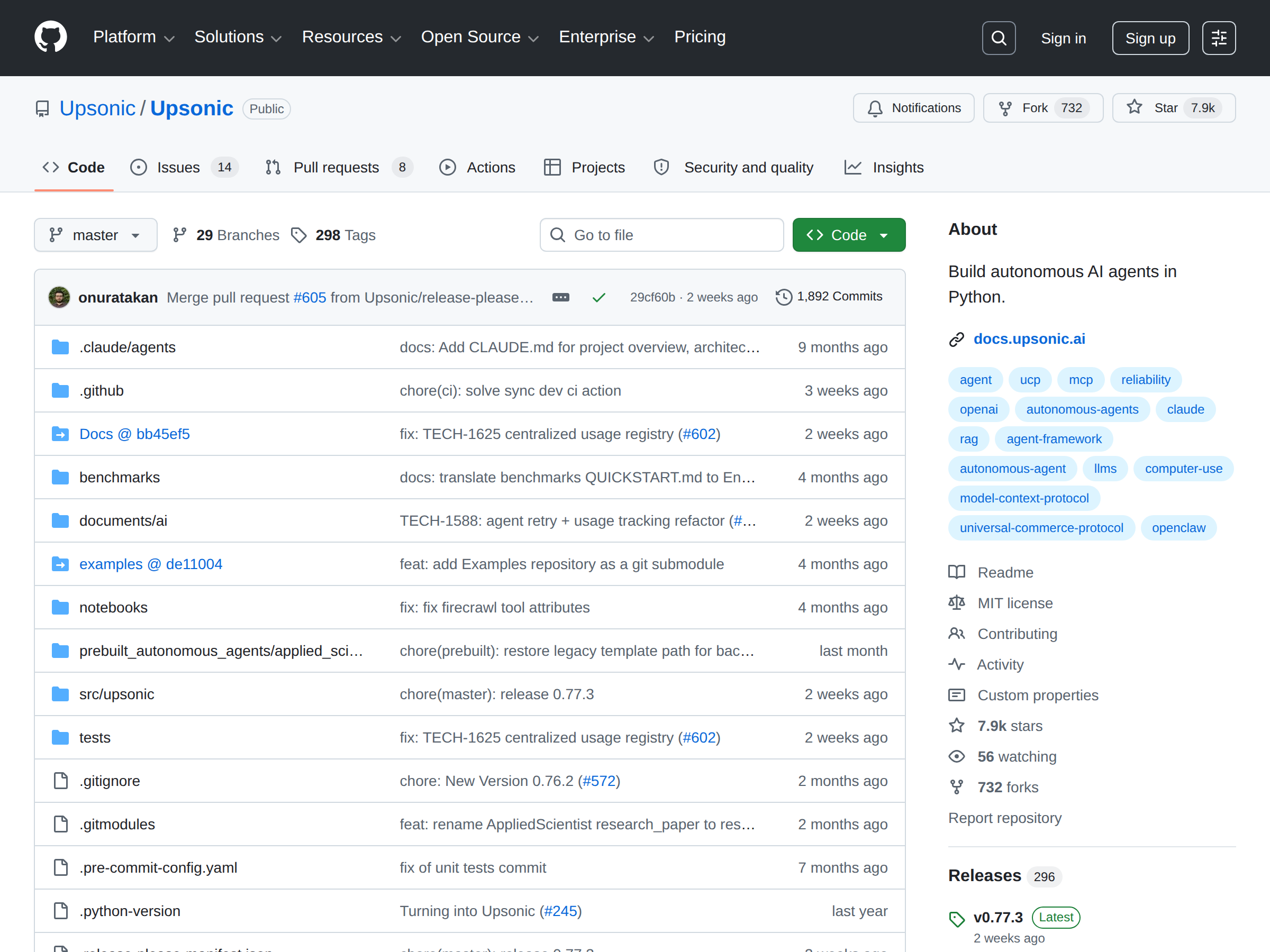
Screenshot of Upsonic
Upsonic
AI Agents Open Source

Upsonic is an open-source, reliable agent framework designed to simplify the creation and deployment of AI agents. It natively supports the Model Context Protocol (MCP), allowing agents to seamlessly integrate with external tools, APIs, and data sources. The framework is likely built in Python and provides abstractions for defining agent behaviors, managing context, and ensuring robust execution even in dynamic environments. Key features may include modular agent architectures, built-in error handling, retry mechanisms, and benchmarking tools to evaluate agent performance. Upsonic appears to target developers and ML engineers who need a production-ready foundation for building autonomous or semi-autonomous AI systems, with a focus on reliability and MCP compatibility.

Solves

Developers building AI agents often struggle with ensuring consistent and reliable behavior when connecting to external tools. Agents can fail due to tool errors, context corruption, or unpredictable model outputs. Upsonic addresses this by offering a framework that handles MCP integration out-of-the-box, providing reliability features such as transactional tool execution, state management, and standardized interfaces. This reduces development time and increases agent trustworthiness, making it suitable for production use cases where failure is costly.

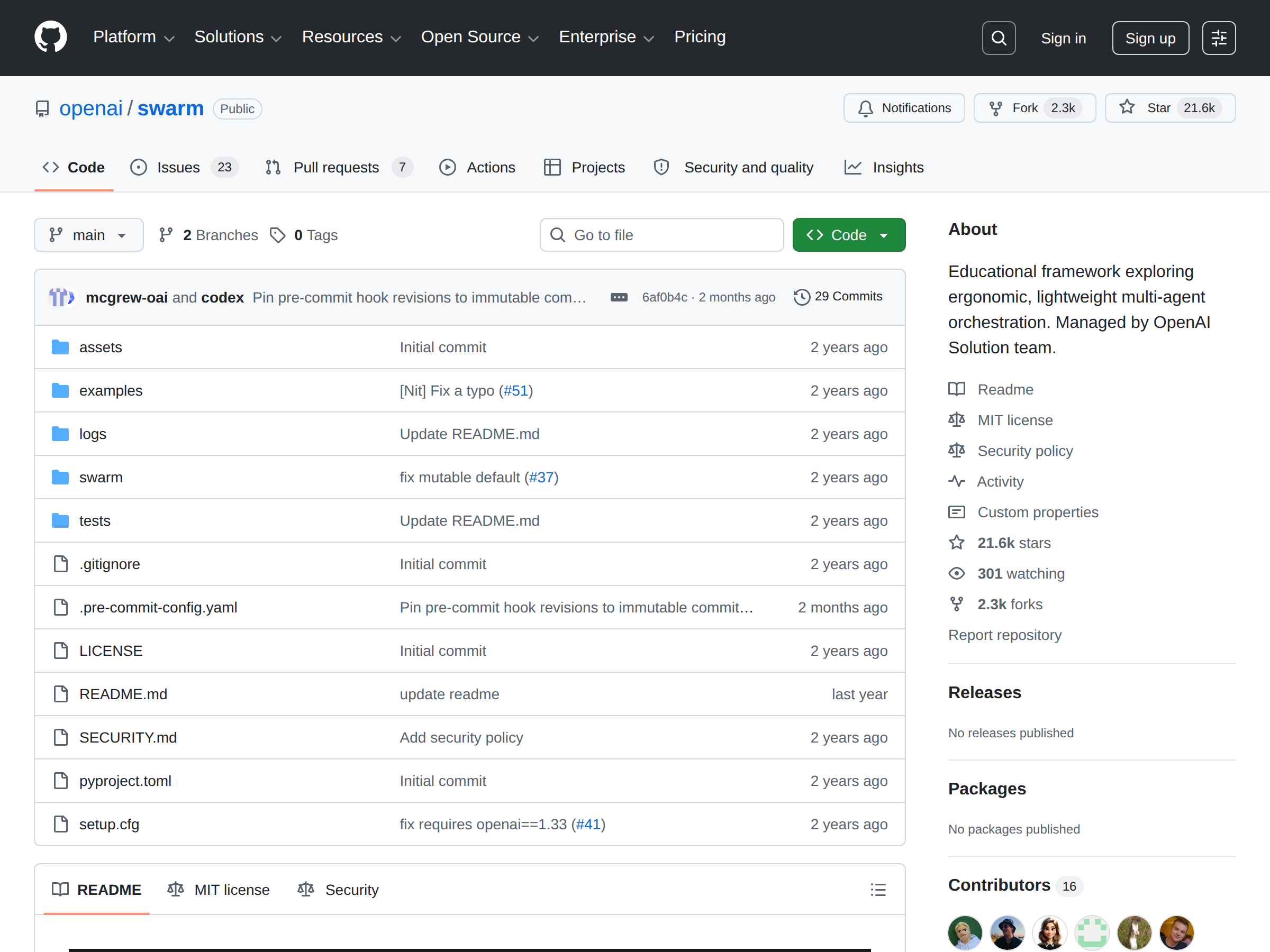
Screenshot of Swarm
Swarm
AI Agents Open Source

Swarm is an educational framework developed by OpenAI that explores ergonomic, lightweight multi-agent orchestration. It is designed to be a minimal and easy-to-understand reference for developers learning about agent coordination patterns. The framework introduces core concepts such as agents with specific instructions and the ability to hand off conversations to other agents, enabling complex task delegation in a simple manner. Swarm leverages OpenAI's chat completions API to power its agents and emphasizes readability and hackability over production readiness. At its core, Swarm provides a small set of abstractions: Agent and Swarm. An Agent encapsulates a persona and a set of functions it can call, while Swarm orchestrates the flow of messages and handoffs between agents. Context variables can be passed and updated across agents, allowing for stateful interactions. The framework also supports function calling, where agents can invoke external tools or APIs to accomplish tasks. Swarm's examples illustrate common scenarios such as triage-based customer support, where a frontline agent determines the nature of a request and hands off to a specialized agent (e.g., billing, technical support). Swarm is implemented in Python and distributed as a pip-installable package. The codebase is intentionally concise, with the core logic contained in a single file, making it suitable for study and experimentation. It is not intended for production use and lacks features such as persistence, monitoring, or robust error handling. Instead, it serves as a learning tool and a starting point for developers who want to build their own multi-agent systems. The framework has gained significant attention in the AI community, as evidenced by its GitHub popularity, and has sparked discussions about agent design patterns. It encourages a compositional approach to building agent systems, where complex behaviors emerge from simple, well-defined agent interactions. While Swarm itself is not a comprehensive agent platform, its design principles have influenced other tools and frameworks in the multi-agent space.

Solves

Developers and researchers exploring multi-agent orchestration often struggle with the complexity of existing frameworks, which can obscure fundamental patterns with heavy abstractions. Swarm solves this by providing a minimal, educational codebase that clearly demonstrates core concepts like agent handoffs, context management, and function calling. It allows learners to rapidly prototype and understand how agents can collaborate without the overhead of production-oriented systems.

Screenshot of AgentScope
AgentScope
AI Agents Open Source

AgentScope is an open-source framework designed to streamline the development of LLM-empowered multi-agent applications. It offers developers a structured environment to define, manage, and orchestrate multiple AI agents that can collaborate, communicate, and perform complex tasks. The framework abstracts away the low-level details of agent interaction, enabling rapid prototyping and deployment of multi-agent systems. With a focus on flexibility and ease of use, AgentScope supports various agent architectures and integration with popular large language models, making it suitable for a wide range of applications from conversational AI to automated problem-solving. At its core, AgentScope provides modular building blocks for agent definition, including roles, memories, and action spaces. Agents can be configured with specific capabilities and personalities, and the framework handles message passing, task delegation, and state management. It likely includes built-in support for common communication patterns such as round-robin discussions, hierarchical task allocation, and debate-style interactions. The framework's design emphasizes scalability, allowing users to run thousands of agents in simulation environments. Developers can leverage AgentScope's extensible architecture to integrate external tools, APIs, and data sources, enabling agents to perform real-world tasks like web search, code execution, or database queries. The project is actively maintained with a growing community, offering examples and documentation to help newcomers get started quickly. AgentScope aims to lower the barrier to entry for building sophisticated multi-agent AI systems, empowering both researchers and practitioners to experiment with advanced agent-based AI.

Solves

Building applications that require multiple LLM-based agents to work together is challenging due to the complexity of coordinating interactions, managing shared state, and ensuring coherent behavior. AgentScope solves this problem by providing a ready-made framework that encapsulates multi-agent coordination logic, allowing developers to focus on defining agent roles and objectives rather than the underlying plumbing. It reduces the time and expertise needed to create robust multi-agent systems, making them accessible to a broader developer audience.

Screenshot of Maestro
Maestro
AI Agents Open Source

Maestro is an open-source Python framework designed to orchestrate AI sub-agents for complex task completion. It leverages large language models (LLMs) such as Anthropic's Claude Opus, Claude 3.5 Sonnet, OpenAI's GPT models, and even local models via Ollama or LM Studio to break down an overarching objective into smaller, manageable sub-tasks. The framework employs a multi-model approach: a powerful 'orchestrator' model (like Opus) handles task decomposition and coordination, while a faster, cost-effective 'executor' model (like Haiku) carries out each sub-task. This division of labor optimizes both performance and cost. The core workflow involves defining an objective, whereupon Maestro automatically generates a plan with sub-tasks, executes them sequentially, and iteratively refines the results. It maintains context across sub-tasks, allowing for coherent, multi-step reasoning. The system includes features like file management for storing intermediate outputs, automatic retries for failed tasks, and the ability to resume from previous checkpoints. Additionally, Maestro offers a Flask-based web interface for interactive use, making it accessible to both developers and non-technical users. Key features include support for various LLM backends through a unified interface, enabling users to switch between models based on their needs and budget. The framework is designed to be extensible, allowing custom sub-agents or task-specific behaviors. It also includes practical scripts for popular configurations, such as maestro.py for basic usage, maestro-anyapi.py for a generic API setup, and specific variants for Groq, GPT-4o, Ollama, and LM Studio. This versatility makes Maestro a flexible tool for AI-assisted automation across different environments. By orchestrating sub-agents, Maestro is particularly useful for tasks that require multiple steps, such as research synthesis, code generation with multiple files, data analysis pipelines, or complex decision-making processes. Its open-source nature encourages community contributions and customization, making it a valuable addition to the growing ecosystem of AI agent frameworks.

Solves

Users often face challenges in breaking down complex objectives into smaller tasks and coordinating multiple AI invocations to achieve a coherent result. Maestro solves this by providing an automated orchestration layer that decomposes objectives, distributes sub-tasks to appropriate AI models, and synthesizes outputs, thereby enabling efficient and scalable AI-driven task completion without manual intervention.

Screenshot of AG2
AG2
AI Agents Open Source

AG2 is an open-source programming framework for building AI agents and orchestrating multi-agent collaboration to solve complex tasks. Originally created by the team behind Microsoft's AutoGen, AG2 provides a flexible and modular architecture that allows developers to define agents with distinct roles, capabilities, and language model backends. These agents can engage in structured conversations, follow predefined workflows, or dynamically adapt to task requirements. The framework supports a variety of conversation patterns, including two-agent chats, sequential task execution, and group chats where multiple agents contribute. It includes built-in mechanisms for human-in-the-loop interaction, allowing human feedback to guide agent behavior at critical points. AG2 also enables agents to generate and execute code, make API calls, and use external tools, making it suitable for automation of coding tasks, data analysis, and research workflows. AG2 is designed to be provider-agnostic, integrating with a wide range of LLM providers such as OpenAI, Anthropic, Google, and open-source models via local APIs. It emphasizes ease of use through a Pythonic API and comes with extensive documentation, example notebooks, and community contributions to accelerate development.

Solves

Building applications that require multiple AI agents to cooperate, reason, and act together is challenging due to the need for coordination, state management, and integration with tools. AG2 solves this by providing a high-level programming framework that abstracts conversation flow, agent memory, and tool use, enabling developers to rapidly prototype and deploy collaborative multi-agent systems without reinventing low-level orchestration logic.

Screenshot of Agent-LLM
Agent-LLM
AI Agents Open Source

AGiXT is an open-source artificial intelligence automation platform designed to streamline the creation, orchestration, and management of AI agents. It provides a flexible environment where developers and businesses can build autonomous agents capable of performing complex workflows by leveraging large language models (LLMs). The platform includes a user-friendly web interface for configuring agents, managing knowledge bases, and monitoring agent activities. Under the hood, AGiXT offers a modular architecture that supports multiple LLM backends, allowing users to switch between different AI models based on their needs. Additionally, it features a plugin system for extending functionality, enabling integration with various APIs, tools, and data sources. The platform is self-hosted, giving users full control over their data and deployment environment.

Solves

Businesses and developers often struggle to integrate multiple AI services and automate complex workflows. AGiXT solves this by providing a unified platform to build, deploy, and manage AI agents that can handle tasks across different systems without needing deep AI expertise.

Screenshot of Botpress
Botpress
AI Agents Open Source

Botpress is an open-source conversational AI platform that provides a comprehensive set of tools for building, deploying, and managing intelligent chatbots and virtual assistants. At its core, Botpress features a visual conversation builder that enables developers to design complex conversational flows using a drag-and-drop interface, making it accessible while still allowing deep customization through code. The platform incorporates built-in natural language understanding (NLU) capabilities to interpret user intents and extract entities, supporting multiple languages and continuous improvement via a dedicated training interface. Botpress is designed with a modular architecture, allowing developers to extend functionality through hooks, custom modules, and integrations. It supports a wide range of messaging channels out-of-the-box, including Slack, WhatsApp, Messenger, and Telegram, as well as custom APIs for web and mobile applications. The platform runs on Node.js and is fully self-hostable, giving organizations complete control over data and infrastructure. A command-line interface (CLI) and REST API facilitate automation and DevOps workflows for bot lifecycle management. The community edition is entirely open-source under the AGPL-3.0 license, fostering a rich ecosystem of contributed modules and integrations. Botpress also offers an enterprise version with additional features such as role-based access control, analytics, and dedicated support. Recent development activity includes enhancements to the CLI, integration versioning, and CI/CD pipeline improvements, indicating an actively maintained project with a growing user base (14.7k GitHub stars). For AI agent builders, Botpress serves as a robust foundation, combining deterministic flow logic with machine learning-powered NLU. Its flexible architecture allows for the integration of external AI services, custom code in JavaScript/TypeScript, and the implementation of complex business logic. Whether creating a simple FAQ bot or a multi-step transactional assistant, Botpress provides the scaffolding to accelerate development while maintaining full control over the bot's behavior and data.

Solves

Organizations and developers face the challenge of building conversational interfaces that are both intelligent and maintainable without reinventing the wheel. Botpress solves this by offering a self-contained platform that handles the core complexities of chatbot development—natural language understanding, conversation state management, and multi-channel routing. It allows teams to quickly prototype and deploy bots while providing the extensibility needed for custom integrations and sophisticated dialogue logic, effectively bridging the gap between simple rule-based systems and expensive proprietary solutions.

Screenshot of LLM Agents
LLM Agents
AI Agents Open Source

LLM Agents is a small Python library designed for building agents that are controlled by large language models (LLMs). It provides a minimal and clear implementation of the core agent loop, making it easy to understand how such agents work under the hood. The library is heavily inspired by LangChain but focuses on simplicity and brevity, with the entire agent logic contained in very few lines of code. The agent operates by following a cycle of `Thought`, `Action`, `Observation`, `Thought`, and so on. At each step, the LLM generates a thought about what to do next and selects an action along with its input. The chosen tool then executes that action, and the resulting observation is fed back into the LLM for the next iteration. This loop continues until the agent has enough information to produce a final answer. Currently implemented tools include a Python REPL for executing code, Google Search, and Hacker News search, with the ability to easily add custom tools. Key features include an easy-to-extend tool system, support for OpenAI's API (requires an API key), and a straightforward installation process. The library is intended for educational purposes, prototyping, and as a foundation for understanding agent-based architectures. It demonstrates how an LLM can autonomously decide which tools to use and in what order to accomplish a given task, serving as a hands-on introduction to the concept of AI agents.

Solves

Developers and researchers who want to learn about or experiment with LLM-driven agents often face the complexity of full-featured frameworks like LangChain, which can be daunting for understanding the fundamental principles. LLM Agents solves this by providing a minimalist, readable codebase that distills the essential components of an agent into a tiny library. This allows users to grasp how an agent decides on actions, uses tools, and iteratively refines its knowledge without getting lost in abstractions.

Screenshot of OpenClaw
OpenClaw
AI Agents Open Source

OpenClaw is an open-source AI agent framework designed to transform large language models (LLMs) into persistent, proactive personal AI agents. It provides a comprehensive infrastructure that enables developers to build agents capable of maintaining long-running conversations, remembering context across interactions, and executing scheduled tasks autonomously. The framework stands out by offering native integrations with multiple messaging platforms—including Signal, Telegram, Discord, and WhatsApp—allowing a single agent to communicate seamlessly across different channels. This multi-channel capability ensures users can interact with their personal AI assistant wherever they prefer, without managing separate bots. At its core, OpenClaw focuses on persistence and proactivity. Unlike many LLM-based tools that operate in a stateless, request-response mode, OpenClaw agents retain conversational memory over time, learning from past exchanges to provide more coherent and personalized responses. The built-in cron scheduling system enables agents to perform routine tasks automatically, such as fetching daily news, sending reminders, or generating reports, without manual triggers. This transforms the agent from a passive responder into an active digital companion that anticipates needs and executes background jobs on a defined timetable. The framework is designed with modularity and extensibility in mind. It supports integration with external services and data sources through MCP (Model Context Protocol), a standard for connecting AI models to real-world tools and APIs. This allows agents to retrieve live information, manipulate data, and execute actions beyond simple text generation. OpenClaw's memory systems are configurable, supporting both short-term and long-term storage backends, enabling agents to recall user preferences, past decisions, and contextual details across sessions. The framework likely provides a plugin architecture, making it straightforward for developers to add custom functionalities or connect to new LLM providers. As an open-source project hosted on GitHub (with a strong community of contributors and stargazers), OpenClaw empowers developers to deploy self-hosted AI agents with full control over data privacy and operational costs. It is particularly suited for hobbyists and professionals who want to build personalized automation assistants, multi-channel customer engagement bots, or experimental agents that combine scheduled intelligence with natural conversation. The framework abstracts away much of the boilerplate needed for stateful agent development, accelerating the path from idea to deployment.

Solves

Many LLM-powered applications are limited to single-turn interactions or short-lived conversations, lacking the ability to remember context over days or weeks and requiring users to manually invoke them. OpenClaw solves this by providing a framework for building persistent, proactive AI agents that maintain memory across sessions, schedule tasks via cron, and communicate across multiple messaging platforms. This turns a basic LLM into a long-term personal assistant that can autonomously handle reminders, data monitoring, and routine reporting, reducing the cognitive load on users who would otherwise juggle multiple disjointed tools.

Screenshot of the-momentum/apple-health-mcp-server
the-momentum/apple-health-mcp-server
Developer Tools Open Source

Apple Health MCP Server is a Python-based Model Context Protocol (MCP) server that allows AI assistants and applications to securely access and analyze personal health data exported from Apple Health. The server ingests the XML export file generated by the Apple Health app, parses it, and imports the data into a local DuckDB database—an efficient in-process analytical database. This structured database contains three tables representing different health record types (such as quantity samples, category samples, and workouts), enabling fast SQL-based querying and analytics. Once the server is running, it exposes a set of MCP tools that AI models (like those in Claude or any MCP client) can invoke to list available health data types, query specific metrics (e.g., daily steps, heart rate, sleep duration), perform statistical aggregations, and retrieve workout details. The server is designed to be self-hosted, ensuring that sensitive health information remains entirely under the user's control—data never leaves the local machine. It runs cross-platform on macOS, Windows, and Linux. The project includes a robust import pipeline that handles large XML exports efficiently. Configuration options allow users to specify the DuckDB database file location and other parameters. Recent updates have switched from Parquet-based storage to a native DuckDB file, improving query performance and simplifying the architecture. The server is part of the growing ecosystem of MCP-enabled tools, making it easy to integrate personal health data into AI workflows for personalized insights, trend analysis, and conversational health coaching. Apple Health MCP Server is an open-source project with an active development community. It is distributed under an open-source license and has gained moderate popularity with 203 GitHub stars at the time of scraping.

Solves

Apple Health collects a wealth of personal wellness data, but exporting and analyzing that data programmatically is cumbersome. Users who want to query their health history, generate reports, or integrate it with AI assistants face the challenge of parsing the verbose XML export file and structuring it into a queryable format. This MCP server solves that problem by automating the import process, providing a simple interface for AI models to retrieve and analyze health metrics. It enables privacy-preserving, on-device health data analytics that can be invoked conversationally via any MCP-compatible client.

Screenshot of LlamaIndex
LlamaIndex
AI Agents Open Source

LlamaIndex is an open-source data framework designed to connect large language models (LLMs) with external data sources. It provides a central interface for ingesting, indexing, and querying data, enabling developers to build retrieval-augmented generation (RAG) applications and other LLM-powered systems that require access to private or domain-specific information. The framework abstracts away the complexities of data loading, transformation, and storage, supporting a wide range of data types including documents, databases, APIs, and more. At its core, LlamaIndex offers a flexible indexing system that converts raw data into structured representations optimized for LLM consumption. It includes various index types such as vector store indices, tree indices, and keyword indices, allowing developers to choose the most suitable retrieval strategy for their use case. The query engine then leverages these indices to retrieve relevant context and generate accurate, context-aware responses. LlamaIndex also provides advanced features like composable data connectors, built-in caching, and callbacks for observability. With its modular architecture, LlamaIndex supports seamless integration with popular LLMs, vector databases, and embedding providers. It offers both a high-level API for quick prototyping and a low-level API for fine-grained control. The framework also includes components for building more complex agents that can perform multi-step reasoning, tool use, and decision-making. LlamaIndex's extensive plugin ecosystem allows users to extend functionality and connect to virtually any data source or service. LlamaIndex is actively maintained by a vibrant open-source community and has become a foundational tool for developers building production-ready LLM applications. Its comprehensive documentation, examples, and integrations make it accessible for newcomers while offering the depth required for advanced customization. As of 2026, LlamaIndex continues to evolve with frequent updates and new features.

Solves

Developers and data scientists often face the challenge of leveraging large language models (LLMs) to work with proprietary or specialized data beyond the models' training sets. Without a dedicated framework, ingesting, indexing, and querying such data requires significant custom engineering. LlamaIndex solves this problem by providing a unified, extensible toolkit that simplifies the entire pipeline—from data loading and transformation to indexing and retrieval—allowing LLMs to access and reason over external data efficiently.

Screenshot of longevity-genie/synergy-age-mcp
longevity-genie/synergy-age-mcp
Developer Tools Open Source

The SynergyAge MCP server is a specialized implementation of the Model Context Protocol (MCP) that provides AI assistants with structured access to the SynergyAge database, a curated repository of synergistic and antagonistic genetic interactions related to longevity and aging. By acting as a bridge between large language models and the SynergyAge dataset, the server enables AI-driven workflows in biogerontology, allowing researchers to query, analyze, and combine information on how gene pairs influence lifespan across different organisms. Built primarily in Python, the server exposes a set of MCP tools and resources that encapsulate database querying, data retrieval, and metadata lookup. Through standard MCP transports (like stdio), it integrates seamlessly with compatible AI clients such as Claude Desktop or other MCP-enabled assistants. The server reads from a locally packaged or remotely accessible version of the SynergyAge data, ensuring that AI models can answer precise questions about gene-gene interactions without requiring users to manually navigate web interfaces or raw data files. Key features include parameterized search for interactions by gene symbol or identifier, retrieval of interaction types (synergistic or antagonistic), effect magnitudes, experimental evidence, and species context. The server also supports returning structured JSON responses that AI models can parse and reason about, facilitating complex queries such as 'Find all genes that synergistically interact with SIRT1 to extend lifespan in yeast.' Configuration is straightforward via environment variables or JSON config files, and the codebase includes tests and example workflows for developers. As an open-source project under the longevity-genie umbrella, the SynergyAge MCP server aims to lower the barrier for AI-augmented longevity research, making specialized biological knowledge instantly queryable through natural language. Its modular design allows extension to other aging-related datasets in the future.

Solves

Biogerontology researchers and AI developers face significant friction when integrating curated genetic interaction data into computational workflows. The SynergyAge database contains valuable structured information on hundreds of gene pairs that influence lifespan, but querying it typically involves manual web searches or custom API scripting. This MCP server solves that problem by exposing the entire SynergyAge dataset through a standardized AI interface, allowing users to pose natural language questions and receive immediate, evidence-backed answers about gene interactions, effect sizes, and species specificity, thereby accelerating aging research and hypothesis generation.

Screenshot of hlydecker/ucsc-genome-mcp
hlydecker/ucsc-genome-mcp
Developer Tools Open Source

The UCSC Genome Browser MCP Server is a Model Context Protocol (MCP) server that provides comprehensive programmatic access to the UCSC Genome Browser API. Designed for integration with large language model (LLM) applications, it enables AI assistants to query genomic data, DNA sequences, annotation tracks, and metadata directly from the authoritative UCSC Genome Browser. The server exposes 12 tools organized into two categories. Discovery tools include finding genomes by keyword or accession, listing public hubs, listing UCSC database genomes, GenArk assembly hub genomes, hub-specific genomes, downloadable files, data tracks, chromosomes, and track schema. Data retrieval tools allow users to retrieve DNA sequences for specified genomic coordinates, get track data such as genes and variants, and search within genome assemblies. Built with Python 3.10+ and requiring only the MCP SDK and httpx, the server can be installed via pip. It communicates over standard input/output, following the MCP specification, allowing seamless integration with any MCP-compatible LLM host like Claude Desktop. A configuration example is provided for easy setup. By abstracting the complex UCSC API behind simple tool calls, this MCP server empowers developers and researchers to build chat-based genomic assistants, automate bioinformatics queries, and enhance AI-driven data analysis pipelines without deep knowledge of the underlying REST API.

Solves

Bioinformatics researchers and developers often need to access genomic data from the UCSC Genome Browser, but integrating such data into modern AI/LLM workflows is challenging due to complex REST APIs and the lack of standardized interfaces. The UCSC Genome Browser MCP Server solves this by implementing the Model Context Protocol, allowing LLMs to easily discover and retrieve genomic information through a set of intuitive tools, thereby bridging the gap between large-scale genomic databases and AI-powered applications.

Screenshot of JamesANZ/medical-mcp
JamesANZ/medical-mcp
Developer Tools Open Source

JamesANZ/medical-mcp is a Model Context Protocol (MCP) server that provides AI assistants with direct access to authoritative medical information. Running entirely locally, it bridges the gap between AI coding environments like Cursor and Claude Desktop, and trusted medical data sources including FDA, WHO, PubMed, RxNorm, Google Scholar, AAP, and pediatric journals. The server requires no API keys, no cloud storage, and no external logging, ensuring complete privacy and data sovereignty. With this MCP server, developers can integrate comprehensive drug information, health statistics, medical literature, clinical guidelines, and pediatric resources into their AI workflows. It supports queries for drug interactions, FDA labels, PubMed articles, and more, all through a simple local interface. The installation is streamlined: one-click setup in Cursor or a quick manual configuration, lowering the barrier for non-experts to leverage medical data. The server is built with TypeScript and distributed via npm, making it lightweight and cross-platform. It leverages the MCP standard to expose tools that AI models can call, enabling dynamic retrieval of up-to-date medical knowledge during conversations. By keeping all data processing local, it addresses compliance concerns common in healthcare applications. JamesANZ/medical-mcp is open source and community-driven, with active maintenance and contributions. It is part of a growing ecosystem of MCP servers that extend AI capabilities into specialized domains, and it is designed to be extensible for additional medical APIs and custom needs.

Solves

AI assistants often lack access to specialized, authoritative medical data, forcing developers to manually integrate APIs, manage API keys, and worry about data privacy. This MCP server solves that by providing a drop-in, local-only bridge between AI models and curated medical sources. It enables healthcare developers, researchers, and clinicians to safely query drug information, medical literature, and guidelines without external dependencies or privacy risks.

Screenshot of longevity-genie/biothings-mcp
longevity-genie/biothings-mcp
Developer Tools Open Source

BioThings MCP is an open-source MCP (Model Context Protocol) server that bridges AI agents and the BioThings API, a comprehensive aggregator of biological knowledge. The server exposes a set of tools that allow AI models, such as large language models, to query structured biological data directly from their conversation or automation context. By implementing the MCP standard, it provides a uniform way for AI clients like Claude Desktop, Cursor, or any MCP-compatible application to access up-to-date information on genes, genetic variants, drugs, and taxonomic classifications. The underlying BioThings API normalizes data from multiple authoritative sources, including NCBI, UniProt, DrugBank, and more, ensuring that the AI receives high-quality, integrated data without needing to handle raw API calls or data transformations. The server is built in Python and supports quick deployment via Docker or direct installation, making it accessible for both local research environments and cloud-based AI infrastructure. It includes ready-to-use configurations for common MCP clients, enabling immediate integration into AI workflows for bioinformatics, personalized medicine, and scientific research.

Solves

Bioinformaticians, computational biologists, and AI developers often struggle to provide AI models with reliable, structured access to biological databases. Each data source has its own API, terminology, and data format, forcing developers to write custom integrations and parsers. BioThings MCP solves this by offering a single, standardized MCP server that translates AI-friendly queries into BioThings API calls and returns structured, annotated biological data. This allows AI agents to seamlessly reason about genes, variants, drugs, and taxonomy without the overhead of manual data wrangling, accelerating the development of intelligent tools for genomics, drug discovery, and research automation.

Screenshot of longevity-genie/gget-mcp
longevity-genie/gget-mcp
Developer Tools Open Source

gget-mcp is an MCP (Model Context Protocol) server that wraps the popular gget bioinformatics library, enabling AI assistants to perform a wide range of genomics queries and analyses. By exposing gget’s functions as MCP tools, it allows language models to fetch gene sequences, retrieve protein structures, search for orthologs, perform BLAST searches, and query multiple genomic databases—all through natural language prompts. The tool bridges the gap between AI-driven conversations and real-world genomic data, making bioinformatics more accessible to researchers and developers who can integrate it into their workflows with minimal setup. The server is built in Python and can be installed via pip. It runs locally or in a container, exposing a standardized API that AI clients like Claude or other MCP-compatible applications can consume. Configuration is straightforward using environment variables or JSON config files, and the project includes examples and tests to help users get started quickly. The tool relies on the underlying gget library, which itself provides a unified interface to over 20 genomic databases including Ensembl, UniProt, NCBI, and others. Key features include the ability to search genes by symbol or ID, fetch protein sequences and structures, retrieve genomic coordinates, find variations, and analyze phylogenetic relationships. By wrapping these into a consistent MCP tool interface, gget-mcp allows AI to answer complex biological questions such as 'What are the homologs of BRCA1 in mouse?' or 'Fetch the protein structure for TP53' and integrate the results directly into the conversation. This opens up possibilities for assisted research, educational applications, and automated bioinformatics pipelines. As an open-source project (MIT license), gget-mcp encourages community contributions and can be extended to cover more gget modules or customized for specific research needs. While still in early development, it has garnered interest from the bioinformatics and MCP communities and is listed in curated collections of MCP servers.

Solves

Bioinformatics researchers and developers often need to query multiple genomic databases using various APIs, each with its own syntax and access method. This fragmentation slows down analysis and increases the learning curve. Additionally, AI-powered assistants like Claude cannot natively interact with bioinformatics data sources. gget-mcp solves this by wrapping the gget library’s unified interface to genomic databases into a standardized MCP server. This allows AI to perform complex genomics queries directly from natural language, reducing the need for manual scripting and enabling seamless integration of bioinformatics into conversational AI workflows.

Screenshot of dnaerys/onekgpd-mcp
dnaerys/onekgpd-mcp
Developer Tools Open Source

The 1000 Genomes Project Dataset MCP Server provides a bridging interface between large language models (LLMs) and the extensive genomic data of the 1000 Genomes Project. Hosted on the Dnaerys variant store, this server implements the Model Context Protocol (MCP) to enable AI assistants to query and retrieve genetic variations, allele frequencies, population statistics, and other related information in real time using natural language. Developed in Java and packaged for easy deployment via Docker, it allows any MCP-compatible client (such as Claude) to seamlessly access and interpret complex genomic datasets without requiring deep bioinformatics expertise. The server exposes a set of MCP tools that encapsulate common queries against the 1000 Genomes data. Users can ask questions like 'What are the variants in gene BRCA1?' or 'Get the allele frequency of rs334 in the African population' and receive structured, context-rich responses. This abstraction layer hides the underlying database schemas and query languages, making genomic data exploration more intuitive for researchers, clinicians, and developers. Key features include support for real-time data access, as the server connects directly to the online Dnaerys variant store, ensuring queries reflect the latest available data. It is cross-platform, running on Windows, macOS, and Linux, and can be containerized for consistent environments. The project includes example prompts and detailed documentation to facilitate integration into any MCP ecosystem. By turning genomic data into an AI-accessible service, this tool accelerates bioinformatics research, enables conversational data exploration, and lowers the barrier for leveraging population genetics data in automated workflows.

Solves

Researchers and bioinformaticians face challenges in efficiently querying large-scale genomic datasets like the 1000 Genomes Project, often requiring specialized programming skills and complex database queries. This tool solves this problem by providing a natural language interface through the Model Context Protocol, allowing users to ask questions in plain English and receive accurate genomic data from a reliable source, thus democratizing access to critical genetic information and speeding up analysis pipelines.

Screenshot of GittyBurstein/mermaid-mcp-server
GittyBurstein/mermaid-mcp-server
Developer Tools Open Source

The GittyBurstein/mermaid-mcp-server is a self-hosted MCP (Model Context Protocol) server that enables AI agents, such as those in IDEs or chat interfaces, to automatically generate visual diagrams from code repositories. By connecting to a local project directory or a GitHub repository, the server analyzes the codebase structure and relationships, then produces Mermaid diagram syntax representing architecture, class hierarchies, or flowcharts. It leverages the Kroki rendering service to convert these textual descriptions into high-quality image outputs (PNG, SVG) directly within the agent conversation. Built in Python, the server exposes a set of MCP tools that can be invoked by any compatible client. It supports two primary modes: scanning a local filesystem path to build a diagram of the project, or fetching and analyzing a remote GitHub repository. The generated diagrams help developers quickly understand unfamiliar codebases, document system architecture, or explain relationships during code reviews. The server can be installed via pip or run inside a Docker container, making it portable across environments. The integration with Kroki ensures that diagrams are rendered without relying on local installations of Mermaid CLI or other heavy dependencies. Users can configure the server via environment variables to specify Kroki server URLs, GitHub tokens for private repos, and output formats. The tool is designed with extensibility in mind, allowing community contributions to add new diagram types or analysis heuristics.

Solves

Developers often struggle to visualize the structure of complex codebases, especially when onboarding to new projects or reviewing pull requests. Manually creating diagrams is time-consuming and often becomes outdated. This tool automates the generation of up-to-date diagrams directly from the code, enabling AI agents to instantly provide visual context, bridging the gap between textual code and graphical understanding.

Screenshot of Narasimhaponnada/mermaid-mcp
Narasimhaponnada/mermaid-mcp
Developer Tools Open Source

Narasimhaponnada/mermaid-mcp is an open-source Model Context Protocol (MCP) server that enables AI assistants to generate a wide variety of diagrams using the Mermaid diagramming language. With support for over 22 diagram types—including flowcharts, sequence diagrams, class diagrams, entity-relationship diagrams, architecture diagrams, state machines, and more—the server interprets natural language requests and produces Mermaid code, which can be rendered as images, SVGs, or data URLs. This tool bridges the gap between conversational AI and visual documentation, allowing developers, architects, and technical writers to create complex diagrams simply by describing them. The server is designed to be self-hosted, giving users full control over their diagram generation environment. It can be deployed via Docker, npm, or directly from the source code, and integrates with any MCP-compatible client, such as Claude Desktop or other AI assistants. The architecture consists of a connector that handles MCP communication and a core server that processes diagram requests, leveraging Mermaid's powerful rendering engine. The tool also provides enhanced API responses, including SVG output and base64-encoded data URLs, for easy embedding in web applications or documents. Key features include AI-powered natural language to diagram conversion, a comprehensive library of diagram types, flexible deployment options, and extensibility for custom diagram configurations. The project is actively maintained on GitHub with a growing community, and it includes utilities for frontend integration and publishing as an npm package. Its lightweight design makes it suitable for both individual developers and enterprise teams looking to automate their diagramming workflows.

Solves

Creating technical diagrams manually is often time-consuming and error-prone, especially for developers, architects, and technical writers who need to produce accurate visual documentation quickly. Narasimhaponnada/mermaid-mcp solves this problem by allowing AI assistants to generate diverse diagrams on demand from simple text descriptions. This eliminates the need for manual drafting, reduces the learning curve for diagramming tools, and ensures consistent, version-controllable diagram code that can be easily edited or regenerated.

Screenshot of betterhyq/mermaid-grammer-inspector-mcp
betterhyq/mermaid-grammer-inspector-mcp
Developer Tools Open Source

The Mermaid Grammar Inspector MCP is a Model Context Protocol (MCP) server that provides comprehensive syntax validation and grammar checking for Mermaid diagrams. It allows MCP-compatible clients, such as Claude Desktop or code editors, to submit Mermaid code snippets and receive detailed feedback on any syntax errors or structural issues. The server leverages the Mermaid library's parsing capabilities to ensure diagrams conform to the expected grammar, supporting a wide range of diagram types including flowcharts, sequence diagrams, Gantt charts, and more. Designed as a lightweight and easy-to-deploy tool, the inspector can be run locally or integrated into development workflows. It exposes MCP tools that accept raw Mermaid syntax and return validation results, enabling real-time feedback during diagram creation. The project is implemented in TypeScript and relies on Puppeteer and the Mermaid CLI for accurate rendering and validation, ensuring consistent results with the official Mermaid interpreter. The server is particularly useful for AI-assisted documentation and development environments where Mermaid diagrams are generated programmatically. By providing immediate grammar checks, it helps prevent common mistakes such as incorrect node definitions, missing arrows, or invalid styling attributes. The tool is open source and was actively developed up until June 2026, after which it was archived by its maintainer. Key features include support for all major Mermaid diagram types, detailed error messages with line and column numbers, and seamless integration with the MCP ecosystem. It can be installed via npm and run as a standalone process, accepting connections from any MCP client. Despite being archived, the server remains functional and useful for projects needing reliable Mermaid validation.

Solves

Developers, technical writers, and AI agents frequently create Mermaid diagrams to visualize processes, architectures, and timelines. However, manually ensuring correct syntax is error-prone and time-consuming, leading to broken diagrams in documentation or presentations. This MCP server solves the problem by providing an automated, accurate validation layer that can be invoked programmatically or through assistive tools, ensuring that Mermaid code is syntactically correct before rendering.

Screenshot of yuvalsuede/agent-media
yuvalsuede/agent-media
Developer Tools Open Source

Agent-media is a command-line interface (CLI) and MCP (Model Context Protocol) server that provides unified access to multiple AI video and image generation models. It acts as a bridge between users and a variety of generative AI services, allowing interaction through a single, consistent interface. Supported models include Kling, Veo, Sora, Seedance, Flux, and Grok Imagine, covering a wide range of video and image generation capabilities. The tool offers nine dedicated functions for generating, managing, and processing media content, making it a versatile companion for creative workflows. As a CLI tool, agent-media enables developers and creators to generate videos and images directly from the terminal using simple commands and parameters. It abstracts away the complexities of individual model APIs, providing a uniform syntax and parameter set. The MCP server mode extends its utility into agentic environments, where AI agents can leverage these generation capabilities as tools within larger workflows. This dual-mode operation ensures flexibility for both interactive use and automated pipelines. Agent-media is designed with extensibility in mind, supporting additional models and tools as the ecosystem evolves. It handles authentication, request formatting, and response parsing for each underlying service, reducing boilerplate code and integration effort. The tool is cross-platform, indicated by its support for Apple, Windows, and Linux systems, and it can be deployed locally or as part of a cloud-based agent infrastructure. By unifying seven distinct generative models under one roof, agent-media simplifies experimentation, comparison, and production deployment. Users can easily switch between models or combine outputs without managing separate SDKs or accounts. Whether for rapid prototyping, creative projects, or building intelligent media pipelines, agent-media streamlines the process of harnessing state-of-the-art AI generation.

Solves

Developers and AI practitioners face fragmentation when working with multiple AI video and image generation services, each requiring unique API keys, request formats, and client libraries. Agent-media solves this by providing a unified CLI and MCP server that consolidates access to seven popular models, reducing integration overhead and enabling seamless switching and combination of generative capabilities in a single interface.

Screenshot of yuna0x0/anilist-mcp
yuna0x0/anilist-mcp
Developer Tools Open Source

AniList MCP is a Model Context Protocol (MCP) server that provides a standardized interface for AI assistants to query the AniList API, a comprehensive database of anime and manga information. It exposes a set of tools that allow AI models to search for titles, retrieve detailed metadata such as synopses, ratings, airing schedules, character and staff information, and more. The server is built in TypeScript and can be run locally or in a containerized environment, supporting both STDIO and Streamable HTTP transport modes for flexible integration with MCP clients. By acting as a bridge between large language models and AniList's GraphQL API, the server enables AI applications to deliver up-to-date anime and manga data directly within conversational contexts. This eliminates the need for developers to implement custom API integrations and protocol handling, significantly speeding up development of AI-powered features that require domain-specific knowledge. The project follows semantic versioning and is actively maintained, with recent updates adding features like improved media filtering, HTTP transport, and containerization. It is distributed as an npm package and via GitHub Container Registry, making it easy to deploy as part of an AI agent stack.

Solves

Developers building AI-driven applications often need to incorporate real-time information about anime and manga, but integrating the AniList API requires writing boilerplate code for GraphQL queries and handling the Model Context Protocol for tool exposure. AniList MCP solves this by providing a ready-to-use MCP server that wraps the AniList API, allowing AI assistants to immediately access rich anime and manga data without custom development.

Screenshot of r-huijts/oorlogsbronnen-mcp
r-huijts/oorlogsbronnen-mcp
Developer Tools Open Source

oorlogsbronnen-mcp is a Model Context Protocol (MCP) server that connects AI assistants like Claude to the Oorlogsbronnen (War Sources) API, providing access to a rich collection of historical World War II records from the Netherlands (1940–1945). It acts as a bridge, translating natural language queries from AI models into structured searches across photographs, documents, and other archival materials, returning detailed metadata and source information. Built in TypeScript, the server is designed to be self-hosted and integrates seamlessly with any MCP-compatible client, enabling users to explore wartime history conversationally. The tool leverages the Oorlogsbronnen database, a collaborative effort to digitize and preserve Dutch war heritage, offering a wide array of primary sources such as personal letters, official records, and images. It exposes multiple MCP tools that allow for searching by keywords, filtering by date ranges or locations, and retrieving specific record details, making it easier to sift through vast collections. Researchers, educators, and hobbyists can use it to uncover stories, verify facts, or simply learn about the impact of the war on the Netherlands through original materials. By wrapping the API in an MCP server, it reduces the complexity of direct API integration, abstracting authentication and query formatting behind a simple, AI-friendly interface. Setup is lightweight, requiring only Node.js and an API key, and the server can be extended or customized to fit specific research workflows. Its modular architecture and open-source nature encourage community contributions, and the included examples and test scripts demonstrate typical usage patterns for searching and data retrieval.

Solves

Historians, genealogists, educators, and researchers often struggle to access and query fragmented WWII archival data from the Netherlands. This tool provides a standardized and AI-friendly interface to the Oorlogsbronnen (War Sources) database, enabling natural language access to a wealth of historical photographs, documents, and records from 1940-1945.

Screenshot of raveenb/fal-mcp-server
raveenb/fal-mcp-server
Developer Tools Open Source

fal-mcp-server is an MCP (Model Context Protocol) server that enables AI assistants like Claude Desktop to generate images, videos, and music using Fal.ai's powerful generative AI models. It acts as a bridge between the natural language interface of Claude and Fal.ai's API endpoints, allowing users to describe media they want and have the server handle model selection, parameter configuration, and result retrieval. The server supports a wide range of models including FLUX for high-quality image generation, Stable Diffusion variants, MusicGen for audio synthesis, and Kling for video generation. It exposes a set of tools that Claude can invoke, such as generating images from text prompts, creating videos from images or text, and composing music tracks. The server manages API keys, polling for async results, and returning media URLs or base64 data directly into the conversation. By hosting the server locally, users can integrate Fal.ai's generative capabilities into their Claude workflows without leaving the desktop application. The server is designed to be easily configured and extended with additional models as Fal.ai releases them, and it includes features like tail image URL support for advanced video generation tasks.

Solves

Content creators, designers, and developers who use Claude Desktop often need to incorporate AI-generated visuals, music, or videos into their projects. Without this MCP server, they must switch contexts, manually craft API calls or use separate tools, and then import results back into their workflow. fal-mcp-server solves this by bringing Fal.ai's generative models directly into the chat interface, enabling on-the-fly media creation through natural language commands. This streamlines the creative process, reduces friction, and allows for rapid prototyping and multimedia content generation without leaving the AI assistant.

Screenshot of r-huijts/rijksmuseum-mcp
r-huijts/rijksmuseum-mcp
Developer Tools Open Source

rijksmuseum-mcp is an open-source Model Context Protocol (MCP) server that provides a seamless interface between AI assistants and the vast collection of the Rijksmuseum, the national museum of the Netherlands. Built with TypeScript, it implements the MCP specification to expose a set of tools that allow language models to query the Rijksmuseum API for artwork details, search across the collection, and browse curated sets. The server acts as a bridge, translating natural language or structured queries from an AI model into HTTP requests to the Rijksmuseum’s public API. It handles authentication via an API key configured through environment variables, and returns structured data—including high-resolution images, artist information, dating, and provenance—that the model can use to generate rich, context-aware responses. Key features include full-text search with filters (artist, date, technique, material), retrieval of object metadata by identifier, and access to user-created sets (e.g., favorites). The server is designed to be lightweight and can be run locally or in a containerized environment, connecting to any MCP-compatible client such as Claude Desktop or custom applications. By standardizing access through MCP, rijksmuseum-mcp eliminates the need for developers to write custom API wrappers and enables AI systems to discover and present cultural heritage content in a conversational, interactive manner. It is ideal for educational tools, art exploration chatbots, research assistants, and creative inspiration apps.

Solves

AI assistants and language models often lack direct, reliable access to specialized cultural datasets. Developers must build custom integrations for each source, dealing with authentication, rate limits, and data formatting. rijksmuseum-mcp solves this by providing a ready-to-use MCP server that encapsulates the Rijksmuseum’s public API, giving any compatible AI model a standardized, discoverable interface to search and retrieve artwork information. This dramatically reduces integration effort and opens up new possibilities for art-aware applications.

Screenshot of samuelgursky/davinci-resolve-mcp
samuelgursky/davinci-resolve-mcp
Developer Tools Open Source

davinci-resolve-mcp is an open-source MCP (Model Context Protocol) server that bridges AI assistants with DaVinci Resolve, enabling natural language control of video editing, color grading, media management, and project control. It exposes a comprehensive set of tools and resources that allow AI agents to perform actions such as creating and managing projects, manipulating timelines and clips, applying color corrections, rendering deliverables, and managing media pools, all through a standardized interface. The server operates by connecting to DaVinci Resolve's Python scripting API, translating high-level MCP requests into Resolve API calls. It includes advanced capabilities like timeline version diffing, declarative project specifications (via YAML/JSON), and a task scheduler for automating repetitive workflows. With features like dry-run previews, idempotent operations, and dependency-ordered settings, it ensures safe and predictable automation. Designed for extensibility and ease of deployment, it can be run locally or in a server environment, and is compatible with any MCP-compliant AI client (e.g., Claude, GPT). It reduces the barrier to programmatic control of Resolve, empowering both technical and non-technical users to orchestrate complex post-production pipelines with conversational commands.

Solves

Video editors, colorists, and content creators often face repetitive manual tasks in DaVinci Resolve, such as setting up project structures, syncing timelines, applying consistent color grades, and rendering deliverables. Existing automation requires scripting knowledge and direct use of Resolve's API, which is inaccessible to many creative professionals. davinci-resolve-mcp solves this by providing an AI-friendly bridge that allows users to describe desired outcomes in plain English, and have an AI assistant execute the necessary Resolve operations automatically, saving time and reducing technical friction.

Screenshot of djalal/quran-mcp-server
djalal/quran-mcp-server
Developer Tools Open Source

This MCP server acts as a bridge between AI language models and the Quran.com API, enabling structured programmatic access to the Quranic corpus. It exposes the API's endpoints—such as chapters, verses, recitations, translations, and tafsirs—as tools that LLMs can invoke directly. Built from the OpenAPI specification of the REST API v4, the server ensures comprehensive coverage of available resources. It supports various query methods: by chapter, page, juz, verse key, or even random selection, providing both text and audio links. The server is implemented in TypeScript and can be run using Node.js or containerized with Docker, making it easy to deploy in any environment. It follows the Model Context Protocol (MCP), which standardizes how external tools communicate with language model–powered applications. When integrated with MCP clients (like Claude Desktop or custom agents), the server allows users to ask natural language questions about the Quran and receive accurate, sourced responses. For example, an LLM can retrieve a specific verse, list chapters, or fetch multiple translations and interpretations on the fly. By leveraging the official Quran.com API, the server provides reliable and up-to-date data, ensuring that the content is aligned with the authoritative corpus. It can be used to build AI-powered applications for Islamic education, research, and content creation. Whether developing a chatbot, a study companion, or an auto‑translation tool, this MCP server simplifies the integration of Quranic knowledge into modern AI workflows.

Solves

Developers and researchers who want to incorporate Quranic text and metadata into AI applications face the challenge that language models lack direct access to this specialized corpus. This MCP server solves that by providing a standardized interface that LLMs can use to query verses, translations, and tafsirs from the Quran.com API, enabling accurate Islamic content retrieval without manual data scraping or API key management.

Screenshot of PatrickPalmer/MayaMCP
PatrickPalmer/MayaMCP
Developer Tools Open Source

MayaMCP is an open-source implementation of the Model Context Protocol (MCP) server for Autodesk Maya, enabling AI assistants such as Claude Desktop to interact with Maya through natural language. It provides a bridge between large language models and Maya's 3D capabilities, allowing users to perform complex modeling, scene management, and object manipulation tasks simply by describing them in plain English. The server runs locally alongside Maya, exposing a set of MCP tools that map to Maya commands, scripts, and APIs. Currently at version 0.2.0, the project focuses on a clean, extensible architecture, laying groundwork for broader functionality. Key features include a range of basic tools for creating primitive objects (cube, sphere, cylinder, etc.), listing and filtering scene objects by type (cameras, lights, materials), getting and setting object attributes, managing scenes (new, open, save), and selecting objects. More advanced modeling tools are also available, such as a dedicated tool for creating complex models, hinting at higher-level generative modeling capabilities. All tools are registered with the MCP server, making them discoverable and callable by any compliant AI client. The server is written in Python and tested with Maya 2023 and 2025, ensuring compatibility with recent versions of the software. Integration is straightforward: users install the package via pip, run the server, and connect their AI client (e.g., Claude Desktop) to the server. This setup allows artists, technical directors, and developers to automate tedious workflows, generate 3D assets from text prompts, and explore new human-AI collaborative creation pipelines without deep scripting knowledge. As an early-stage project, MayaMCP demonstrates the potential of MCP in creative tools, opening doors for natural language-driven 3D content creation, educational applications, and rapid prototyping. The community can contribute additional tools, improve stability, and expand support to other Maya versions and AI assistants.

Solves

3D artists, technical artists, and developers often need to automate tasks in Autodesk Maya, but traditional scripting requires proficiency in MEL or Python. This barrier limits accessibility and slows down workflows. MayaMCP solves this by enabling control of Maya through natural language, allowing users to instruct an AI agent to perform actions like creating scenes, modifying attributes, or generating models. This makes complex 3D operations more intuitive and accessible to non-programmers, while also empowering experienced users to streamline their pipelines with conversational commands.

Screenshot of drakonkat/wizzy-mcp-tmdb
drakonkat/wizzy-mcp-tmdb
Developer Tools Open Source

Wizzy MCP TMDB is an open-source Model Context Protocol (MCP) server that bridges AI assistants and The Movie Database (TMDB) API. It implements the MCP standard, allowing language models like Claude to make structured requests for movie, TV show, and person data through a defined set of tools. The server handles authentication with TMDB, processes queries, and returns clean JSON responses that the AI can interpret. It supports searching by title, retrieving detailed information, discovering popular content, and filtering results. Built as a Node.js application, the server is designed to run locally or on any infrastructure that supports Node.js. It can be configured with a TMDB API key and added to MCP-compatible clients such as Claude Desktop, enabling seamless integration. The project includes standard open-source elements like a contribution guide, code of conduct, and test structure. The server exposes multiple MCP tools covering the core TMDB endpoints. Users can search for movies or TV shows, get details by ID, look up cast and crew, and retrieve person biographies. It translates natural language queries from the AI into API calls, then formats the response for the model to consume. This makes movie-related conversations much more dynamic and factual. Wizzy MCP TMDB is hosted on GitHub under the drakonkat account, with version history and community contribution support. It is distributed under an open-source license, encouraging adaptations and extensions. The project is actively maintained, with the latest updates focusing on MCP client integration guides.

Solves

AI assistants lack direct, real-time access to film and TV information. Users frequently ask about movies, actors, or show details, but models often hallucinate answers or rely on outdated training data. This MCP server solves that problem by giving language models a structured, authenticated interface to TMDB. It enables accurate, up-to-date responses about titles, cast, release dates, plot summaries, ratings, and more.

Screenshot of mikechao/metmuseum-mcp
mikechao/metmuseum-mcp
Developer Tools Open Source

The MetMuseum MCP server is a server implementation of the Model Context Protocol (MCP) that integrates with the Metropolitan Museum of Art's public Collection API. It allows Large Language Models (LLMs) and AI applications to search, retrieve, and display artworks from the Met's extensive collection. Built with TypeScript, the server exposes tools that enable natural language queries over the museum's data, making it possible to find artworks by artist, title, date, culture, medium, and more. The server handles API communication, data formatting, and presents results in a structured way suitable for AI agents. Users can run the server locally via Docker or npm, and connect it to any MCP-compatible client, such as Claude Desktop or other AI assistants. Once connected, the AI can access detailed artwork metadata, including images, descriptions, dimensions, and provenance. This opens up possibilities for art exploration, research, education, and creative applications that require rich cultural data. The project is open source, hosted on GitHub, and follows best practices for MCP server development. It includes pre-built scripts, CI workflows, and an AGENTS.md file to guide other agents. With a modular architecture and clear separation of concerns, the server can be extended to support additional museum APIs or custom functionalities.

Solves

AI developers and researchers often need to integrate domain-specific data sources into their LLM applications but face the challenge of bridging proprietary or public APIs with AI models. The MetMuseum MCP server solves this by providing a standardized interface that connects any MCP-enabled LLM to the Metropolitan Museum of Art's collection, enabling seamless natural language queries over millions of artworks without custom coding for each API endpoint.

Screenshot of molanojustin/smithsonian-mcp
molanojustin/smithsonian-mcp
Developer Tools Open Source

The molanojustin/smithsonian-mcp is an open-source Model Context Protocol (MCP) server that enables AI assistants, such as ChatGPT and Claude, to query and retrieve metadata from the Smithsonian Institution's Open Access collections. It acts as a bridge between large language models and the Smithsonian's vast repository of millions of records, including artifacts, artworks, specimens, and historical documents. Built primarily in Python, the server implements the MCP specification, providing a set of tools that AI models can call to search, filter, and fetch detailed information about collection items. The server provides tools like search_collection and get_item_details, which allow AI assistants to perform structured queries against the Smithsonian Open Access API (likely version 3). Users can search by keywords, categories, or identifiers, and retrieve rich metadata such as descriptions, images, dates, and related resources. The server handles API communication, pagination, and response formatting, making it simple for AI developers to integrate Smithsonian data into their applications. Designed for flexibility, the smithsonian-mcp server can be deployed locally via Docker or installed as a Python package using pip. Configuration is managed through environment variables or a .env file, allowing customization of API endpoints and authentication if needed. The project includes examples, tests, and documentation to help developers get started quickly. It also features a CLI tool for command-line interaction with the collections. Maintained as an open-source project with regular releases (latest version 1.2.6), it encourages community contributions and is distributed under a permissive license. It is part of a growing ecosystem of MCP servers that extend AI capabilities with domain-specific knowledge, making it a valuable resource for anyone looking to leverage the wealth of information held by the Smithsonian.

Solves

AI assistants often lack direct access to specialized, authoritative datasets like museum collections. Researchers, developers, and curious users who want to explore the Smithsonian's artifacts, artworks, and scientific specimens within an AI conversation face the challenge of integrating external APIs with large language models. This MCP server solves that problem by providing a standardized, easy-to-deploy interface that allows any MCP-compatible AI assistant to query the Smithsonian Open Access API, bringing accurate, up-to-date information and multimedia directly into the chat experience.

Screenshot of khglynn/spotify-bulk-actions-mcp
khglynn/spotify-bulk-actions-mcp
Developer Tools Open Source

Spotify Bulk Actions MCP is a Model Context Protocol (MCP) server that provides a set of tools for performing bulk operations on Spotify. Built in Python, it connects to the Spotify Web API and exposes actions such as batch playlist creation from CSV files or podcast show notes, library exports for saved tracks, albums, and artists, and large-scale library management. The server is designed to be used with AI assistants that support MCP, enabling natural language commands to control Spotify in bulk. The tool's standout feature is its confidence-scored song matching. When searching for songs in batch, it returns a confidence level (HIGH, MEDIUM, LOW) for each match, helping users identify exact hits from potentially ambiguous queries. This is especially useful when importing song lists from unstructured sources like podcast transcripts or handwritten lists. Along with search, the server can create multiple playlists at once, export entire libraries to JSON or CSV for analysis, and provide insights into listening habits by ranking most-saved artists or albums. Installation is via pip, and configuration requires Spotify API credentials set in an environment file. Once running, the MCP server can be connected to any compatible client, such as Claude Desktop or other MCP hosts. The server’s tools are then available for the AI to execute, allowing users to say things like "Create a playlist from the songs I saved last month" or "Export my library and tell me my top artists." The project is open source and actively maintained on GitHub, with a permissive license and a modular codebase that encourages contributions.

Solves

Music enthusiasts, playlist curators, and data-savvy Spotify users often struggle with repetitive, time-consuming tasks like creating playlists from lists of songs, managing large libraries across multiple playlists, or gaining insights into their listening history. Manual operations in the Spotify app are slow and error-prone, especially when dealing with hundreds of tracks. Spotify Bulk Actions MCP solves this by providing an automated, AI-accessible layer that handles bulk search, playlist creation, library export, and analysis with intelligent matching, turning hours of manual work into a single natural language command.

Screenshot of diivi/aseprite-mcp
diivi/aseprite-mcp
Developer Tools Open Source

Aseprite MCP is a Model Context Protocol (MCP) server that enables AI assistants to create and manipulate pixel art directly within Aseprite, a popular pixel art editor. It exposes Aseprite's comprehensive scripting API as a set of MCP tools, allowing AI models to perform drawing operations, manage layers and frames, and automate sprite creation workflows. The server communicates with Aseprite via its local API, translating high-level AI instructions into precise pixel manipulations, including drawing primitive shapes like pixels, lines, rectangles, ellipses, polygons, and paths, as well as applying fills and gradients. It properly handles coordinate systems, including cel position offsets, ensuring accurate rendering across complex sprite sheets. Built in Python, the server is designed to be run as a subprocess, interfacing with MCP clients such as Claude or other AI hosts via standard I/O. It requires a local installation of Aseprite (v1.3+), and can be deployed using pip for Python environments or via a Docker container for consistent cross-platform execution. The project includes a comprehensive test suite and supports CI/CD through GitHub Actions, emphasizing reliability for automated art generation pipelines. Key features include the ability to programmatically create and modify sprites, animations, and tilesets from natural language descriptions, making it valuable for rapid prototyping in game development or generating large volumes of art assets. The server maintains accurate sprite-global coordinates, a recent fix that addresses edge cases with trimmed cels, ensuring drawing commands land at the correct pixel locations regardless of canvas adjustments. By bridging AI reasoning with pixel art creation, Aseprite MCP opens up possibilities for generative art experiments, AI-assisted content creation, and educational tools that teach pixel art concepts interactively. Its open-source nature encourages community contributions and customization for specialized workflows.

Solves

Digital artists and game developers often spend significant time manually creating pixel art assets, which can be slow and repetitive. AI assistants lack native integration with professional pixel art tools like Aseprite, leaving no direct way to translate natural language requests into actual sprite edits. Aseprite MCP solves this by providing a seamless bridge: an AI can now command Aseprite to draw, modify, and export pixel art automatically, reducing manual effort and enabling rapid iteration of graphic assets for games and applications.

Screenshot of ConstantineB6/comfy-pilot
ConstantineB6/comfy-pilot
Developer Tools Open Source

comfy-pilot is an open-source MCP (Model Context Protocol) server designed specifically for ComfyUI, the popular node-based image generation tool. It acts as a bridge between AI agents and ComfyUI, allowing large language models and other AI systems to directly view, edit, and execute node-based workflows. The server exposes a comprehensive set of MCP tools that cover visual graph manipulation, node creation, workflow execution, and even terminal access to the ComfyUI environment. This enables AI-driven automation of complex image generation pipelines, making it possible for agents to design, debug, and run workflows without manual intervention. Key features include the ability to edit the node graph programmatically (edit_graph), place nodes with automatic collision avoidance, center the view on specific nodes, and retrieve detailed status information about the ComfyUI instance. The embedded terminal allows agents to execute shell commands within the ComfyUI environment, facilitating advanced operations like installing custom nodes or managing the filesystem. The project also includes Claude Code skills specifically tailored for ComfyUI node development, making it easier for developers to create and test new nodes with AI assistance. comfy-pilot is implemented as a ComfyUI plugin that starts an MCP server alongside the standard web interface. It uses WebSocket connections to synchronize state between the server, the ComfyUI backend, and connected clients. The server is designed to be lightweight and non-intrusive, with memory monitoring and a focus on avoiding disruptions to the user's manual workflow. The project includes unit tests and CI workflows, ensuring reliability and facilitating contributions. The tool is particularly useful for scenarios where an AI agent needs to autonomously create or modify image generation pipelines. For example, a coding assistant could generate a ComfyUI workflow from a natural language prompt, iteratively refine it based on user feedback, and execute it to produce images. Developers can extend the server's capabilities by adding new MCP tools or leveraging the built-in skills framework for Claude Code.

Solves

AI agents and developers who wish to automate and control ComfyUI workflows programmatically face a gap: existing APIs are limited to basic queueing and execution, while the node graph is typically manipulated through a visual UI. This makes it hard for AI systems to create, edit, or explore complex workflows without manual steps. comfy-pilot solves this by providing a full-featured MCP server that exposes all graph editing, execution, and system control capabilities as structured tools that any MCP-compatible AI agent can call. This enables seamless integration of AI into the ComfyUI ecosystem, saving time and reducing errors in tasks like pipeline generation, batch processing, and workflow optimization.

Screenshot of cswkim/discogs-mcp-server
cswkim/discogs-mcp-server
Developer Tools Open Source

The Discogs MCP Server is an open-source implementation of the Model Context Protocol (MCP) that enables AI assistants, such as Claude or other MCP-compatible clients, to interact with the Discogs music database API. It acts as a bridge, translating natural language or structured queries from the AI into authenticated HTTP requests to the Discogs API, and returning the results in a format consumable by the assistant. The server exposes a set of tools (like search, get_release, get_artist, etc.) that map to the most commonly used Discogs API endpoints. It requires a valid Discogs API consumer key and secret, which are configured via environment variables. The server runs as a standalone Node.js process and communicates with the MCP client over standard I/O, making it easy to integrate into any MCP-compatible environment, including local development setups and cloud-hosted AI agents.

Solves

AI assistants and automated agents often need access to authoritative music metadata—such as release details, artist discographies, label information, and marketplace data—but lack a built-in capability to query specialized APIs like Discogs. This server solves that problem by providing a ready-to-use, MCP-compliant interface that enables AI models to programmatically retrieve and explore the vast Discogs database. It eliminates the need for developers to build custom integrations, handle authentication, or manage response formatting, thereby accelerating the development of music-aware AI applications.

Screenshot of cantian-ai/bazi-mcp
cantian-ai/bazi-mcp
Developer Tools Open Source

Bazi, also known as the Four Pillars of Destiny, is a traditional Chinese astrological system that uses a person's birth date and time to construct a chart of heavenly stems and earthly branches. This chart forms the basis for personality analysis, life path prediction, and compatibility assessment. The bazi-mcp server bridges this ancient practice with modern AI by providing a standardized interface for AI assistants to compute and interpret Bazi charts. It implements the Model Context Protocol (MCP), allowing seamless integration with MCP-compatible clients like Claude Desktop or any LLM-powered application. Built as a Node.js server using TypeScript, bazi-mcp accepts birth date, time, and optional location parameters and returns detailed Bazi charts including the eight characters, animal signs, element distribution, and other derived information. The server leverages the tymext library for accurate Chinese calendar calculations and supports both Gregorian and lunar dates. It provides multiple MCP tools for different levels of analysis, from basic chart generation to detailed elemental balance assessments, and supports stdio and streamable HTTP transports for flexible deployment via npx or Docker. Key features include comprehensive chart breakdowns, easy extensibility for custom analysis tools, and an open-source design that encourages community contributions. The server handles the computational heavy lifting of Bazi, while the interpretive part relies on the AI model's capabilities, making it a versatile backend for astrology-focused chatbots, personal assistants, or research tools. Its containerized deployment and detailed documentation lower the barrier for developers to incorporate traditional Chinese metaphysics into their software solutions.

Solves

Bazi analysis traditionally requires deep expertise or manual consultation with almanacs, making it inaccessible for casual users and hard to integrate into digital products. The bazi-mcp server solves this by providing a reliable, programmatic way to generate accurate Bazi charts and expose them to AI models, enabling automated, conversational astrology experiences without needing to implement complex Chinese calendar algorithms from scratch.