Tool discovery

What type of AI tool
are you looking for?

Search the active catalog with LambdaBase AI Search, or keep browsing the popularity-ordered directory below.

Submitted search queries and interaction metrics may be analyzed to improve result quality. Do not include personal or confidential information

Browse popular tools.

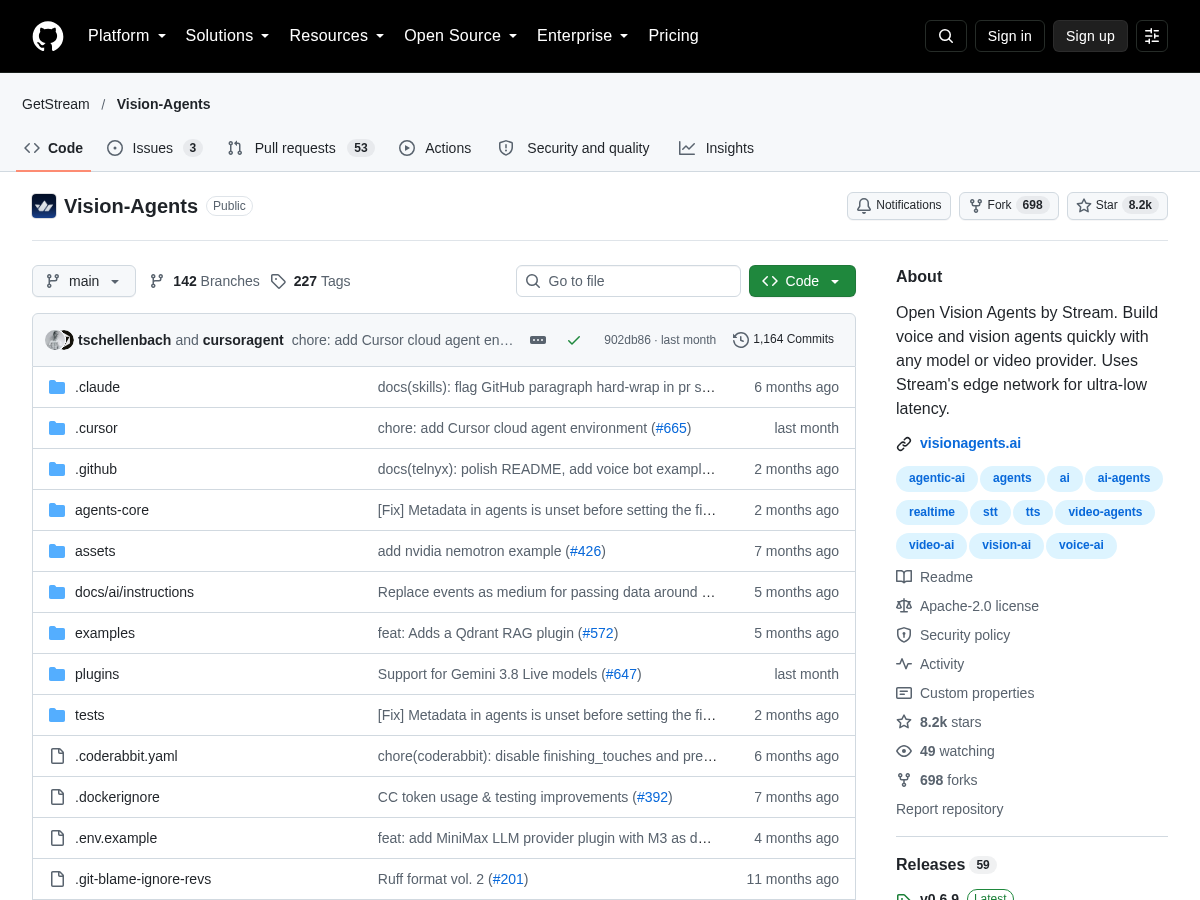
Screenshot of Vision Agents
Vision Agents
AI Agents Open Source

Vision Agents is an open-source project developed by Stream that enables the creation of intelligent, low-latency video experiences powered by custom models, infrastructure, and use cases. It provides a set of building blocks for developers to build voice and vision agents quickly with any model or video provider, utilizing Stream's edge network for ultra-low latency. The project supports real-time video AI, low-latency video interactions, and native APIs from providers like OpenAI and Gemini. Vision Agents also features a pluggable processor pipeline for YOLO, Roboflow, or custom PyTorch/ONNX models, turn detection with VAD, diarization, and smart turn-taking, and phone integration via Twilio or Telnyx with bidirectional audio streaming. Additionally, it includes tools for MCP and function calling, allowing agents to validate data and take real-world actions during live conversations. The project has a wide range of applications, including real-time coaching, video understanding, and custom video models for security monitoring and moderation. Vision Agents is designed to be production-ready, with built-in HTTP server, Prometheus metrics, horizontal scaling, and Kubernetes deployment support.

Solves

Vision Agents solves the problem of creating intelligent, low-latency video experiences that can understand and respond to user input in real-time. It addresses the challenges of building voice and vision agents that can process video and audio inputs, detect turns, and respond accordingly, all while maintaining low latency and high performance. By providing a set of building blocks and a flexible architecture, Vision Agents enables developers to create custom video experiences that can be used in a variety of applications, from real-time coaching and video understanding to security monitoring and moderation.
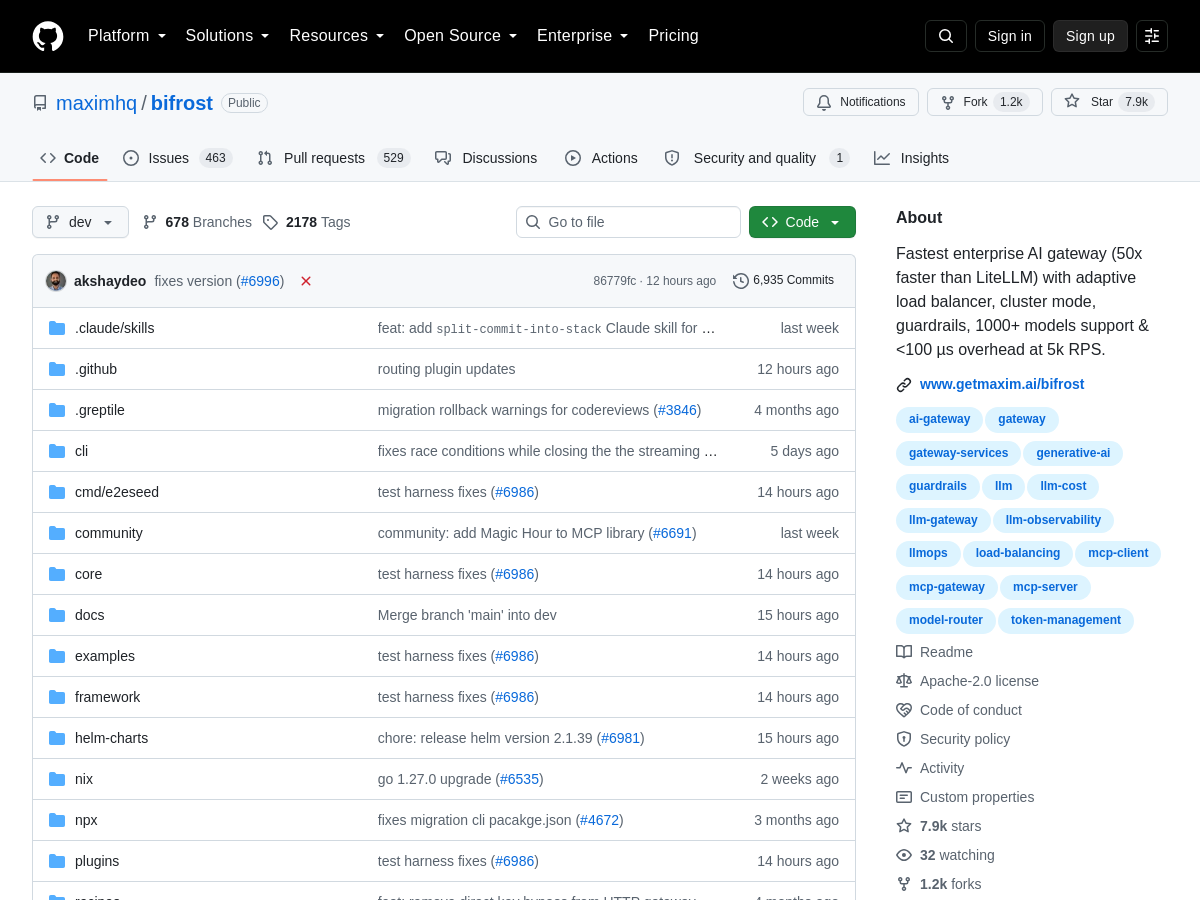
Screenshot of Bifrost
Bifrost
LLM Open Source

Bifrost is an open-source enterprise AI gateway designed to provide high-speed, reliable access to a broad ecosystem of large language models. According to its project description, Bifrost is up to 50x faster than LiteLLM, offering less than 100 microseconds of overhead at 5,000 requests per second. This level of performance makes it suitable for applications that demand real-time AI responses at scale. A key feature of Bifrost is its adaptive load balancer, which intelligently distributes traffic across multiple model providers to optimize throughput, availability, and cost. The gateway also supports cluster mode, enabling horizontal scaling and high availability across multiple nodes. This allows enterprises to build resilient AI infrastructure that can handle growing demand without compromising on latency or reliability. In addition to performance and scaling, Bifrost includes built-in guardrails for content safety and policy enforcement, along with compatibility for more than 1,000 different models. It centralizes access control, routing, and observability, simplifying the integration and management of LLMs within enterprise environments. As an open-source project, Bifrost offers organizations full control over their gateway layer without vendor lock-in.

Solves

Modern AI applications often need to communicate with many different LLM providers, but each provider has its own API, rate limits, and reliability characteristics. Managing these integrations directly is complicated and can introduce performance bottlenecks. Bifrost solves this by providing a unified, ultra-fast gateway that routes, load balances, and secures requests to thousands of models while maintaining sub-millisecond overhead, simplifying deployment and scaling.

Screenshot of AI Song Maker
AI Song Maker
Music Freemium

AI Song Maker is an AI-powered tool designed to generate royalty-free music tracks directly from a web browser. It aims to simplify the creative process, allowing users to produce songs without needing deep musical knowledge or composition skills. The freemium pricing model makes it accessible for casual creators while offering premium features for more demanding projects. The tool leverages artificial intelligence algorithms to compose melodies, harmonies, and rhythms based on user inputs such as genre, mood, or instrumentation. This enables rapid iteration and experimentation, with the platform generating full-length tracks in seconds. It is particularly useful for content creators who require original music for videos, podcasts, games, and other media. As a cloud-based solution, AI Song Maker eliminates the need for expensive software installations and provides a user-friendly interface suitable for both beginners and professionals. While the generated songs are royalty-free, users should verify the specific licensing terms on the platform to ensure compliance with their intended use cases. Overall, it lowers the barrier to music production and fosters creativity across various disciplines.

Solves

AI Song Maker addresses the challenge of quickly obtaining original, royalty-free music without requiring musical expertise or expensive production equipment. It allows individuals and businesses to generate custom tracks on demand, avoiding copyright issues associated with using commercial music and reducing time spent searching for suitable soundtracks.

Screenshot of Hermes Studio
Hermes Studio
LLM Open Source

Hermes Studio is a web-based dashboard designed to complement the Hermes Agent framework, providing a graphical interface for managing AI agents. It enables users to conduct multi-platform AI chats, manage agent sessions, schedule automated jobs, and monitor usage analytics. The dashboard connects to a Hermes Agent backend via API, allowing real-time interaction with agents and configuration of their behavior. It serves as a central hub for operating AI agents, reducing the complexity of command-line or programmatic interaction. The frontend is likely built with modern web technologies (e.g., React or Vue.js), offering a responsive and intuitive user experience. It supports multiple user accounts with role-based access, making it suitable for teams. Hermes Studio displays active and past chat sessions, stores chat history, and provides tools for session handoff or termination. Scheduled jobs can be configured with cron-like syntax, automating repetitive tasks such as data scraping, report generation, or periodic agent prompts. Key features include a unified chat panel that works across different messaging platforms (web, mobile, etc.), detailed usage analytics dashboards showing API call volumes, latency, cost estimation, and error rates, and a job scheduler with a visual interface. The tool also likely offers integration with various LLM providers and custom agent plugins, enabling extensibility. All data is persisted, and the dashboard supports export of analytics for reporting. As an open-source project, Hermes Studio encourages community contributions and can be self-hosted on-premises or in the cloud. It is intended to be a companion for Hermes Agent deployments, lowering the barrier for non-technical users to leverage AI agents while providing power users with deep operational insights. The dashboard accelerates development, debugging, and monitoring of agent-based applications.

Solves

Organizations and developers deploying the Hermes Agent framework often lack a convenient graphical interface to manage, monitor, and interact with their AI agents. Without a dashboard, operations such as viewing agent conversations, scheduling background jobs, or analyzing usage patterns require direct API calls or database queries, which is cumbersome and error-prone. Hermes Studio solves this by providing a centralized web interface that streamlines these tasks, enabling efficient agent oversight, reducing operational overhead, and making AI agent systems accessible to both technical and non-technical team members.

Screenshot of Presenton
Presenton
Dev Tools Open Source

Presenton is an open-source AI presentation generator and API designed as an alternative to commercial tools like Gamma, Beautiful AI, and Decktopus. It enables users to generate slide decks programmatically or through AI-driven content creation, with full access to the underlying source code for customization and self-hosting. The project provides an API that developers can integrate into their own applications to automate presentation creation from structured data or natural language prompts. Because it is open source, organizations can deploy it on their own infrastructure, retaining control over data and avoiding subscription fees. While specific feature details are limited in available metadata, the project positions itself as a flexible, self-hosted solution for teams seeking AI-assisted presentation workflows without proprietary constraints.

Solves

Presenton addresses the need for a cost-effective, self-hosted AI presentation generator with API access, reducing reliance on proprietary SaaS platforms and enabling integration into automated document generation pipelines.

Screenshot of Evolver
Evolver
Prompt Engineering Open Source

Evolver is an open-source engine designed to enable AI agents to self-evolve through the principles of Genetic Evolutionary Programming (GEP). It provides a structured framework for agents to adapt and improve their behavior over time, with a focus on auditable evolution. The engine introduces core abstractions such as Genes, Capsules, and Events, which together form a transparent lineage of changes and adaptations. The tool is particularly relevant in the field of prompt engineering, where it can be used to evolve and optimize prompts for large language model-based agents. By applying evolutionary algorithms, Evolver helps discover high-performing prompts and agent configurations while maintaining a record of the evolution process. Evolver is hosted on GitHub and is free to use, making it accessible for developers and researchers interested in building self-improving AI systems. Its modular design allows integration into existing agent pipelines, and the emphasis on auditability ensures that every evolutionary step can be traced and analyzed.

Solves

Evolver addresses the challenge of continuously improving AI agent behavior and prompts in a way that is transparent, reproducible, and auditable. Traditional manual tuning is time-consuming and lacks a systematic record of changes; Evolver automates the search for better configurations using genetic evolutionary programming while logging the evolution trail through Genes, Capsules, and Events.

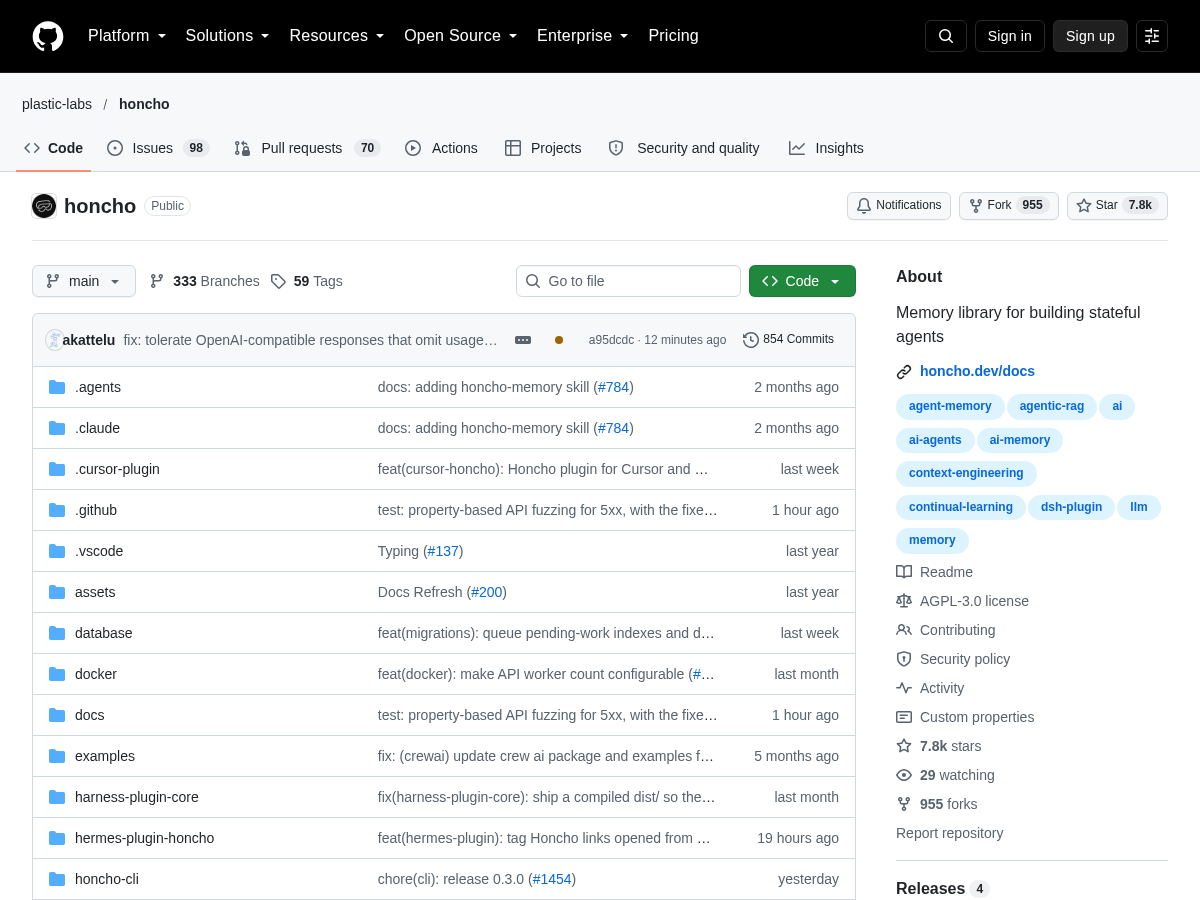
Screenshot of Honcho
Honcho
AI Agents Open Source

Honcho is a memory library designed for building stateful agents. It provides a framework for managing agent memory, allowing developers to create more sophisticated and context-aware agents. The library is open-source and has a strong focus on community involvement, with a large number of contributors and a comprehensive documentation set. Honcho is designed to be highly customizable, with a modular architecture that allows developers to easily extend and modify its functionality. The library is written in Python and has a simple, intuitive API that makes it easy to integrate into existing projects. Honcho has a wide range of potential applications, from chatbots and virtual assistants to more complex systems like autonomous vehicles and robots. The library is highly scalable, making it suitable for large-scale deployments, and has a strong focus on performance and reliability. Overall, Honcho is a powerful tool for building stateful agents, and its open-source nature and large community of contributors make it an attractive choice for developers looking to create more sophisticated and context-aware agents. Honcho's documentation includes a comprehensive guide to getting started with the library, as well as a detailed API reference and a number of example projects to help developers get up to speed quickly. The library is also highly customizable, with a number of configuration options and a modular architecture that makes it easy to extend and modify its functionality. Honcho has a strong focus on community involvement, with a large number of contributors and a comprehensive set of documentation and resources. The library is designed to be highly scalable, making it suitable for large-scale deployments, and has a strong focus on performance and reliability. Honcho's open-source nature and large community of contributors make it an attractive choice for developers looking to create more sophisticated and context-aware agents.

Solves

Developers of stateful agents face the problem of managing agent memory in a way that is efficient, scalable, and reliable. Honcho solves this problem by providing a comprehensive framework for managing agent memory, allowing developers to create more sophisticated and context-aware agents. With Honcho, developers can easily manage agent memory, creating a more seamless and intuitive user experience. The library's modular architecture and customizable nature make it an attractive choice for developers looking to create more sophisticated and context-aware agents, and its open-source nature and large community of contributors ensure that it will continue to evolve and improve over time.

Screenshot of Transformer Explainer
Transformer Explainer
LLM Open Source

Transformer Explainer is an open-source interactive web application developed by the Polo Club at Georgia Tech to demystify the inner workings of Transformer-based large language models. It runs entirely in the browser and allows users to input text and observe how each token flows through a multi-layer Transformer architecture. The tool visualizes key components such as tokenization, embedding, positional encoding, multi-head self-attention, feed-forward networks, and output probability distributions. Users can click on individual attention heads to inspect attention weights between tokens, and adjust temperature or top-k sampling to see generation dynamics. By making abstract concepts concrete, Transformer Explainer serves as an educational resource for students, researchers, and practitioners who want to build intuition about how models like GPT process and generate text. It is ideal for classroom demonstrations, self-study, and conference presentations. The project is hosted on GitHub under the Polo Club organization, is free to use, and can be easily launched locally or accessed via the provided live demo.

Solves

Transformer models are often treated as black boxes, making it difficult for learners and even practitioners to understand why they make certain predictions. Transformer Explainer addresses this by providing an interactive, visual breakdown of each step in the Transformer pipeline, reducing the barrier to understanding and enabling users to explore model behavior in real time.

Screenshot of A Stock Data
A Stock Data
Database Open Source

A Stock Data is an open-source, full-stack data toolkit designed for accessing and consolidating China A-share market data. It aggregates information from 15 different data sources and exposes 43 endpoints, covering a wide range of data types including real-time quotes, historical market data, research reports, capital flow, chip distribution, corporate announcements, limit-up board analysis, ETF options, and market sentiment. The toolkit features a 10-layer architecture to ensure robustness and scalability, and includes 3 official backup sources for automatic failover, enhancing data availability. It aims to provide a comprehensive one-stop solution for quantitative analysis, investment research, and financial data applications.

Solves

Gathering and standardizing diverse China A-share stock market data from multiple sources is complex and error-prone. This toolkit simplifies the process by offering a unified access layer, reducing development effort and enabling faster data-driven insights.

Screenshot of Agent Squad
Agent Squad
AI Agents Open Source

Agent Squad is an open-source framework developed by 2FastLabs for managing multiple AI agents and handling complex conversations. It enables developers to orchestrate interactions among various agents, facilitating multi-agent collaboration and dialogue management. The framework is designed to be flexible and powerful, allowing customization for different conversational workflows. The project is hosted on GitHub and is distributed under an open-source license, making it accessible for integration into existing systems. It targets applications that require coordination of several AI agents, such as advanced chatbots, automated reasoning systems, and task-specific agent networks.

Solves

Agent Squad addresses the need for a flexible and powerful framework to manage multiple AI agents and handle complex conversations, simplifying the development of multi-agent systems where agents must interact and collaborate to accomplish tasks.

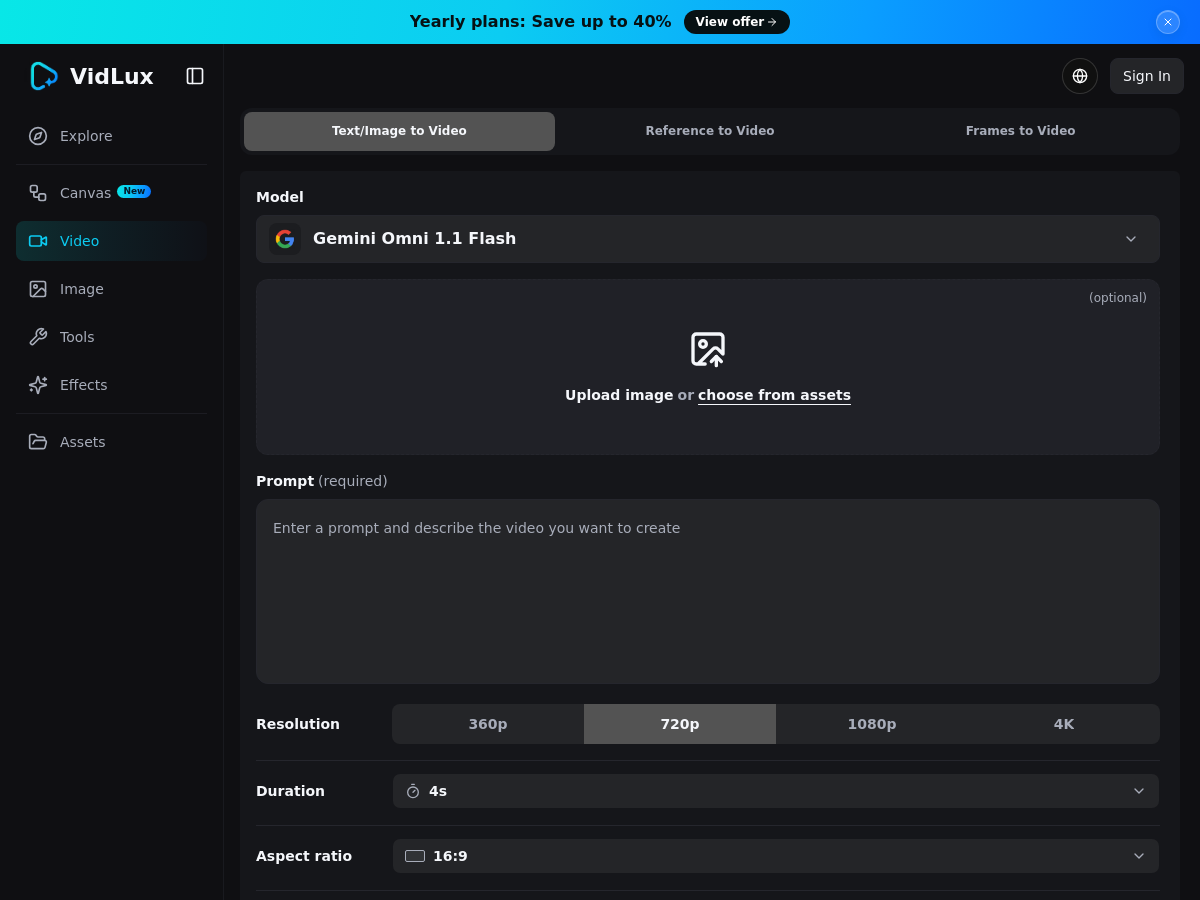
Screenshot of VidLux - Image to Video AI
VidLux - Image to Video AI
Image to video Free

VidLux is a web-based AI image-to-video generator that animates still photos by adding motion and cinematic camera movement. The homepage positions VidLux as a free tool for bringing photos to life, with the image-to-video workflow as its primary video offering. It also links to related video modes such as Text/Image to Video, Reference to Video, and Frames to Video, as well as image tools like Text to Image and Image to Image. The platform presents itself as a creative suite with an Explore section, a Canvas tool, effects, and assets, suggesting that users can generate and manage AI media in one interface. According to the homepage, VidLux uses leading models to produce natural motion and cinematic camera movement. The page advertises that users can try it free, and it also promotes yearly plans with savings up to 40%. No public GitHub repository or self-hosted installation instructions are provided on the homepage. The homepage does not list specific underlying models, output resolution, maximum clip length, or API access. As a result, evaluation of VidLux's technical stack, licensing, and limits requires using the hosted service or contacting the vendor.

Solves

Creating video from a single still image traditionally requires animation, compositing, or editing skills. VidLux addresses this by using AI to add motion and camera movement to photos, allowing users to produce short video clips from images through a hosted web interface.

Screenshot of Evidently
Evidently
LLM Open Source

Evidently is an open-source Python framework for ML and LLM observability. It provides over 100 metrics to evaluate, test, and monitor AI-powered systems and data pipelines, covering both tabular data and generative AI applications. The framework generates interactive reports and test suites that can be used for debugging, validation, and ongoing monitoring. It detects data drift, model performance degradation, and quality issues in LLM outputs, helping teams maintain reliable AI systems. Evidently integrates easily into Python workflows, including Jupyter notebooks, CI/CD pipelines, and production monitoring stacks. It is designed for data scientists and ML engineers who need observability without heavy infrastructure.

Solves

Evidently helps teams detect and diagnose issues in ML and LLM systems by providing automated evaluation, testing, and monitoring capabilities, reducing the risk of model drift, data quality problems, and poor generative outputs in production.

Screenshot of Prompt_Engineering
Prompt_Engineering
LLM Open Source

This repository provides a comprehensive and hands-on guide to prompt engineering with 22 techniques, ranging from basic to advanced strategies for interacting with large language models (LLMs). Each technique is implemented in a self-contained Jupyter Notebook, complete with explanations, code examples, and practical demonstrations. The techniques cover a wide spectrum: fundamental methods like zero-shot, few-shot, and chain-of-thought prompting; advanced approaches such as self-consistency, generated knowledge, and directional stimulus; and applied strategies including prompt chaining, retrieval augmented generation (RAG), and structured output formatting. The notebooks are designed to be executable, allowing users to run and modify code against real LLM APIs (e.g., OpenAI) to see immediate effects of different prompt designs. The project is actively maintained, with regular updates to keep code compatible with the latest library versions and API changes. It serves as both a learning resource for beginners and a reference for experienced practitioners seeking to refine their prompting skills.

Solves

Many developers, data scientists, and engineers struggle to consistently elicit accurate, contextually relevant, and well-structured responses from large language models. The repository addresses this by providing structured, tried-and-tested prompt engineering patterns. Users can learn how to craft prompts that reduce hallucinations, improve reasoning, handle complex tasks, and adapt to specific use cases, thereby boosting the performance and reliability of LLM-powered applications without needing to fine-tune models.

Screenshot of Rig
Rig
LLM Open Source

Rig is an open-source Rust library designed for building modular and scalable applications powered by large language models (LLMs). It provides a unified interface to interact with popular LLM providers such as OpenAI, Anthropic, Cohere, and others, simplifying the integration of AI capabilities into Rust projects. The library emphasizes type safety, performance, and a composable architecture, enabling developers to create robust AI systems without sacrificing the benefits of the Rust ecosystem. The library includes abstractions for key LLM application patterns, including completion and chat generation, embeddings, vector stores for retrieval-augmented generation (RAG), and agent-based workflows that can use external tools. Its modular design allows users to mix and match components, extend functionality with custom providers and storage backends, and maintain clean separation of concerns. Rig also supports streaming responses, asynchronous execution with Tokio, and configuration through environment variables. Rig aims to bring the productivity of Python-based LLM frameworks to Rust while leveraging Rust's low-level control, memory safety, and concurrency. It is suitable for building production-grade services, CLI tools, and high-performance AI applications where latency and resource usage are critical. The project is actively maintained and welcomes community contributions.

Solves

Rig addresses the lack of a mature, type-safe framework for developing LLM applications in Rust. It provides a unified abstraction over multiple AI providers and common LLM workflows (generation, embeddings, agents, RAG), reducing boilerplate and enabling developers to build efficient and reliable AI-powered software in the Rust ecosystem.

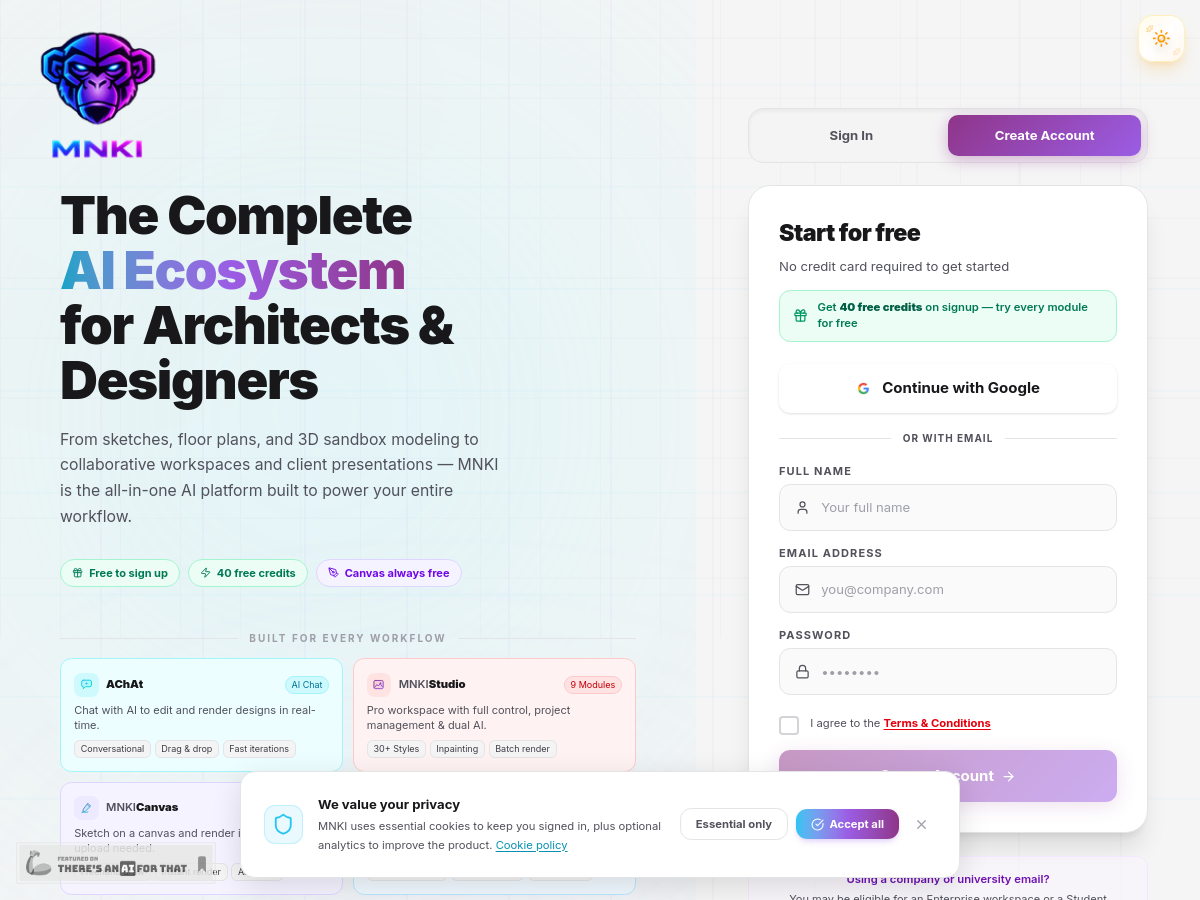
Screenshot of MNKI
MNKI
Architectural design Free

MNKI is an AI-powered architectural rendering and design platform that converts sketches, floor plans, and 3D sandbox models into photorealistic renders in seconds. It provides a full ecosystem with multiple integrated modules: a chat tool for conversational design edits, a Studio workspace with 30+ rendering styles and inpainting, a free Canvas for freehand drawing, a Space hub for team collaboration, a 3D Sandbox for building models and walkthroughs, and an AI presentation generator for client-facing decks. The platform is designed to support the entire architectural visualization workflow from initial idea to final presentation. Users can start for free with 40 credits, and Canvas access remains free, with no credit card required at signup. MNKI is marketed toward architects, interior designers, and real estate-related professionals. It also highlights support for Arabic users and includes features for live team permissions, shared projects, and batch rendering. Because it is browser-based, it can be used without local GPU hardware, making rapid prototyping and iterations accessible on almost any device.

Solves

Traditional architectural rendering requires specialized 3D software, significant time, and technical skill. MNKI addresses this by letting users quickly create realistic visuals from hand drawings, floor plans, or 3D sketches, reducing the time to produce high-quality concept images during early design and client approval stages.

Screenshot of Html Anything
Html Anything
AI Agents Open Source

Html Anything is an agentic HTML editor that leverages a local AI agent to write HTML code, allowing users to ship content rapidly. It comes with 75 skills that can generate content across 9 different surfaces: magazine layouts, presentation decks, posters, XHS/tweet images, prototypes, data reports, and Hyperframes. The tool runs entirely locally within a sandboxed environment, ensuring security and privacy while providing a flexible, prompt-driven approach to HTML creation. Users can describe the desired output, and the AI agent produces the corresponding HTML, which can then be used and shared directly.

Solves

It eliminates the need for manual HTML coding by enabling prompt-based generation of diverse visual content, making it easy for non-technical users to produce professional-looking, shareable HTML without deep web development expertise.

Screenshot of Hermes Web Ui
Hermes Web Ui
LLM Open Source

Hermes Web UI is an open-source web dashboard designed for Hermes Agent, providing a user-friendly interface for multi-platform AI chat. It enables users to manage chat sessions across different platforms, schedule automated jobs, and monitor usage analytics from a single location. The dashboard is built to simplify interaction with Hermes Agent, an LLM-based agent, by offering session persistence and management capabilities. Users can create, organize, and revisit conversations, schedule periodic LLM tasks, and track how the agent is being used over time. The project is intended to be self-hosted and customizable, making it suitable for individuals and teams who want a visual layer over their Hermes Agent deployment.

Solves

Hermes Web UI addresses the lack of a centralized, visual interface for managing Hermes Agent. It consolidates chat, session management, job scheduling, and usage analytics into one dashboard, reducing the need for command-line or API-only interaction and improving productivity for teams and individuals using the agent.

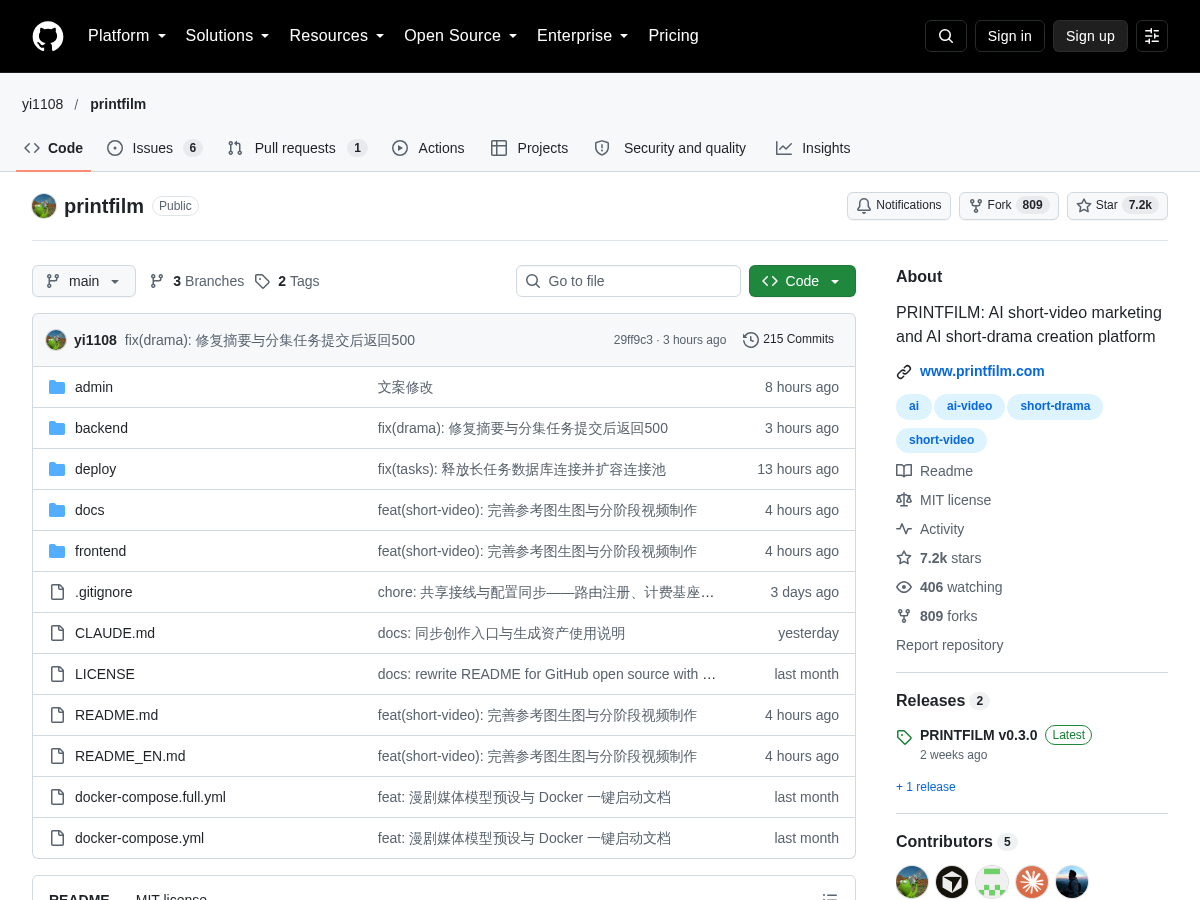
Screenshot of Printfilm
Printfilm
Video Open Source

Printfilm is an AI-powered platform for creating short videos and dramas. It provides a step-by-step process for creating short videos, from setting up the project to generating the final video. The platform includes features such as AI video generation, 3D animation, and video editing. It also has a user-friendly interface that allows users to easily navigate and manage their projects. Printfilm is open-source and available on GitHub, making it accessible to developers and creators who want to contribute to or use the platform. The platform has a range of tools and features that make it suitable for creating a variety of content, from short videos to full-length dramas. Printfilm's AI technology allows users to generate high-quality videos quickly and efficiently, making it a valuable tool for content creators. The platform's open-source nature also means that it can be customized and extended by users, allowing for a high degree of flexibility and creativity. Overall, Printfilm is a powerful tool for creating high-quality video content, and its open-source nature makes it an attractive option for developers and creators. Printfilm's documentation and community support also make it easy for new users to get started and learn how to use the platform. The platform's GitHub page provides detailed information on how to install, configure, and use Printfilm, as well as a range of tutorials and examples to help users get started. Printfilm's community of developers and users also provides support and feedback, helping to ensure that the platform continues to evolve and improve over time. With its powerful features, flexible customization options, and supportive community, Printfilm is an ideal choice for anyone looking to create high-quality video content. The platform's AI technology and user-friendly interface make it easy to use, even for those without extensive video production experience. Whether you're a seasoned developer or just starting out, Printfilm provides a range of tools and features that can help you bring your video content to life.

Solves

Printfilm solves the problem of creating high-quality video content quickly and efficiently. Many content creators struggle with the time and resources required to produce high-quality videos, but Printfilm's AI technology and user-friendly interface make it easy to generate professional-looking videos in a fraction of the time. This makes it an ideal solution for businesses, marketers, and individuals who need to create video content on a regular basis, but may not have the resources or expertise to do so. By providing a range of tools and features that simplify the video creation process, Printfilm helps to level the playing field and make high-quality video content accessible to everyone.

Screenshot of Glean
Glean
Personal assistant Unknown

Glean is an enterprise-focused work AI platform that connects to a company's tools, data, and context to provide intelligent search, assistance, and automation. It unifies information from over 250 connectors including SaaS applications, documents, and internal systems. The platform includes enterprise search with hybrid capabilities, a personal graph that understands individual work context, an enterprise graph mapping company knowledge, and an AI assistant that can answer questions, generate content, analyze data, and execute actions across systems. Glean also offers AI agents with a builder, orchestration, governance, and a library of reusable agents. Security and governance are emphasized, with features like an AI gateway and model hub to manage AI usage safely at scale. Glean is adopted by large enterprises such as Booking.com, Zillow, TIME, and Ericsson, positioning it as a comprehensive solution for knowledge management and AI-driven productivity.

Solves

Glean solves the problem of fragmented enterprise information and inefficient knowledge work by providing a unified AI layer that indexes all company data, understands context, and enables employees to find answers, generate content, and automate tasks without switching between tools.

Screenshot of Flower
Flower
Framework Open Source

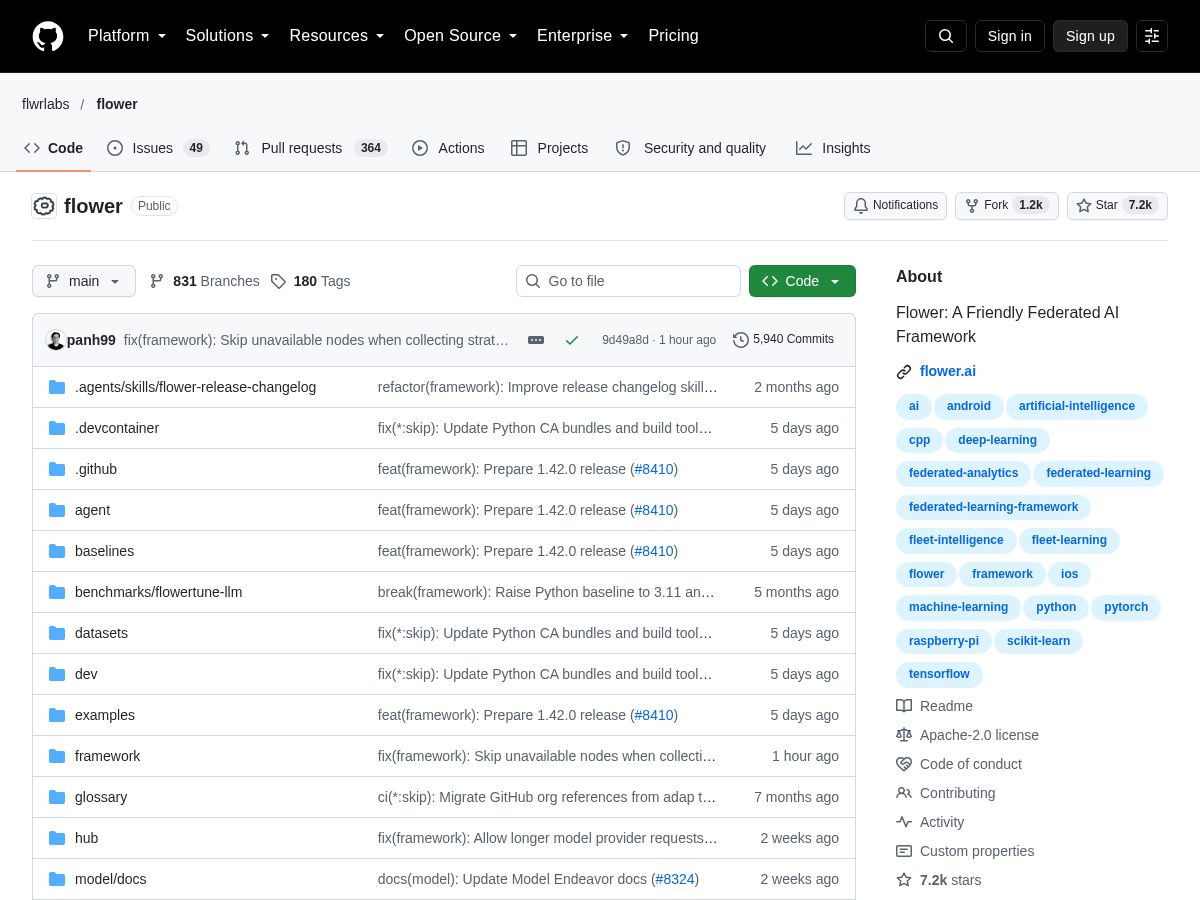
Flower is a friendly federated AI framework that enables the development of artificial intelligence and machine learning models in a decentralized and collaborative manner. It provides a platform for data scientists, researchers, and developers to work together on AI projects, sharing data, models, and expertise. The framework is designed to be flexible and scalable, allowing it to be used in a variety of applications, from edge devices to cloud-based systems. Flower supports multiple AI frameworks, including PyTorch, TensorFlow, and scikit-learn, and provides a range of tools and features for data preprocessing, model training, and deployment. With its focus on federated learning, Flower enables the development of AI models that can be trained on decentralized data, reducing the need for data centralization and improving model accuracy and robustness. The framework is also designed to be extensible, allowing developers to add new features and tools as needed. Overall, Flower provides a powerful and flexible platform for building and deploying AI models in a decentralized and collaborative way. Flower has a wide range of applications, including edge AI, IoT, and robotics, and is suitable for use in a variety of industries, including healthcare, finance, and manufacturing. The framework is open-source and has a large and active community of developers and users, who contribute to its development and provide support and resources for new users. Flower is designed to be easy to use and provides a range of tutorials, documentation, and examples to help users get started. The framework is also highly customizable, allowing users to tailor it to their specific needs and use cases. In addition to its technical features, Flower also provides a range of benefits, including improved model accuracy, increased efficiency, and enhanced collaboration and knowledge sharing. Overall, Flower is a powerful and flexible framework for building and deploying AI models in a decentralized and collaborative way.

Solves

Flower solves the problem of developing and deploying AI models in a decentralized and collaborative manner. Traditional AI development approaches often require large amounts of centralized data, which can be difficult to obtain and may raise privacy and security concerns. Flower addresses this problem by providing a platform for federated learning, which enables the development of AI models that can be trained on decentralized data. This approach improves model accuracy and robustness, while also reducing the need for data centralization and improving privacy and security. Additionally, Flower provides a range of tools and features for data preprocessing, model training, and deployment, making it easier for data scientists, researchers, and developers to work together on AI projects.

Screenshot of Openllmetry
Openllmetry
LLM Open Source

Openllmetry is an open-source project that provides observability for Generative AI and LLM applications using OpenTelemetry standards. It offers automatic instrumentation for popular LLM frameworks and services, capturing traces, metrics, and logs related to model calls, token usage, latency, and errors. The project includes SDKs for Python and TypeScript, enabling developers to add observability to their AI applications with minimal code changes. It supports integration with existing OpenTelemetry collectors and backends, allowing data to be exported to any observability platform that supports OTLP. Developed by Traceloop, Openllmetry aims to provide vendor-neutral telemetry for AI workloads, helping teams monitor performance, cost, and quality without being locked into a specific commercial observability tool. It is distributed under the Apache 2.0 license.

Solves

Openllmetry solves the challenge of monitoring and debugging LLM-based applications by providing standardized, vendor-neutral observability. It captures detailed telemetry data such as prompts, completions, token counts, latency, and model metadata, enabling teams to understand performance, cost, and reliability of their AI services.

Screenshot of Opensquilla
Opensquilla
AI Agents Open Source

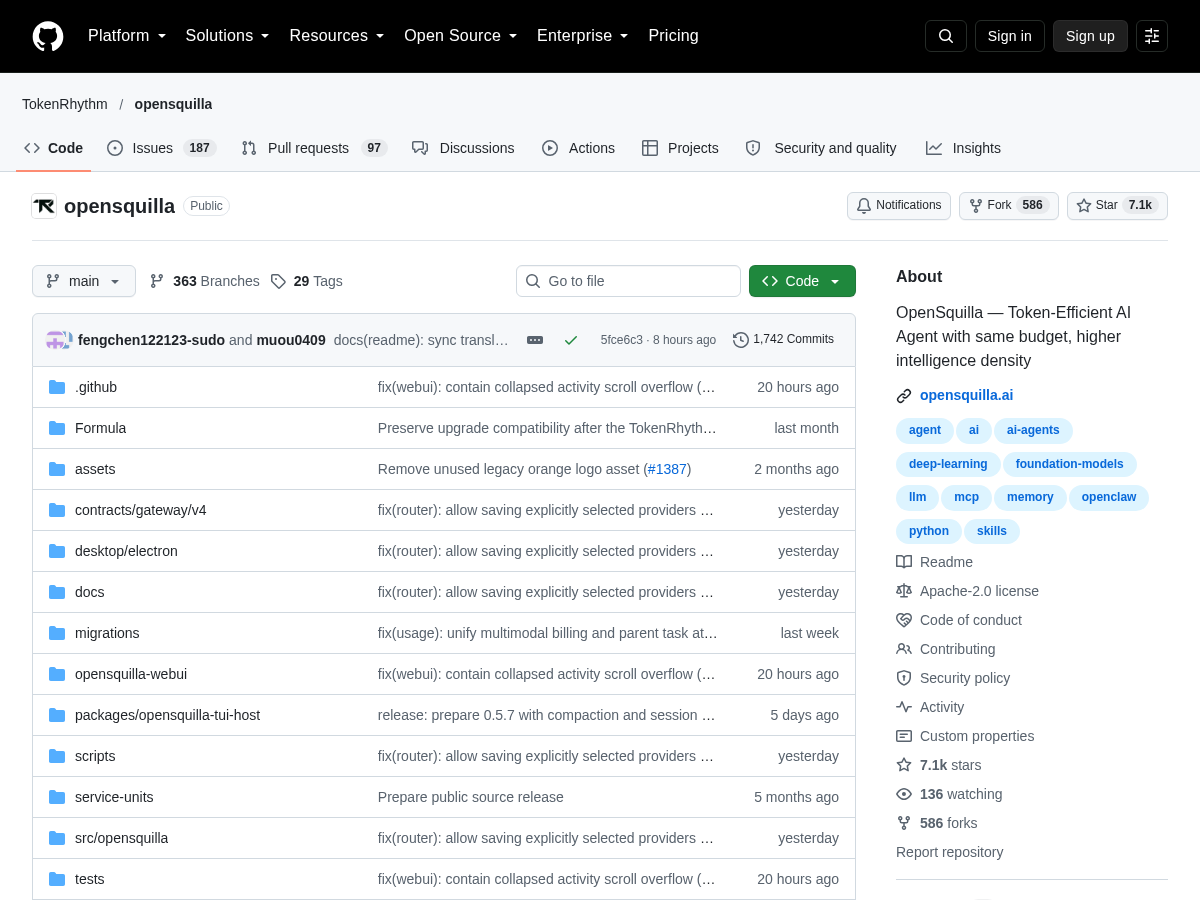
OpenSquilla is a token-efficient AI agent that provides higher intelligence density with the same budget. It is an open-source project hosted on GitHub, with a focus on AI, deep learning, and foundation models. The project has a large community of contributors and users, with over 7,000 stars and 586 forks on GitHub. OpenSquilla is designed to be a highly efficient and scalable AI agent, with a range of features and tools for developers and researchers. The project is written in Python and has a range of dependencies and libraries, including Apache-2.0 license. OpenSquilla has a range of applications and use cases, including natural language processing, computer vision, and robotics. The project is highly customizable and extensible, with a range of APIs and interfaces for integrating with other tools and systems. Overall, OpenSquilla is a powerful and flexible AI agent that is well-suited to a range of applications and use cases. OpenSquilla's architecture is designed to be modular and scalable, with a range of components and modules that can be easily integrated and customized. The project has a strong focus on community and collaboration, with a range of resources and tools for contributors and users. OpenSquilla is a rapidly evolving project, with a range of new features and updates being added regularly. The project has a range of applications and use cases, including research, development, and production environments. OpenSquilla is a highly versatile AI agent that can be used for a range of tasks and applications, from natural language processing and computer vision to robotics and autonomous systems.

Solves

OpenSquilla solves the problem of inefficient AI agents that require large amounts of computational resources and data to operate effectively. By providing a token-efficient AI agent that can operate with the same budget as other agents, OpenSquilla enables developers and researchers to build and deploy AI models that are more efficient, scalable, and cost-effective. This is particularly important in applications where computational resources are limited, such as in edge computing or mobile devices. OpenSquilla's efficient architecture and modular design also make it easier to integrate and customize, reducing the time and effort required to build and deploy AI models.

Screenshot of Lyria
Lyria
Music Free

Lyria is Google DeepMind's advanced music generation model family, with Lyria 3.5 being the latest iteration. It enables users to create high-fidelity music and audio from textual descriptions, supporting a wide range of musical genres and styles. The model is designed to produce both instrumental and vocal tracks with impressive audio quality and coherence, making it suitable for creative professionals and enthusiasts. Lyria integrates with other Google DeepMind products and tools, offering a streamlined experience for generating musical content directly from prompts.

Solves

Lyria addresses the challenge of generating high-quality, original music using AI, eliminating the need for extensive musical training or expensive production equipment. It helps creators quickly transform ideas and text prompts into fully-formed musical pieces, accelerating the music creation process and enabling rapid prototyping of songs.

Screenshot of LTX 2
LTX 2
Video Open Source

LTX-2 is an open-source generative AI model developed by Lightricks that creates videos with synchronized audio from textual descriptions. The repository provides an official Python inference package, allowing users to generate audio-video content easily. It also includes a LoRA trainer, enabling fine-tuning on custom datasets to adapt the model to specific styles, characters, or domains without full retraining. LTX-2 leverages state-of-the-art deep learning techniques to produce high-quality, coherent video and audio outputs. The model weights are available on Hugging Face, and a live demo showcases its capabilities. With a modular codebase and pip-installable package, LTX-2 is designed for seamless integration into research and creative workflows. Active development and community contributions ensure continuous improvements and support.

Solves

Video content creators, researchers, and developers often struggle to produce engaging video content with matching audio from text descriptions alone, due to the complexity and resource requirements of existing tools. LTX-2 solves this by providing an open-source, accessible model that generates both video and audio in one pass, with the option to fine-tune on custom data using LoRA, dramatically lowering the barrier for personalized video generation.
Screenshot of Inkos
Inkos
AI Agents Open Source

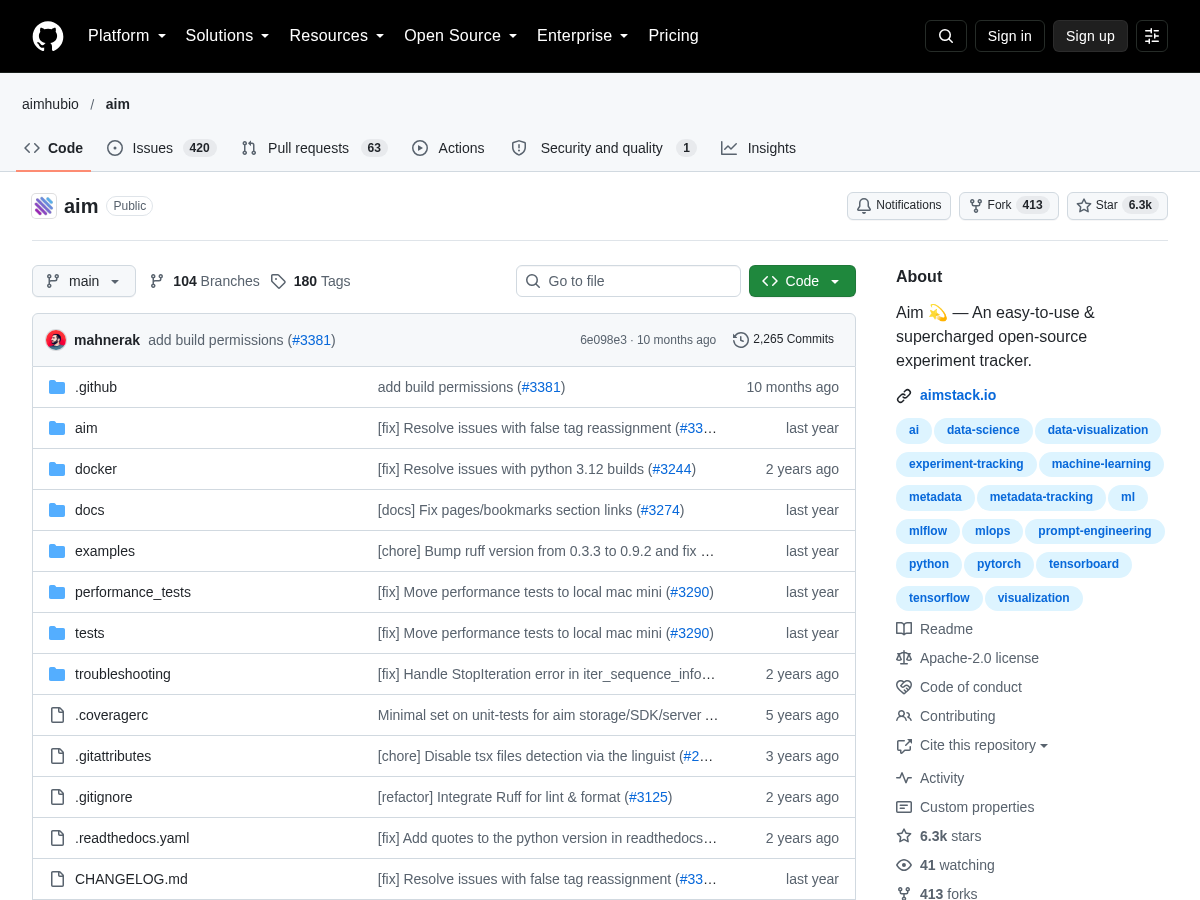
Inkos is an open-source AI agent framework for autonomous story creation. It supports writing novels, scripts, translations, interactive game narratives, and other IP content. The system orchestrates multiple AI agents that collaborate on drafting, auditing, and revising narrative text. Human review gates are integrated to allow authors to approve or intervene at key stages, ensuring creative control and quality assurance. Inkos is designed to reduce the manual burden of long-form writing while maintaining human oversight. The project is hosted on GitHub and can be self-hosted by users.
Solves

Inkos addresses the challenge of producing long-form narrative content by coordinating multiple AI agents to write, audit, and revise text. It reduces manual effort while preserving human oversight through review gates, enabling faster draft generation without sacrificing creative control.

Screenshot of Learning
Learning
AI/ML Open Source

This repository is a personal learning log by Amit Chaudhary (amitness) that documents his ongoing studies, primarily in artificial intelligence and machine learning. It contains a collection of markdown notes, summaries, code snippets, and curated references on topics such as deep learning, natural language processing, computer vision, and MLOps. The content is organized by date and topic, allowing both the author and visitors to follow the learning journey and review key concepts. The repository serves as a public, versioned knowledge base that demonstrates a structured approach to self-directed learning in the AI/ML field.

Solves

It addresses the challenge of retaining and organizing knowledge from diverse learning sources by providing a public, versioned log of learnings. This helps the author reinforce concepts and enables others to find a curated path through AI/ML topics.

Screenshot of Bindu
Bindu
AI Agents Open Source

Bindu is an open-source project that serves as the identity, communication, and payments layer for AI agents. It provides foundational infrastructure to enable autonomous agents to establish verifiable identities, exchange messages securely, and conduct financial transactions. By offering these core capabilities, Bindu aims to facilitate trust and interoperability in multi-agent ecosystems. Developers can integrate Bindu into their agent frameworks to allow agents to authenticate, communicate, and transact without relying on centralized intermediaries. The project focuses on creating a standardized layer that abstracts away the complexities of agent-to-agent interaction, making it easier to build decentralized agent networks and marketplaces. As an open-source initiative hosted on GitHub, Bindu invites community contributions and aims to become a common substrate for the emerging agent economy. Its modular approach is designed to be extensible, supporting various identity schemes, communication protocols, and payment rails as the ecosystem evolves.

Solves

Bindu addresses the lack of standardized mechanisms for AI agents to identify themselves, communicate securely, and handle payments, enabling trustworthy and efficient interactions between autonomous agents in decentralized environments.

Screenshot of ChatLab
ChatLab
AI Agents Open Source

ChatLab is an open-source, local-first tool designed to analyze chat histories using artificial intelligence. It enables users to extract insights, patterns, and summaries from their chat logs without uploading data to external servers, preserving privacy and data sovereignty. The tool is hosted on GitHub and can be self-hosted or run locally, making it suitable for individuals and organizations concerned about data confidentiality. By leveraging modern AI techniques, ChatLab can process various chat formats and provide features such as sentiment analysis, topic detection, and conversation summarization. Its local-first architecture ensures that all analysis happens on the user's machine, reducing latency and eliminating cloud costs. The project is community-driven and open for contributions, aiming to provide a flexible and transparent solution for chat data analysis.
Solves

ChatLab addresses the challenge of extracting meaningful information from chat logs while maintaining privacy and control. Many existing chat analysis tools require uploading conversations to cloud services, which may not be acceptable for sensitive or personal data. ChatLab solves this by enabling AI-powered analysis entirely on the local device, allowing users to gain insights without compromising data security.

Screenshot of Julep
Julep
AI Agents Open Source

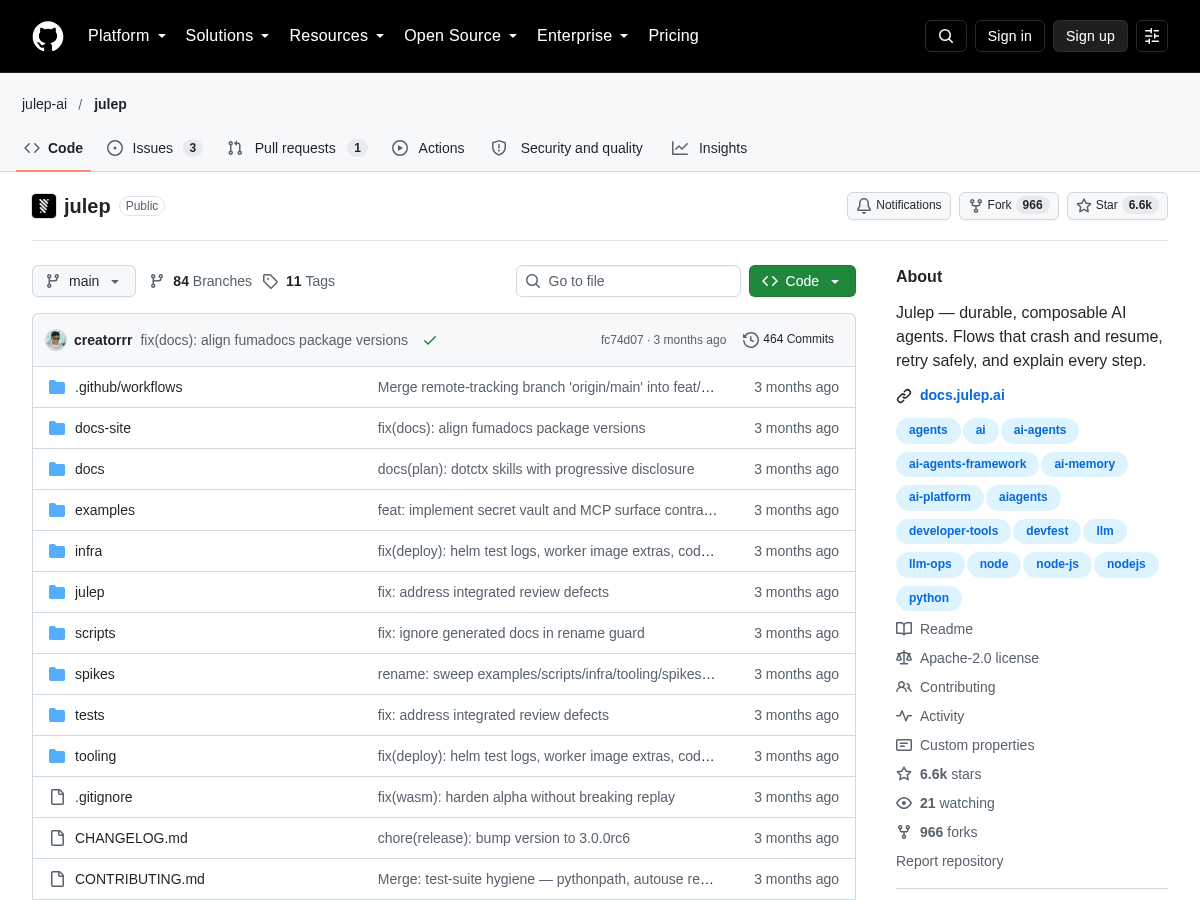
Julep is an open-source project that provides durable, composable AI agents. It allows for flows that can crash and resume, retry safely, and explain every step. The project is designed to be flexible and adaptable, with a focus on providing a robust and reliable platform for building AI-powered applications. Julep's architecture is based on a modular design, allowing developers to easily integrate and extend its functionality. The project's documentation and community resources are available on its GitHub page and website, providing a comprehensive guide for developers to get started with using Julep. Additionally, Julep has a strong focus on security and reliability, with features such as retry-safe and explainable AI agents. The project is actively maintained and updated, with a recent version bump to 3.0.0rc6, indicating a strong commitment to its development and improvement. Overall, Julep provides a powerful and flexible platform for building AI-powered applications, with a strong focus on reliability, security, and community support. Julep's composable AI agents can be used in a variety of applications, including automation, decision-making, and data analysis. The project's modular design and extensive documentation make it an attractive choice for developers looking to build AI-powered applications. Furthermore, Julep's focus on explainability and transparency makes it an ideal choice for applications where understanding the decision-making process is crucial. With its strong community support and active development, Julep is a project that is well worth considering for anyone looking to build AI-powered applications.

Solves

Developers and organizations face the challenge of building reliable and efficient AI-powered applications. Julep solves this problem by providing a durable and composable AI agent platform that can crash and resume, retry safely, and explain every step. This allows developers to build applications that are more robust, reliable, and transparent, which is critical in applications where decision-making and automation are involved. By using Julep, developers can focus on building the logic of their application, without worrying about the underlying AI infrastructure, making it an ideal choice for a wide range of applications.

Screenshot of Intentkit
Intentkit
AI Agents Open Source

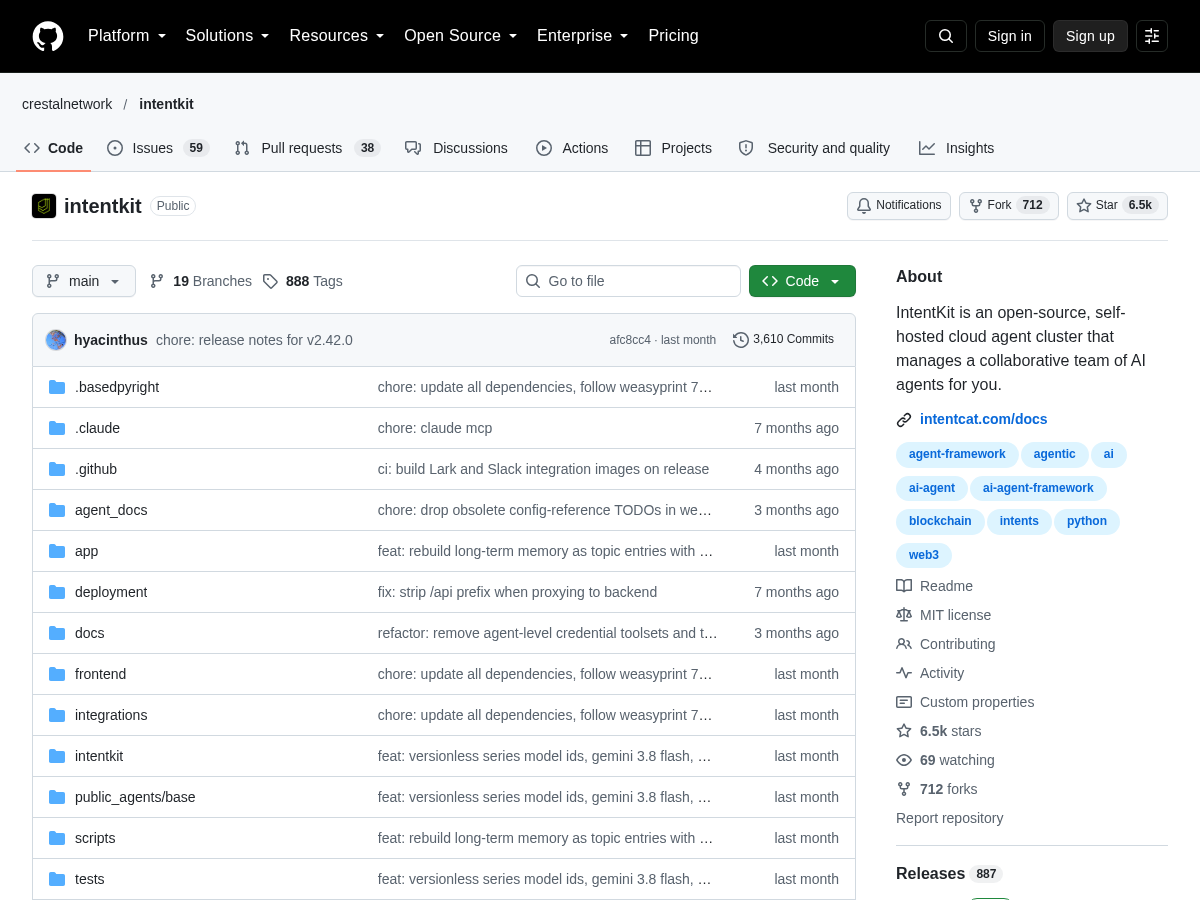
IntentKit is an open-source, self-hosted cloud agent cluster that manages a collaborative team of AI agents for you. It offers a cloud-native solution with ultimate resource efficiency, secure by design, and collaborative AI capabilities. The platform provides out-of-the-box readiness, crypto-friendly features with optional Web3 and blockchain integrations, social media integration, and an extensible skill system. IntentKit can be used as a Python library, allowing users to import and extend its capabilities or add agent cluster features to existing projects. Additionally, it provides API endpoints for interacting with agents from external applications, regardless of the deployment method. The project is licensed under the MIT License and has a comprehensive documentation available on the IntentCat website.

Solves

IntentKit solves the problem of managing and deploying AI agents in a cloud-native environment. It provides a robust and secure solution for users who need to manage a team of AI agents, offering features such as collaborative AI, out-of-the-box readiness, and crypto-friendly integrations. By using IntentKit, users can efficiently deploy and manage their AI agents, reducing the need for expensive hardware and extensive local permissions.

Screenshot of Undetectr
Undetectr
AI/ML Paid

Undetectr is a paid AI/ML audio processing tool designed to remove artificial artifacts from music tracks before distribution. It targets the audible signatures that can make AI-generated or AI-assisted music sound synthetic, such as metallic timbres, unnatural transients, or digital noise. The tool is intended for musicians, producers, and content creators who use generative music software and need their final masters to meet the quality expectations of streaming platforms and listeners. By cleaning these artifacts, Undetectr helps users prepare recordings for commercial distribution. Many digital service providers and distributors are increasingly screening for AI-generated content; Undetectr positions itself as a post-production step to reduce telltale markers and create a more natural, polished result. Its workflow is focused on audio processing rather than composition, making it suitable for finalizing tracks rather than creating them from scratch. The official homepage listed in the source data did not resolve to an Undetectr-specific site at the time of enrichment, and detailed technical documentation, pricing tiers, and supported input formats were not available from the provided homepage markdown. Therefore this description is based on the tool's stated purpose and category, not on verified implementation details.

Solves

Undetectr addresses the challenge of distributing AI-generated music that may contain obvious synthetic artifacts or be flagged by AI detection systems. It cleans audio to make AI-assisted productions sound more human and distribution-ready.

Screenshot of Postfox
Postfox
Voice & Audio Unknown

Postfox is a comprehensive LinkedIn content creation and scheduling platform that uses AI to write posts in your unique voice. It starts by analyzing your existing LinkedIn posts to detect patterns in your writing style, including tone, hook types, and topic preferences. This analysis generates a personalized 'content playbook' with insights such as your best posting times, most effective hooks, and winning content formulas. Once your style is learned, Postfox can generate fresh post ideas and full drafts that authentically mimic your voice, helping you overcome writer's block. The platform includes a content calendar for planning posts, a scheduler for automated publishing, and a browser extension that allows you to curate and schedule posts directly from LinkedIn. Additional features include a library of pre-written templates, real-time post previews, and performance analytics to track engagement. Postfox aims to save time while maintaining consistency and authenticity across your LinkedIn content strategy.

Solves

LinkedIn professionals, marketers, and founders often struggle to consistently produce engaging posts that sound authentic and match their personal brand. Writing takes time, and many feel unsure about what content will resonate with their audience. Postfox addresses this by offering AI-driven style analysis and content generation, helping users understand what works for them and effortlessly create posts that sound like they wrote them themselves. This reduces the time and effort required to maintain a strong LinkedIn presence, enabling users to grow their network and influence through regular, high-quality content.

Screenshot of JustVibe
JustVibe
Search Free

JustVibe is a free search engine that positions itself as 'the search engine for doing, with instant apps built for you.' Unlike traditional search engines that primarily return links and informational results, JustVibe aims to generate interactive mini-applications directly from search queries. This allows users to perform tasks immediately within the browser, without needing to navigate to separate websites or install software. The platform is designed to bridge the gap between searching for information and taking action. The service appears to focus on practical, task-oriented searches, such as converting units, calculating values, generating codes, or setting timers. By dynamically creating an app tailored to the user's query, JustVibe seeks to reduce friction and save time. As a web-based tool, it requires no installation and is accessible from any modern browser. However, detailed technical documentation and public information about the underlying technology are currently limited, as the homepage presents only a security challenge and no GitHub repository is available. Overall, JustVibe represents an interesting evolution in search technology, shifting from passive information retrieval to active task completion. Its success will depend on the quality and breadth of its instant apps, as well as its ability to handle a wide range of user intents. For now, it offers a glimpse into a more action-oriented future for search engines.

Solves

Traditional search engines return lists of links, requiring users to visit multiple sites to complete a task. JustVibe solves this by generating instant apps that let users perform actions directly from the search results page, streamlining workflows and reducing the number of steps needed to accomplish common tasks.

Screenshot of Aim
Aim
AI/ML Open Source

Aim is an easy-to-use and supercharged open-source experiment tracker. It is designed to help data scientists, machine learning engineers, and researchers track and manage their experiments, including data visualization, metadata tracking, and collaboration. Aim provides a simple and intuitive interface for users to log and track their experiments, making it easier to reproduce and compare results. The tool also supports integration with popular machine learning frameworks such as PyTorch and TensorFlow. Aim is highly customizable, allowing users to define their own metrics, parameters, and tags for tracking experiments. The project is actively maintained and has a strong community of contributors, with over 6,000 stars on GitHub.

Solves

Data scientists, machine learning engineers, and researchers often struggle with tracking and managing their experiments, which can lead to difficulties in reproducing and comparing results. Aim solves this problem by providing a simple and intuitive interface for logging and tracking experiments, making it easier to collaborate and reproduce results.

Screenshot of Adversarial Robustness Toolbox
Adversarial Robustness Toolbox
Model Serving Open Source

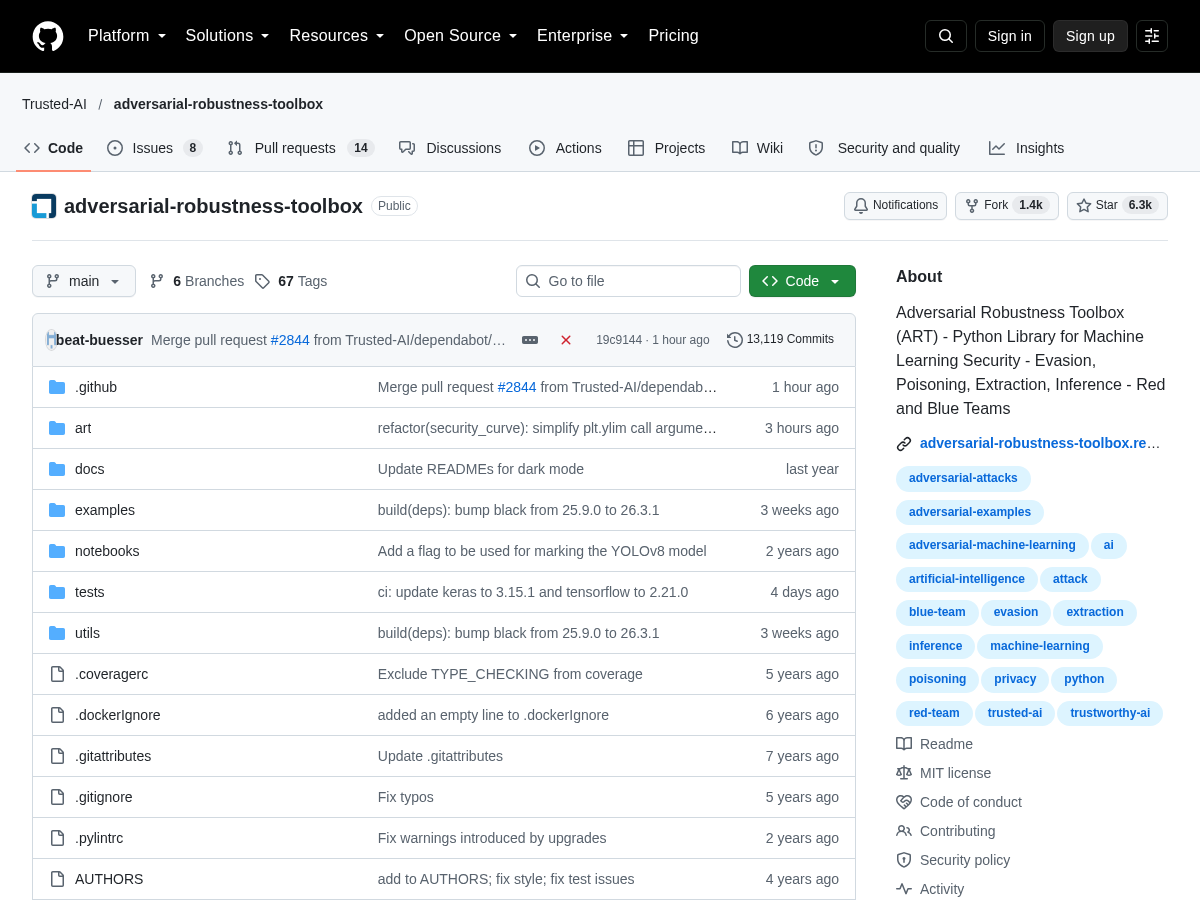
The Adversarial Robustness Toolbox (ART) is a Python library for Machine Learning Security. It provides tools that enable developers and researchers to defend and evaluate Machine Learning models and applications against the adversarial threats of Evasion, Poisoning, Extraction, and Inference. ART supports all popular machine learning frameworks (TensorFlow, Keras, PyTorch, scikit-learn, XGBoost, LightGBM, CatBoost, GPy, etc.), all data types (images, tables, audio, video, etc.) and machine learning tasks (classification, object detection, speech recognition, generation, certification, etc.). The library is under continuous development and is hosted by the Linux Foundation AI & Data Foundation (LF AI & Data). ART is designed to be used by both Red and Blue Teams, providing a comprehensive set of tools for evaluating and improving the security of Machine Learning models. The library includes a range of features, including attacks, defences, estimators, and metrics, as well as a range of examples and notebooks to help users get started. ART is widely used in the field of Machine Learning Security and has been cited in numerous research papers. The library is open-source and is available on GitHub, where it has received over 6,000 stars and has been forked over 1,400 times. ART is licensed under the MIT License and is available for use in commercial and non-commercial applications. The library has a strong community of developers and users, with a Slack channel and a range of documentation and resources available to help users get started and contribute to the project. Overall, ART is a powerful and widely-used library for Machine Learning Security, providing a comprehensive set of tools for evaluating and improving the security of Machine Learning models.

Solves

The Adversarial Robustness Toolbox (ART) solves the problem of evaluating and improving the security of Machine Learning models against adversarial threats. Machine Learning models are vulnerable to a range of attacks, including Evasion, Poisoning, Extraction, and Inference, which can compromise their security and reliability. ART provides a comprehensive set of tools for evaluating and improving the security of Machine Learning models, enabling developers and researchers to defend against these threats and improve the overall security of their models. By using ART, developers and researchers can identify vulnerabilities in their models, evaluate the effectiveness of different defences, and improve the overall security of their models.

Screenshot of Marvin
Marvin
Chatbots Open Source

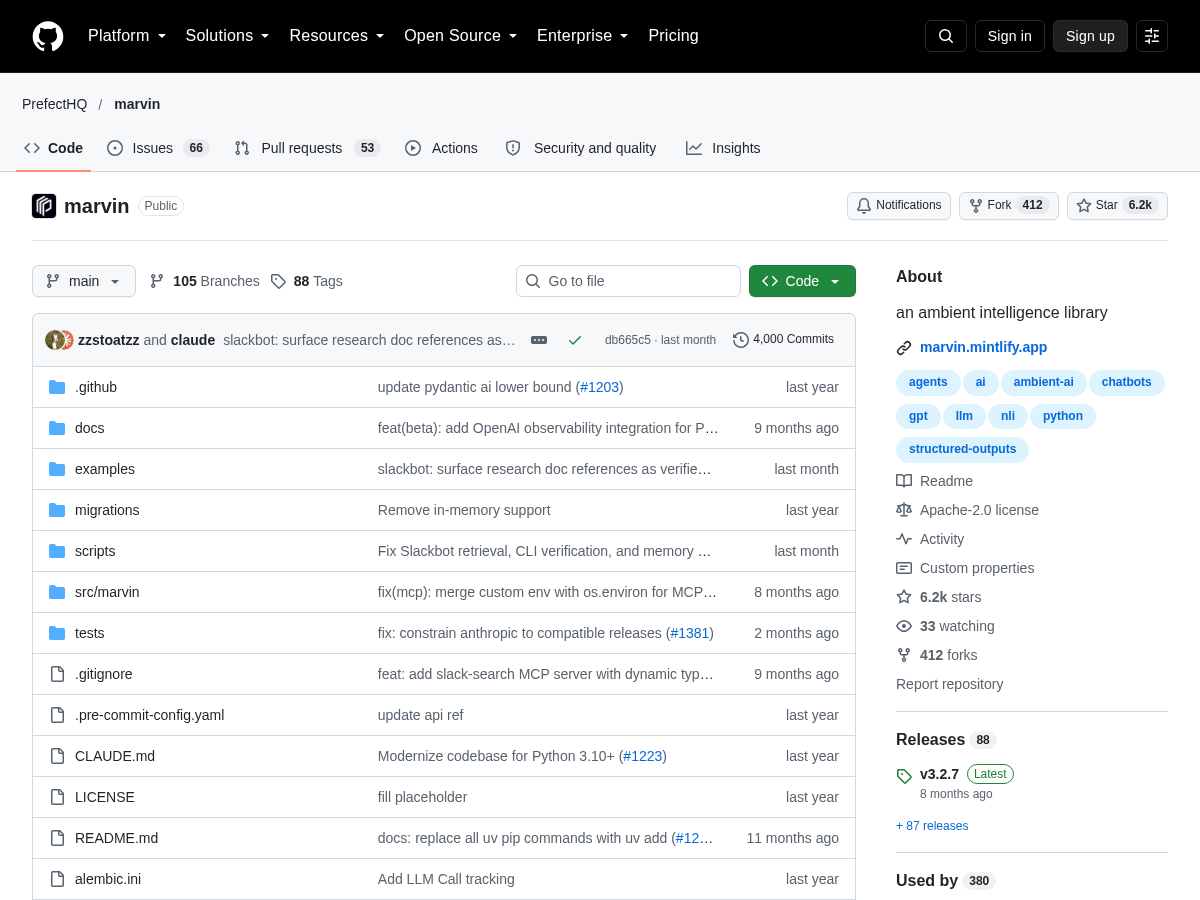
Marvin is a Python framework for producing structured outputs and building agentic AI workflows. It provides an intuitive API for defining workflows and delegating work to LLMs. Marvin allows users to cast, classify, extract, and generate structured data from any inputs, create discrete, observable tasks that describe objectives, assign one or more specialized AI agents to each task, and combine tasks into a thread to orchestrate more complex behaviors. Marvin is built around powerful abstractions that make it easy to work with AI, including tasks, agents, and planning and orchestration features. It includes high-level functions for common tasks like summarizing text, classifying data, extracting structured information, and more. Marvin's top-level API is largely unchanged for both Marvin and ControlFlow users, and it uses Pydantic AI for LLM interactions, supporting a range of LLM providers. Marvin's workflow example demonstrates how it can help build real applications by creating a specialized writing agent, using a thread to maintain context across multiple tasks, and researching a topic, writing a structured article, and printing the article's title and content.

Solves

Marvin solves the problem of working with AI by providing a simple and intuitive API for defining workflows and delegating work to LLMs. It helps users break down complex objectives into manageable tasks, assign specialized AI agents to each task, and combine tasks into a thread to orchestrate more complex behaviors. Marvin's abstractions and features make it easy to work with AI, allowing users to focus on building real applications rather than worrying about the underlying complexity of AI workflows.

Screenshot of Zcf
Zcf
LLM Open Source

Zcf is an open-source tool designed to provide a zero-configuration code flow for AI coding assistants Claude Code and Codex. Hosted on GitHub under the repository UfoMiao/zcf, it aims to streamline the use of these powerful language models in software development by eliminating the need for manual configuration. The project is positioned as a convenience layer that lets developers immediately start using AI-generated code and automated edits without wrestling with setup scripts or complex integration steps. By targeting both Claude Code and Codex, Zcf offers a unified approach to managing code-related workflows across two major AI coding ecosystems. While the repository's metadata does not detail the full feature set, the core value proposition is clear: reduce friction in leveraging AI for coding tasks such as code generation, refactoring, and multi-file modifications. The tool is distributed as open source, allowing users to inspect, modify, and contribute to its development.

Solves

Zcf addresses the configuration overhead often required when integrating AI coding tools like Claude Code and Codex into a developer's environment. By offering a zero-configuration setup, it lowers the barrier to entry, enabling developers to focus on writing code rather than managing tool setups and workflow configurations.

Screenshot of Voiact
Voiact
Personal assistant Free

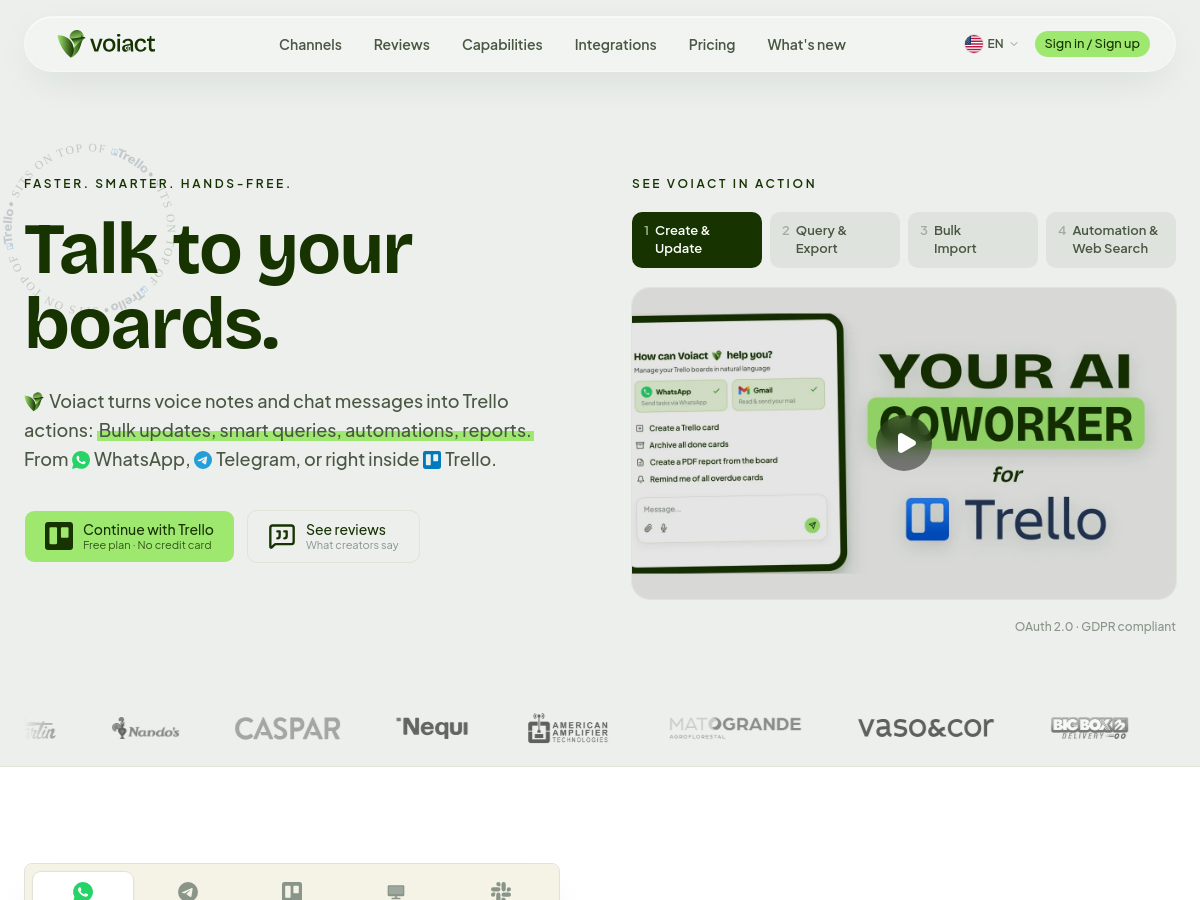
Voiact is an AI assistant designed specifically for Trello, allowing users to manage their boards and cards through voice commands and chat. It integrates with various channels such as WhatsApp, Telegram, and Slack, enabling users to interact with their Trello boards from multiple platforms. Voiact's capabilities include turning voice notes and chat messages into Trello actions, such as bulk updates, smart queries, and automations. It also supports file creation, web research, and reminders, making it a comprehensive tool for Trello users. The platform is built around Trello, providing a seamless experience for users who want to manage their boards and cards more efficiently. With its AI-powered features, Voiact aims to simplify Trello management, making it easier for users to focus on their work. Voiact's transformation layer captures user input in their preferred language and translates it into Trello's language, ensuring a smooth interaction between the user and the Trello board. The platform also offers a range of integrations, including Outlook Mail, Microsoft Calendar, Gmail, and Google Calendar, allowing users to connect their favorite tools and services. Overall, Voiact is a powerful tool for Trello users who want to streamline their workflow and increase productivity. It offers a free plan, as well as several paid plans, including a 14-day free trial, allowing users to choose the plan that best suits their needs. With its robust features and seamless integrations, Voiact is an excellent choice for anyone looking to take their Trello experience to the next level. Voiact's pricing plans are designed to accommodate different user needs, with options ranging from a free plan with limited features to a pro plan with advanced features and support. The platform also offers a tailor-made plan for users with specific needs, ensuring that everyone can find a plan that meets their requirements. In addition to its features and pricing plans, Voiact also provides a range of resources, including a changelog, terms, privacy policy, and legal notice, making it a transparent and trustworthy platform for users.

Solves

Trello users often face the problem of managing their boards and cards efficiently, which can be time-consuming and tedious. Voiact solves this problem by providing an AI-powered assistant that can perform various Trello actions through voice commands and chat, making it easier for users to manage their boards and cards. With Voiact, users can automate repetitive tasks, such as bulk updates and smart queries, and focus on more important tasks, increasing their productivity and streamlining their workflow. Additionally, Voiact's integrations with other tools and services enable users to connect their favorite platforms, making it a comprehensive solution for Trello users.

Screenshot of AgentGuide
AgentGuide
LLM Free

AgentGuide is an open-source project that serves as a comprehensive guide for AI agent development, with a focus on practical implementations using LangGraph. It covers advanced retrieval-augmented generation (RAG) techniques, large language model (LLM) interview preparation, reinforcement learning, and data synthesis. The repository is associated with a website (https://adongwanai.github.io/AgentGuide) that hosts the guide content. The guide is designed to help developers and engineers transition into the field of large models and become algorithm engineers. It includes a collection of interview questions, practical examples, and tutorials on building AI agents with LangGraph. Topics range from foundational concepts to advanced topics like high-level RAG and reinforcement learning. The project is freely accessible on GitHub and is primarily written in Chinese, making it a valuable resource for Chinese-speaking learners aiming to master AI agent development and prepare for technical interviews in the LLM domain.

Solves

AgentGuide addresses the lack of centralized, practical resources for learning AI agent development and preparing for LLM-related job interviews. It provides curated tutorials, code examples, and interview questions covering LangGraph, advanced RAG, reinforcement learning, and data synthesis, helping learners efficiently acquire the necessary skills to become algorithm engineers.

Screenshot of Email Marketing | Hostinger
Email Marketing | Hostinger
Email marketing Free

Hostinger Reach is an AI-powered email marketing platform designed to help businesses and creators connect with their audience through professional email campaigns. With its AI-driven template creator, users can describe what they want to send, and Reach builds a professional email campaign in minutes. The platform offers a range of features, including automated follow-ups, customizable templates, and real-time support. Hostinger Reach is built for simplicity, speed, and results, requiring no design or marketing experience. It integrates seamlessly with other Hostinger tools and offers affordable plans that scale as users grow. The platform also provides reliable deliverability, double opt-in ready, and built-in compliance features to ensure users can send emails with confidence. Additionally, Hostinger Reach offers a range of automation features, including automated email sequences and workflows, to help users streamline their email marketing efforts. Overall, Hostinger Reach is a powerful tool for anyone looking to grow their brand, build trust, and drive engagement through email marketing. The platform's AI-powered features and user-friendly interface make it an ideal solution for businesses and creators of all sizes. With its focus on simplicity, speed, and results, Hostinger Reach is an excellent choice for those looking to take their email marketing to the next level. The platform's ability to craft professional, mobile-friendly emails, suggest the best layout for messages, and save style settings, makes it a valuable asset for any business or creator looking to establish a strong online presence. Furthermore, Hostinger Reach's integration with other Hostinger tools and its affordable pricing plans make it an attractive option for those looking for a comprehensive email marketing solution. The platform's commitment to deliverability, compliance, and support also ensures that users can trust their email marketing efforts are in good hands. In terms of its technical capabilities, Hostinger Reach is a robust platform that can handle a wide range of email marketing tasks, from creating and sending professional email campaigns to automating follow-ups and workflows. Its AI-powered features and customizable templates make it an ideal solution for businesses and creators looking to establish a strong online presence and drive engagement with their audience.

Solves

Hostinger Reach solves the problem of creating and sending professional email campaigns without requiring design or marketing experience. Many businesses and creators struggle to create effective email marketing campaigns, either due to lack of time, resources, or expertise. Hostinger Reach addresses this problem by providing an AI-powered platform that can craft professional, mobile-friendly emails in minutes, allowing users to focus on running their business. The platform's automated features and customizable templates also help users streamline their email marketing efforts, saving time and increasing productivity. By providing a simple, fast, and effective solution for email marketing, Hostinger Reach helps businesses and creators build trust, drive engagement, and grow their brand.

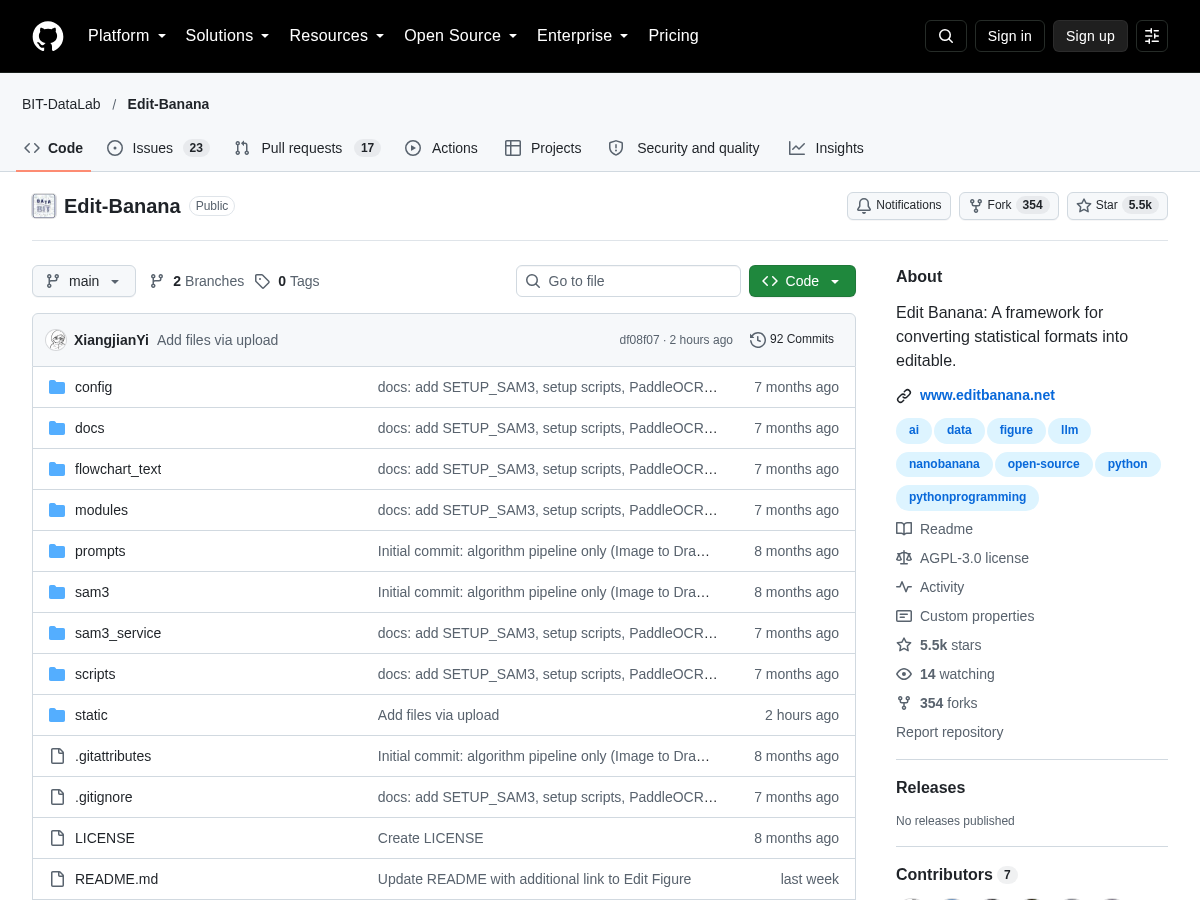
Screenshot of Edit Banana
Edit Banana
LLM Open Source

Edit Banana is an open-source framework designed to convert statistical formats into editable ones. It utilizes advanced technologies such as SAM 3 (Segment Anything Model 3) for segmentation and multimodal large models for high-fidelity reconstruction. The platform allows users to transform fixed content into fully manipulatable assets, preserving the original diagram details and logical relationships. Edit Banana supports various features including advanced segmentation, fixed multi-round VLM scanning, text recognition, and a user system with registration, credit system, and multi-user concurrency. The project is written in Python and utilizes PyTorch with CUDA support for efficient processing. It also includes a command-line interface for easy usage and a web API for more advanced applications.

Solves

Edit Banana solves the problem of converting static formats into editable ones, which is a common challenge in data analysis and visualization. Many users face the issue of having fixed content that cannot be easily modified or manipulated, which limits their ability to work with the data effectively. Edit Banana addresses this problem by providing a powerful and flexible framework for converting statistical formats into editable ones, enabling users to work more efficiently and effectively with their data.

Screenshot of HolaOS
HolaOS
AI Agents Open Source

HolaOS is an open-source, local-first AI agent workspace designed to unify multiple AI agents such as Claude Code and Codex. It provides a single environment where agents can operate across your tools, applications, browser, and files, with access to over 100 integrations and MCP (Model Context Protocol) servers. The platform features shared memory, allowing agents to learn your working context in minutes and retain that information across sessions. Users can either use built-in models or bring their own API keys (BYOK) for flexibility and privacy. HolaOS aims to reduce the friction of managing multiple AI agents by providing a cohesive interface and persistent context, making it suitable for developers and professionals who rely on AI assistance for daily tasks.

Solves

HolaOS solves the problem of fragmented AI agent usage by providing a unified local-first workspace with shared memory, enabling multiple agents to work together across tools and files without losing context.

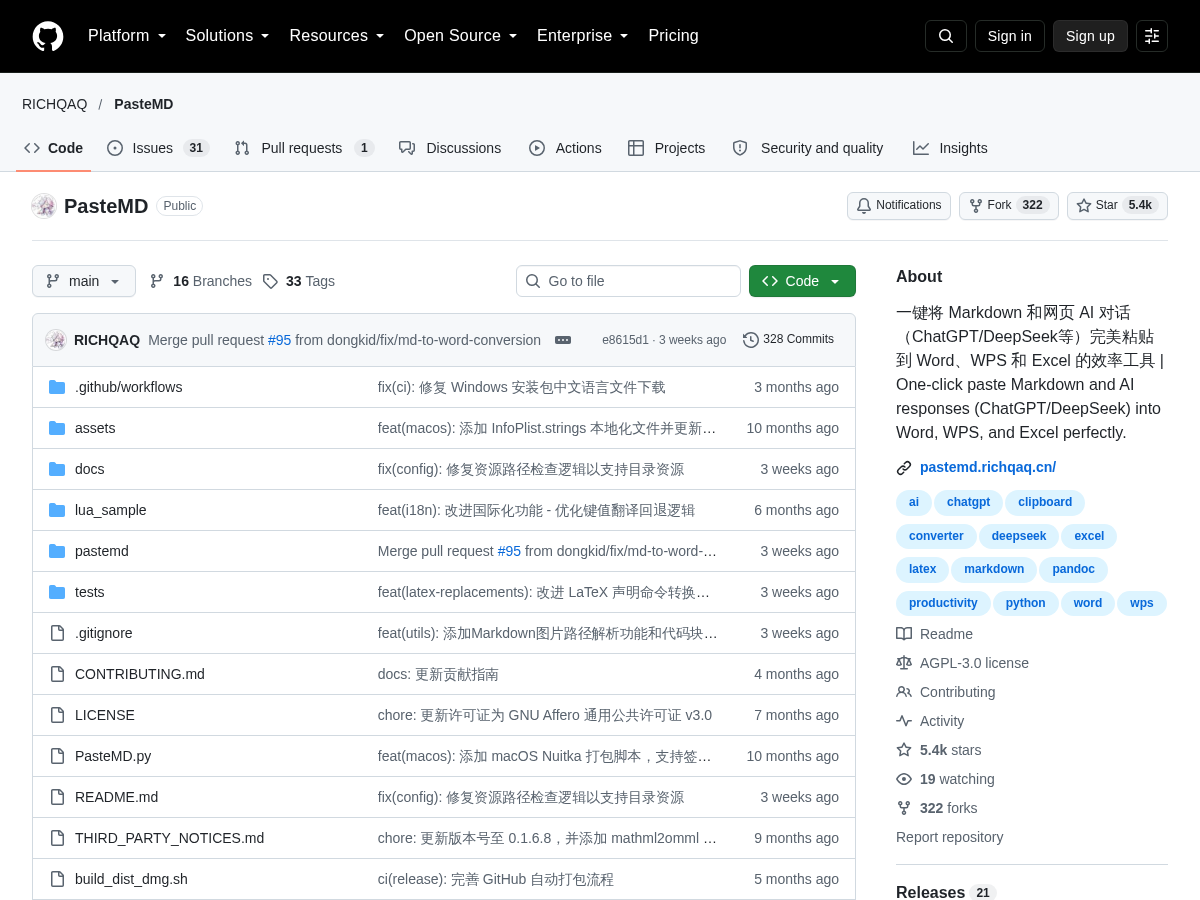
Screenshot of PasteMD
PasteMD
Productivity Open Source

PasteMD is a productivity tool designed to simplify the process of pasting Markdown and AI responses into Word, WPS, and Excel. It allows users to paste Markdown content, including tables and formulas, into these applications with ease. The tool also supports pasting HTML content from web pages, making it a versatile solution for users who need to work with different types of content. PasteMD is available as a desktop application and can be downloaded from the GitHub releases page. It is compatible with Windows and macOS operating systems. The tool has a user-friendly interface and provides features such as automatic detection of the target application, smart table recognition, and support for LaTeX formulas. Additionally, PasteMD allows users to customize the pasting process through a configuration file, enabling them to tailor the tool to their specific needs. The tool is open-source and licensed under the GNU Affero General Public License v3.0.

Solves

PasteMD solves the problem of formatting issues when pasting Markdown and AI responses into Word, WPS, and Excel. It provides a seamless way to paste content from various sources, including web pages and Markdown files, into these applications without losing formatting or experiencing compatibility issues. This tool is particularly useful for users who work with Markdown content, such as writers, researchers, and students, as well as those who need to paste AI responses into documents or spreadsheets.

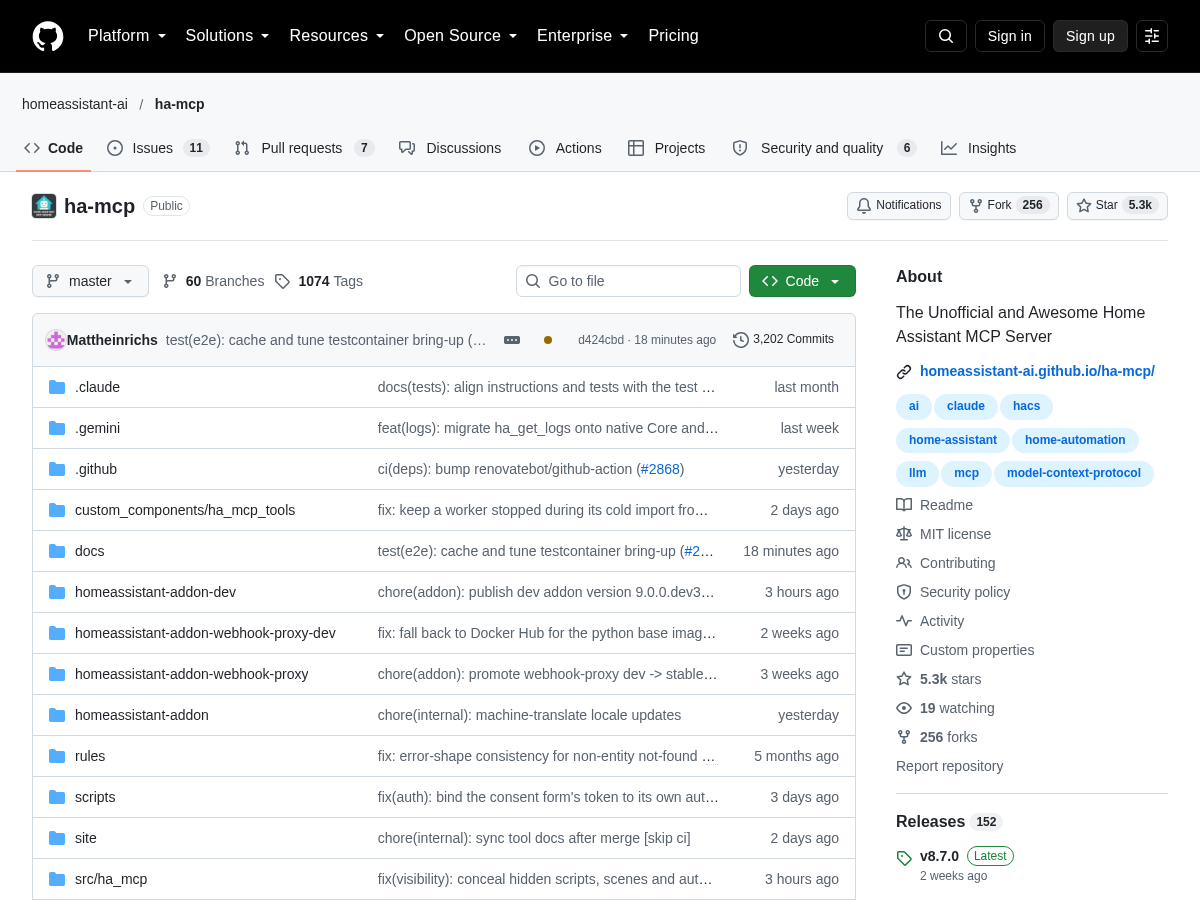
Screenshot of Ha Mcp
Ha Mcp
LLM Open Source

Ha Mcp is an open-source project that provides an unofficial and awesome Home Assistant MCP Server. It is designed to work with Home Assistant, a popular home automation platform, and provides a Model Context Protocol (MCP) server for integrating with other devices and services. The project is hosted on GitHub and has a large community of contributors and users. Ha Mcp provides a range of features, including support for multiple devices and services, a robust and scalable architecture, and a user-friendly interface. It is designed to be highly customizable and extensible, making it a popular choice among home automation enthusiasts. The project is constantly evolving, with new features and updates being added regularly. Ha Mcp is a great example of the power of open-source software and community-driven development. It has a strong focus on security, with features such as encryption and secure authentication. The project also has a comprehensive documentation and a active community forum, making it easy for users to get started and find help when needed. Overall, Ha Mcp is a powerful and flexible tool for home automation, and its open-source nature makes it a great choice for developers and users alike. The project's architecture is designed to be modular, allowing users to easily add or remove features as needed. This makes it a great choice for users who want a high degree of customization and control over their home automation system. Ha Mcp also has a strong focus on integration, with support for a wide range of devices and services. This makes it easy for users to integrate their existing devices and services with the platform, and to add new ones as needed. The project's community is also very active, with many users and developers contributing to the project and providing support to others. This makes it a great choice for users who want a supportive and engaged community to help them get the most out of the platform.

Solves

Ha Mcp solves the problem of integrating multiple devices and services into a single home automation platform. It provides a robust and scalable architecture that can handle a wide range of devices and services, making it easy for users to control and automate their home. The project also solves the problem of security, with features such as encryption and secure authentication. This makes it a great choice for users who want a secure and reliable home automation platform. Additionally, Ha Mcp solves the problem of customization, with a highly customizable and extensible architecture that makes it easy for users to add or remove features as needed. This makes it a great choice for users who want a high degree of control over their home automation system.

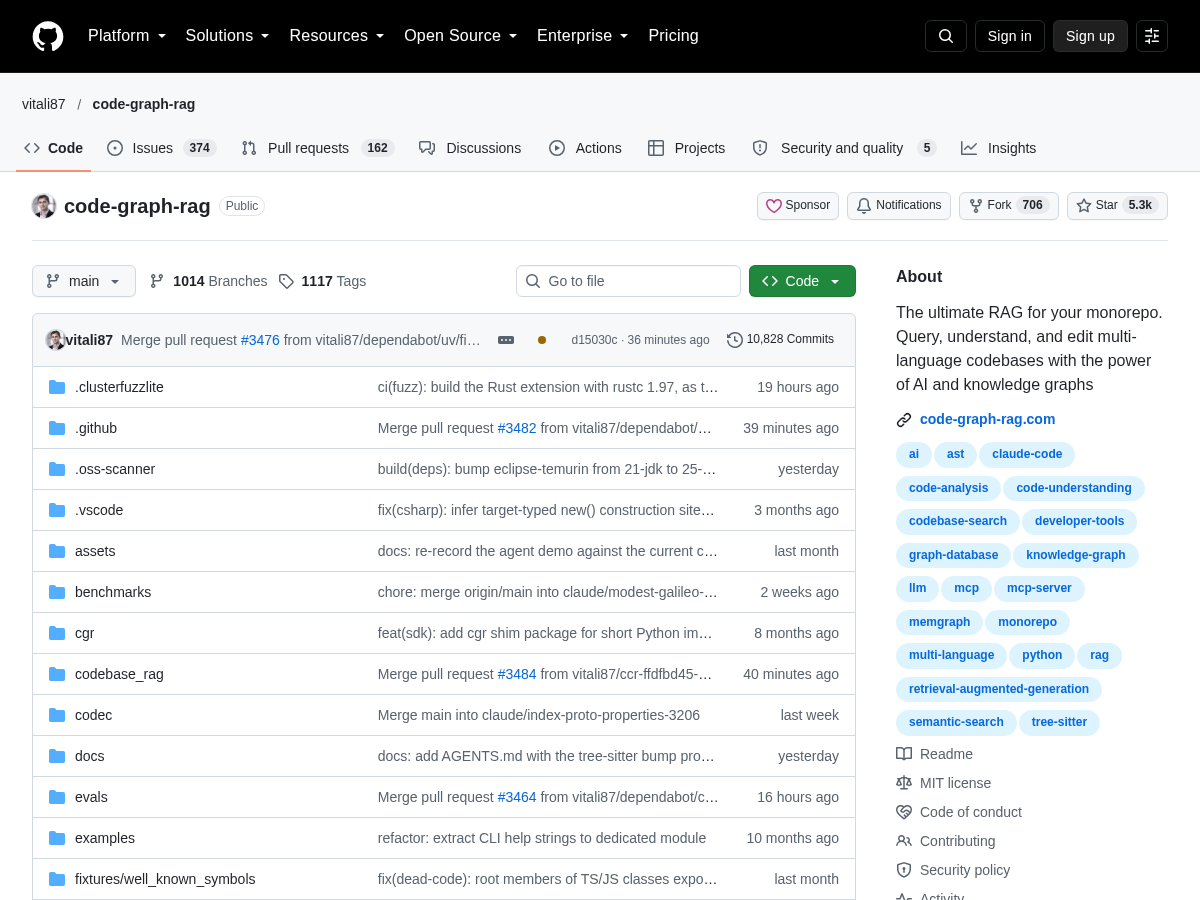
Screenshot of Code Graph Rag
Code Graph Rag
Dev Tools Open Source

Code Graph Rag is an open-source tool that enables users to query, understand, and edit multi-language codebases with the power of AI and knowledge graphs. It uses a Tree-sitter based parser to read the codebase and ingests functions, classes, methods, modules, and their relationships into a graph under a single language-agnostic schema. The system has two components: a multi-language parser and a RAG system that turns natural language into Cypher queries, retrieves matching code, and drives AI-powered editing and optimisation. The graph is stored in an embedded SQLite file by default, but Memgraph and Neo4j are also available as opt-in backends. Code Graph Rag supports a wide range of languages, including Python, TypeScript, JavaScript, Rust, Go, Java, C, C++, and many others. It provides features such as code optimisation, dead code detection, dynamic call tracing, and graph export. The tool is designed to be used by developers, ML engineers, and data scientists who need to work with large and complex codebases. Code Graph Rag is available on GitHub and can be installed using pip or uv. It is licensed under the MIT license and has a strong focus on community involvement and contribution.

Solves

Code Graph Rag solves the problem of navigating and understanding large and complex codebases, which can be time-consuming and difficult for developers. It provides a unified graph schema that allows users to query and edit code in plain English, making it easier to work with multi-language codebases. By using AI and knowledge graphs, Code Graph Rag enables users to optimise code, detect dead code, and trace dynamic calls, making it a powerful tool for developers and ML engineers.

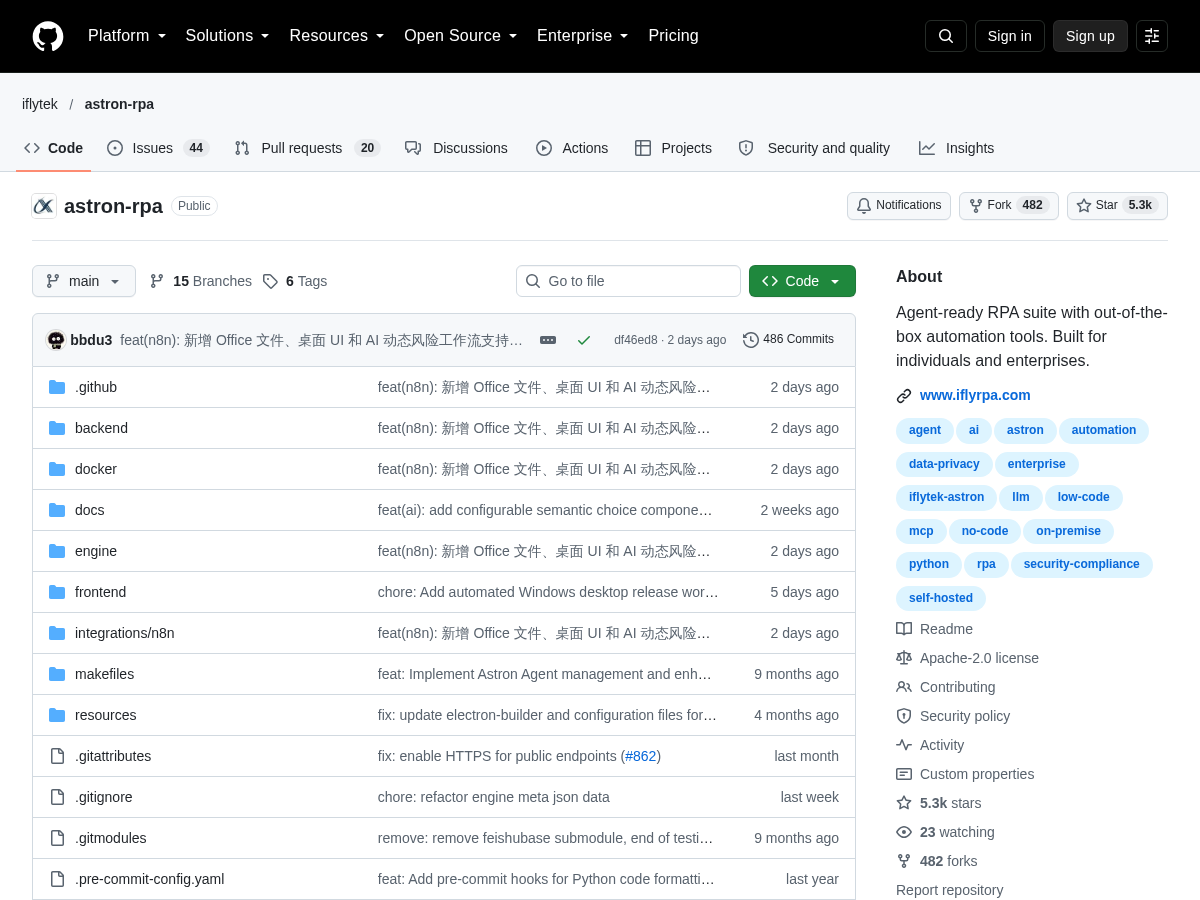
Screenshot of Astron Rpa
Astron Rpa
LLM Open Source

Astron RPA is an open-source, agent-ready RPA suite that provides out-of-the-box automation tools for individuals and enterprises. It is designed to automate tasks and workflows, and it supports various features such as Office file and desktop UI automation, AI dynamic code risk handling, and more. The project is built using Python and is available on GitHub under the Apache-2.0 license. Astron RPA has a strong focus on security and compliance, and it provides features such as data privacy and security-compliance. The project has a large community of contributors and users, and it is actively maintained with regular updates and new features being added.

Solves

Astron RPA solves the problem of automating repetitive and mundane tasks for individuals and enterprises. It provides a platform for automating workflows and tasks, which can help to increase productivity and efficiency. The tool is particularly useful for businesses that need to automate tasks such as data entry, document processing, and other repetitive tasks. By using Astron RPA, businesses can free up resources and focus on more strategic and creative tasks.

Screenshot of Edith
Edith
AI/ML Freemium

Edith is a personal AI assistant designed to be a proactive companion that integrates into a user's daily life. Unlike typical chatbots, Edith can initiate contact, surfacing reminders, insights, and performing tasks on your behalf even when you're not actively prompting it. It communicates through natural platforms like Telegram, WhatsApp, SMS, and phone calls, making it accessible as if texting or calling a friend. The AI is equipped with deep memory, allowing it to remember your goals, relationships, and personal history over time, becoming uniquely tailored to you. Edith can handle scheduled tasks and reminders—both one-off and recurring—such as daily research briefings, ensuring nothing slips through. It can browse the web to conduct research, make bookings, summarize YouTube videos and X posts, and even take actions online. Notably, Edith has its own virtual computer where it can manipulate files, create spreadsheets, slide decks, and reports, effectively automating document generation. Additionally, Edith learns from repeated tasks, automatically saving them as skills to improve efficiency over time, and it can spin up mini applications like dashboards or trackers on the fly. A web-based control panel gives users fine-grained control to manage tasks, take notes, and assign work. The service operates on a credit-based pricing model with monthly plans, making it a versatile AI companion for personal productivity and life management.

Solves

In the fast-paced digital age, individuals often struggle to manage their personal and professional tasks, appointments, and information overload. Edith solves the problem of having to constantly prompt AI assistants by acting proactively—remembering important details, anticipating needs, and automating routine tasks. It serves as an always-available personal assistant that communicates via preferred messaging channels, freeing users from the need to log into separate apps and manually schedule everything.

Screenshot of Kiln
Kiln
Evaluation Open Source

Kiln is a free, local-first workbench for the full AI development loop, including evals, optimization, prompts, RAG, fine-tuning, synthetic data, agents, and tools. The desktop app allows the whole team to contribute, while the MIT-licensed Python library ships the same tasks to production. Kiln runs entirely on the user's machine, with the option to bring their own API keys or go fully offline with Ollama. The platform tracks quality across every dimension, allowing users to iterate without breaking what already works. Kiln's Auto-Optimize feature searches across hundreds of prompt mutations and models to find what works best for every eval dimension. The open-source Python library allows users to build AI tasks in the app and deploy them with the library, with the same engine and project files, and no rewrite required. Kiln supports 190+ models tested across every provider, including OpenAI, Anthropic, Gemini, Bedrock, Ollama, OpenRouter, Fireworks, Groq, and more. The platform provides a GUI for the whole team, a library for engineers, and is local-first, with team-sync provided via Git infrastructure. Kiln's core Python library and REST server are MIT-licensed, and the desktop app is source-available, free to use, and built on the fair-code model. Datasets are open JSON, and users own and control their datasets. Kiln Pro is an opt-in service that adds the AI Assistant, Auto-Optimize, and the Eval Builder, while the core Kiln app remains fully functional without it. The Kiln name and logos are trademarks of Chesterfield Laboratories Inc.

Solves

Kiln solves the problem of AI development and deployment by providing a comprehensive, local-first workbench that allows users to build, evaluate, and optimize AI systems. It addresses the challenges of AI development, such as the need for a code-only framework, paid SaaS, and data lock-in, by providing a free, open-source platform that runs entirely on the user's machine. Kiln also solves the problem of tracking quality across every dimension, allowing users to iterate without breaking what already works. Additionally, Kiln's Auto-Optimize feature solves the problem of finding the best way to run AI tasks, by searching across hundreds of prompt mutations and models to find what works best for every eval dimension.