Tool discovery

What type of AI tool
are you looking for?

Search the active catalog with LambdaBase AI Search, or keep browsing the popularity-ordered directory below.

Submitted search queries and interaction metrics may be analyzed to improve result quality. Do not include personal or confidential information

Browse popular tools.

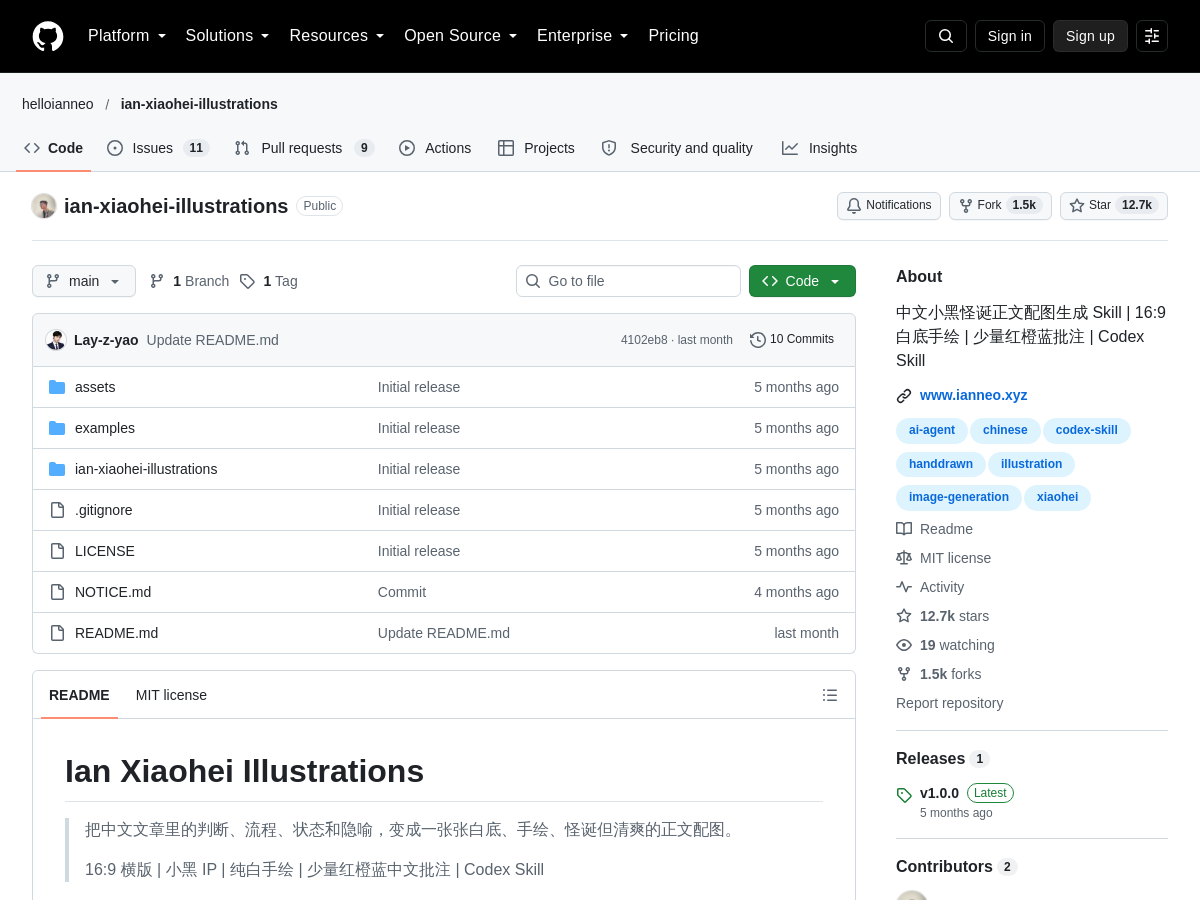
Screenshot of Ian Xiaohei Illustrations
Ian Xiaohei Illustrations
Image Gen Open Source

Ian Xiaohei Illustrations is a Codex Skill designed to generate illustrations for Chinese articles, posts, blogs, and Notion documents. It uses a unique visual style, characterized by a white background, black hand-drawn lines, and minimal red, orange, and blue annotations. The skill is intended to help AI agents create illustrations that are not only visually appealing but also convey complex ideas and concepts in a simple and intuitive way. The illustrations are designed to be used as inline images, and the skill can produce a series of images for a single article, each with its own unique theme and core idea. The skill is particularly suited for individuals who write Chinese articles, create knowledge-based content, or work with AI workflows. It is not suitable for those who require commercial illustrations, traditional PPT information graphics, or complex architecture diagrams. The skill is available on GitHub and can be installed by cloning the repository.

Solves

The problem that Ian Xiaohei Illustrations solves is the need for high-quality, customized illustrations for Chinese articles and documents. Many writers and content creators struggle to find illustrations that accurately convey the complex ideas and concepts in their work, and often resort to using low-quality or generic images. Ian Xiaohei Illustrations provides a solution to this problem by using AI to generate custom illustrations that are tailored to the specific needs of each article or document. This not only improves the visual appeal of the content but also helps to convey complex ideas in a more intuitive and engaging way.

Screenshot of Zeal
Zeal
Dev Tools Open Source

Zeal is an open-source offline documentation browser designed to provide developers with instant access to API references, manuals, and guides without requiring an internet connection. It aggregates documentation in the Dash docset format, allowing users to download and manage sets from various sources or create custom ones. The application supports full-text search with fuzzy matching and can display documentation in a clean, readable interface. Zeal is available for Windows and Linux, and it is inspired by the macOS application Dash. It is built with C++ and Qt, making it fast and lightweight. Users can integrate Zeal with code editors and IDEs through plugins, enabling context-sensitive lookup of symbols and keywords. The project is actively maintained and welcomes contributions from the community. Zeal solves the problem of slow or unavailable online documentation by providing a local, searchable library that works offline. It is particularly useful for developers who work in environments with restricted internet access or who prefer a distraction-free reference tool. The tool supports a wide range of programming languages and frameworks through its docset ecosystem, making it a versatile addition to any developer's toolkit.

Solves

Zeal addresses the need for quick, offline access to developer documentation. Instead of relying on web browsers and internet connectivity, it provides a local, searchable library of docsets that can be browsed instantly, improving productivity and ensuring documentation is always available.

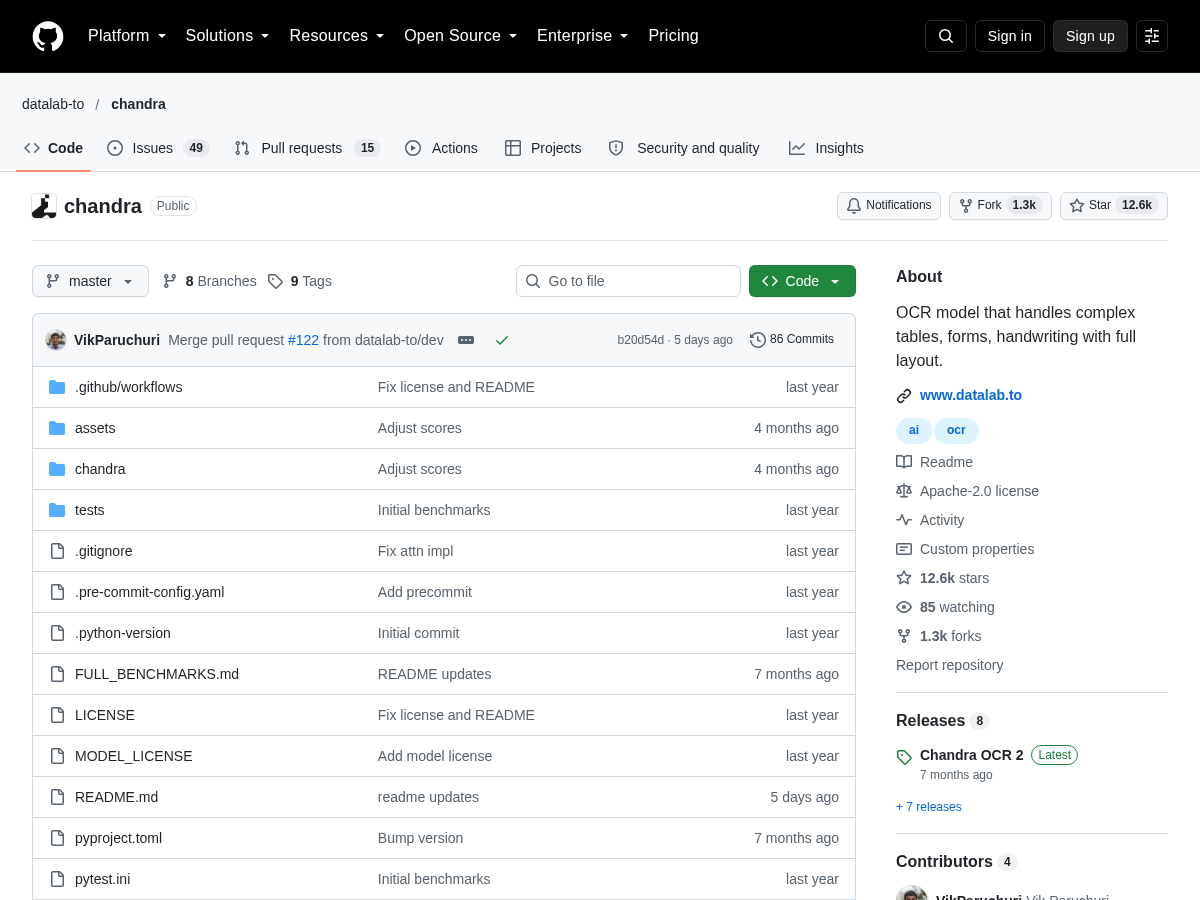
Screenshot of Chandra
Chandra
AI/ML Open Source

Chandra is a state-of-the-art OCR model that converts images and PDFs into structured HTML/Markdown/JSON while preserving layout information. It handles complex tables, forms, handwriting, and supports over 90 languages. The model is available under the Apache 2.0 license, and the model weights use a modified OpenRAIL-M license. Chandra can be used via a CLI tool, a Streamlit web app, or a vLLM server. It has been benchmarked against other OCR models and has shown excellent performance, especially in multilingual settings. The model has been trained on a diverse set of documents, including math, tables, scans, and multi-column layouts.

Solves

Chandra solves the problem of extracting structured data from unstructured documents, such as images and PDFs, while preserving layout information. This is particularly useful for applications where data needs to be extracted from documents, such as document scanning, data entry, and document analysis. Chandra's ability to handle complex tables, forms, and handwriting makes it a powerful tool for a wide range of use cases.

Screenshot of Illa Builder
Illa Builder
Dev Tools Open Source

ILLA Builder is an open-source low-code platform designed to accelerate the creation of business applications and internal tools. It offers a visual, drag-and-drop interface that allows developers and business users to build dashboards, CRUD apps, admin panels, CRM systems, CMS platforms, and more without writing extensive code. The platform integrates with a wide array of data sources, including PostgreSQL, MySQL, Supabase, GraphQL, MongoDB, MSSQL, REST APIs, Hugging Face, and Redis. This enables seamless connection to existing databases and services, making it easier to unify data and build functional tools. ILLA Builder supports workflow automation through scheduled tasks and webhooks, allowing users to create event-driven or time-based automations. It is positioned as an open-source alternative to Retool, offering the flexibility of self-hosting and customization while reducing reliance on proprietary SaaS solutions.

Solves

ILLA Builder addresses the challenge of quickly building internal business tools without the overhead of traditional software development. It reduces the time, cost, and technical barriers associated with creating custom dashboards, admin panels, and data management applications, while providing integrations with multiple data sources.

Screenshot of Awesome Generative Ai
Awesome Generative Ai
Model Serving Open Source

Awesome Generative AI is a curated list hosted on GitHub that aggregates modern generative artificial intelligence projects, services, and resources. The list covers a wide range of generative AI domains, including text generation, image synthesis, video generation, audio generation, code generation, and multi-modal models. It is maintained by the community and aims to provide a comprehensive overview of the rapidly evolving generative AI landscape. The repository organizes entries into categories such as large language models, diffusion models, tools, frameworks, datasets, and applications. It includes links to both open-source projects and commercial services, making it a valuable starting point for anyone exploring generative AI. The list is regularly updated, with contributions from developers, researchers, and enthusiasts. Unlike a traditional software tool, Awesome Generative AI functions as a living document or directory. It does not provide executable code but offers a structured collection of pointers to other projects. Users can browse the list to discover new tools, learn about state-of-the-art models, or find resources for building generative AI applications. As an open-source project, the repository is free to access and contributions are welcome. It has gained popularity among the AI community for its breadth and organization. The list is especially useful for staying up-to-date with the fast-paced advancements in generative AI.

Solves

The explosive growth of generative AI has led to a fragmented ecosystem of models, tools, and services, making it difficult to discover relevant resources. Awesome Generative AI solves this by providing a single, curated, and categorized list of projects and services, saving users time and effort in researching the landscape. It also serves as a community-driven hub for sharing new developments.

Screenshot of Posting
Posting
Dev Tools Open Source

Posting is an open-source, terminal-based API client designed to bring the power and flexibility of modern GUI tools like Postman into the command line. It is built with Python and the Textual framework, providing a rich, interactive text user interface (TUI) for crafting and sending HTTP requests. Users can easily manage request collections, environments, and variables directly from their terminal, making it ideal for developers who prefer keyboard-driven workflows. The tool supports all common HTTP methods, custom headers, request bodies, authentication, and response viewing with syntax highlighting. Posting also allows saving requests and collections to disk in a simple, human-readable format, enabling version control and sharing. Its streamlined interface reduces context switching and integrates seamlessly with existing terminal-based development workflows. Posting is distributed as a Python package installable via pip, and it runs on any system with a terminal, including remote servers and containers. This makes it particularly useful for developers who need to test APIs over SSH or in headless environments without a graphical interface. The project is actively maintained on GitHub and welcomes community contributions.

Solves

Posting solves the problem of needing a full-featured API client without leaving the terminal. Traditional GUI clients like Postman or Insomnia are resource-intensive and require a graphical environment, which is inconvenient for developers working in remote shells, over SSH, or in minimal setups. Posting provides a modern, keyboard-driven alternative that fits into existing terminal workflows, allowing developers to test and debug APIs quickly and efficiently.

Screenshot of PromptFix
PromptFix
Prompts Free

PromptFix is an AI output reliability platform designed to help users create prompts that deliver consistent, accurate, and on-brand results from ChatGPT, Claude, and Gemini. It provides a prompt score from 0 to 100 based on output reliability, hallucination risk, and constraint coverage, along with actionable fixes that clarify ambiguous instructions, add output format constraints, and specify target audiences. The platform aims to reduce trial-and-error by diagnosing prompt weaknesses in under 60 seconds. Beyond scoring, PromptFix includes tools for prompt improvement and testing. Users can create optimized variants, run A/B tests to compare reliability, build reusable preference profiles for tone and brand rules, and track prompt versions over time. Team collaboration features support sharing prompts and profiles, while a REST API enables programmatic integration. A Chrome extension brings prompt optimization directly into ChatGPT, Claude, Gemini, and Perplexity, and 300+ templates cover common use cases. PromptFix offers a free plan with 15 analyses per month, 25 templates, and one preference profile. Paid Starter and Pro tiers add more analyses, full template access, A/B testing, team collaboration, API access, reverse prompt from images, and multi-model comparison. Additional resources include a prompt engineering academy, a games hub, and a certified professional credential. The platform works as a responsive mobile web app and serves individuals, creators, and teams.

Solves

PromptFix solves the problem of unreliable AI outputs by giving users a quantitative reliability score for their prompts and specific suggestions to fix ambiguity, missing constraints, and other weaknesses. It helps users stop guessing and instead optimize prompts systematically across ChatGPT, Claude, Gemini, and other models, leading to more consistent, accurate, and on-brand results.

Screenshot of Clocsy
Clocsy
Sales Freemium

Clocsy is an autonomous sales engine designed to handle the repetitive parts of the sales process. According to its homepage, it finds buyers, starts conversations, follows up, and moves opportunities toward closed deals automatically. The platform positions itself as a tool that can find customers, fill roles, and track competitors without constant manual input, making it a broad revenue operations assistant rather than a single-purpose sales tool. Clocsy appears to be delivered as a cloud-based SaaS product with a freemium pricing model. It is aimed at businesses that want to automate outbound sales workflows and reduce the time spent on prospecting and follow-up. The tool combines sales automation with recruiting and competitive intelligence, suggesting it is designed for small teams and companies that need an all-in-one growth assistant. Because the product is described primarily through marketing materials, detailed technical specifications such as underlying models, integrations, and data sources are not publicly documented. Users should evaluate the tool based on trial usage and current feature documentation. Clocsy is best suited for organizations looking to augment their sales efforts with autonomous AI agents while maintaining human oversight for high-stakes interactions.

Solves

Clocsy addresses the time-consuming manual work of sales prospecting, outreach, follow-up, and pipeline management by using an autonomous AI agent to find buyers, start conversations, and move opportunities toward close. It also extends to recruiting and competitive tracking, reducing the need for separate tools and manual monitoring.

Screenshot of Gateway
Gateway
LLM Open Source

Portkey Gateway is an open-source AI gateway designed to provide a unified API for interacting with over 1,600 large language models (LLMs) from various providers. It acts as a central routing layer between your application and multiple LLM services, simplifying integration and management. One of its key features is integrated guardrails, offering more than 50 AI guardrails that can be applied to requests and responses for content moderation, PII redaction, and other policy enforcement. This helps ensure compliance and safety without additional tooling. The gateway is built for speed and reliability, supporting features like automatic retries, fallbacks, load balancing, and semantic caching to optimize performance and cost. It aims to provide a fast and friendly API, masking the differences between providers and enabling developers to switch models or providers with minimal code changes. Portkey Gateway is self-hosted and open source, allowing teams to maintain full control over their data and infrastructure. It is part of the broader Portkey ecosystem, which also offers a cloud-based version with additional enterprise features.

Solves

Portkey Gateway solves the complexity of integrating and managing multiple LLM providers by offering a single, unified API. It centralizes routing, reliability, and governance concerns such as guardrails, fallbacks, and caching, allowing developers to focus on building AI applications rather than dealing with provider-specific integrations and operational overhead.

Screenshot of RemoveWindowsAI
RemoveWindowsAI
Code Open Source

RemoveWindowsAI is an open-source utility designed to forcefully remove AI-related features from Windows 11, including Copilot, Recall, and other integrated components. It provides a script-based approach that allows users to reclaim control over their operating system and enhance privacy. The tool targets intrusive AI functionalities that some users find unnecessary or privacy-invasive. By executing the provided scripts, users can disable or uninstall these features, potentially improving system performance and reducing data collection. It is intended for those who prefer a minimal Windows experience. As an open-source project, it is available on GitHub for inspection and contribution. The scripts are likely written in PowerShell or Batch, making them accessible to technically inclined users. The repository includes instructions for use and may offer options for selective removal.

Solves

It solves the problem of unwanted AI features in Windows 11 that cannot be easily removed through standard settings, providing a forceful removal method for privacy-conscious users and administrators.

Screenshot of Camofox Browser
Camofox Browser
AI Agents Open Source

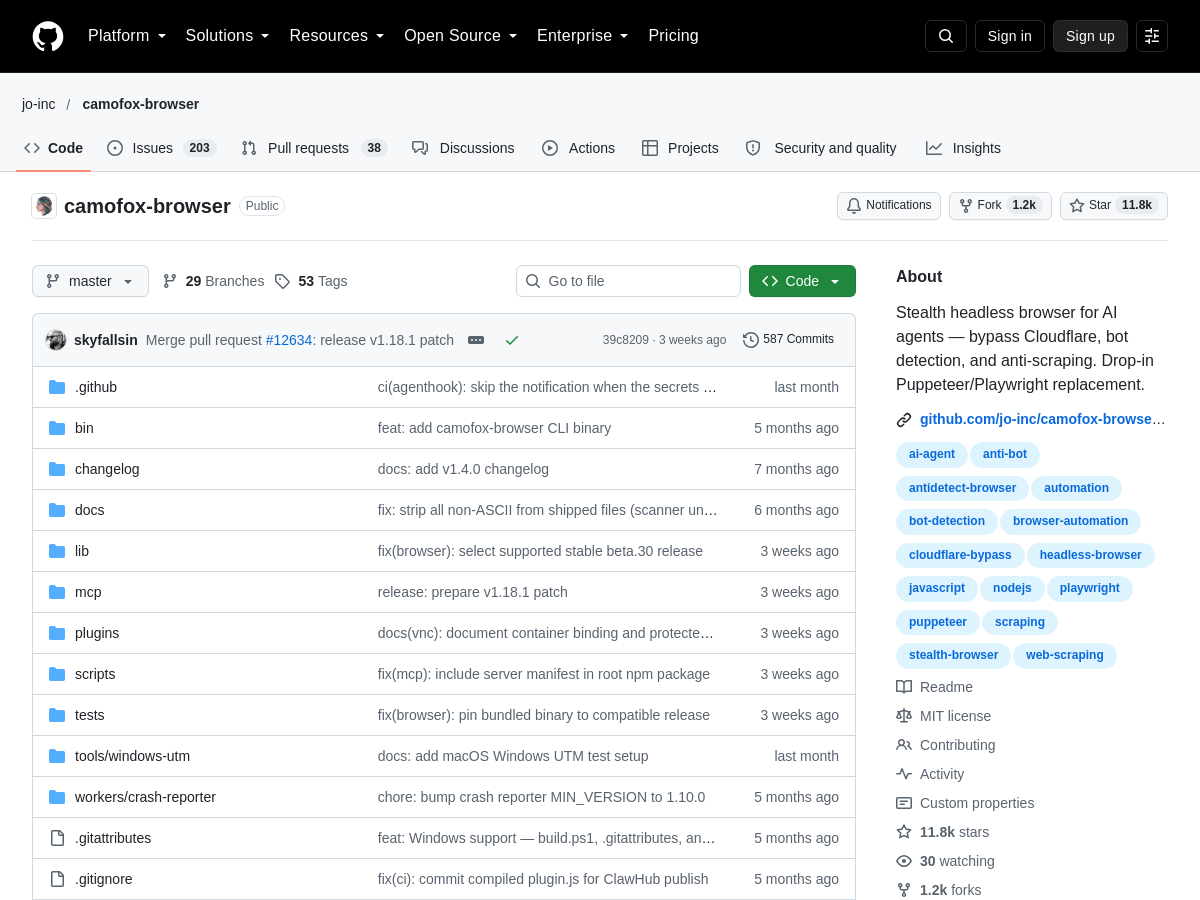
Camofox Browser is a stealth headless browser designed for AI agents, allowing them to bypass Cloudflare, bot detection, and anti-scraping measures. It serves as a drop-in replacement for Puppeteer and Playwright, providing a more efficient and reliable way to automate browser interactions. The library is built on top of Node.js and utilizes JavaScript, making it a versatile tool for web scraping, automation, and other applications. With its ability to evade detection, Camofox Browser is particularly useful for tasks that require anonymous browsing or scraping data from websites that employ anti-scraping measures. The library is actively maintained, with regular updates and a strong community of contributors, ensuring that it stays up-to-date with the latest developments in browser automation and anti-detection techniques. Camofox Browser is open-source, licensed under the MIT license, and has gained significant popularity among developers and researchers, with over 11,800 stars on GitHub. Its extensive documentation and community support make it an attractive choice for those looking to integrate a reliable and efficient headless browser into their projects. The library's architecture is designed to be highly customizable, allowing users to tailor it to their specific needs and use cases, ranging from simple web scraping to complex automation tasks. By providing a robust and stealthy browsing experience, Camofox Browser has become a go-to solution for many applications, including data mining, monitoring, and automation. With its strong focus on evasion techniques and anti-detection measures, Camofox Browser is an essential tool for anyone looking to automate browser interactions while avoiding detection. The library's commitment to open-source development and community involvement has fostered a collaborative environment, where users can contribute to its growth and improvement, ensuring that Camofox Browser remains a cutting-edge solution for browser automation and anti-detection. As the library continues to evolve, it is likely to become an even more indispensable tool for developers, researchers, and anyone looking to leverage the power of headless browsing for their projects.

Solves

Developers and researchers often face the problem of being detected and blocked by websites when attempting to scrape data or automate browser interactions. This can be due to various reasons, including the use of outdated or detectable browser automation tools. Camofox Browser solves this problem by providing a stealth headless browser that can bypass Cloudflare, bot detection, and anti-scraping measures, allowing users to automate browser interactions without being detected. By using Camofox Browser, developers and researchers can ensure that their projects are not disrupted by anti-scraping measures, and they can collect data or automate tasks with greater efficiency and reliability.

Screenshot of Awesome Chatgpt Zh
Awesome Chatgpt Zh
Prompt Engineering Open Source

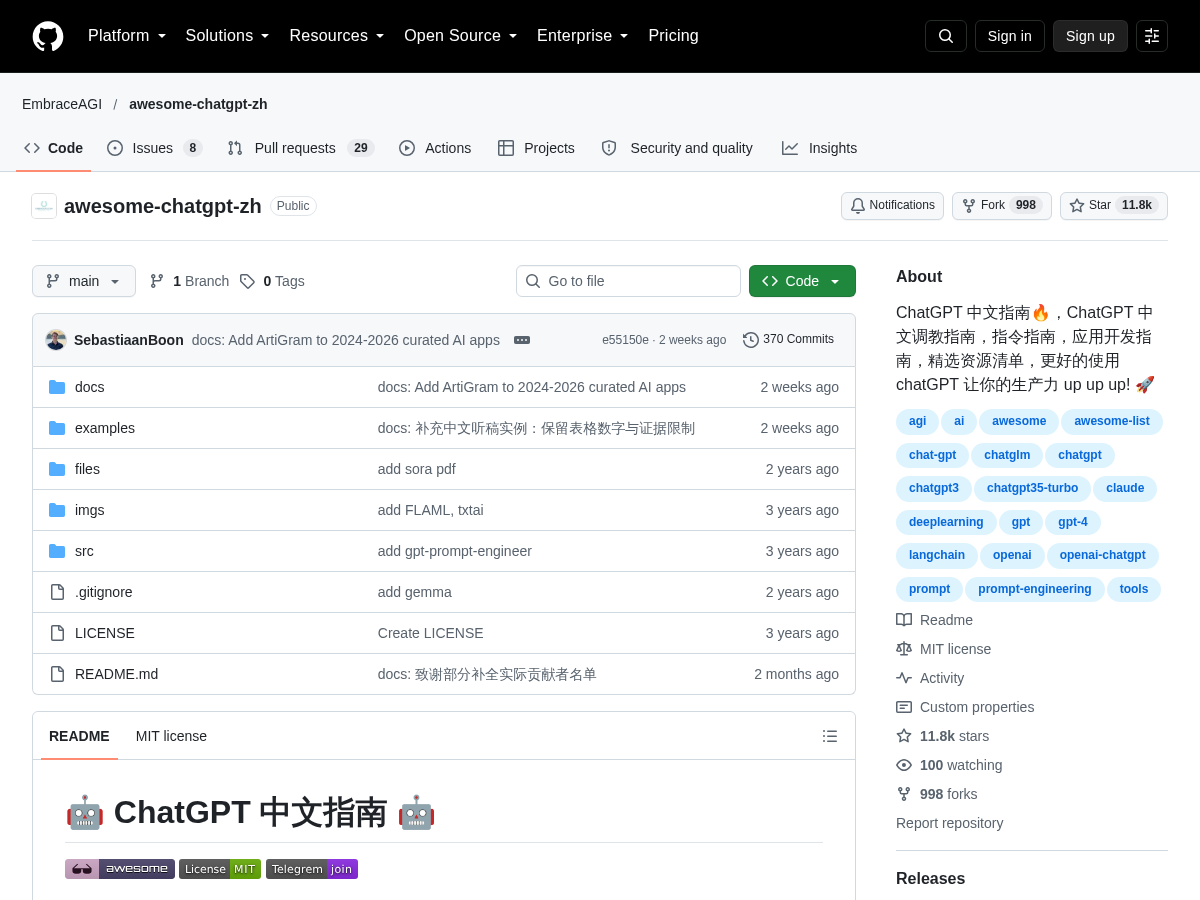
Awesome ChatGPT Zh is an open-source project that aims to provide a comprehensive guide for Chinese users to understand and utilize ChatGPT and other cutting-edge AI technologies. The project collects various free and paid resources, efficient methods for using Chinese to communicate with large models, and relevant resources for application development. It also covers production tools based on large model capabilities. The project is continuously updated to follow the latest AI developments, including GPT-5, Claude 4, DeepSeek-V4, and Gemini 3. It provides a wealth of tools, applications, and examples for users to explore.

Solves

The project solves the problem of Chinese users having limited access to resources and guidance on using ChatGPT and other AI technologies. By providing a comprehensive guide and collecting relevant resources, the project helps users to efficiently use ChatGPT and other large models, and to develop applications based on these technologies.

Screenshot of Codebase Memory Mcp
Codebase Memory Mcp
Dev Tools Open Source

Codebase Memory Mcp is a high-performance code intelligence server that implements the Model Context Protocol (MCP), designed to provide AI assistants with a structured, queryable knowledge graph of an entire codebase. It accepts an entire repository, indexes it into a persistent semantic graph of code entities—such as functions, classes, variables, imports, and their relationships—across 158 programming languages. The entire indexing process completes in mere milliseconds, even for large projects, making it suitable for real-time development workflows. The tool operates as a standalone binary, requiring no external dependencies or complex setup. Once deployed, it watches a repository directory (or accepts a path) and builds a persistent knowledge graph that survives server restarts. This graph enables sub-millisecond queries that can retrieve precise code context, including definitions, references, call hierarchies, and cross-file dependencies. Because it directly understands code structure, it can return exactly the relevant snippets, reducing the token footprint for LLM prompts by up to 99% compared to traditional file-based or search-based approaches. Key features include broad language support (158 languages), persistent on-disk storage for instantaneous startup, sub-millisecond query latency, and a simple MCP interface that works with any MCP-compliant client (e.g., Claude Desktop, Continue, Cursor). The tool is optimized for speed and resource efficiency, making it ideal for embedding into AI coding assistants, automated documentation tools, and continuous integration pipelines that require fast, accurate code understanding. Under the hood, it likely leverages incremental parsing and a graph database to minimize reindexing time and memory usage. The knowledge graph can answer complex queries such as “find all functions that call X” or “what are the dependencies of module Y” orders of magnitude faster than grep or conventional LSP servers. By offloading code intelligence to this dedicated server, LLM-based tools can focus on generation while dramatically reducing context length and improving output quality.

Solves

Developers and AI engineers often grapple with feeding relevant code context to large language models without overwhelming the context window with unnecessary tokens. Traditional methods like whole-file reading or keyword search produce tons of irrelevant code, leading to higher API costs, slower response times, and poorer model performance. Codebase Memory Mcp solves this by precomputing a compact, semantic representation of the codebase, allowing queries to fetch only the most relevant definitions and relationships in sub-milliseconds. This reduces token usage by up to 99% and enables faster, more accurate AI responses for code-related tasks.

Screenshot of Superset
Superset
AI Agents Open Source

Superset is an open-source code editor purpose-built for the era of AI agents. It allows developers to run and manage multiple AI coding assistants—such as Claude Code, OpenAI Codex, and others—simultaneously on their local machine. The editor provides a unified interface where users can spawn an 'army' of AI agents, each tasked with different aspects of software development like code generation, code review, bug fixing, or automated testing. By enabling parallel execution of these agents, Superset significantly accelerates development workflows and reduces the bottleneck of sequential AI interactions. Under the hood, Superset integrates deeply with popular AI coding tools through plugins and a flexible skills system. Commits in the repository reveal features like agent-driven ticket drafting for Linear, diff pane reviewing with comment composers, and command-line driven automation. The editor likely leverages modern web technologies (Electron) to deliver a cross-platform desktop experience. It also comes with a set of pre-built agent configurations and the ability to define custom skills and commands, making it extensible for diverse use cases. The tool embraces a local-first philosophy, keeping compute and data on the developer’s machine, which is crucial for privacy and latency-sensitive AI tasks. The active development community (over 11k stars and nearly 3,000 commits) continuously contributes improvements and integrations. Superset positions itself as the control center for AI-augmented programming, aiming to replace traditional IDEs with an agent-orchestrated coding environment.

Solves

Developers using AI coding assistants often juggle multiple tools or run agents sequentially, leading to context-switching overhead and idle wait time. Superset solves this by providing a cohesive environment where many AI agents can run in parallel, each handling distinct tasks (code generation, review, automation) without leaving the editor. This consolidates AI-assisted development into a single, efficient workflow.

Screenshot of Ekko Studio
Ekko Studio
LLM Open Source

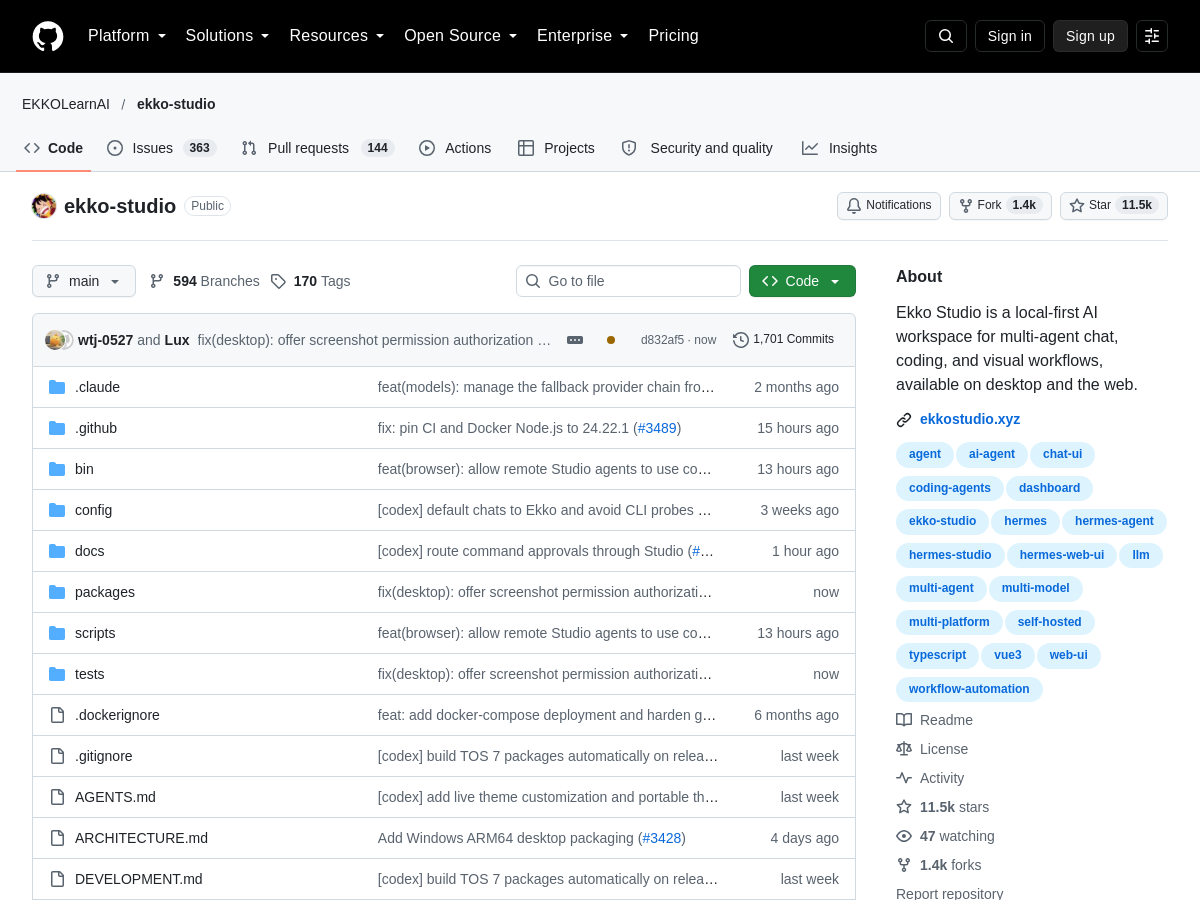
Ekko Studio is a local-first AI workspace designed for multi-agent chat, coding, and visual workflows. It is available on both desktop and the web, providing users with a flexible and accessible platform for various tasks. The studio supports a range of features, including multi-agent interactions, coding capabilities, and visual workflow management. With its self-hosted nature, Ekko Studio offers users control over their data and workflows, making it an attractive option for those prioritizing privacy and customization. The platform's architecture allows for the integration of multiple models and providers, enabling users to create complex workflows and automate tasks efficiently. Ekko Studio's web UI provides an intuitive interface for managing these workflows, including features like a Fallback tab for managing provider chains and support for dragging and dropping elements to reorder them. The studio also includes a range of tools for coding and development, such as a code editor and a terminal, making it a comprehensive environment for developers and users alike. Furthermore, Ekko Studio's focus on local-first design means that users can work offline, and their data is stored locally, enhancing security and reducing dependence on cloud services. Overall, Ekko Studio is a powerful tool for anyone looking to leverage AI and automation in their workflows, offering a unique blend of flexibility, privacy, and functionality. Ekko Studio is constantly evolving, with regular updates and commits from its development team, ensuring that the platform stays up-to-date with the latest technologies and user needs. The community around Ekko Studio is active, with many users contributing to its development through issues, pull requests, and discussions, which helps in shaping the platform's future and ensuring it meets the demands of its diverse user base. With its open-source nature, Ekko Studio encourages collaboration and transparency, making it an excellent choice for developers, researchers, and organizations seeking a customizable and community-driven AI workspace.

Solves

Developers, researchers, and organizations face the challenge of managing complex workflows, integrating multiple AI models, and ensuring data privacy and security. Ekko Studio solves this problem by providing a self-hosted, local-first AI workspace that allows users to create, manage, and automate workflows efficiently while maintaining control over their data. The platform's support for multi-agent chat, coding, and visual workflows makes it an ideal solution for tasks that require collaboration, automation, and customization, addressing the needs of a wide range of users from individual developers to large enterprises.

Screenshot of Pyroscope
Pyroscope
Dev Tools Open Source

Pyroscope is an open-source continuous profiling platform that enables developers to debug performance issues down to a single line of code. Originally developed by Pyroscope Inc. and later acquired by Grafana Labs, it is now part of the Grafana observability stack. The platform supports profiling of applications written in multiple languages including Go, Java, Python, Ruby, .NET, and more, using language-specific SDKs or low-overhead agents. It collects CPU, memory, and I/O profiles continuously with minimal performance impact. Pyroscope provides a rich UI with flamegraphs, comparison views, and tagging to analyze performance data over time. It can be deployed as a single binary, in Docker containers, or on Kubernetes, and integrates with Grafana for unified observability.

Solves

Pyroscope solves the challenge of identifying performance bottlenecks in production applications. Traditional profiling is often manual and intermittent, but Pyroscope provides continuous, always-on profiling with low overhead, allowing developers to pinpoint CPU, memory, and I/O issues down to the exact line of code causing slowdowns.

Screenshot of Tensorzero
Tensorzero
LLM Open Source

TensorZero is an open-source LLMOps platform designed to create a single control plane for large language model applications. It unifies an LLM gateway, observability, evaluation, optimization, and experimentation in one self-hosted system. The gateway provides a unified API for many model providers, with features like caching, retries, fallbacks, and rate limiting. Inference requests and user feedback are logged, enabling fine-grained monitoring and analysis. The platform supports online experimentation through A/B testing and can dynamically route traffic based on configurable rules. It includes built-in evaluation metrics and allows teams to define custom evaluators. TensorZero also captures data for offline fine-tuning and reinforcement learning from human feedback, closing the loop between production usage and model improvement. TensorZero is designed for teams building production LLM applications that need reliability, observability, and continuous optimization without locking into a single vendor. It is open source and can be deployed in your own infrastructure.

Solves

TensorZero solves the problem of fragmented LLM operations by providing a unified platform to manage inference, monitor quality, run experiments, and optimize models. It reduces manual plumbing and enables data-driven improvement of LLM applications.

Screenshot of Ccstatusline
Ccstatusline
Dev Tools Open Source

ccstatusline is an open-source statusline enhancement for the Claude Code CLI, designed to replace the default minimal prompt with a visually appealing, highly customizable interface. It leverages powerline symbols and a theming system to display contextual information in an elegant, structured format directly in the terminal. The project provides a beautiful statusline out of the box while allowing users to tailor colors, segments, and layouts to match their personal or team preferences. Built with extensibility in mind, ccstatusline integrates seamlessly with the Claude Code CLI workflow, offering real-time status indicators that improve situational awareness during AI-assisted coding sessions. Users can choose from several built-in themes or create their own, adjusting everything from segment order to color schemes. The tool is lightweight and loads quickly without impacting CLI responsiveness. As a community-driven project hosted on GitHub, ccstatusline welcomes contributions and feedback, encouraging developers to share custom themes and enhancements. Its installation is straightforward, typically involving cloning the repository and running a setup script, making it accessible even to those new to customizing their development environment. Overall, ccstatusline elevates the terminal experience for Claude Code users by blending form and function, turning a utilitarian status display into a polished, informative dashboard that boosts productivity and aesthetic satisfaction.

Solves

The default statusline in Claude Code CLI is sparse and lacks visual customization, offering no powerline support or theming options. This can reduce user engagement and make it harder to parse contextual information quickly. ccstatusline solves this by providing a feature-rich, themeable statusline with powerline aesthetics, enabling users to effortlessly monitor their session state while enjoying a modern terminal look.

Screenshot of Octop
Octop
AI Agents Open Source

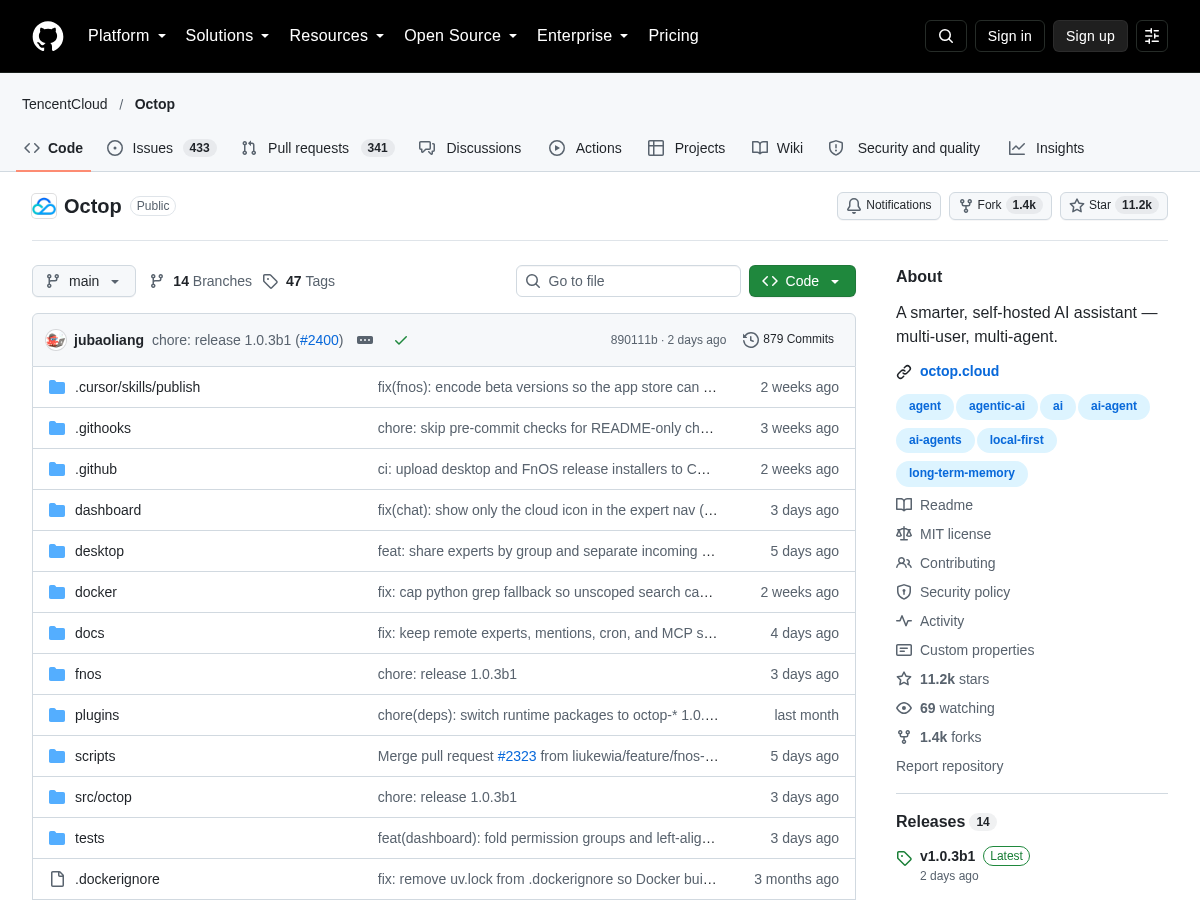
Octop is an open-source, self-hosted AI assistant platform designed for households and small teams. It operates as a single process, serving a web dashboard, CLI, IM channels, and cron automation, all sharing one control-plane database. The platform's primary goal is to keep every conversation, workspace, and credential on the user's machine, ensuring privacy while providing a personal team of specialized agents that can be switched between per task. Octop features multi-user support with JWT authentication, expert library, and market, as well as connectors for integrating with various services like Tencent Docs and Notion. It also includes a knowledge base for managing document corpora and semantic retrieval, and supports plugins for extending its functionality. The platform is built using Python 3.12+, FastAPI, and React, and can be deployed locally or using Docker. Octop's architecture is designed as a single process, with a restart-safe state rebuilt from the control-plane database on boot, ensuring data persistence and minimizing the risk of data loss.

Solves

Octop solves the problem of providing a private, self-hosted AI assistant that can be customized and extended to meet the specific needs of households and small teams. It addresses the issue of data privacy by keeping all conversations, workspaces, and credentials on the user's machine, and provides a flexible and scalable solution for managing multiple agents and experts. By offering a range of features, including multi-user support, expert library, and connectors, Octop helps users streamline their workflows, automate tasks, and improve productivity.

Screenshot of Open Swe
Open Swe
LLM Open Source

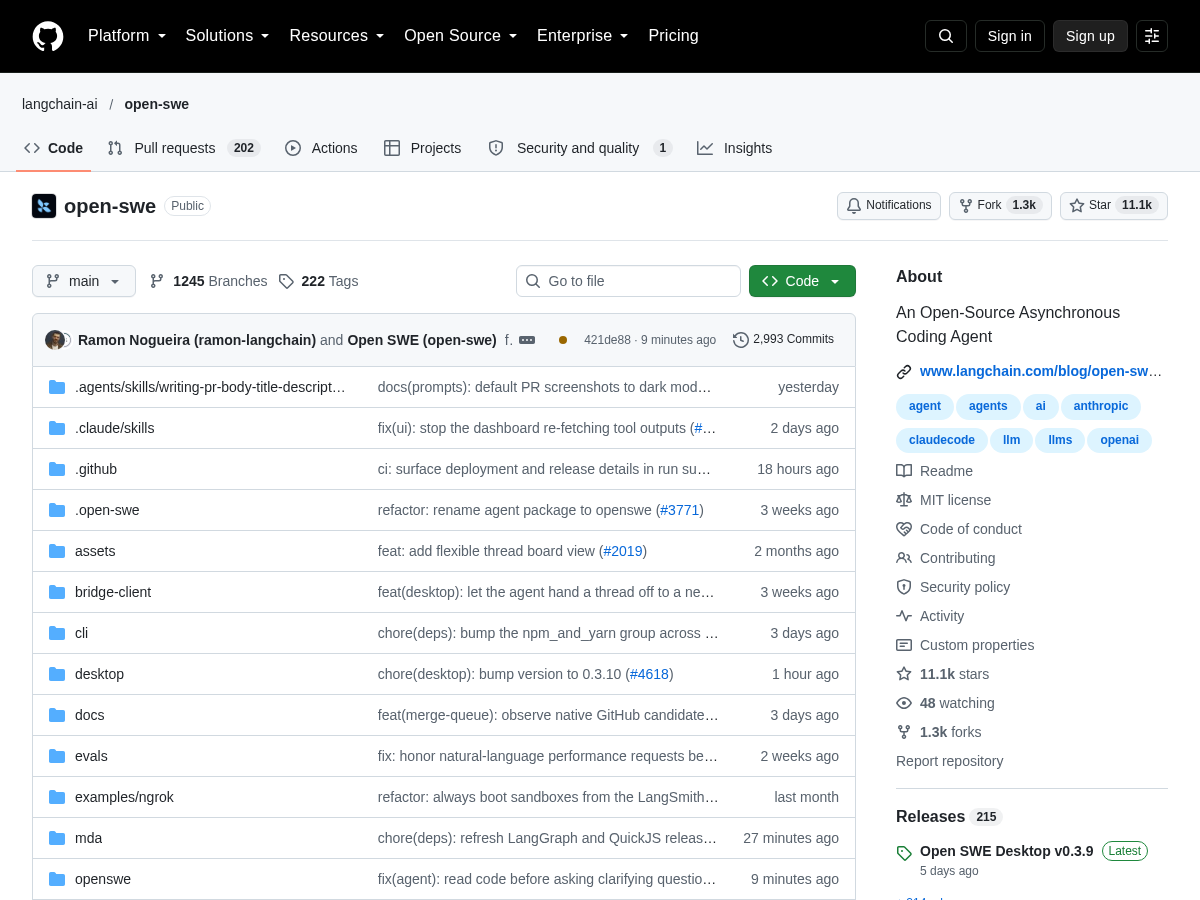
Open Swe is an open-source asynchronous coding agent designed to assist with various coding tasks. It is built on top of the LangChain framework and utilizes large language models (LLMs) to generate code and provide coding assistance. The project is hosted on GitHub and has gained significant traction, with over 11,000 stars and 1,300 forks. Open Swe is designed to be highly customizable, allowing developers to extend its functionality through plugins and integrations. The project's goal is to provide a robust and flexible coding assistant that can be used in a variety of development environments. Open Swe's architecture is based on a modular design, allowing developers to easily add or remove features as needed. The project is actively maintained, with regular updates and contributions from the community. Open Swe has the potential to revolutionize the way developers work, by providing a highly advanced and customizable coding assistant that can help with tasks such as code completion, code review, and debugging. The project's open-source nature allows for community involvement and contributions, which can help to drive innovation and improvement. Overall, Open Swe is a powerful tool that has the potential to significantly improve the development process, and its open-source nature makes it an exciting project to watch and contribute to. Open Swe's documentation and community resources are also well-maintained, making it easier for new users to get started and for experienced users to dive deeper into the project's capabilities. The project's maintainers are also actively engaged with the community, responding to issues and pull requests in a timely manner. This level of engagement and support is crucial for the success of any open-source project, and Open Swe's maintainers have demonstrated a strong commitment to building and maintaining a strong community around the project.

Solves

Open Swe solves the problem of inefficient coding practices by providing a highly advanced and customizable coding assistant that can help with tasks such as code completion, code review, and debugging. This can be particularly useful for large and complex codebases, where manual coding and review can be time-consuming and prone to errors. By leveraging the power of LLMs, Open Swe can help developers to work more efficiently and effectively, reducing the time and effort required to complete coding tasks. Additionally, Open Swe's open-source nature allows for community involvement and contributions, which can help to drive innovation and improvement, and ensure that the project remains relevant and effective in addressing the evolving needs of developers.

Screenshot of Harper
Harper
Dev Tools Open Source

Harper is an offline, privacy-first grammar checker developed by Automattic. It is written in Rust for maximum performance and safety. Unlike cloud-based grammar checkers, Harper processes all text locally, ensuring that sensitive content never leaves the user's device. This makes it ideal for environments where data privacy is paramount, such as in enterprise, healthcare, or legal writing. The tool provides real-time grammar and style suggestions, correcting common mistakes like subject-verb agreement, punctuation errors, and word choice. It is designed to be integrated into a variety of applications through its library, command-line interface, or desktop application. Because it is open source, developers can customize rules, add new languages, or embed it directly into their own software. The Rust core ensures low latency and minimal resource usage, making it suitable for use on devices with limited hardware capabilities. Harper’s architecture separates the core engine from language-specific rules, allowing it to support multiple languages with ease. It uses a combination of pattern matching and linguistic rules to detect errors, avoiding the need for large machine learning models that would compromise speed and offline capability. The project is actively maintained by Automattic, the company behind WordPress.com, WooCommerce, and other popular platforms, guaranteeing ongoing development and community support. For end users, Harper offers a desktop application that runs in the background and checks text in any application via accessibility APIs, providing universal grammar checking across macOS. It is also available as a command-line tool for batch processing of text files, and as a library for embedding in editor plugins, writing apps, or CI/CD pipelines for documentation checks. The tool is released under a permissive open-source license, encouraging widespread adoption.

Solves

Many writers, developers, and professionals rely on grammar checkers to polish their writing, but popular solutions like Grammarly require sending text to cloud servers, raising privacy concerns and requiring constant internet connectivity. Harper solves this by providing a fully offline grammar checker that runs locally, ensuring privacy and speed. It can be embedded in any application without the user needing to trust a third-party service with their data. This is especially critical for users handling confidential documents, those in regions with unreliable internet, or developers building writing tools that need a lightweight, self-hosted grammar engine.

Screenshot of Fiftyone
Fiftyone
Database Open Source

FiftyOne is an open-source toolkit designed to help machine learning practitioners refine high-quality datasets and visual AI models. It provides a unified environment for exploring, analyzing, and curating image, video, and multimodal datasets. At its core is a flexible Python library that enables users to load data from various formats, attach predictions and annotations, and perform complex queries and transformations. A built-in interactive web application—the FiftyOne App—offers rich visualizations such as grid views, similarity graphs, embedding plots, and sample details, making it easy to explore data and model results side by side. The tool integrates seamlessly with popular ML frameworks like PyTorch, TensorFlow, and Hugging Face, allowing users to compute embeddings, evaluate models, and identify failure modes directly within their workflows. Through its plugin system, FiftyOne supports custom visualizations, dataset operations, and integrations with other tools, enabling a highly extensible data-centric AI development cycle. With a focus on visual data understanding, FiftyOne accelerates the process of turning raw data into production-ready models by systematically uncovering annotation errors, class imbalances, and underperforming slices.

Solves

Computer vision engineers and data scientists often struggle to understand the quality of their training datasets and debug model failures without writing extensive custom scripts. They need to identify mislabeled samples, visualize model predictions, find duplicate or near-duplicate data, and explore embedding spaces to detect biases. FiftyOne solves this by providing a systematic, visual, and programmatic environment that unifies dataset exploration, model evaluation, and data curation. It eliminates the need for ad-hoc tooling by offering a flexible data model, powerful querying capabilities, and an interactive app that surfaces actionable insights, thereby shortening the iteration cycle for improving model accuracy.

Screenshot of Vibe Trading
Vibe Trading
LLM Open Source

Vibe-Trading is an open source project developed by HKUDS (University of Hong Kong Data Science Lab) that aims to provide a personal trading agent powered by large language models (LLMs). The tool is designed to assist users in making trading decisions by leveraging natural language processing and possibly automated analysis of market data. It falls under the LLM category and is available for free under an open source license on GitHub. While specific features and implementation details are not fully documented in the provided metadata, the project's positioning as a personal trading agent suggests it may integrate with financial data sources, execute trades, or provide recommendations based on LLM reasoning. As an open source project, it invites contributions and customization by developers and researchers interested in applying LLMs to quantitative finance. The repository is hosted at https://github.com/HKUDS/Vibe-Trading, and the tool is offered at no cost under open source terms. Users can clone, modify, and run the agent locally or in their own infrastructure, consistent with open source software practices.

Solves

Vibe-Trading addresses the challenge of integrating large language models into personal trading workflows by providing an open source agent that can analyze market information and assist with trading decisions, reducing the barrier to using AI for individual investors and developers.

Screenshot of PixelRAG
PixelRAG
Search Open Source

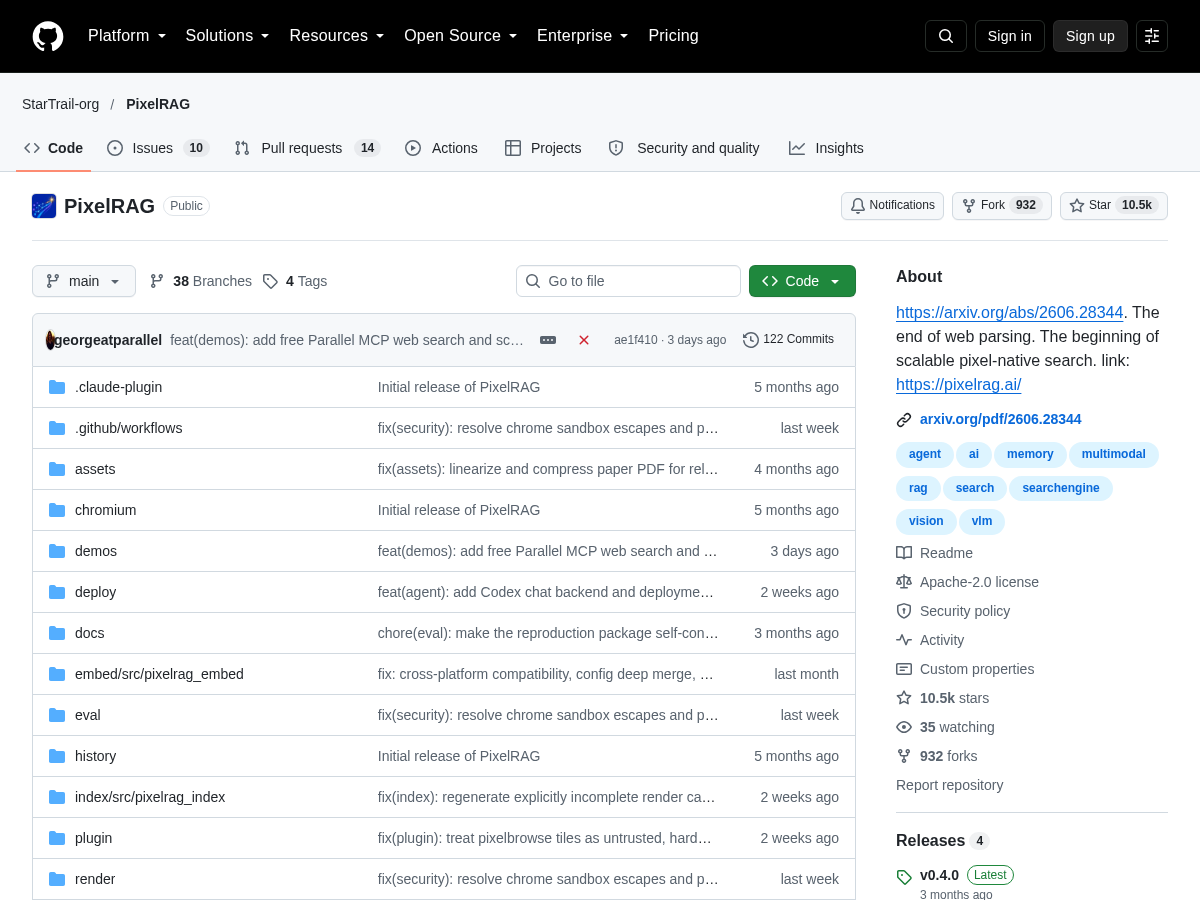
Overall, PixelRAG is a powerful open-source project that enables scalable pixel-native search. The project includes a range of tools and features, including a renderer, an embedder, and a search API, making it a versatile tool for a range of applications. PixelRAG is designed to be general-purpose and can be used for a range of applications, including question answering, text generation, and information retrieval. The project is built using a range of technologies, including Python, Playwright, and FAISS, and is licensed under the Apache-2.0 license.

Solves

PixelRAG solves the problem of scalable pixel-native search by rendering documents as screenshots and retrieving information over the images directly. This approach preserves visual structure that HTML parsing throws away, allowing the reader model to answer questions about the content. PixelRAG provides a range of tools and features that enable scalable pixel-native search, including a renderer, an embedder, and a search API. The project is designed to be general-purpose and can be used for a range of applications, including question answering, text generation, and information retrieval.

Screenshot of Linkeddit
Linkeddit
AI/ML Freemium

Linkeddit is an AI-powered Reddit marketing platform that helps businesses and solopreneurs find high-intent buyers, manage content, and monitor their presence on Reddit. It comprises seven integrated tools: a lead generation engine that discovers users ready to purchase based on product descriptions and scores them by buying intent; an AI keyword research tool that identifies high-converting search terms; an AI subreddit discovery feature that finds relevant communities; an AI content writer that generates engaging posts from top Reddit content; a Reddit CMS for planning, creating, and scheduling posts; an MCP integration to connect with AI assistants like Claude and Cursor; and a Chrome extension for sending DMs and comments directly. The platform automates the entire Reddit marketing workflow, from discovering leads to publishing content that ranks on Google, all without requiring prior Reddit experience. Users simply describe their product or service, and the AI adapts to their niche to surface opportunities. The system also includes monitoring tools for brand mentions, competitor analysis, and scheduled keyword scans with AI reply suggestions.

Solves

Businesses and marketers struggle to identify and engage potential customers on Reddit because manual searching is time-consuming and inefficient. Linkeddit automates lead discovery by scanning Reddit conversations for buying signals, scoring leads by intent, and providing context for personalized outreach. This eliminates hours of scrolling through subreddits and enables teams to connect with ready-to-buy prospects at scale, leading to higher conversion rates than traditional cold email.

Screenshot of Llm Engineer Toolkit
Llm Engineer Toolkit
LLM Open Source

Llm Engineer Toolkit is an open-source curated list on GitHub that aggregates over 120 LLM libraries and tools, organized by category. It serves as a reference for engineers and developers working with large language models. The repository provides a categorized collection, making it easier to discover libraries for various LLM-related tasks such as model training, fine-tuning, inference, deployment, evaluation, and more. Categories include frameworks, APIs, vector databases, prompt engineering tools, and other relevant areas. Maintained by KalyanKS-NLP, the project aims to keep the list updated with new relevant resources. It does not contain executable code but rather links and descriptions to external projects. Because it is a static list, users can browse, contribute via pull requests, and use it as a starting point for selecting appropriate tools for their LLM projects.

Solves

It solves the problem of fragmented information by providing a centralized, categorized index of LLM libraries, saving time for engineers who otherwise would need to search across multiple sources.

Screenshot of Openvino
Openvino
Model Serving Open Source

OpenVINO™ (Open Visual Inference and Neural network Optimization) is an open-source toolkit designed to optimize and deploy deep learning inference across a variety of Intel hardware platforms, including CPUs, integrated GPUs, discrete GPUs, and VPUs. It provides a unified API for inference in C++ and Python, along with a model optimizer that converts models from popular frameworks such as TensorFlow, PyTorch, and ONNX into an intermediate representation (IR) optimized for execution. The toolkit includes advanced optimization techniques like quantization, pruning, and layer fusion, which reduce model size and improve performance without significant accuracy loss. OpenVINO also features a runtime that supports heterogeneous execution, allowing parts of a model to run on different devices simultaneously to maximize throughput and efficiency. OpenVINO is widely used in computer vision, natural language processing, and generative AI applications across edge, cloud, and on-premises environments. It integrates with popular development tools and frameworks, supports Linux, Windows, and macOS, and offers a rich set of samples, benchmarks, and pre-trained models to accelerate development.

Solves

OpenVINO addresses the challenge of deploying deep learning models efficiently on diverse Intel hardware by providing a comprehensive set of tools to optimize, convert, and execute inference workloads, thereby improving performance, reducing latency, and minimizing resource consumption for AI applications.

Screenshot of Krita Ai Diffusion
Krita Ai Diffusion
Image Gen Open Source

Krita AI Diffusion is an open-source plugin for the Krita digital painting application that integrates AI image generation directly into the canvas. It provides a streamlined interface for inpainting and outpainting with optional text prompts, allowing artists to generate, edit, and extend images without leaving their workflow. The plugin supports various Stable Diffusion models and offers features like live preview, selection-based generation, and layer integration. It is designed to simplify AI-assisted art creation by eliminating the need for complex external tools or manual parameter tweaking. Users can select an area, type a prompt, and generate content that blends seamlessly with the existing artwork. The plugin runs locally and can leverage GPU acceleration for faster results, making it suitable for both casual experimentation and professional use. Since it operates within Krita, it benefits from Krita's robust layer system, brushes, and editing capabilities, enabling a hybrid workflow of traditional digital painting and AI generation.

Solves

It addresses the challenge of integrating AI image generation into a professional digital art workflow. Traditionally, artists had to switch between separate AI tools and image editors, which disrupted the creative process. This plugin brings inpainting and outpainting directly into Krita, allowing for seamless editing with minimal setup.

Screenshot of Metaflow
Metaflow
LLM Open Source

Metaflow is an open-source framework originally developed by Netflix to help data scientists and ML engineers build, manage, and deploy AI/ML systems efficiently. It provides a straightforward Python (and R) API to define complex data processing and model training workflows as a series of steps with automatic dependency management. Metaflow abstracts away infrastructure concerns, allowing users to prototype locally and then scale seamlessly to cloud resources like AWS Batch, Kubernetes, or other compute platforms without changing their code. The framework emphasizes human-centric design, making it easy to debug, inspect, and version data artifacts and models alongside code. With built-in features for experiment tracking, artifact persistence, and parallelization, Metaflow accelerates the end-to-end ML lifecycle from experimentation to production. Although the scraped content lacks detailed feature descriptions, these capabilities are widely recognized as core to the Metaflow project as inferred from its public documentation and community presence.

Solves

Data scientists and machine learning engineers often face challenges in moving from ad-hoc, local experimentation to scalable, production-ready workflows. Packaging code, managing dependencies, tracking experiments, and deploying models reliably can be complex and error-prone. Metaflow solves this by providing a unified framework where users define their workflows in Python or R, and the tool handles orchestration, versioning, and scaling across environments, reducing the engineering overhead and enabling faster iteration on ML projects.

Screenshot of SeeGrant
SeeGrant
Grant discovery Free

SeeGrant is an AI-powered grant discovery platform designed specifically for small businesses and nonprofits. It positions itself as a 'Grant Autopilot' that simplifies the entire grant-seeking process, from finding relevant opportunities to submitting applications. The platform aggregates a curated list of currently open canonical grant opportunities, which at the time of writing includes 861 entries, and uses AI to qualify them against an organization's profile and mission. Beyond simple discovery, SeeGrant provides intelligent analysis to help users understand their chances of success and whether a grant aligns with their goals. It also includes features for drafting applications, leveraging AI to generate tailored content and reduce the paperwork burden. The platform includes deadline tracking so that users can manage multiple applications without missing critical dates, allowing them to focus on their core mission rather than administrative tasks. SeeGrant is offered as a free service, making it accessible to small organizations with limited resources. Its user interface is designed to be straightforward, allowing users to quickly browse available grants, filter by criteria, and access AI-powered insights. While it is not a comprehensive database of all grant opportunities, it provides a carefully selected list of 'canonical' opportunities, ensuring quality over quantity. The platform is especially valuable for organizations that lack dedicated grant writers or development staff. By automating the initial research and drafting stages, SeeGrant helps level the playing field, giving smaller entities access to sophisticated tools that were once only available to larger institutions. Its focus on small businesses and nonprofits distinguishes it from more general-purpose funding search tools.

Solves

Finding and applying for grants is time-consuming and complex. SeeGrant solves this by providing an AI-powered, centralized platform that curates open grant opportunities, assesses fit, helps draft applications, and tracks deadlines, enabling small businesses and nonprofits to focus on their mission instead of paperwork.

Screenshot of Wordware
Wordware
AI Agents Unknown

Wordware is a web-based platform designed to enable users to build AI agents using natural language. It provides an interface where individuals can describe the desired agent behavior in plain English, and the platform translates those instructions into functional AI workflows. This approach abstracts away traditional coding requirements, making AI agent development more accessible. The platform likely supports features such as defining agent prompts, integrating with external APIs and data sources, testing agent responses, and deploying agents for production use. By using natural language as the primary programming paradigm, Wordware aims to streamline the creation, iteration, and maintenance of AI-powered assistants and automations. While specific technical details such as supported AI models, hosting options, and pricing are not publicly documented in the provided metadata, Wordware positions itself as a tool for both technical and non-technical users to quickly prototype and ship AI agents without deep programming knowledge.

Solves

Building AI agents typically requires programming expertise, model configuration, and infrastructure management. Wordware solves this by allowing users to define agent logic through natural language descriptions, reducing the barrier to entry and speeding up the development of AI-powered applications.

Screenshot of Beamtrace
Beamtrace
Observability Freemium

Hyprcore is a native macOS workspace that combines an AI-powered wiki, meeting recorder, solo screen recordings, web captures, and dictation with voice commands. It captures the words you say, hear, and read into a single local-first vault that can be searched by AI. Users can dictate into any app by pressing a shortcut, or speak 'Hyper' to trigger voice commands that edit selected text. Recordings of calls or solo walkthroughs are automatically transcribed and summarized, with key decisions and action items extracted and linked into the wiki. The application emphasizes on-device processing and privacy, storing data locally while providing AI search and agent capabilities. It includes a Notion-style page tree, command palette (⌘K), and integration with multiple speech recognition engines. Hyprcore is distributed as a signed and notarized macOS app for Apple Silicon with automatic updates, available under a freemium model.

Solves

Hyprcore solves the fragmentation of meeting notes, dictation, screen recordings, and web captures by unifying them into a searchable local-first knowledge base, reducing the need to switch between separate tools.

Screenshot of Garak
Garak
LLM Open Source

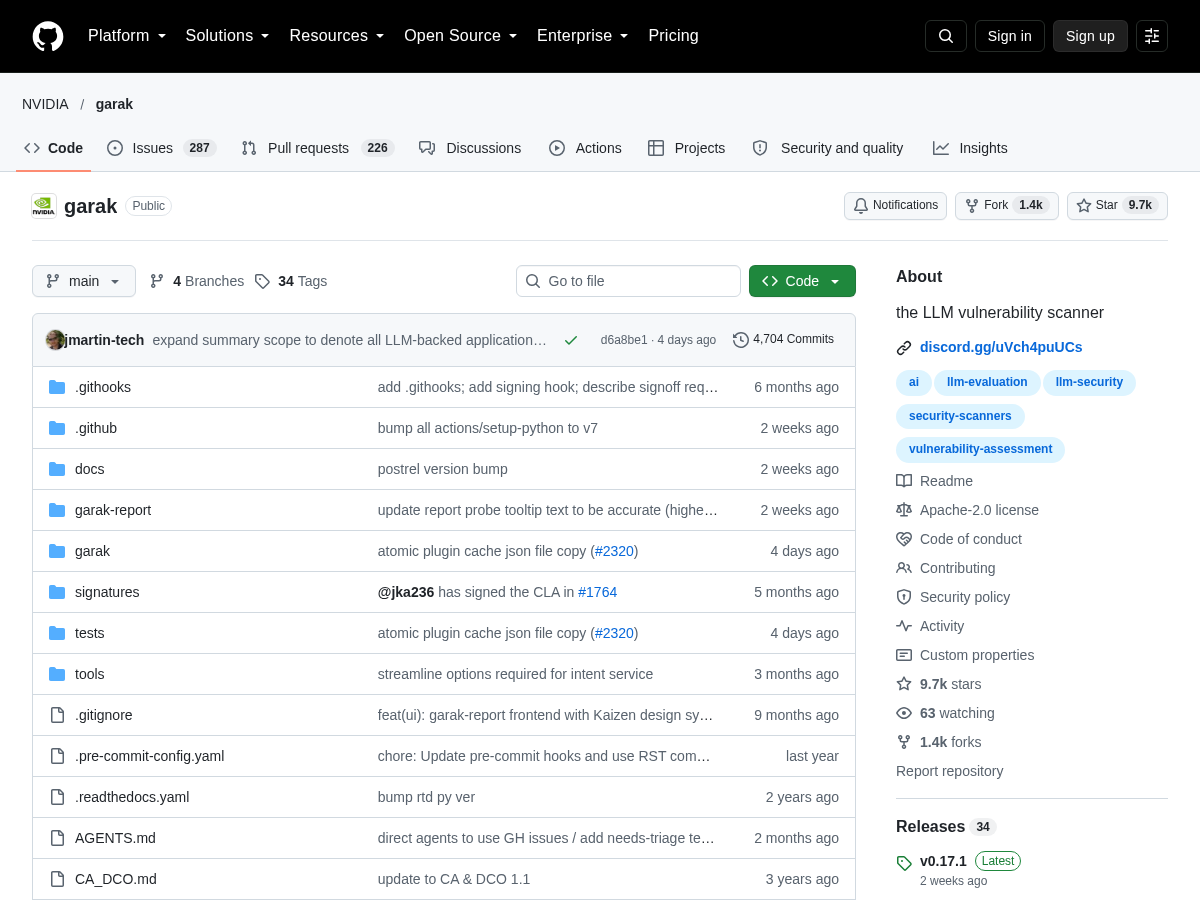
Garak is an open-source LLM vulnerability scanner developed by NVIDIA. It is designed to test the security of large language models (LLMs) by probing them with various attacks and evaluating their responses. Garak supports a wide range of LLMs, including those from Hugging Face, OpenAI, and Replicate, and can be used to identify potential vulnerabilities such as hallucination, data leakage, prompt injection, and toxicity generation. The tool is highly customizable, allowing users to specify the target model, probe, and detector to use, and provides detailed logging and reporting capabilities. Garak is developed in Python and is available on GitHub, with a user guide and reference documentation available on the project's website.

Solves

Garak solves the problem of identifying potential security vulnerabilities in large language models, which is a critical issue in the development and deployment of AI systems. By providing a comprehensive testing framework, Garak helps developers and researchers to identify and address potential weaknesses in their models, reducing the risk of security breaches and other adverse consequences.

Screenshot of MotionGen | Make Continues Video with Top Models

MotionGen is an AI-powered video generation platform that enables users to create continuous, full-length videos starting from a single good clip. Leveraging top AI models, it automatically extends and enhances video content, ensuring smooth and seamless motion across the entire video. The platform offers a rich template gallery organized by styles (such as Portraits, Romantic, Epic, Pets, Ads & E-com, ASMR, Chibi, Comedy, Stylize) and scenes (like Fashion, Cinematic, Futuristic, Anime & Cartoons, Gaming & TV, Crafts, Pop Art, Retro). This variety allows users to easily find and apply a desired aesthetic to their videos. With MotionGen, users can browse real examples to get inspiration and quickly understand the capabilities. The process is straightforward: upload or select a starting clip, choose a style and scene, and let the AI generate a coherent and visually appealing video. The tool is designed for both novice and experienced creators, eliminating the need for complex video editing software or advanced AI knowledge. MotionGen is particularly useful for creating short-form video content for social media, advertisements, e-commerce product showcases, and personal projects. Its freemium model allows users to explore basic features for free, with premium options likely offering higher resolution, longer durations, and additional customization. Overall, MotionGen democratizes video creation by harnessing cutting-edge AI to turn simple clips into professional-looking videos in minutes, empowering content creators, marketers, and hobbyists to produce engaging visual stories effortlessly.

Solves

Many individuals and businesses struggle to create long, engaging videos from short clips or static ideas due to lack of time, skills, or resources. MotionGen solves this by using advanced AI models to automatically generate continuous video from a single starting clip, with a variety of pre-built templates and styles, making high-quality video production accessible to everyone.

Screenshot of Toonflow App
Toonflow App
Image Gen Open Source

Toonflow is an open-source, cross-platform desktop application for creating animated short dramas from novels and scripts. It provides an integrated, one-stop pipeline that combines AI scriptwriting, intelligent storyboarding, character generation, and video generation. The application is designed to lower production costs and reduce the skill barrier for visual content creation by automating key steps from text to animation. The tool runs as a lightweight desktop app, allowing local deployment and batch processing of content. It is particularly suited for creators who want to turn written stories into ready-to-publish animated shorts without specialized animation expertise. By being open source, Toonflow also enables customization and community contributions to extend its capabilities.

Solves

Toonflow addresses the difficulty and expense of producing animated short dramas from written material. Traditionally, this process requires skilled animators, costly software, and significant time. Toonflow's AI-powered workflow automates scriptwriting, storyboarding, character design, and video synthesis in a single desktop tool, enabling creators to produce visual content quickly and at a fraction of the cost.

Screenshot of Managed Hermes Agent | Hostinger

Hostinger offers a managed Hermes Agent deployment, allowing users to launch the self-improving AI agent on a virtual private server (VPS) with a one-click Docker setup. The service eliminates the need for manual installation, ongoing maintenance, or infrastructure management. Hermes Agent features a browser-based admin panel for easy configuration and monitoring. It supports multi-platform messaging, enabling integrations with various chat and communication services. The agent is compatible with over 200 large language models, providing flexibility in AI model selection. Hostinger manages the underlying VPS, including automatic weekly backups and AI-driven server management. Pricing starts at $6.49 per month with a 30-day money-back guarantee, making it accessible for individuals and small teams.

Solves

Managed Hermes Agent removes the complexity of deploying and operating a persistent, self-improving AI agent. Users avoid manual server setup, Docker configuration, and ongoing maintenance, while gaining access to an admin panel, multi-platform messaging, and a wide range of LLM support.

Screenshot of Ralph Claude Code
Ralph Claude Code
AI Agents Open Source

Ralph Claude Code is an open-source command-line tool that creates an autonomous development loop for Claude Code. It repeatedly invokes Claude Code to work on a coding task, using intelligent exit detection to determine when the task is complete and stop the loop. This automates iterative workflows where the AI needs to make changes, run tests, and refine its output without manual intervention between steps. The tool is designed to improve developer productivity by allowing Claude Code to handle multi-step tasks autonomously, reducing the need for constant supervision. It is particularly useful for long-running coding sessions where the AI can explore a codebase, implement changes, and verify results until a satisfactory endpoint is reached.

Solves

Ralph Claude Code solves the problem of manually re-invoking Claude Code multiple times for complex tasks. It automates the iterative process, letting the AI continue working until it detects that the task is complete, saving developer time and reducing the need for constant supervision.

Screenshot of Harness Sdk
Harness Sdk
AI Agents Open Source

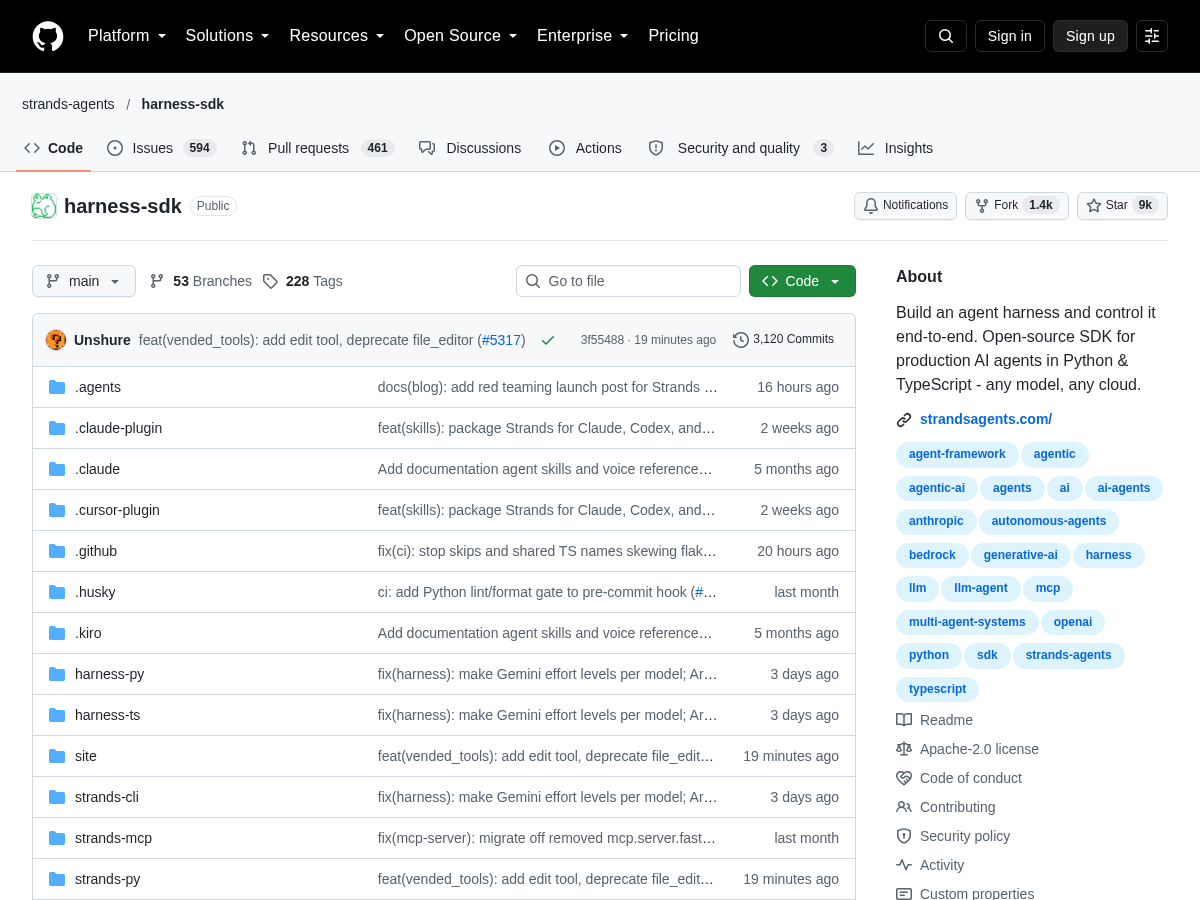
The Harness SDK is an open-source library for building and running AI agents in Python and TypeScript. It provides a model-driven approach to building AI agents, allowing users to build and control their agents end-to-end. The SDK includes features such as lifecycle controls, tools, structured output, MCP, multi-agent patterns, memory, sessions, model portability, streaming, guardrails, tracing, and evals. It also supports multiple model providers, including Amazon Bedrock, Anthropic, OpenAI, and Gemini, and allows users to swap backends when scaling. The SDK is designed to be flexible and customizable, with a focus on delivering outcomes that work. It includes a fully assembled agent, known as Strands harness, which can be used to get started quickly. The SDK also provides a range of documentation and examples to help users get started and learn more about the library.

Solves

The Harness SDK solves the problem of building and running AI agents in a flexible and customizable way. It provides a model-driven approach to building AI agents, allowing users to build and control their agents end-to-end. This solves the problem of having to write custom code to manage the agent loop, tools, model providers, and memory, and provides a range of features and tools to help users deliver outcomes that work. The SDK is particularly useful for developers who want to build AI agents that can be used in a variety of applications, and who need a flexible and customizable solution that can be scaled up or down as needed.

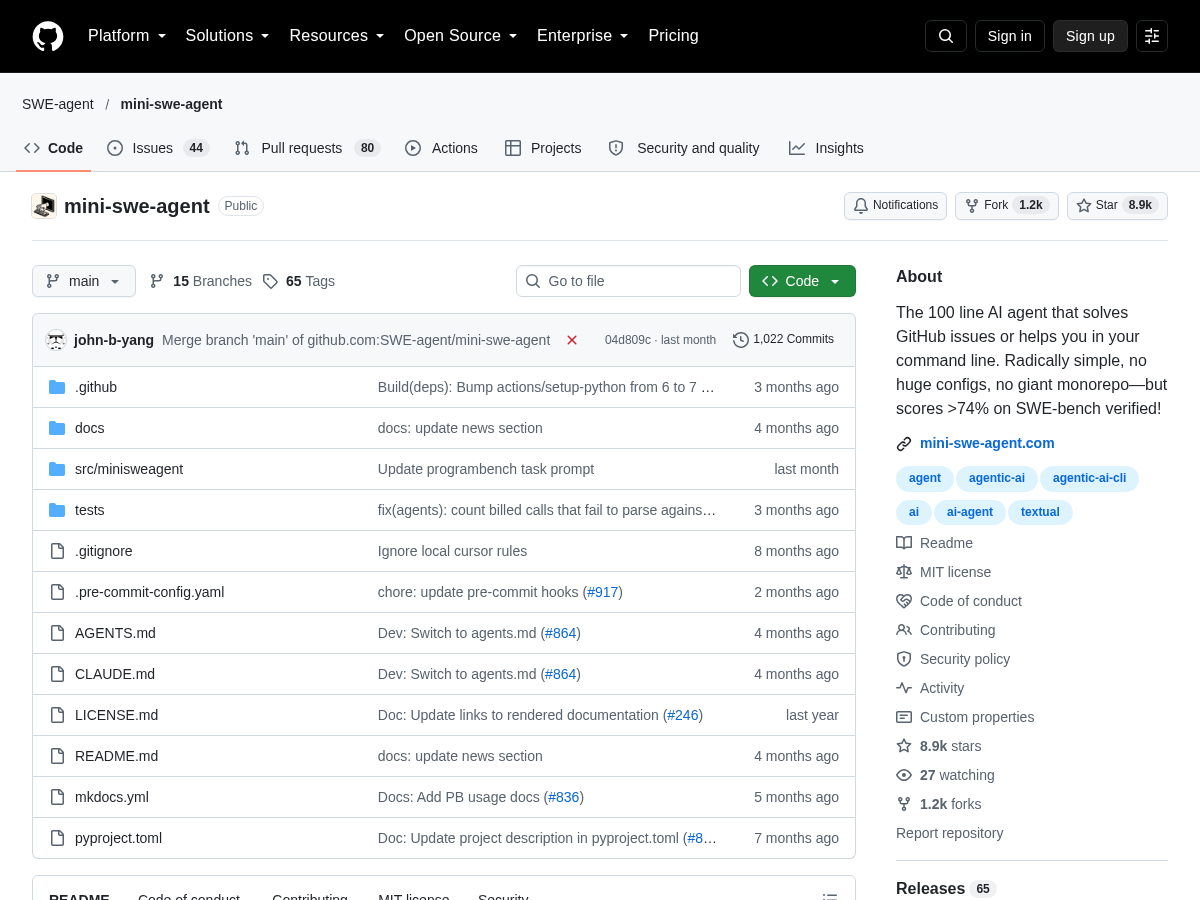
Screenshot of Mini Swe Agent
Mini Swe Agent
AI Agents Open Source

The Mini Swe Agent is an open-source AI agent designed to solve GitHub issues or assist in command line tasks. It is radically simple, consisting of only 100 lines of Python code, and does not require huge configurations or a giant monorepo. The agent scores over 74% on the SWE-bench verified benchmark and is widely adopted by companies such as Meta, NVIDIA, and IBM. It is also compatible with various models, including Litellm, Openrouter, and Portkey, and supports local environments, Docker, Singularity, and other deployment options. The agent's simplicity and flexibility make it an ideal choice for developers, researchers, and users who want a hackable tool that can be easily extended and customized. The Mini Swe Agent is built by the Princeton and Stanford team behind SWE-bench and SWE-agent, and is tested using Codecov. The project provides a range of features, including a CLI, batch inference, trajectory browser, and Python bindings, making it a versatile tool for various use cases. The agent's documentation is extensive, with a quick start guide, usage examples, and a FAQ section, making it easy for users to get started and troubleshoot issues. Overall, the Mini Swe Agent is a powerful and flexible tool that can be used for a variety of tasks, from solving GitHub issues to assisting in command line tasks, and is an excellent choice for anyone looking for a simple and effective AI agent. The agent's performance is also evaluated on the SWE-bench leaderboard, which provides a comprehensive comparison of different LMs with the mini agent. Additionally, the project provides a migration guide for users who want to switch from the previous version of the agent to the new version. The agent's simplicity and performance make it an ideal choice for users who want a reliable and efficient AI agent for their software engineering tasks.

Solves

The Mini Swe Agent solves the problem of providing a simple and effective AI agent for software engineering tasks, such as solving GitHub issues or assisting in command line tasks. The agent's radical simplicity and flexibility make it an ideal choice for developers, researchers, and users who want a hackable tool that can be easily extended and customized. The agent's compatibility with various models and deployment options also makes it a versatile tool for various use cases. By providing a simple and effective AI agent, the Mini Swe Agent helps users to streamline their software engineering tasks and improve their productivity.
Screenshot of Morphic
Morphic
Search Open Source

Morphic is an open-source AI-powered search engine that features a generative user interface. It is designed to provide more interactive and dynamic search results by leveraging artificial intelligence to understand queries and generate relevant UI components. The project is available on GitHub, allowing developers to self-host and customize the search experience. Built with modern web technologies, Morphic aims to offer an alternative to traditional search engines by combining AI-driven answer generation with a flexible, component-based interface. Users can deploy their own instance to create personalized search solutions for various domains. The open-source nature encourages community contributions and adaptation.

Solves

Morphic addresses the limitations of conventional search engines that return static lists of links. By using AI and a generative UI, it provides more contextual and interactive answers, enabling users to find information quickly and explore results in a dynamic interface. This is particularly useful for private or domain-specific search scenarios.

Screenshot of Cai
Cai
Framework Open Source

Cybersecurity AI (CAI) is an open-source framework for AI security developed by Alias Robotics. It provides a structured approach to identifying and mitigating security risks in AI and machine learning systems. The framework aims to bridge the gap between cybersecurity practices and AI development, enabling teams to incorporate security assessments throughout the AI lifecycle. CAI offers a set of tools and methodologies for testing AI models against potential threats such as adversarial attacks, data poisoning, and model inversion. It is designed to be integrated into existing AI pipelines, allowing developers and security professionals to evaluate the robustness and security posture of AI applications before deployment. As an open-source project, CAI encourages collaboration and transparency in AI security research. It targets researchers and practitioners who need a practical framework for securing AI systems, regardless of the underlying ML frameworks or deployment environments.

Solves

CAI addresses the growing need for security in AI systems by providing a framework to systematically evaluate and defend AI models against cyber threats. It helps organizations reduce the risk of AI vulnerabilities being exploited, ensuring that AI applications are robust and trustworthy.

Screenshot of Junie by JetBrains
Junie by JetBrains
Coding Free

Junie by JetBrains is an AI coding agent that brings end-to-end software development assistance directly to the command line and CI/CD workflows. Built on the IntelliJ IDEA engine, it understands code and handles tasks such as refactoring, migrations, and test coverage. The tool supports more than ten AI models through bring-your-own-key (BYOK), including Claude, Gemini, GPT, and Grok, letting teams choose the model that best fits their needs and budget. Junie is designed to reduce tool-switching and keep developers in control. It includes an advanced Plan Mode that writes structured, editable plans before touching code, live prompting to steer the agent mid-task, and human-in-the-loop approval for key actions. Cost efficiency is achieved by allowing planning on a powerful model and implementation on a faster, cheaper model, with the same output quality at a fraction of the cost. The agent works from the terminal, as a GitHub Action, or in GitLab CI/CD, enabling AI tasks to run directly from issues, pull requests, or merge requests. It also supports persistent team guidelines, custom skills, and /commands shared between the CLI and JetBrains IDEs through the Agent Client Protocol. Junie offers a free tier with 5 AI credits and paid AI Pro/AI Ultimate subscriptions, along with BYOK provider-rate pricing without markup.

Solves

Junie reduces the overhead of switching between a terminal, IDE, chat tools, and CI systems by providing a single AI coding agent that works across all of them. It helps developers plan, implement, and review code changes with configurable AI models while maintaining human oversight, cost control, and minimal migration friction.

Screenshot of BentoML
BentoML
LLM Open Source

BentoML is an open-source framework that simplifies the deployment of AI applications. It provides a unified environment for packaging, serving, and managing machine learning models in production. BentoML supports a wide range of ML frameworks, including TensorFlow, PyTorch, Scikit-learn, XGBoost, and more. Models are packaged into a standardized format called 'Bentos', which includes all dependencies, ensuring consistency across development and deployment. The framework offers built-in support for creating high-performance API services with adaptive batching, micro-batching, and GPU support. BentoML also enables the composition of multiple models into inference pipelines and provides a job queue system for long-running or batch inference tasks. It integrates with cloud-native technologies and can be deployed on platforms like AWS, Google Cloud, Azure, and Kubernetes using Docker. The tool streamlines the transition from model training to production, reducing the engineering overhead required to serve models at scale.

Solves

Deploying machine learning models to production is often complex and time-consuming, requiring engineers to handle infrastructure, scaling, and API development. BentoML solves this by providing a standardized, easy-to-use platform that packages models and their dependencies into a portable format, automatically generates REST APIs, and manages serving infrastructure, allowing data scientists and ML engineers to focus on model development rather than operations.

Screenshot of Blink.new
Blink.new
AI/ML Freemium

Blink.new is an AI-powered full-stack app builder that allows users to describe applications in plain English, and its AI agent automatically generates, deploys, and hosts production-ready software. The platform handles everything from database setup and authentication to payment integration and API creation, requiring no coding knowledge. With over 1 million builders and 3 million apps created, Blink positions itself as a complete solution for turning ideas into live applications quickly. Unlike code assistants or low-code tools, Blink delivers true full-stack apps with real databases, edge functions, and global hosting configured automatically. It includes an AI Gateway providing instant access to over 200 frontier AI models (text, image, video, speech) via a single API key, and Blink Claw, which runs persistent AI agents on messaging platforms like Slack, Telegram, and Discord for 24/7 automated tasks. The platform also enables users to build custom alternatives to popular SaaS tools such as Salesforce, HubSpot, Notion, Shopify, and many more, with pre-built templates and community examples available. Its explore section showcases 50,000+ real apps across categories like CRM, dashboards, e-commerce, and productivity, while step-by-step tutorials help users get started quickly.

Solves

Many individuals and businesses want to build custom software but lack coding expertise, time, or resources. Blink solves this by allowing anyone to create production-grade, full-stack applications using only natural language descriptions. It eliminates the need for traditional development, infrastructure management, and third-party integrations, enabling rapid prototyping and deployment of scalable apps with features like databases, authentication, and payments out of the box.

Screenshot of ChatGPT Shortcut
ChatGPT Shortcut
LLM Open Source

ChatGPT Shortcut is a browser extension designed to supercharge productivity when using ChatGPT. It provides a sleek sidebar panel that users can open directly within the ChatGPT interface to access, manage, and share a vast library of community‑curated prompts. Each prompt is just a click away, instantly pasting the text into the chat input, eliminating the need to retype common or complex queries. Beyond simple insertion, the tool offers full prompt management: users can create custom categories, bookmark favorites, and even write their own prompts with variables for dynamic reuse. The extension supports multiple languages, including English, Chinese, Spanish, and Arabic, making it accessible to a global audience. A built‑in editor with syntax highlighting helps users craft and refine prompts, while sharing features allow them to contribute back to the public prompt hub or share privately via links. Developed as an open‑source project, ChatGPT Shortcut is transparent and continuously improved by a community of contributors. Its lightweight design ensures it doesn’t slow down the browsing experience, and it works seamlessly with the standard ChatGPT web app. The prompt library covers a wide range of domains, from coding and SEO to creative writing and education, making it a versatile companion for anyone who relies on ChatGPT regularly.

Solves

ChatGPT users often spend excessive time typing familiar or elaborate prompts, or they struggle to recall the exact phrasing that yields the best results. This repetitive effort reduces efficiency and can lead to inconsistent outputs. ChatGPT Shortcut solves this problem by offering a one‑click prompt injection system, coupled with an extensive, organized, and shareable prompt library. It transforms ChatGPT into a more streamlined and powerful tool, enabling users to focus on the conversation rather than prompt construction.

Screenshot of Semantica
Semantica
AI/ML Open Source

Semantica is an open-source, graph-native infrastructure designed to provide context and accountability for AI systems. It enables developers to build AI applications on top of a flexible graph data model, representing entities, relationships, and provenance as first-class citizens. This approach facilitates traceability, explainability, and integration with existing knowledge graphs and data sources. The project aims to address the 'black box' problem in AI by offering a substrate where decisions, data lineage, and model interactions are explicitly modeled and queryable. By leveraging graph technology, Semantica can power retrieval-augmented generation (RAG) with rich context, audit trails for compliance, and dynamic knowledge bases for intelligent agents. As an infrastructure layer, Semantica is designed to be modular and extensible, allowing developers to connect it with LLMs, vector stores, and other AI components. It is available on GitHub under the Semantica AGI organization, encouraging community contributions and adoption.

Solves

Semantica addresses the lack of context and accountability in modern AI systems by providing a graph-based foundation to capture relationships, provenance, and reasoning paths, enabling explainable and auditable AI applications.

Screenshot of Aident Loadout
Aident Loadout
AI integration Free

Aident Loadout is a platform that provides AI agents with access to over 1,000 pre-integrated third-party tools and services. It allows users to connect their accounts to services like Notion, Gmail, Google Calendar, and X (Twitter) once, and then reuse those authenticated connections across any supported AI agent, including Claude Code, Cursor, Codex, and ChatGPT. The platform is designed to eliminate the manual setup and maintenance typically required to give agents real-world capabilities. Key features include a unified dashboard for managing all tool connections, a secure credential vault that keeps raw API keys hidden while providing an audit trail of agent actions, and support for premium built-in tools like Firecrawl, Gladia, Fal, and Exa at discounted rates using Aident credits. Installation can be completed by pasting a prompt into a coding agent or using one-click installers for specific environments. Aident Loadout emphasizes cross-compatibility, allowing users to build a tool configuration once and run it across different AI harnesses, chat interfaces, and devices. This reduces friction for developers and teams who work with multiple AI systems. The platform also addresses security concerns by ensuring that every action is auditable and that credentials are never exposed to the AI agent itself.

Solves

Aident Loadout solves the problem of manually integrating and managing multiple third-party APIs and services for AI agents. Instead of writing custom code or configuring each tool individually, users can connect services once through a centralized dashboard and immediately grant their agents the ability to perform real-world actions, saving time and reducing complexity.

Screenshot of MailSweeper
MailSweeper
Email management Unknown

MailSweeper is a web-based SaaS tool that connects to Gmail to automatically clean and organize inboxes. It identifies mailing lists, old promotional and social emails, and large attachments, then allows users to bulk unsubscribe or delete them in a few clicks. A dashboard provides metrics such as emails cleaned, storage space reclaimed, and unsubscribe count. Users can also schedule automatic sweeps that move clutter to a designated 'Dustpan' label and delete messages older than 30 days, keeping the primary inbox focused on important mail. The service emphasizes privacy by stating that emails are never stored, sold, or read by humans. It offers a Quick Clean feature for instant cleanup, one-click unsubscribe from all detected lists, smart labeling to route clutter away from the inbox, and scheduled automatic cleanup. MailSweeper is targeted at individual Gmail users and families who want to reduce inbox clutter and avoid paying for extra Google storage.

Solves

MailSweeper solves the problem of Gmail inbox clutter and storage bloat by automating the discovery and removal of unwanted newsletters, old promotions, social updates, and large attachments. It reduces the manual effort of searching, selecting, and deleting messages, and prevents clutter from accumulating again through recurring automatic sweeps.