Tool discovery

What type of AI tool
are you looking for?

Search the active catalog with LambdaBase AI Search, or keep browsing the popularity-ordered directory below.

Submitted search queries and interaction metrics may be analyzed to improve result quality. Do not include personal or confidential information

Browse popular tools.

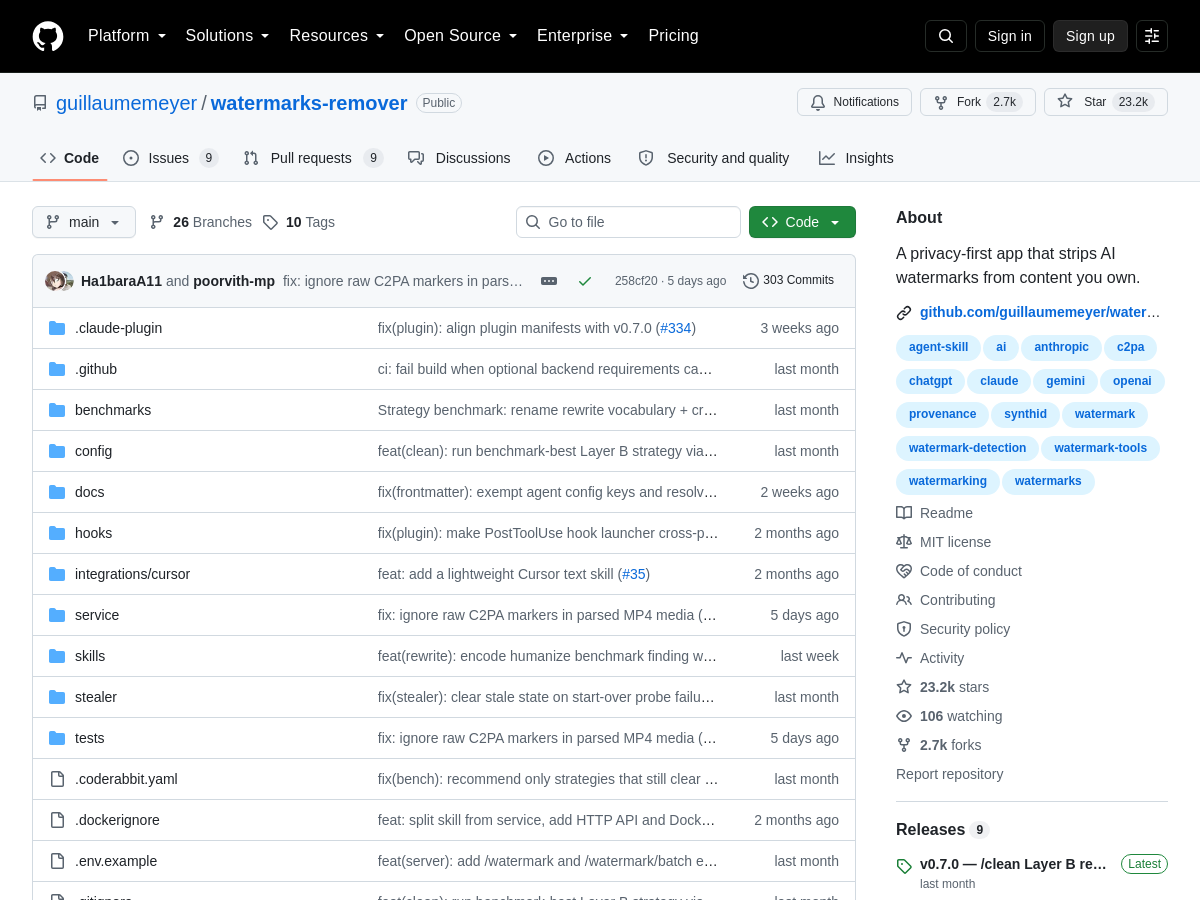
Screenshot of Watermarks Remover
Watermarks Remover
AI/ML Open Source

Watermarks Remover is a privacy-first app that strips AI watermarks from content you own. The project is hosted on GitHub and has gained significant attention with over 23,000 stars. The tool is designed to remove watermarks from AI-generated content, ensuring that users have control over their own creations. The project has a strong focus on community involvement, with multiple contributors and a transparent development process. The codebase is well-organized, with clear documentation and a robust testing framework. The tool supports various input formats and provides a range of configuration options, making it a versatile solution for users who want to remove AI watermarks from their content. The project's commitment to privacy and user control has resonated with the open-source community, and it continues to evolve with new features and improvements. The development team is active, and the project has a clear roadmap for future development. Overall, Watermarks Remover is a powerful tool that empowers users to take control of their AI-generated content and ensures that their creations are free from unwanted watermarks. The project's open-source nature and strong community involvement make it an attractive solution for users who value transparency and collaboration. With its robust feature set and active development, Watermarks Remover is an excellent choice for anyone looking to remove AI watermarks from their content. The tool's documentation is comprehensive, and the codebase is well-maintained, making it easy for users to get started and for developers to contribute to the project. The project's focus on privacy and user control has significant implications for the future of AI-generated content, and Watermarks Remover is poised to play a key role in shaping this landscape.

Solves

The problem of AI watermarks being embedded in user-generated content is a significant concern for many creators. These watermarks can be used to track and identify the source of the content, potentially infringing on the user's privacy and intellectual property rights. Watermarks Remover solves this problem by providing a simple and effective way to remove these watermarks, giving users control over their own creations and ensuring that their content is free from unwanted tracking or identification. By removing AI watermarks, users can protect their privacy and maintain ownership of their content, which is essential for creators who rely on their intellectual property to make a living.

Screenshot of Letta
Letta
AI Agents Open Source

Letta is an open-source platform for building stateful AI agents with advanced memory management. Originally released as MemGPT, it introduces a virtual context management system that allows large language models to store and retrieve long-term memory beyond their fixed context windows. This enables agents to maintain persistent state, recall past interactions, and self-improve over time. The platform includes a Python SDK, a REST API server, and a CLI for defining agents with custom memory blocks, tools, and multi-step workflows. Developers can connect various LLM providers, integrate external APIs and vector databases, and deploy agents as services. Letta supports scheduling, human-in-the-loop interruptions, and hierarchical memory tiers for efficient context handling. Letta can be self-hosted entirely via Docker or Kubernetes, or used through the hosted Letta Cloud service. The open-source core is actively developed and suitable for experimentation and production deployments. Its architecture decouples agent logic from model context, enabling more reliable long-running autonomous tasks.

Solves

Traditional LLM applications are stateless and limited by context windows, making it hard to build agents that remember users, learn from history, and execute long tasks. Letta solves this by providing persistent memory, virtual context management, and a framework for stateful agents that can accumulate knowledge and adapt over time.

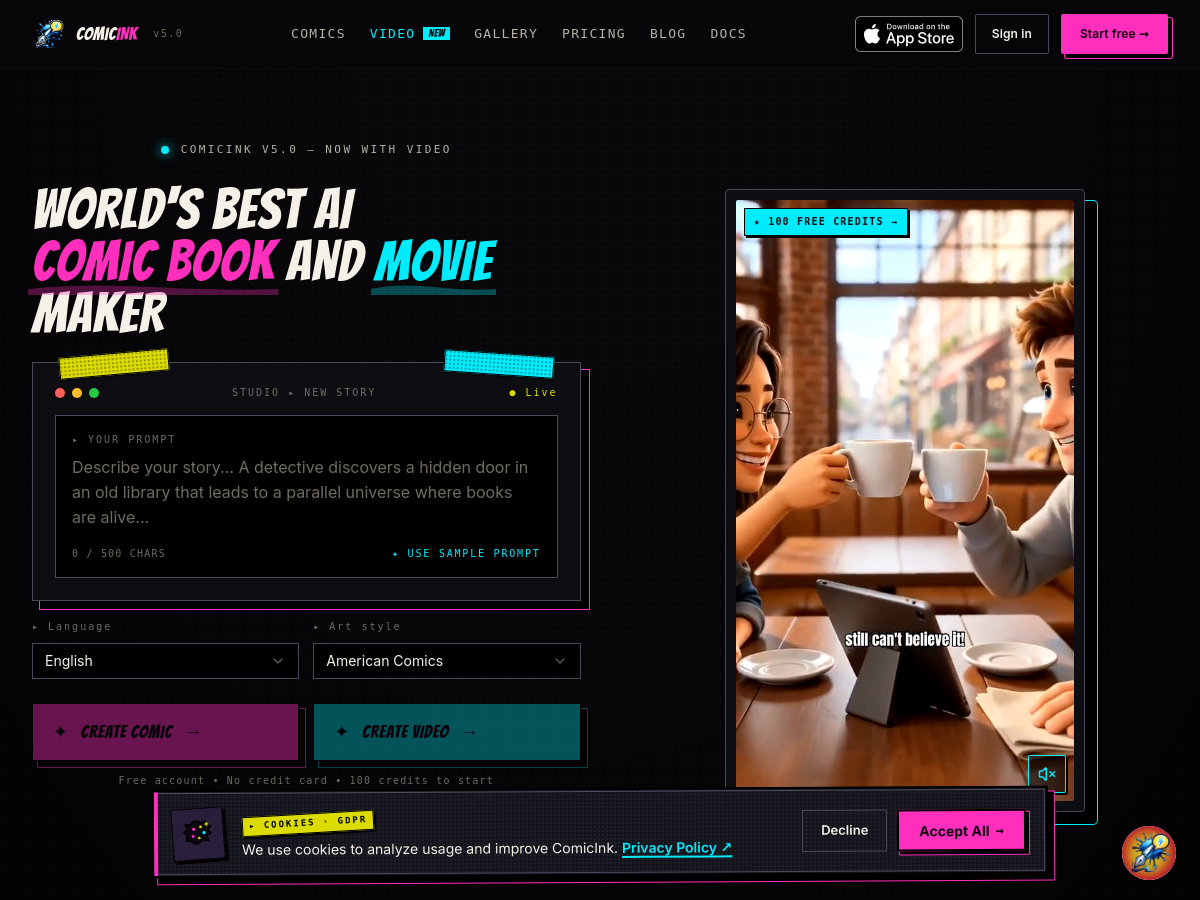
Screenshot of ComicInk
ComicInk
Comics Freemium

ComicInk is a freemium AI creative studio for generating comic books and narrated story videos from text prompts. The homepage describes it as the “World's best AI comic book and movie maker” and states that it turns words into printable comics and narrated films. Users provide a prompt (up to 500 characters), choose a language and an art style, and can create either a comic issue or a video. The platform advertises 12 art styles, including American Comics, Cartoon, European BD, Digital Art, and Chibi. Version v5.0 introduced video support, allowing a single prompt to generate a multi-scene film. ComicInk offers a free account with 100 credits and no credit card required. The site includes a public gallery of user-created comics and films, pricing, blog, help docs, and an iOS app available on the App Store. It is positioned for storytellers and creators who want to produce illustrated narratives or animated story videos without manual drawing or animation. The homepage shows example outputs such as personal stories, educational comics, and short films. It also lists support for multiple languages and several visual styles. The service is cloud-based and accessible through the web and iOS.

Solves

ComicInk reduces the skill and production barriers of creating comics and animated story videos by using AI to generate illustrated panels and narrated films from text prompts. It helps users avoid manual drawing, lettering, storyboarding, and animation work, making comic and video creation accessible to non-artists.

Screenshot of Grok
Grok
Productivity Free

Grok is a conversational AI assistant developed by xAI, designed to provide answers and engage in dialogue on a wide range of topics. It is integrated with the X platform (formerly Twitter) to access real-time information, allowing it to reference current events and social media trends. Grok is noted for its 'rebellious' and humorous personality, aiming to answer questions with wit and a touch of irreverence. The model is trained to be helpful and entertaining, with fewer restrictions than some competing assistants. As of the available public information, Grok is available to X Premium subscribers and has also been offered through a standalone chatbot interface. It represents xAI's effort to create AI systems that are curious and grounded in real-time knowledge. The service is consumer-facing, with potential API access for developers, though specifics are not confirmed. Grok is a closed-source commercial product, and its exact technical specifications are not publicly detailed.

Solves

Grok solves the problem of generic AI responses by providing a conversational assistant that incorporates real-time context from the X platform, delivering timely and context-aware answers. It also aims to address the demand for AI with a distinctive personality and fewer safety constraints, appealing to users seeking a more candid interaction.

Screenshot of 1-Click OpenClaw | Hostinger

1-Click OpenClaw by Hostinger is a managed AI assistant service that lets users deploy an always-on, private AI agent with a single click. It is designed for everyday automation, handling daily tasks around the clock with zero configuration and no hidden steps. Hostinger manages the underlying infrastructure, including security, updates, and backups, so users do not need to maintain servers or containers. OpenClaw includes built-in tools such as access to AI models, web browsing capabilities, and an agentic mailbox, enabling it to perform tasks like email drafting, research, and workflow automation. The service is positioned within Hostinger's agentic AI ecosystem, where users can choose from multiple automation apps on a single plan and switch anytime. The platform targets both technical and non-technical users by eliminating jargon and complexity. With more than 100,000 agents already deployed, Hostinger promotes OpenClaw as a fast, low-maintenance way to adopt AI agents for personal or small business productivity.

Solves

OpenClaw removes the complexity of setting up and maintaining an always-on AI agent. Users can deploy a private AI assistant in 60 seconds with zero configuration, and Hostinger handles security, updates, and backups, letting them automate daily tasks without DevOps expertise.

Screenshot of Stagehand
Stagehand
AI Agents Open Source

Stagehand is an open-source software development kit (SDK) designed to simplify the creation of AI-powered browser agents. It provides a high-level, natural language interface that allows developers to instruct agents to perform tasks on web pages without writing detailed DOM manipulation code. The SDK abstracts away the complexities of browser automation, enabling agents to navigate, click, type, and extract data using simple commands. Developed and maintained by Browserbase, Stagehand is built on top of robust browser automation technologies, likely leveraging Playwright for cross-browser support. It is intended for developers building intelligent agents that need to interact with the web, such as automated research assistants, data extraction pipelines, or end-to-end testing bots. The SDK is written in TypeScript and can be integrated into Node.js projects. Stagehand allows agents to understand and execute natural language instructions like "find the top news headlines and summarize them" or "fill out the contact form with the given details". It handles the translation of these instructions into low-level browser actions, including waiting for elements, handling dynamic content, and managing page state. The result is a significant reduction in development time for browser-based AI applications. The project is open source, encouraging community contributions and transparency. It is part of Browserbase's ecosystem, which offers additional cloud infrastructure for browser automation at scale. Stagehand can be used independently or in conjunction with other AI frameworks and language models, making it a flexible choice for developers exploring agentic web automation.

Solves

Stagehand addresses the challenge of building AI agents that can reliably interact with web pages. It provides a natural language abstraction over browser automation, eliminating the need for brittle selectors and manual scripting. Developers can quickly create agents that perform complex web tasks, reducing time-to-market for automation solutions.

Screenshot of Free Llm Api Resources

Free LLM API Resources is a curated list hosted on GitHub that aggregates free API endpoints for accessing large language models. It aims to help developers find no-cost options for LLM inference without needing to self-host models. The list includes various providers that offer free tiers or trial credits for their LLM APIs. The repository likely contains entries with details such as provider name, API endpoint, authentication method, rate limits, and supported models. It serves as a convenient reference for quickly locating free LLM services for experimentation, prototyping, and small-scale applications. By centralizing this information, the project lowers the barrier to entry for developers who want to integrate LLM capabilities into their projects but have budget constraints. It is community-maintained and open for contributions.

Solves

Finding free LLM inference APIs can be time-consuming and scattered across the web. This curated list solves that by providing a centralized, up-to-date resource where developers can quickly discover free options for LLM access without cost.

Screenshot of Awesome Ai Engineering
Awesome Ai Engineering
AI Agents Open Source

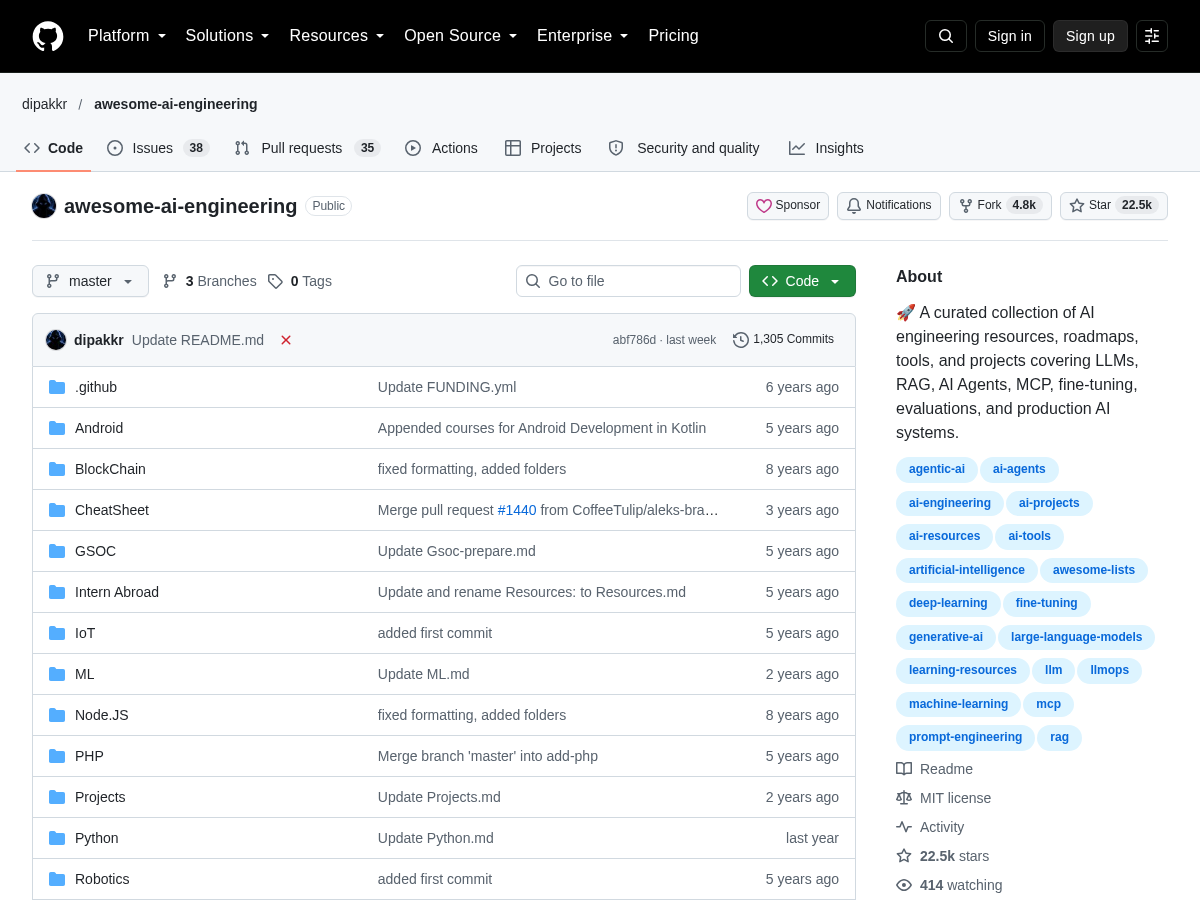
Awesome Ai Engineering is a curated collection of AI engineering resources, roadmaps, tools, and projects covering LLMs, RAG, AI Agents, MCP, fine-tuning, evaluations, and production AI systems. This project provides a comprehensive list of resources for AI engineers, including topics such as agentic-ai, ai-agents, ai-engineering, ai-projects, ai-resources, ai-tools, artificial-intelligence, awesome-lists, deep-learning, fine-tuning, generative-ai, large-language-models, learning-resources, llm, llmops, machine-learning, mcp, prompt-engineering, and rag. The project is hosted on GitHub and has a large community of contributors and users. It is a valuable resource for anyone looking to learn about AI engineering and stay up-to-date with the latest developments in the field. The project includes a wide range of resources, including tutorials, articles, research papers, and code repositories. It also provides a platform for AI engineers to share their knowledge and experiences, and to collaborate on projects. Overall, Awesome Ai Engineering is a unique and valuable resource that provides a comprehensive overview of the field of AI engineering. The project is constantly evolving, with new resources and updates being added regularly. It is a must-visit destination for anyone interested in AI engineering, and is a great starting point for those looking to learn more about the field. The project's contributors are actively working on improving and expanding the resources available, and the community is always looking for new contributors and users to join and participate. The project's goal is to provide a one-stop-shop for AI engineers, where they can find all the resources they need to learn, grow, and succeed in their careers. With its comprehensive list of resources, active community, and constant updates, Awesome Ai Engineering is an invaluable resource for anyone involved in AI engineering.

Solves

AI engineers and researchers often struggle to find comprehensive and up-to-date resources on AI engineering, including LLMs, RAG, AI Agents, MCP, fine-tuning, evaluations, and production AI systems. Awesome Ai Engineering solves this problem by providing a curated collection of resources, roadmaps, tools, and projects that cover these topics. The project provides a single destination for AI engineers to find all the resources they need, saving them time and effort in searching for relevant information. Additionally, the project's community and contributors provide a platform for AI engineers to share their knowledge and experiences, and to collaborate on projects, which helps to advance the field of AI engineering as a whole.

Screenshot of Openui
Openui
AI/ML Open Source

OpenUI is an open-source tool developed by Weights & Biases that allows users to describe user interfaces using natural language and instantly see them rendered live in the browser. The platform leverages large language models to interpret text descriptions—ranging from simple layout requests to detailed component specifications—and generates corresponding HTML, CSS, and JavaScript code in real time. This immediate feedback loop enables rapid iteration, making it easy to tweak the description and watch the UI update on the fly. Built with a Python backend and a modern frontend, OpenUI can be deployed locally or on a server, giving users full control over their data and environment. The tool supports a variety of UI frameworks and component libraries, and it can export clean, production-ready code for further development. Its interactive playground includes features like live preview, code editing, and version history to streamline the UI creation process. OpenUI is designed to bridge the gap between idea and implementation, empowering both technical and non-technical users to prototype interfaces without writing a single line of code. It integrates with the Weights & Biases ecosystem, allowing ML practitioners to quickly build monitoring dashboards or experiment tracking UIs. The project is actively maintained on GitHub, with a growing community contributing templates, models, and extensions.

Solves

Designers, product managers, and developers often struggle to quickly translate conceptual UI ideas into visual mockups, leading to slow iteration cycles and communication gaps. OpenUI solves this by enabling anyone to describe a desired interface in plain English and instantly see a rendered version, eliminating the need for manual coding or design tools during early-stage prototyping.

Screenshot of 100 Days Of ML Code
100 Days Of ML Code
Code Open Source

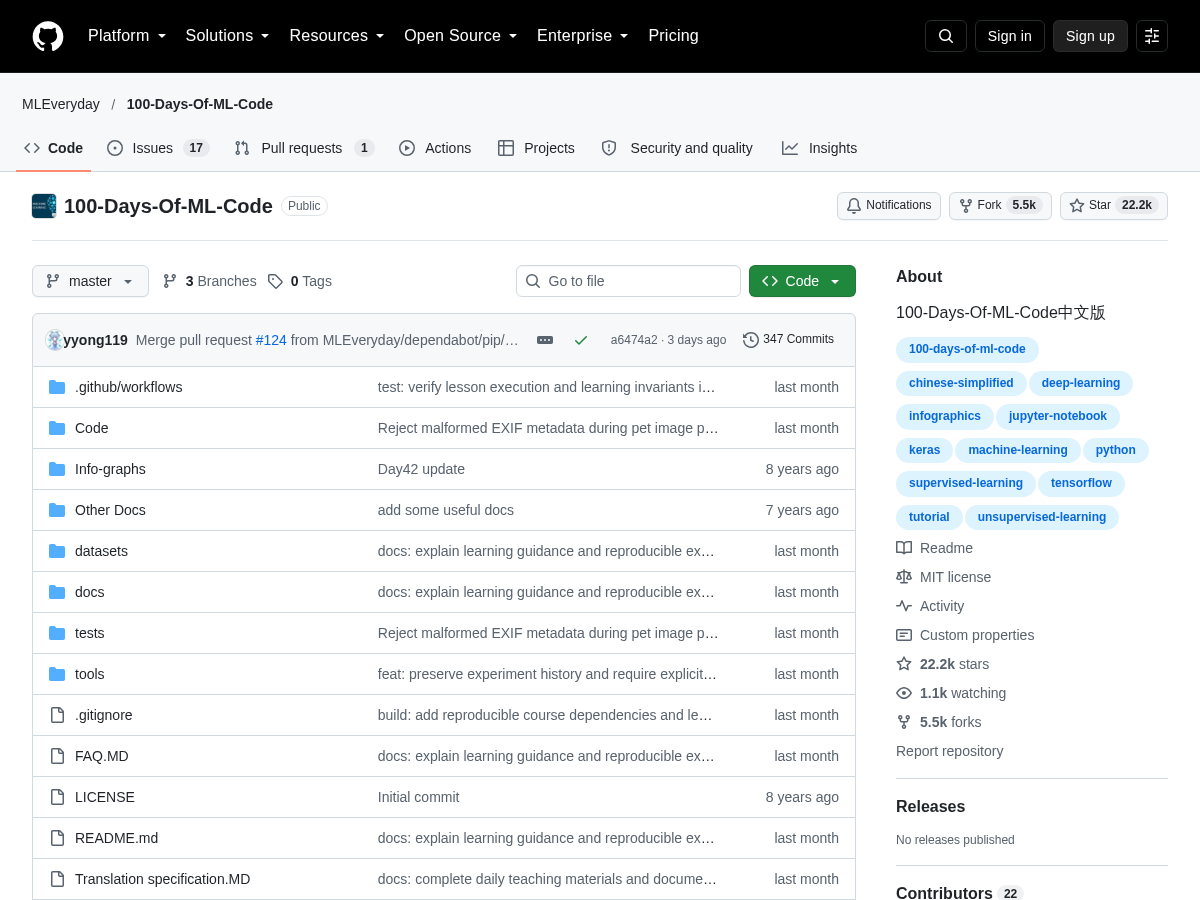
100 Days Of ML Code is an open-source project on GitHub that provides a comprehensive guide to learning machine learning in 100 days. The project is designed for individuals with or without prior knowledge of machine learning and offers a structured learning path. It covers various topics, including deep learning, supervised and unsupervised learning, and includes practical exercises and projects to help learners gain hands-on experience. The project is written in Python and utilizes popular libraries such as TensorFlow and Keras. The code is well-organized, and the project includes a README file, FAQs, and other documentation to help users navigate the project. The project has gained significant popularity, with over 22,000 stars on GitHub, and has been forked over 5,500 times. The project is actively maintained, with regular updates and contributions from the community. Overall, 100 Days Of ML Code is a valuable resource for anyone looking to learn machine learning and gain practical experience in the field.

Solves

The problem that 100 Days Of ML Code solves is the lack of structured learning resources for machine learning. Many individuals who want to learn machine learning may find it difficult to get started, as the field is vast and complex. 100 Days Of ML Code provides a clear and concise learning path, making it easier for individuals to learn machine learning and gain practical experience. The project also addresses the issue of reproducibility in machine learning, by providing a framework for saving and reproducing experiments. This makes it easier for learners to track their progress and share their results with others.

Screenshot of Onnxruntime
Onnxruntime
Fine-tuning Open Source

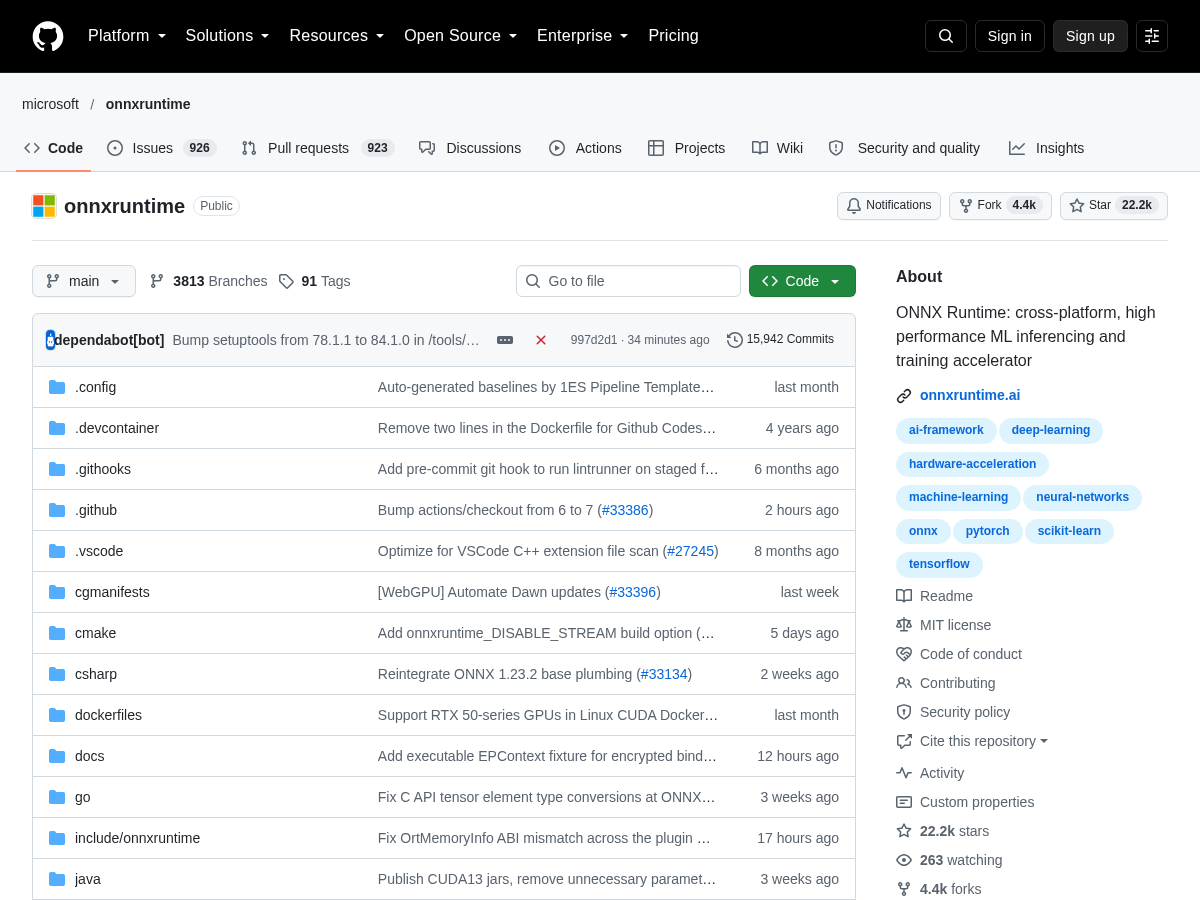
Onnxruntime is an open-source, cross-platform, high-performance machine learning (ML) inferencing and training accelerator. It supports a wide range of ML frameworks, including PyTorch, TensorFlow, and scikit-learn, and provides a unified interface for deploying ML models across different hardware platforms. Onnxruntime is designed to be highly scalable and flexible, allowing developers to easily integrate it into their existing ML workflows. The project is actively maintained by Microsoft and has a large community of contributors. Onnxruntime provides a range of features, including hardware acceleration, dynamic quantization, and support for multiple input and output formats. It is widely used in production environments and has been adopted by many organizations for deploying ML models at scale. Onnxruntime is available under the MIT license and can be easily installed using pip or Docker. The project has a strong focus on security and provides a range of features to ensure the integrity and confidentiality of ML models, including support for secure enclaves and encrypted model storage. Overall, Onnxruntime is a powerful and flexible ML accelerator that provides a unified interface for deploying ML models across different hardware platforms.

Solves

Onnxruntime solves the problem of deploying machine learning models across different hardware platforms, providing a unified interface for inferencing and training. This is a significant challenge in the field of machine learning, as different hardware platforms have different performance characteristics and requirements. Onnxruntime provides a flexible and scalable solution to this problem, allowing developers to easily deploy ML models across different platforms, including CPUs, GPUs, and specialized AI accelerators. By providing a unified interface for ML deployment, Onnxruntime simplifies the process of deploying ML models and reduces the complexity and cost associated with supporting multiple hardware platforms.

Screenshot of Archon
Archon
Dev Tools Open Source

Archon is an open-source harness builder designed for AI coding. It provides a structured environment that allows developers to define, manage, and execute AI-powered coding tasks. The goal is to make AI coding deterministic and repeatable, addressing the common challenge of inconsistent outputs from AI models. By offering a harness, Archon enables integration of AI coding into existing development workflows with more control. It is positioned as the first open-source tool of its kind, aiming to bring reliability and reproducibility to AI-assisted software development.

Solves

AI coding often produces non-deterministic results, making it difficult to use reliably in production or CI/CD pipelines. Archon solves this by providing a harness that structures AI coding tasks, ensuring deterministic and repeatable execution.

Screenshot of Adk Python
Adk Python
AI Agents Open Source

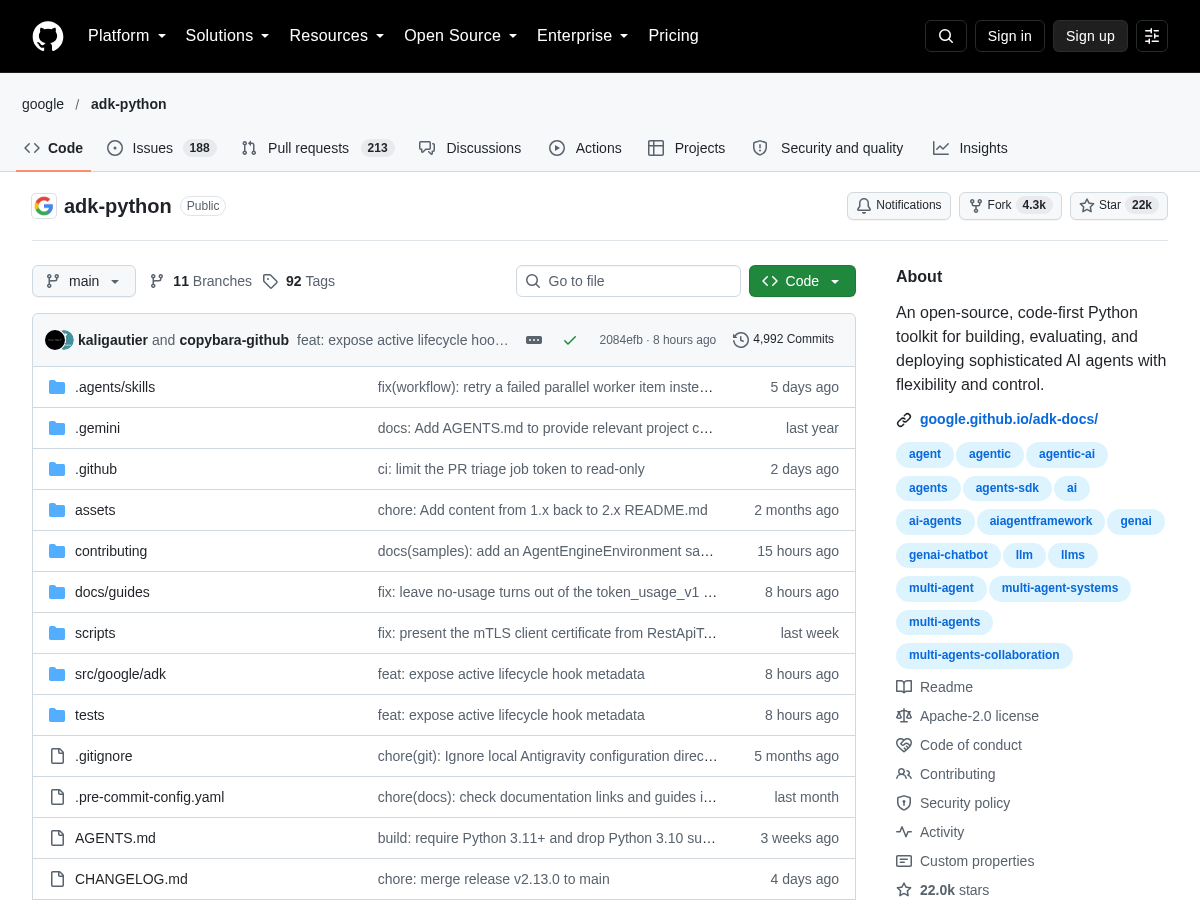
The Agent Development Kit (ADK) is an open-source, code-first Python framework for building, evaluating, and deploying sophisticated AI agents with flexibility and control. It applies software development principles to AI agent creation, simplifying the process of building, deploying, and orchestrating agent workflows. ADK is designed to be model-agnostic, deployment-agnostic, and compatible with other frameworks. It provides a range of features, including a workflow runtime, task API, modular multi-agent systems, and a rich tool ecosystem. ADK allows developers to define agent logic, tools, and orchestration directly in Python, providing ultimate flexibility, testability, and versioning. The framework also includes a built-in development UI to help test, evaluate, debug, and showcase agents. ADK can be deployed locally with Docker Container or in Google Cloud (Cloud Run), and it supports various environment variables for customization. The project is licensed under the Apache 2.0 License and welcomes contributions from the community.

Solves

The ADK solves the problem of building, evaluating, and deploying sophisticated AI agents by providing a flexible and modular framework that applies software development principles to AI agent creation. This allows developers to create AI agents with ease, flexibility, and control, and to deploy them in various environments. The ADK also addresses the issue of integrating AI agents with other systems and tools, providing a rich tool ecosystem and supporting various deployment options.

Screenshot of Recommenders
Recommenders
AI/ML Open Source

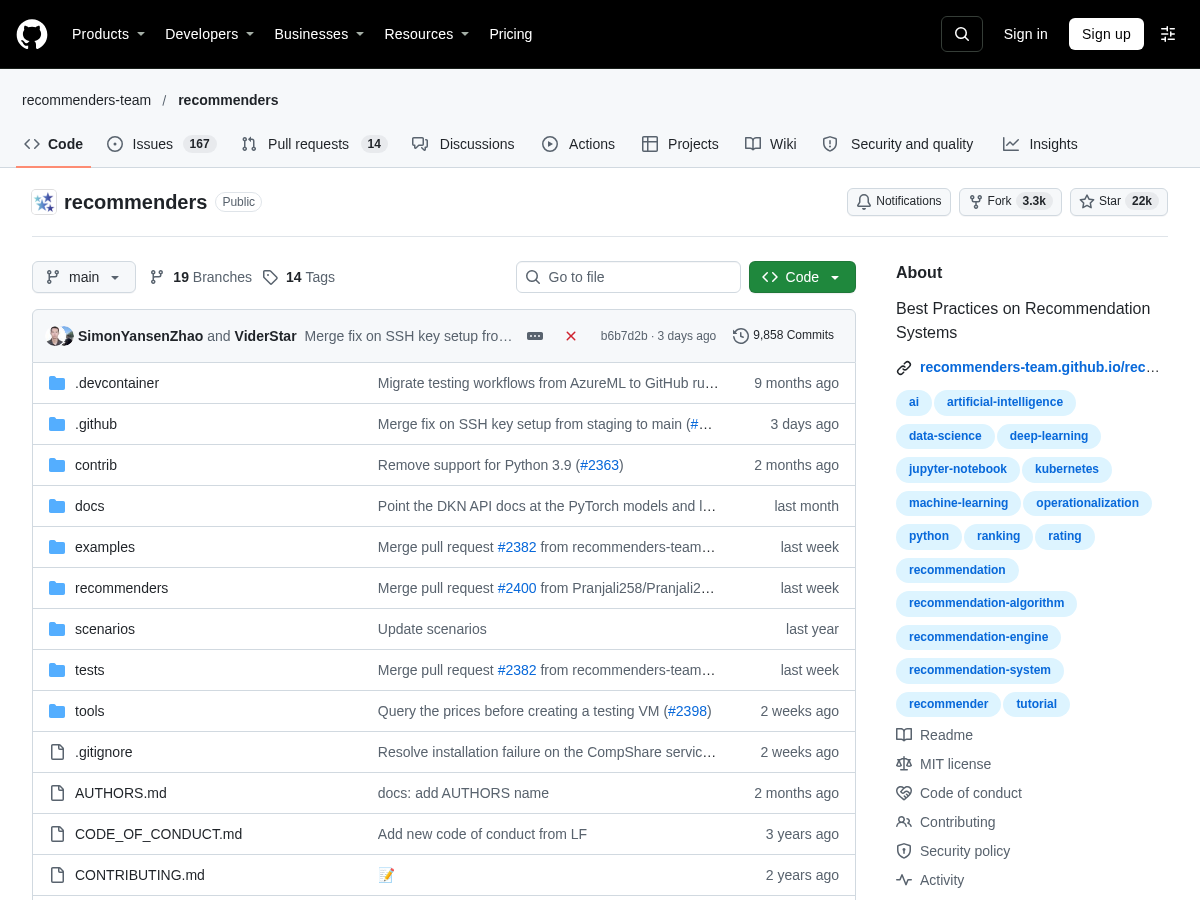
The Recommenders project is an open-source repository that provides best practices on recommendation systems. It is hosted on GitHub and has gained significant attention with over 22,000 stars and 3,300 forks. The project is dedicated to providing a comprehensive guide on building and deploying recommendation systems, including tutorials, examples, and documentation. The repository includes a variety of topics such as AI, artificial intelligence, data science, deep learning, and machine learning. The project is licensed under the MIT license and has a code of conduct in place to ensure a positive and inclusive community. The Recommenders project is a valuable resource for developers, data scientists, and researchers looking to build and improve recommendation systems.

Solves

The Recommenders project solves the problem of building and deploying effective recommendation systems, which is a challenging task in the field of artificial intelligence and machine learning. Recommendation systems are crucial in many applications, such as e-commerce, content streaming, and social media, as they help users discover new products, content, or services. However, building a recommendation system that is accurate, scalable, and reliable can be a complex task, requiring significant expertise and resources. The Recommenders project provides a comprehensive guide and resources to help developers and data scientists build and deploy recommendation systems, making it easier to solve this problem.

Screenshot of Teable
Teable
AI/ML Open Source

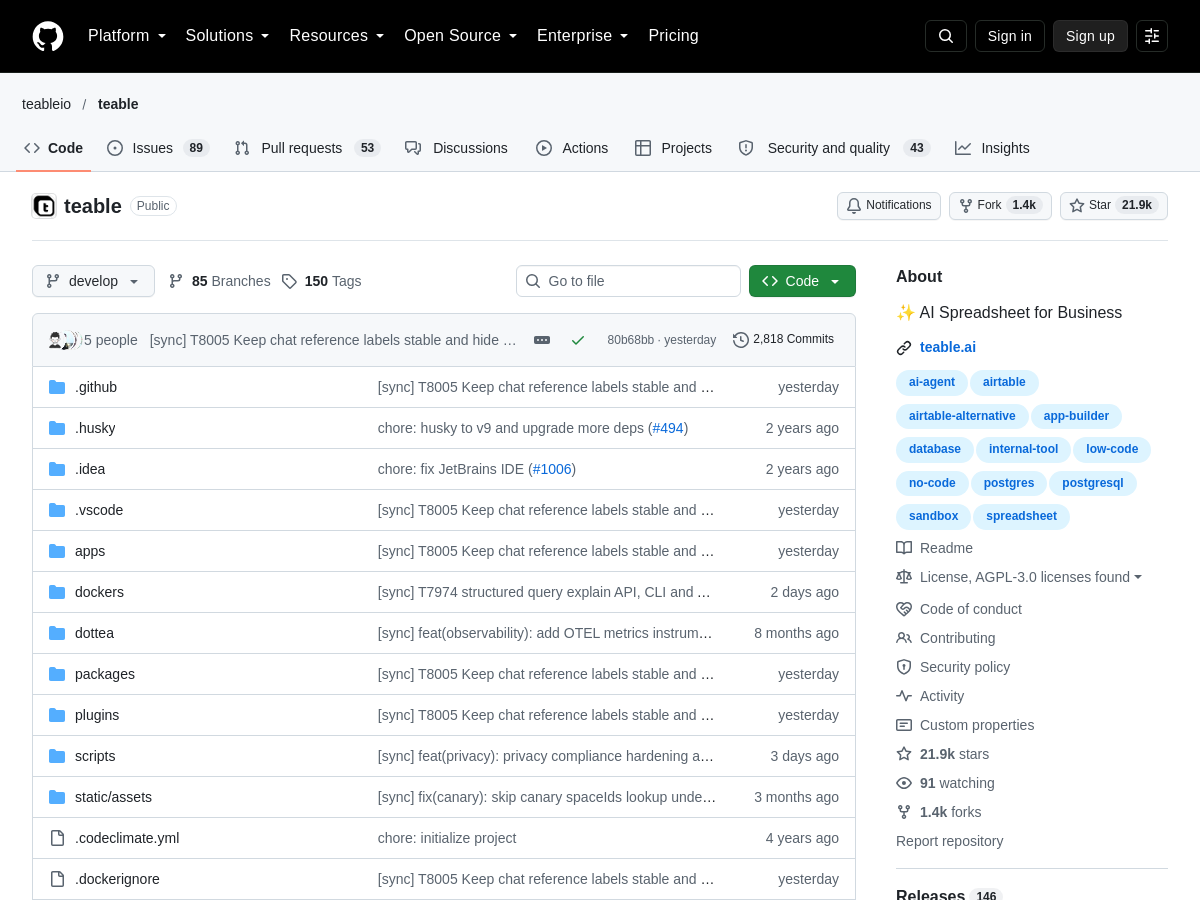
Teable is an AI-powered spreadsheet for business, designed to provide a more efficient and intelligent way of working with data. It combines the familiarity of a spreadsheet with the power of artificial intelligence, allowing users to automate tasks, analyze data, and make informed decisions. With its low-code and no-code capabilities, Teable enables users to build custom applications and workflows without requiring extensive programming knowledge. The platform also features a range of tools and features, including data visualization, reporting, and collaboration, making it an ideal solution for businesses of all sizes. Teable is built on top of a range of technologies, including PostgreSQL, and is designed to be highly scalable and customizable. The project is open-source, which means that it is free to use, modify, and distribute, and is supported by a community of developers and users. Overall, Teable has the potential to revolutionize the way businesses work with data, and is an exciting development in the field of AI-powered productivity tools. Teable's architecture is modular, with a range of packages and plugins that can be easily integrated into the platform. This makes it easy for developers to extend and customize the functionality of the platform, and to build custom applications and workflows. The platform also features a range of APIs and interfaces, making it easy to integrate with other systems and tools. With its strong focus on community and collaboration, Teable is an ideal solution for businesses that want to work with data in a more efficient, intelligent, and collaborative way.

Solves

Businesses often struggle with working with data, as traditional spreadsheet tools can be limited and inflexible. Teable solves this problem by providing a more intelligent and automated way of working with data, allowing businesses to make informed decisions and drive growth. With its low-code and no-code capabilities, Teable also makes it easy for non-technical users to work with data, without requiring extensive programming knowledge. This makes it an ideal solution for businesses of all sizes, from small startups to large enterprises.

Screenshot of Awesome Gpt Image 2
Awesome Gpt Image 2
Prompt Engineering Open Source

Awesome Gpt Image 2 is an open-source prompt engineering repository dedicated to GPT-Image2, a generative AI model for image creation. It presents a 'Prompt as Code' philosophy, treating prompts as structured, reusable code-like artifacts rather than ad-hoc text. The repository includes a comprehensive template library of over 20 industrial-grade prompt templates, designed to produce consistent and high-quality image outputs across various use cases such as marketing, design, and content generation. The project is built on the reverse engineering of more than 530 real-world GPT-Image2 cases, providing users with concrete examples and patterns that have been tested in practice. These examples are distilled into reusable 'Skills'—modular prompt components that can be combined to address specific image generation challenges. The repository is continuously updated, reflecting the evolving capabilities of GPT-Image2 and emerging best practices in prompt engineering. As a community-driven resource, Awesome Gpt Image 2 serves as both a learning hub for newcomers and a practical toolkit for professionals seeking to harness the full potential of GPT-Image2. It bridges the gap between experimental prompt crafting and systematic, reproducible prompt management, making complex image generation workflows more accessible and efficient.

Solves

This tool addresses the difficulty of crafting effective prompts for GPT-Image2, which often requires experimentation and domain knowledge. By providing a curated collection of reverse-engineered cases, standardized templates, and modular Skill components, it enables users to generate high-quality images consistently without starting from scratch, reducing trial-and-error and improving productivity.

Screenshot of Nnn
Nnn
Dev Tools Open Source

nnn is a full-featured terminal file manager designed for performance and efficiency. It is written in C with minimal dependencies, resulting in a lightweight and fast user experience. The tool is built to be keyboard-driven, allowing users to navigate, manipulate, and manage files directly from the command line without leaving the terminal. Beyond basic file operations, nnn includes advanced features such as fuzzy search, bookmarks, batch rename, disk usage analysis, and a plugin system for extensibility. It supports multiple platforms, including Linux, macOS, and Windows (via WSL or other Unix-like environments), and integrates well with other command-line tools by allowing files to be selected and passed to external commands. nnn emphasizes low resource usage and responsiveness, making it suitable for use on older hardware or in resource-constrained environments. Its "unorthodox" approach includes a minimal interface that prioritizes speed and scriptability, positioning it as a practical alternative to more heavyweight file managers.

Solves

nnn addresses the need for efficient, keyboard-centric file management within the terminal environment. It eliminates the overhead of graphical file managers and provides power users with a fast, scriptable tool to handle file operations without leaving the command line.

Screenshot of Datasets
Datasets
Database Open Source

Hugging Face Datasets is an open-source Python library that provides a unified hub for accessing, sharing, and processing thousands of ready-to-use datasets for machine learning and AI. It simplifies the entire data pipeline by offering a consistent API to load datasets of various formats (text, image, audio, video, tabular, etc.) from a centralized repository—the Hugging Face Hub—or from local files. The library automatically handles downloading, caching, and versioning, ensuring reproducibility across experiments. Under the hood, Datasets leverages Apache Arrow for efficient, zero-copy reads and supports memory-mapping, allowing users to work with datasets larger than available RAM. It includes built-in features for data manipulation such as filtering, shuffling, splitting into train/test sets, and applying custom pre-processing functions in a batched, multi-processed manner. Integration with popular deep learning frameworks like PyTorch, TensorFlow, and JAX is seamless, enabling direct conversion to native data loaders. The library also supports streaming mode for massive datasets that cannot fit on disk, fetching and processing data on-the-fly. Beyond data access, it provides evaluation metrics and is tightly integrated with the Hugging Face ecosystem, including transformers, tokenizers, and the Hub’s web interface for exploring dataset cards and configurations. Key features include a simple `load_dataset()` function, dataset versioning and fingerprinting, dynamic shapes via Arrow arrays, parallelized tokenization, and a growing collection of community-contributed datasets. It is designed to accelerate both research prototyping and production ML pipelines by eliminating data engineering overhead.

Solves

Machine learning practitioners and researchers often waste significant time on data acquisition, format conversion, and preprocessing when building models. Hugging Face Datasets solves this by offering a single, consistent interface to thousands of curated, versioned datasets across modalities, with efficient caching and parallel processing, drastically reducing the boilerplate and time from data to training.

Screenshot of Ai Guide
Ai Guide
LLM Open Source

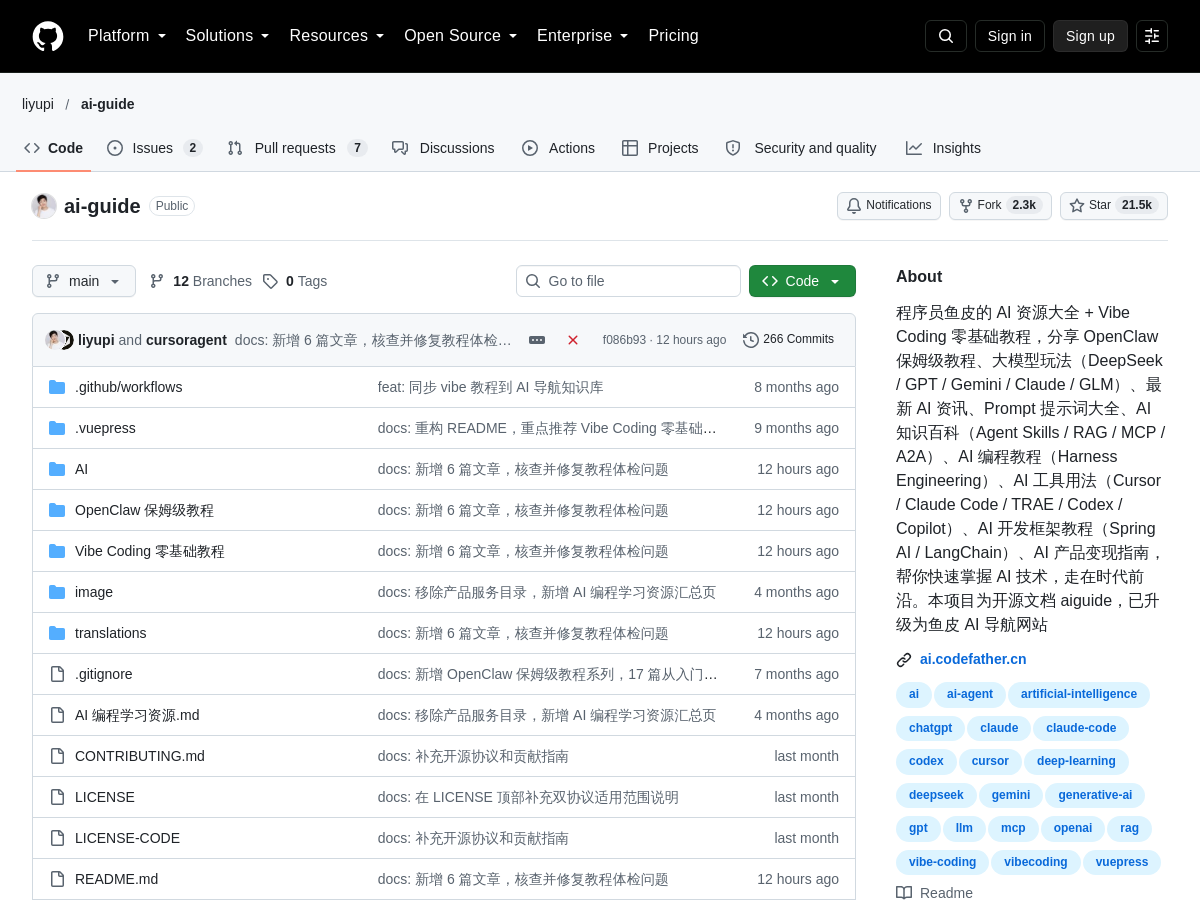
Ai Guide is an open-source project that provides a comprehensive resource for AI-related knowledge and tools. It includes tutorials, guides, and resources for various AI models and frameworks, such as OpenClaw, DeepSeek, GPT, Gemini, and Claude. The project also covers AI programming, AI tools, and AI development frameworks, making it a one-stop-shop for AI enthusiasts and developers. The project is constantly updated with new content, including articles, tutorials, and projects, and has a large community of contributors and users. Ai Guide is designed to help users quickly grasp AI technology and stay up-to-date with the latest developments in the field. The project is hosted on GitHub and has gained significant popularity, with over 21,000 stars and 2,300 forks. Ai Guide is a valuable resource for anyone interested in AI, from beginners to experienced developers.

Solves

Ai Guide solves the problem of finding reliable and comprehensive resources for AI-related knowledge and tools. Many AI enthusiasts and developers struggle to find trustworthy and up-to-date information on AI models, frameworks, and programming. Ai Guide addresses this issue by providing a centralized platform that aggregates and curates high-quality content, making it easier for users to learn and stay current with AI technology. By using Ai Guide, users can save time and effort in searching for relevant information and focus on developing their AI skills and projects.

Screenshot of FinGPT
FinGPT
LLM Open Source

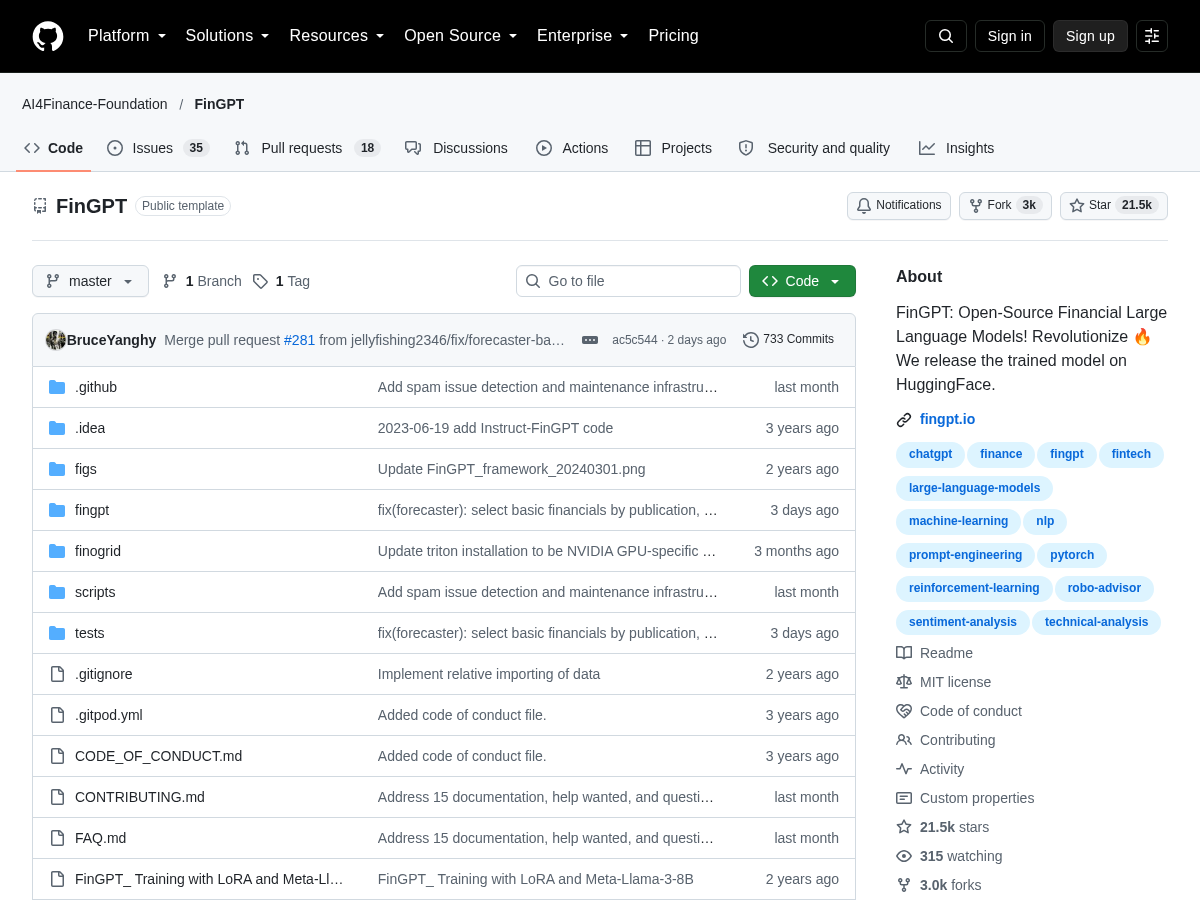
FinGPT is an open-source financial large language model that aims to revolutionize the field of finance with its advanced language understanding capabilities. The model is trained on a vast amount of financial data and can be used for a variety of tasks such as sentiment analysis, technical analysis, and financial forecasting. FinGPT is built using the popular PyTorch framework and is available on the HuggingFace model hub. The project is actively maintained by the AI4Finance-Foundation and has a large community of contributors. FinGPT has a wide range of applications in finance, including stock market prediction, risk analysis, and portfolio optimization. The model can also be used for natural language processing tasks such as text classification, language translation, and question answering. Overall, FinGPT is a powerful tool for anyone looking to leverage the power of AI in finance. The project is well-documented and has a comprehensive README file that provides instructions on how to use the model, contribute to the project, and report issues. FinGPT is also actively used in research and has been cited in several academic papers. The model has a strong focus on explainability and transparency, making it a great choice for applications where interpretability is important. FinGPT is a rapidly evolving project with new features and improvements being added regularly. The project has a strong community of developers and researchers who contribute to the project and provide support to users. FinGPT is a great example of how open-source AI models can be used to drive innovation and progress in finance.

Solves

FinGPT solves the problem of limited access to advanced financial language models for individuals and organizations. Traditional financial models are often proprietary and expensive, making it difficult for smaller organizations or individuals to access them. FinGPT provides a free and open-source alternative that can be used for a wide range of financial tasks, making it a great choice for anyone looking to leverage the power of AI in finance. Additionally, FinGPT provides a platform for researchers and developers to collaborate and contribute to the development of financial language models, driving innovation and progress in the field.

Screenshot of Marimo
Marimo
Code Open Source

Marimo is an open-source reactive notebook for Python that changes the paradigm of interactive computing. Unlike traditional notebooks where cells are executed sequentially and hidden state can accumulate, Marimo automatically keeps track of dependencies between cells. When you modify a cell, only the cells that depend on it are re-executed, ensuring that the notebook's state is always consistent and reproducible. This reactive model eliminates common bugs like undefined variables, stale outputs, and broken pipelines. Marimo notebooks are stored as pure Python (.py) files, making them fully compatible with version control systems like Git. This means you can diff, merge, and review notebook changes just like any other code. The plain-text format also allows you to run notebooks as regular Python scripts from the command line, or deploy them as interactive web apps with `marimo run`. The editor is designed with both developers and AI in mind. It features modern code completion, inline documentation, and an AI chat panel that can assist with coding. You can interactively query databases with SQL directly inside the notebook, and the results are displayed live. Marimo also supports building rich, interactive UI elements like sliders and charts, turning notebooks into shareable dashboards. Marimo is highly flexible: use it as a traditional notebook for exploratory analysis, as a script for batch processing, or as an app for end-user interaction. It is easy to install via pip and runs locally in your browser, with support for VS Code integration. The project is actively maintained and has a growing community around reproducible, literate programming in Python.

Solves

Data scientists and developers often struggle with traditional notebooks because execution order and hidden state lead to reproducibility failures. Marimo solves this by making notebooks reactive: cells are automatically structured as a directed acyclic graph, and any change triggers a re-execution of only the affected cells. Combined with a pure Python file format, this guarantees that the notebook always reflects a consistent, deterministic state, and it can be easily versioned, shared, and deployed.

Screenshot of Learn Harness Engineering
Learn Harness Engineering
AI Agents Open Source

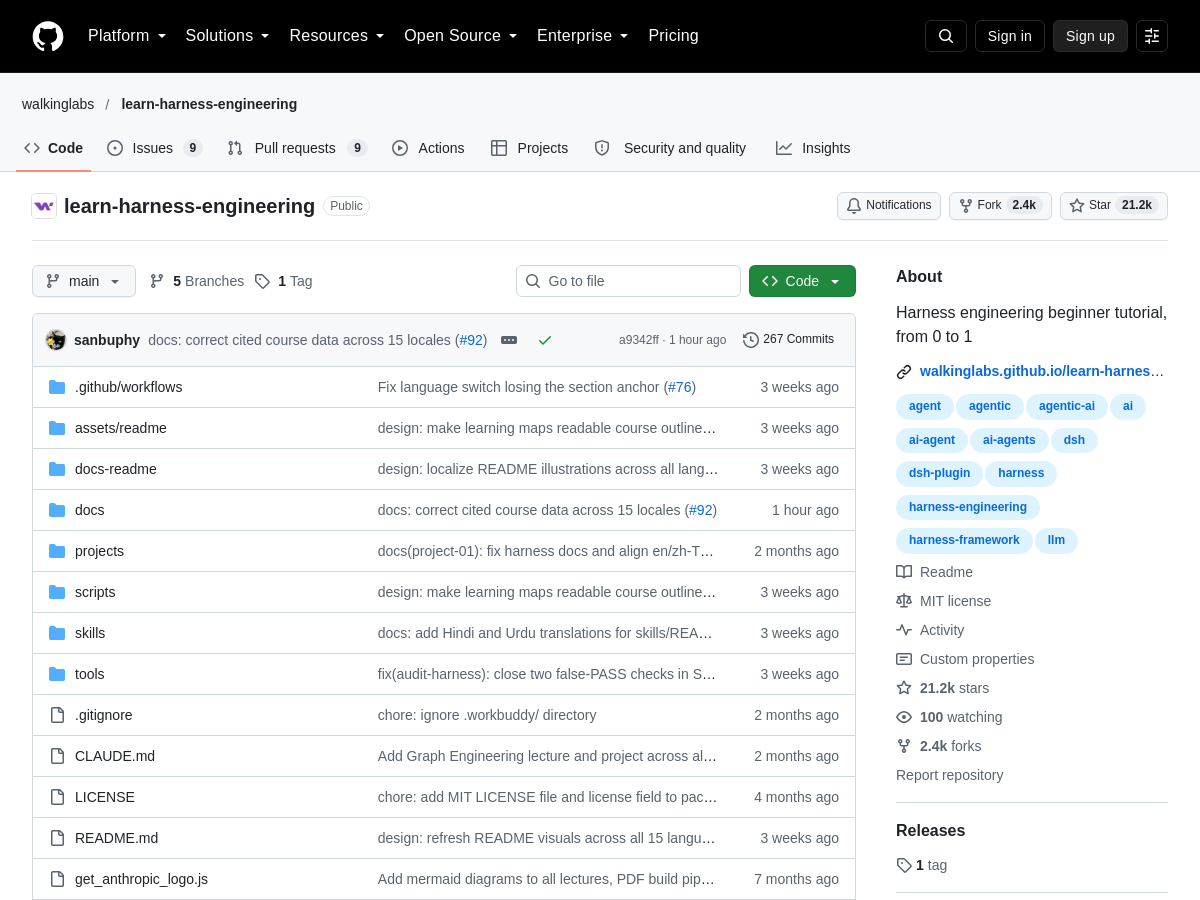
Learn Harness Engineering is an open-source project that provides a beginner tutorial on harness engineering, taking users from zero to one. The project is hosted on GitHub and has gained significant attention, with over 21,000 stars and 2,400 forks. The tutorial covers various topics related to harness engineering, including agent, agentic, AI, and more. The project is well-maintained, with regular updates and contributions from multiple authors. The latest commit was made on October 22, 2026, and the project has a total of 267 commits. The project uses the MIT license and has a custom properties file. The repository also includes a README file, an activity log, and a list of contributors. Overall, Learn Harness Engineering is a valuable resource for anyone looking to learn about harness engineering and its applications.

Solves

The problem that Learn Harness Engineering solves is the lack of resources and tutorials for beginners in the field of harness engineering. By providing a comprehensive and well-structured tutorial, the project helps users to gain a deeper understanding of the subject and its applications. The project also addresses the issue of language barriers by providing translations in multiple languages, including Hindi, Urdu, and Spanish. Additionally, the project's use of locale-invariant anchor IDs ensures that users can easily navigate the tutorial, regardless of their language or location.

Screenshot of Agentmemory
Agentmemory
AI Agents Open Source

Agentmemory is an open-source project that provides persistent memory for AI coding agents. The project positions itself as the #1 persistent memory solution based on real-world benchmarks, aiming to enhance the ability of AI agents to retain context and knowledge across tasks and sessions. The tool is designed to be integrated into AI agent systems, offering a memory layer that can store, retrieve, and manage information. This enables agents to build upon previous interactions, reducing repetition and improving efficiency in coding and other tasks. The project is available under an open-source license, allowing developers to inspect, modify, and contribute to the codebase.

Solves

AI coding agents often lack long-term memory, causing them to forget context between sessions or tasks, leading to repetitive work and suboptimal performance. Agentmemory solves this by providing a persistent memory system that allows agents to store and recall information, thereby improving continuity and effectiveness.

Screenshot of Flow
Flow
AI/ML Open Source

Flow is an open-source framework designed to help developers build autonomous AI agents that can perform complex tasks with minimal human intervention. By leveraging large language models, Flow enables agents to plan, reason, and execute multi-step workflows, allowing users to 'move faster with autonomy.' The framework provides a modular architecture where developers can define tools, memory, and decision-making processes, making it easy to create custom AI assistants for a variety of domains. At its core, Flow abstracts the complexities of agent development, offering built-in support for task decomposition, context management, and error handling. Agents built with Flow can interact with external APIs, databases, and software interfaces, enabling automation of repetitive tasks such as data gathering, report generation, and software development. The framework emphasizes flexibility and extensibility, allowing integration with different LLM providers and custom toolkits. Flow's design philosophy centers on providing a production-ready environment for autonomous systems. It includes features like persistent memory, multi-agent collaboration, and human-in-the-loop oversight, ensuring reliable and safe operation. Developers can quickly prototype agents using declarative configurations or programmatic APIs, and then deploy them as services or integrated components within larger applications. Overall, Flow aims to accelerate the development of AI-powered automation, reducing the time and expertise required to build sophisticated autonomous agents. Its open-source nature fosters a community-driven ecosystem where contributors can share tools, workflows, and best practices, making advanced AI capabilities accessible to a wider audience.

Solves

Many developers and businesses struggle with the complexity of automating multifaceted tasks that require reasoning and adaptability. Traditional automation tools are rigid and fail in dynamic environments. Flow addresses this by providing a framework for creating autonomous AI agents that can understand objectives, break them down into actionable steps, and execute them using various tools and APIs. This allows users to delegate complex, time-consuming work to AI, boosting productivity and freeing humans to focus on creative and strategic activities.

Screenshot of Code
Code
Code Open Source

Code is an open-source project hosted on GitHub under the repository nikivdev/code. The repository page does not provide a detailed description, README, or any documentation to clarify its purpose and features. It is categorized under the 'Code' category, indicating that it is likely a tool related to programming, code editing, analysis, or management. Without further information, users must examine the source code or commit history to infer its functionality.

Solves

The specific problem solved by this tool is not documented. Based on its category, it may aim to assist with software development tasks such as code editing, generation, or collaboration.

Screenshot of Jcode
Jcode
LLM Open Source

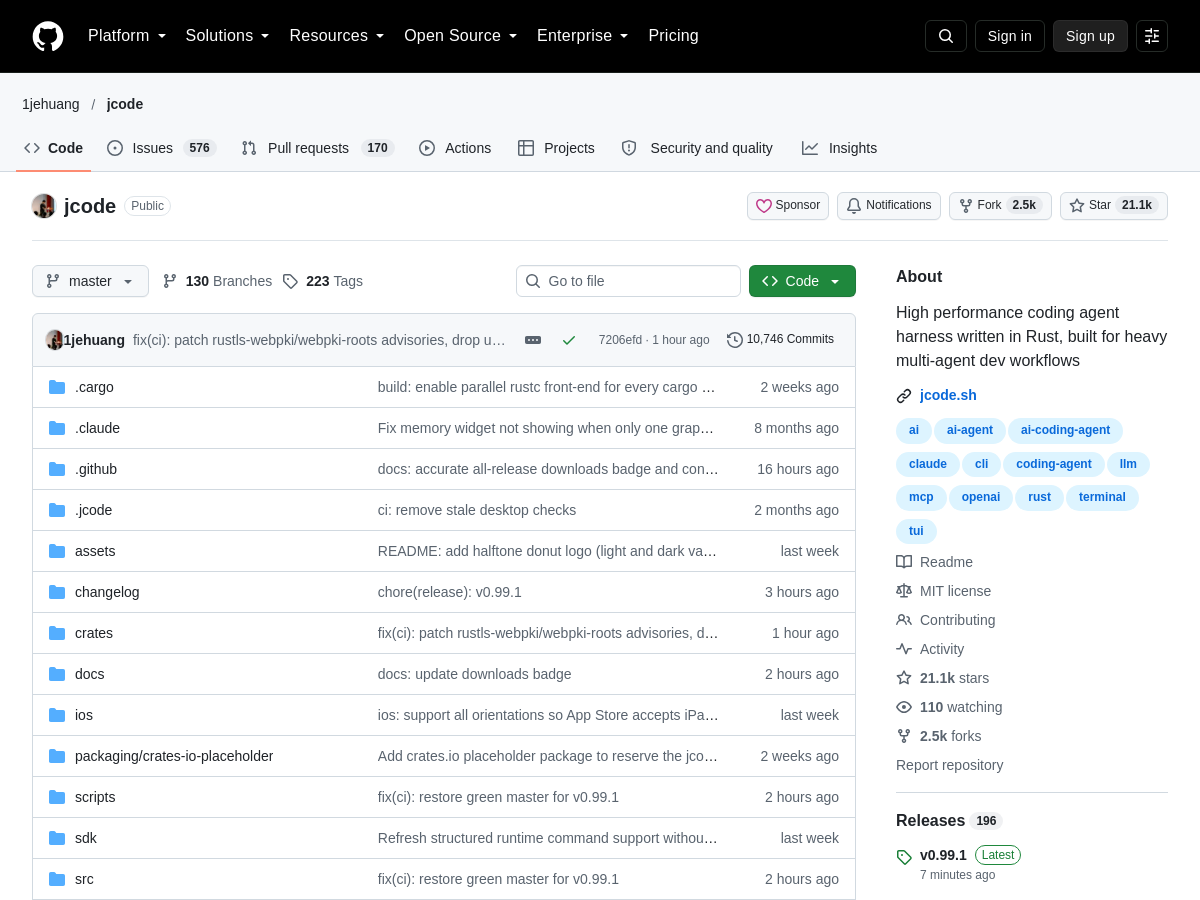
Jcode is a high-performance coding agent harness written in Rust. It is designed to handle heavy multi-agent development workflows, making it an ideal tool for developers who need to manage complex coding tasks. The tool is built with a focus on performance and scalability, allowing it to handle large-scale development projects with ease. Jcode also features a command-line interface, making it easy to use and integrate into existing development workflows. The tool is open-source and has a large community of contributors, ensuring that it is constantly updated and improved. Jcode supports a range of features, including AI-powered coding assistance, project management, and collaboration tools. The tool is highly customizable, allowing developers to tailor it to their specific needs and workflows. Overall, Jcode is a powerful and flexible tool that can help developers streamline their coding workflows and improve their productivity. Jcode has a strong focus on security, with features such as secure authentication and authorization, as well as support for secure coding practices. The tool also has a range of integrations with other development tools and platforms, making it easy to incorporate into existing workflows. With its high-performance capabilities, scalability, and range of features, Jcode is an ideal choice for developers who need a powerful and flexible coding agent harness. The tool is constantly evolving, with new features and updates being added regularly. This ensures that Jcode stays up-to-date with the latest developments in the field of coding and software development. Jcode's open-source nature also means that it is highly transparent, with all code and updates available for review and contribution. This transparency, combined with the tool's strong focus on security, makes Jcode a trusted and reliable choice for developers.

Solves

Jcode solves the problem of managing complex coding workflows and tasks. Many developers struggle with managing multiple projects and tasks, which can lead to decreased productivity and increased stress. Jcode provides a solution to this problem by offering a range of features and tools that help developers streamline their workflows and improve their productivity. With Jcode, developers can easily manage multiple projects and tasks, collaborate with team members, and access a range of AI-powered coding assistance tools. This helps to reduce the complexity and overhead of coding, allowing developers to focus on what they do best - writing high-quality code.

Screenshot of Waveterm
Waveterm
Dev Tools Open Source

Wave Terminal is an open-source, cross-platform terminal application designed to integrate AI capabilities directly into the command-line workflow. It aims to provide a seamless experience for developers and technical users who need to combine traditional terminal operations with AI-powered assistance, such as command suggestions, natural language interactions, and automated task execution. The application is built to run on multiple operating systems, including Windows, macOS, and Linux, offering a consistent interface across environments. The terminal features a modern user interface with support for multiple tabs and panes, enabling users to manage several sessions simultaneously. Its AI integration allows users to ask questions, generate commands, and receive contextual help without leaving the terminal environment. This reduces context switching and enhances productivity for tasks ranging from system administration to software development and data analysis. Wave Terminal is developed as an open-source project, encouraging community contributions and transparency. It leverages modern technologies to deliver a fast and responsive experience, with a focus on extensibility and customization. The project is hosted on GitHub, where users can access the source code, report issues, and contribute to its ongoing development.

Solves

Traditional terminals lack built-in AI assistance, forcing users to switch between the terminal and external AI tools or documentation. Wave Terminal solves this by embedding AI capabilities directly into the terminal, enabling users to generate commands, receive explanations, and automate workflows without leaving the command-line environment. It also addresses the need for a modern, cross-platform terminal with a consistent experience across different operating systems.

Screenshot of Onnx
Onnx
AI/ML Open Source

ONNX (Open Neural Network Exchange) is an open standard for representing machine learning models, designed to enable interoperability across a wide range of frameworks, tools, runtimes, and hardware. It defines a common set of operators and a common file format, allowing AI developers to use models with a variety of frameworks, tools, runtimes, and compilers. The standard is backed by a consortium of major companies including Microsoft, Facebook, AWS, and others, ensuring broad industry adoption and continuous evolution. The ONNX repository provides a comprehensive Python library for creating, parsing, validating, and manipulating ONNX models. It includes the formal specification of the ONNX intermediate representation, a rich API to build and inspect computational graphs, and tools for shape inference and model verification. The library supports versioning of operator sets and models, enabling forward and backward compatibility. Additionally, it offers utilities for converting models from popular frameworks like PyTorch and TensorFlow into the ONNX format, as well as optimizing models for inference. Key features of ONNX include a large and growing set of built-in operators covering standard neural network layers, activation functions, and numeric operations. It also supports custom operators, allowing extensions for domain-specific needs. The ecosystem around ONNX includes high-performance runtimes like ONNX Runtime, hardware-specific optimizers, and integration with compilers such as TensorRT, OpenVINO, and MLIR, making it a central piece in cross-platform deployment pipelines. Overall, ONNX acts as a bridge between the training and deployment phases of machine learning workflows, reducing friction and preventing vendor lock-in. Its open governance and Apache 2.0 licensing encourage community contributions and ensure transparency. The active development community continuously refines the standard to support the latest advancements in AI, including transformers, quantization, and sparse models.

Solves

Machine learning practitioners often face the challenge of deploying models trained in one framework (e.g., PyTorch) to a production environment that requires a different framework or specialized hardware. Without a common representation, this involves costly rewrites or manual conversion scripts. ONNX solves this by providing a universal, framework-agnostic model format. It allows users to export models from a training framework and run them efficiently on diverse target platforms using a unified set of tools and runtimes, thus streamlining the entire MLOps lifecycle and enabling true model portability.

Screenshot of Coze Studio
Coze Studio
AI Agents Open Source

Coze Studio is an open-source AI agent development platform that provides an all-in-one visual environment for creating, debugging, and deploying AI agents. It aims to simplify the agent development process by offering intuitive visual tools, reducing the need for extensive coding and complex configurations. The platform supports the entire agent lifecycle from design to production, enabling developers to build custom AI solutions efficiently. Key features include a visual workflow builder that allows users to design agent logic through drag-and-drop interfaces, integrated debugging tools to test and refine agent behavior in real time, and seamless deployment options for self-hosted environments. Coze Studio is designed to be extensible, allowing integration with various AI models, APIs, and external services. As an open-source project, Coze Studio is freely available on GitHub, giving developers full control over customization and deployment. It fosters a community-driven approach to agent development, encouraging contributions and shared improvements. The platform is suitable for both individual developers and teams looking to accelerate AI agent production.

Solves

Building AI agents typically requires combining multiple tools and writing substantial code for orchestration, testing, and deployment. Coze Studio solves this by providing a unified visual platform that streamlines the entire process, enabling developers to create, debug, and deploy agents without deep coding expertise, thereby reducing development time and complexity.

Screenshot of Colleague Skill
Colleague Skill
AI/ML Open Source

Colleague Skill is an open-source project hosted on GitHub that provides a skill definition intended for AI assistants or digital life platforms. The project is described as transforming cold farewells into warm skills, welcoming users to 'Digital Life 1.0'. While specific implementation details are not provided in the repository's public description, the skill appears to be designed to enhance AI interactions related to colleague departures, possibly by creating a persona or response template that conveys warmth and empathy during farewells. It may be used to simulate a departing colleague's presence, preserve their knowledge, or generate comforting messages. The project is open source and free to use, making it accessible for developers and hobbyists interested in AI personalities or workplace communication tools. It is distributed via GitHub, allowing for community contributions and customization.

Solves

Addresses the challenge of handling colleague departures in an impersonal or cold manner by offering a skill that brings warmth and personality to farewell interactions. It enables AI systems to generate empathetic, human-like responses during employee offboarding or team transitions, potentially preserving the departing colleague's knowledge and persona in a friendly way.

Screenshot of SWE Agent
SWE Agent
Dev Tools Open Source

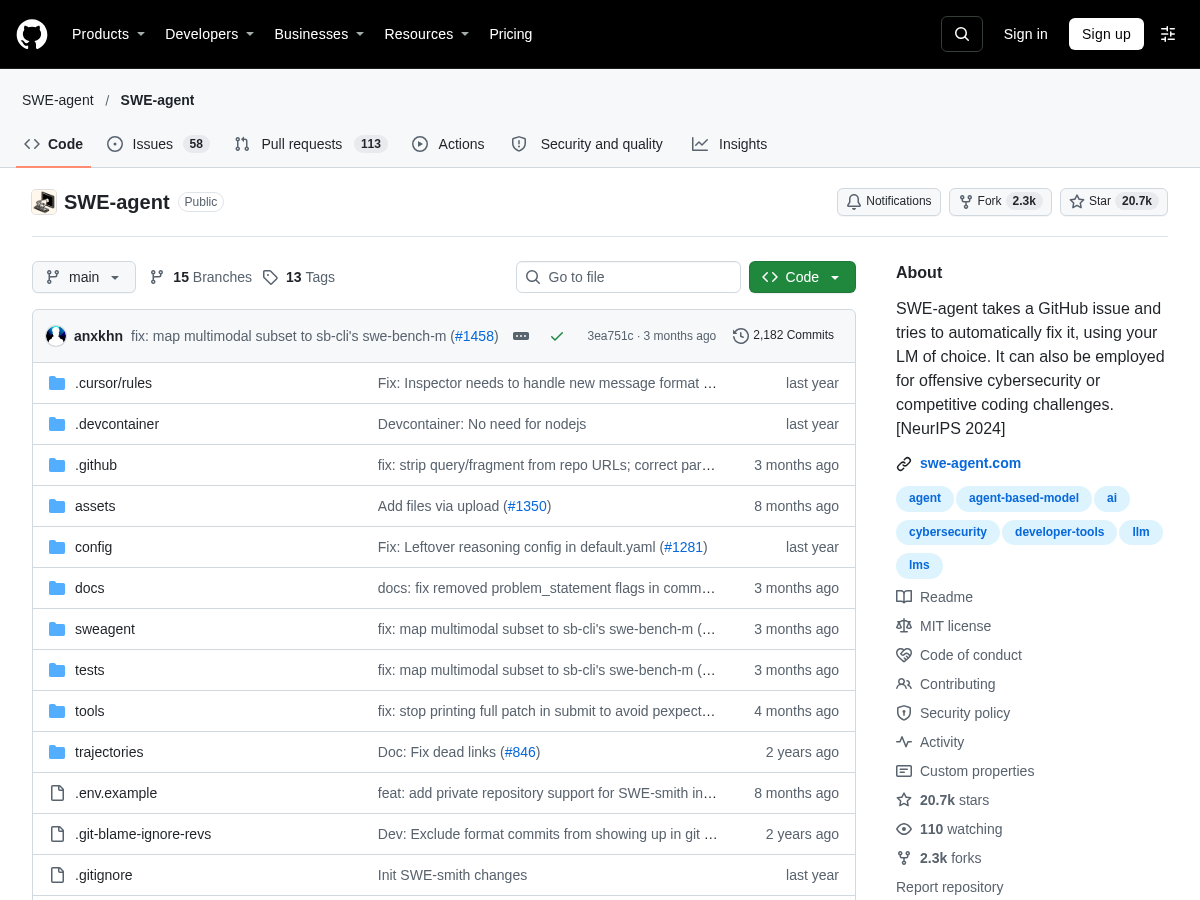
SWE-agent is an open-source tool that takes a GitHub issue and attempts to automatically fix it using a language model (LM) of choice. It can also be employed for offensive cybersecurity or competitive coding challenges. The tool is designed to work with GitHub issues, allowing users to automate the process of resolving issues using AI-powered solutions. SWE-agent supports various language models, providing users with flexibility in choosing the best model for their specific needs. The tool has been presented at NeurIPS 2024, a renowned conference in the field of artificial intelligence. With its ability to automate issue resolution and support for multiple language models, SWE-agent has the potential to significantly impact the field of software development and cybersecurity. The project is hosted on GitHub, where users can access the source code, report issues, and contribute to the development of the tool. SWE-agent has gained popularity, with over 20,000 stars and 2,000 forks on GitHub, indicating a strong interest in the tool from the developer community. The tool's documentation and code are well-organized, making it easier for users to understand and contribute to the project. Overall, SWE-agent is a powerful tool that leverages AI to automate issue resolution, making it an exciting project in the field of software development and AI research. The tool's capabilities and potential applications make it a valuable resource for developers, researchers, and organizations looking to automate and improve their software development processes. By providing an automated solution for resolving GitHub issues, SWE-agent can help reduce the time and effort required to address bugs and errors, allowing developers to focus on more complex and creative tasks. Additionally, the tool's support for offensive cybersecurity and competitive coding challenges makes it a useful resource for security researchers and developers looking to test and improve their skills. With its strong community support and ongoing development, SWE-agent is likely to continue to evolve and improve, providing even more value to its users and the broader software development community.

Solves

Developers and software development teams often struggle with resolving GitHub issues, which can be time-consuming and require significant expertise. SWE-agent solves this problem by providing an automated solution that uses AI-powered language models to resolve issues, reducing the time and effort required to address bugs and errors. By automating issue resolution, SWE-agent enables developers to focus on more complex and creative tasks, improving overall productivity and efficiency. Additionally, the tool's support for offensive cybersecurity and competitive coding challenges makes it a valuable resource for security researchers and developers looking to test and improve their skills.

Screenshot of Agents Towards Production
Agents Towards Production
AI Agents Open Source

Agents Towards Production is an open-source GitHub repository providing end-to-end, code-first tutorials for building production-grade GenAI agents. The project offers a comprehensive collection of practical guides that cover the entire lifecycle of agent development, from rapid prototyping to secure, scalable enterprise deployment. Each tutorial is designed to be hands-on, with copy-paste ready code snippets and detailed explanations that walk users through the integration of LLMs, tool calling, memory management, guardrails, monitoring, and other production essentials. The repository is structured to address real-world challenges faced when moving AI agents from experimental notebooks to robust production systems. Tutorials cover a variety of topics including agent architecture patterns, retrieval-augmented generation (RAG), multi-agent collaboration, deployment on cloud platforms, and implementing safety and reliability measures. By following these guides, developers can build agents that are not only functional but also maintainable, observable, and ready for high-traffic applications. Agents Towards Production is maintained by Nir Diamant and has gained significant community traction, with thousands of stars and forks. It serves as both a learning resource and a reference implementation for best practices in the rapidly evolving field of generative AI agents. The project encourages contributions and feedback, aiming to keep pace with the latest advancements in AI agent frameworks and tools. The tutorials are code-first, meaning they emphasize executable Python code over lengthy prose, making it easier for engineers to directly apply concepts to their own projects. Supporting materials may include Jupyter notebooks, dependency files, and configuration examples, ensuring that readers can reproduce the results and adapt them for their specific use cases.

Solves

Building a prototype AI agent is straightforward, but transitioning that prototype into a reliable, secure, and scalable production system is riddled with challenges: managing state, handling tool errors, ensuring consistent outputs, scaling user requests, monitoring performance, and maintaining security. Agents Towards Production solves this by providing battle-tested patterns and end-to-end tutorials that bridge the gap between experimental code and production-ready systems, enabling developers to deploy Generative AI agents with confidence.

Screenshot of Dyad
Dyad
AI/ML Open Source

Dyad is an open-source AI application builder designed for power users, providing a local alternative to cloud-based tools like v0, Lovable, Replit, and Bolt. It allows users to generate and assemble full applications using AI directly on their own machines, leveraging local models and giving complete control over the development process. As a local tool, Dyad ensures that code and data remain on the user's device, addressing privacy and security concerns. It targets developers and technical users who want the convenience of AI-driven app generation without relinquishing control to external services. The project is community-driven and open for contributions. The tool is distributed via GitHub, encouraging collaboration and customization. Users can extend its functionality, integrate with their preferred AI models, and adapt it to specific workflows. Dyad represents a shift toward self-hosted, privacy-conscious AI development environments.

Solves

Dyad solves the problem of relying on proprietary cloud AI app builders that require account sign-ups, impose usage limits, and may compromise sensitive project data. It provides a local, open-source alternative that gives users full ownership, offline capability, and the ability to customize the tool to their needs.

Screenshot of Cube
Cube
AI/ML Open Source

Cube is an open-source semantic layer that provides a unified data modeling and access layer for analytics, BI, and AI applications. It sits between your data sources (such as Postgres, MySQL, Snowflake, BigQuery, and many others) and downstream consumers, allowing you to define metrics, dimensions, and data transformations once and reuse them consistently across multiple tools and applications. Cube supports multi-tenancy, row-level security, and caching with pre-aggregations to deliver high-performance queries even at scale. The core of Cube is its data modeling language, where you define 'cubes' representing entities like users, orders, or products. Each cube contains measures (aggregations like count, sum, average) and dimensions (attributes for grouping and filtering). Cube automatically generates optimized SQL queries based on these definitions, which can be accessed via multiple APIs including REST, GraphQL, and SQL. This abstraction enables developers to build embedded analytics, dashboards, and data applications without worrying about the underlying database schema. Cube can be self-hosted using Docker, Kubernetes, or Node.js, and it also integrates with popular BI tools, data visualization libraries, and AI frameworks. It is widely used by companies to standardize metrics, improve query performance, and embed analytics into customer-facing products. The open-source community actively contributes extensions, drivers, and examples, making it a flexible foundation for modern data stacks.

Solves

Cube solves the problem of metric inconsistency and query performance in data-driven applications. By providing a centralized semantic layer, it ensures that all BI tools, embedded analytics, and AI systems use the same definitions and calculations, eliminating discrepancies. It also improves performance through pre-aggregations and caching, reducing load on underlying databases and enabling interactive dashboards.

Screenshot of Daily
Daily
Dev Tools Open Source

Daily is an open-source repository that provides a collection of AI-powered skills and integrations for popular coding assistants such as Claude, Cursor, and Codex. It is part of the daily.dev ecosystem, a professional network for developers to learn and collaborate. This tool enables developers to enhance their coding workflows by leveraging pre-built AI skills that assist with code generation, debugging, documentation, and more. The project organizes skills in a modular way, with dedicated directories for different AI platforms, allowing users to easily add or customize skills. It also includes a skill marketplace where developers can discover and share their own skills, fostering a community-driven approach to AI-assisted development.

Solves

Developers often struggle to effectively integrate AI assistants into their daily coding tasks due to a lack of standardized, ready-to-use skills. Daily solves this by providing a curated collection of AI skills that work across multiple coding assistant platforms, reducing the time and effort required to configure and optimize AI tools for specific tasks.

Screenshot of Ml Engineering
Ml Engineering
LLM Open Source

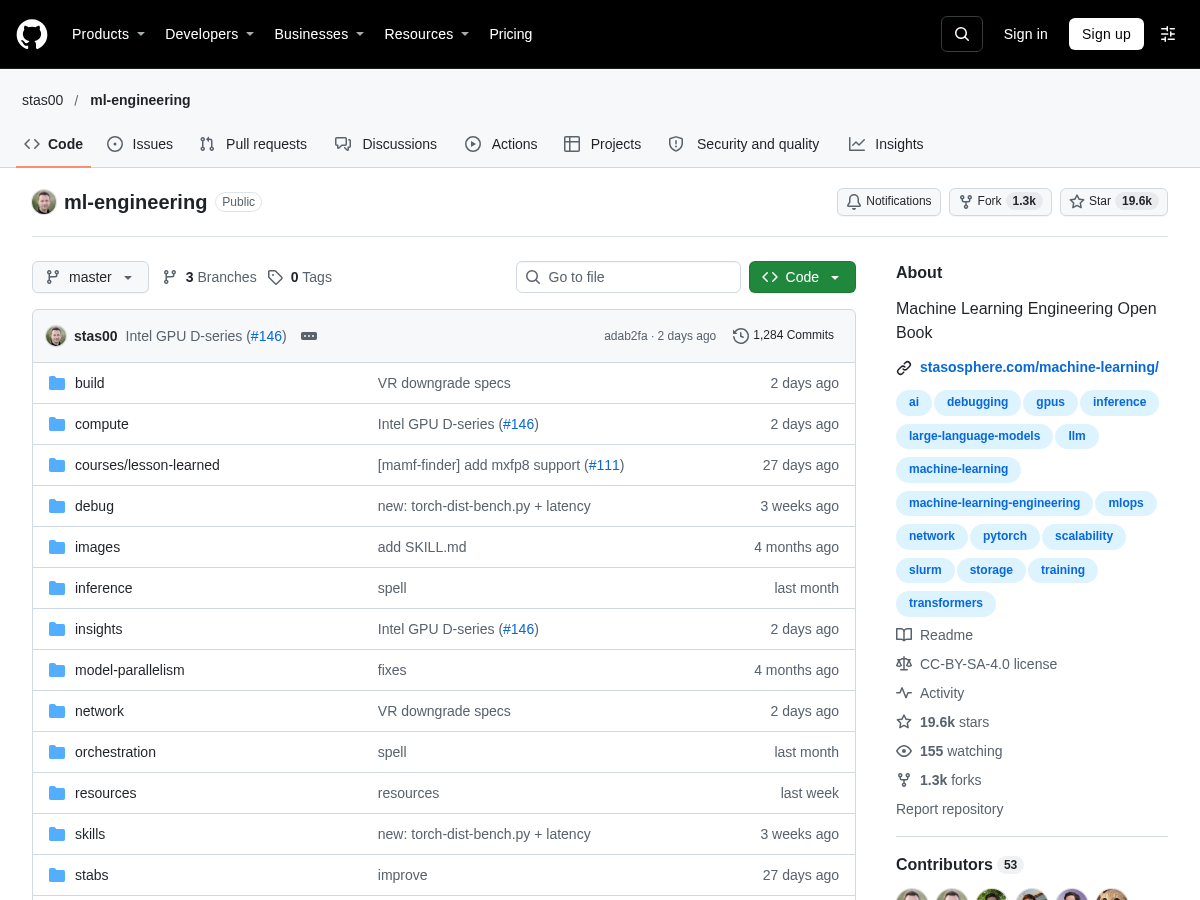
Ml Engineering is an open-source project that provides a comprehensive resource for machine learning engineering. The project is hosted on GitHub and has gained significant attention with over 19.6k stars and 1.3k forks. The project's description states that it is a 'Machine Learning Engineering Open Book', indicating that it is a freely available resource for learning and understanding machine learning engineering concepts. The project has a wide range of topics covered, including AI, debugging, GPUs, inference, large language models, machine learning, and more. The project also has a list of resources, including a readme file, a CC-BY-SA-4.0 license, and a link to the project's activity page. The project's code is organized into various folders, including build, compute, debug, images, inference, insights, model-parallelism, network, orchestration, resources, and skills. Each folder has its own set of files and subfolders, indicating a well-structured and organized project. The project's commit history shows regular updates and contributions from the maintainer, Stas Bekman, and other contributors. Overall, Ml Engineering appears to be a valuable resource for machine learning engineers and enthusiasts alike, providing a comprehensive and well-organized collection of information and code. The project's open-source nature and active maintenance make it a great starting point for those looking to learn and contribute to the field of machine learning engineering. With its extensive range of topics and resources, Ml Engineering has the potential to become a go-to resource for machine learning engineers and researchers. The project's focus on machine learning engineering also highlights the importance of this field, which is increasingly becoming a critical component of many industries, including healthcare, finance, and technology. As machine learning continues to evolve and improve, resources like Ml Engineering will play a vital role in helping professionals and researchers stay up-to-date with the latest developments and advancements in the field.

Solves

Machine learning engineers and enthusiasts often face the problem of finding reliable and comprehensive resources for learning and understanding machine learning engineering concepts. Ml Engineering solves this problem by providing a freely available and well-organized collection of information and code, covering a wide range of topics related to machine learning engineering. The project's open-source nature and active maintenance also ensure that the resource remains up-to-date and relevant, making it a valuable asset for those looking to learn and contribute to the field.

Screenshot of Taipy
Taipy
Dev Tools Open Source

Taipy is an open-source Python framework designed to transform data and AI algorithms into production-ready web applications with minimal effort. It provides a comprehensive toolkit that includes a visual GUI builder with pre-built, customizable components based on Material UI, a robust data management layer for handling large datasets, and a scenario/pipeline management system for orchestrating complex data workflows. Taipy abstracts away the complexities of frontend development, allowing developers, data scientists, and ML engineers to focus on their Python logic while automatically generating interactive, multi-user web interfaces. It supports real-time dashboards, what-if analysis, and model versioning, making it suitable for enterprise-grade applications. The framework is highly extensible, enabling integration with popular data science libraries like Pandas, NumPy, and TensorFlow, and offers features like caching, scheduling, and user authentication out of the box. With its low-code approach, Taipy aims to bridge the gap between data prototyping and full-scale deployment, empowering teams to quickly iterate and share insights through functional, aesthetically pleasing web apps.

Solves

Data scientists and ML engineers often face challenges when trying to turn their Python-based analyses, models, and algorithms into interactive, shareable web applications without extensive web development knowledge. Traditional approaches require learning JavaScript frameworks like React or Angular, which is time-consuming and diverts focus from data science tasks. Taipy solves this by providing a Python-native framework that handles the entire web app lifecycle—from data binding and UI generation to state management and deployment—allowing users to build full-stack data applications using only Python.

Screenshot of Airllm
Airllm
LLM Open Source

AirLLM is an open-source Python library that enables inference of large language models (LLMs) such as LLaMA 70B on a single GPU with as little as 4GB of VRAM. It achieves this by loading only one transformer layer at a time into GPU memory, while keeping the remaining layers on CPU or disk. This layer-by-layer execution strategy drastically reduces memory footprint, making it possible to run models that would otherwise require multiple high-end GPUs. The library supports popular model architectures like LLaMA, Llama 2, Code Llama, and other Hugging Face transformer models. It incorporates techniques such as model sharding, quantization, and disk offloading. Users can invoke inference with a few lines of code, similar to using Hugging Face's transformers, but with the added benefit of memory efficiency. AirLLM is particularly useful for developers, researchers, and hobbyists who want to experiment with large models on consumer hardware. It allows prototyping and testing without the need for expensive cloud GPU instances or specialized hardware. The project is actively maintained and open for community contributions.

Solves

AirLLM addresses the challenge of running large language models on hardware with limited GPU memory. By offloading model layers to CPU/disk and processing them sequentially, it enables inference of models like LLaMA 70B on a single 4GB GPU, which is typically impossible due to high memory requirements.

Screenshot of Screenpipe
Screenpipe
AI/ML Open Source

Screenpipe is an open-source tool that continuously records your screen and audio 24/7, entirely on your local machine. It captures everything you see, say, or hear, and stores it locally for privacy and security. The tool provides APIs and plugins that allow AI agents and applications to query and access this recorded context, enabling them to have a detailed understanding of your digital activity. Screenpipe is built with performance in mind, using Rust for efficient screen and audio capture. It integrates with many popular AI frameworks and apps, including OpenClaw and Hermes agent, and supports connection to over 100 applications. The project is part of Y Combinator's S26 batch.

Solves

Screenpipe addresses the lack of contextual memory in AI assistants. Traditional AI agents only know what users type or explicitly provide, missing the broader context of what they have seen, said, or heard throughout the day. Screenpipe fills this gap by continuously recording screen and audio, creating a searchable, local database of personal activity that AI can use to provide more informed and personalized responses.

Screenshot of Spira
Spira
Social media posts Unknown

Spira is an AI-powered social media platform designed to automate content creation, publishing, and audience growth across major social networks including TikTok, Instagram, YouTube, and X. It introduces AI influencers—virtual persona accounts that can produce on-brand content, engage with trends, and post around the clock without manual intervention. The platform includes a suite of tools for social media management: workflow automation, a visual content calendar, social publishing scheduler, advanced analytics, and AI video/image generation. Users can create short-form videos, AI avatars, translate videos, convert scripts to video, and utilize text-to-speech. It also integrates with various AI models for content generation. Spira is built by a team with experience at CapCut, TikTok, and other creative platforms. It targets content creators, brands, and marketers who want to maintain a strong social presence without dedicating excessive time. The product has been featured on Product Hunt and offers a free tier with no credit card required.

Solves

Spira solves the challenge of consistently creating and publishing engaging social media content while growing an audience. It eliminates the manual effort of content ideation, production, scheduling, and performance tracking by using AI influencers and automation tools.

Screenshot of DB GPT
DB GPT
LLM Open Source

DB-GPT is an open-source framework designed to simplify the development of AI-powered data applications. It enables developers to build agentic workflows that combine large language models (LLMs) with data sources, tools, and memory. The framework provides a comprehensive set of components for building data agents, including multi-agent orchestration, retrieval-augmented generation (RAG), and text-to-SQL capabilities. DB-GPT introduces AWEL (Agentic Workflow Expression Language), a language for defining complex agent workflows. It supports integration with various databases, vector stores, and LLM providers, allowing users to create custom data assistants. The framework is designed for self-hosting, giving enterprises full control over their data and models. DB-GPT is used to build private domain knowledge bases, natural language data query systems, and automated data analysis agents. It aims to accelerate the development of next-generation AI + Data products by providing production-ready infrastructure.

Solves

DB-GPT addresses the complexity of building LLM-based data applications from scratch by providing pre-built agents, workflow orchestration, and integrations. It enables developers to quickly create secure, private, and accurate data assistants without deep expertise in AI infrastructure.

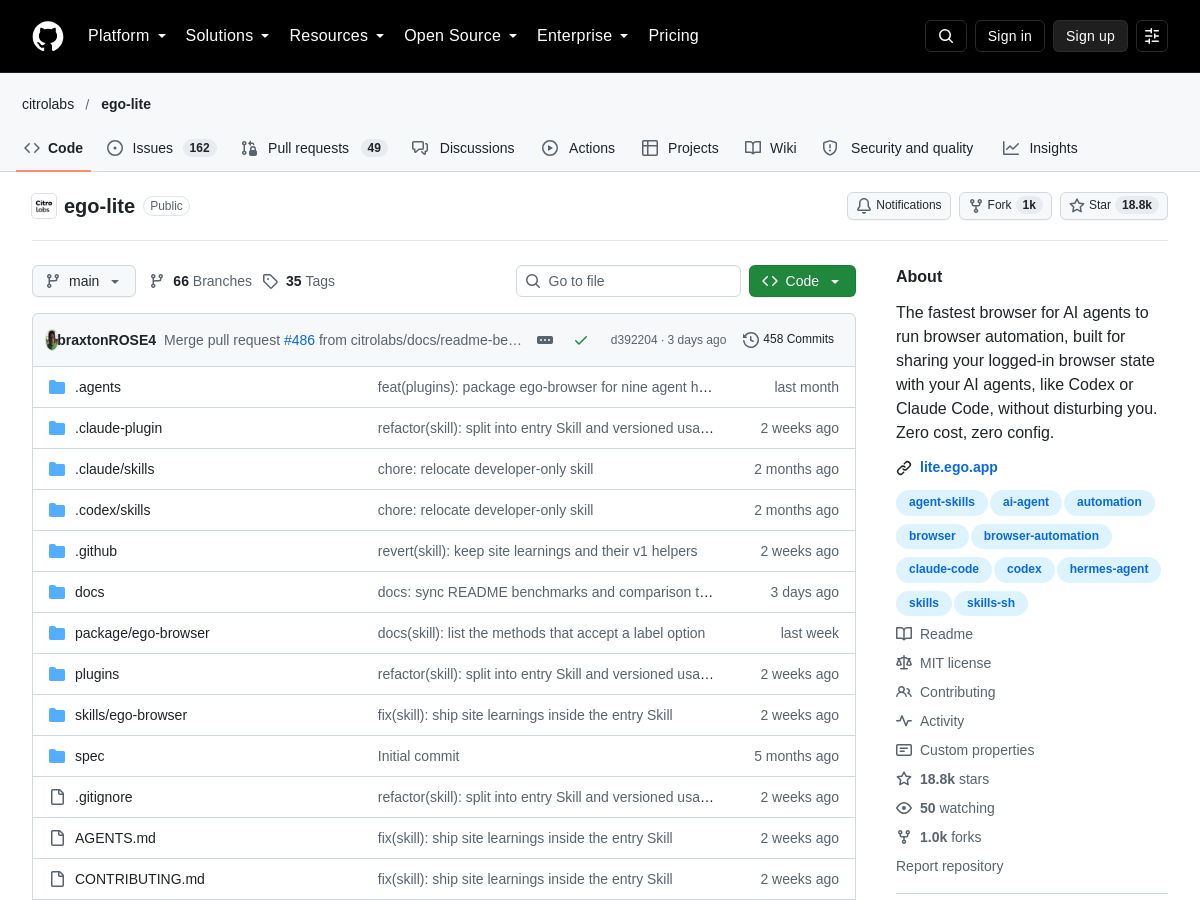
Screenshot of Ego Lite
Ego Lite
LLM Open Source

Ego Lite is a browser extension designed for AI agents to run browser automation. It allows users to share their logged-in browser state with AI agents like Codex or Claude Code without disturbing them. The extension is built for speed and has zero cost and zero configuration. It enables AI agents to automate browser tasks efficiently, making it an ideal tool for developers and researchers working with AI agents. Ego Lite is open-source and has a large community of contributors, with over 18,000 stars on GitHub. The extension is constantly being updated and improved, with new features and bug fixes being added regularly. Overall, Ego Lite is a powerful tool for anyone looking to automate browser tasks with AI agents. It is fast, efficient, and easy to use, making it an essential tool for anyone working in the field of AI and browser automation. The extension's ability to share logged-in browser state with AI agents without disturbing the user makes it a unique and valuable tool. Ego Lite is also highly customizable, with a wide range of settings and options available to users. This makes it an ideal tool for developers and researchers who need to automate complex browser tasks. In addition to its core features, Ego Lite also has a number of additional tools and resources available, including a comprehensive documentation and a community forum. These resources make it easy for users to get started with the extension and to troubleshoot any issues that may arise.

Solves

Developers and researchers working with AI agents often face the problem of automating browser tasks efficiently. Ego Lite solves this problem by providing a fast and efficient way to automate browser tasks with AI agents. The extension's ability to share logged-in browser state with AI agents without disturbing the user makes it an ideal tool for this task. By using Ego Lite, developers and researchers can automate complex browser tasks with ease, saving time and increasing productivity. The extension's zero cost and zero configuration also make it an attractive solution for those looking to automate browser tasks with AI agents.

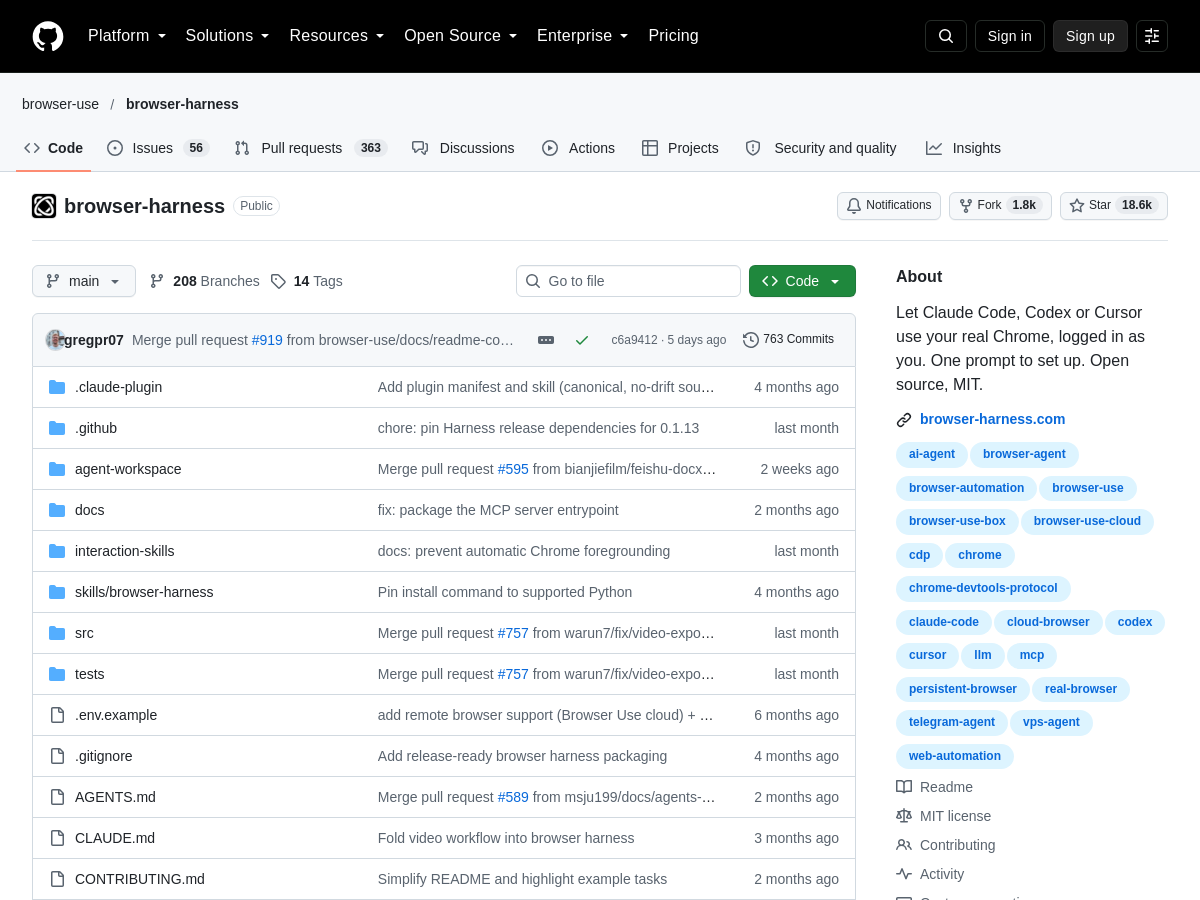
Screenshot of Browser Harness
Browser Harness
LLM Open Source

Browser Harness is an open-source project that enables users to utilize their real Chrome browser, logged in as themselves, with AI agents like Claude Code, Codex, or Cursor. The project allows for a seamless integration of these AI agents with the user's browser, enabling them to perform various tasks with ease. With a simple one-prompt setup, users can leverage the capabilities of these AI agents to automate tasks, scrape data, and more. The project is built on top of the Chrome DevTools Protocol and provides a robust framework for developers to build custom skills and integrations. Browser Harness is designed to be highly extensible, with a modular architecture that allows developers to easily add new features and functionality. The project is actively maintained, with regular updates and contributions from the community.

Solves

Developers and power users face the challenge of automating tasks and workflows that involve web browsing and data scraping. Browser Harness solves this problem by providing a simple and intuitive way to integrate AI agents with the user's browser, enabling them to automate tasks and workflows with ease. This saves time and increases productivity, allowing users to focus on more complex and creative tasks.

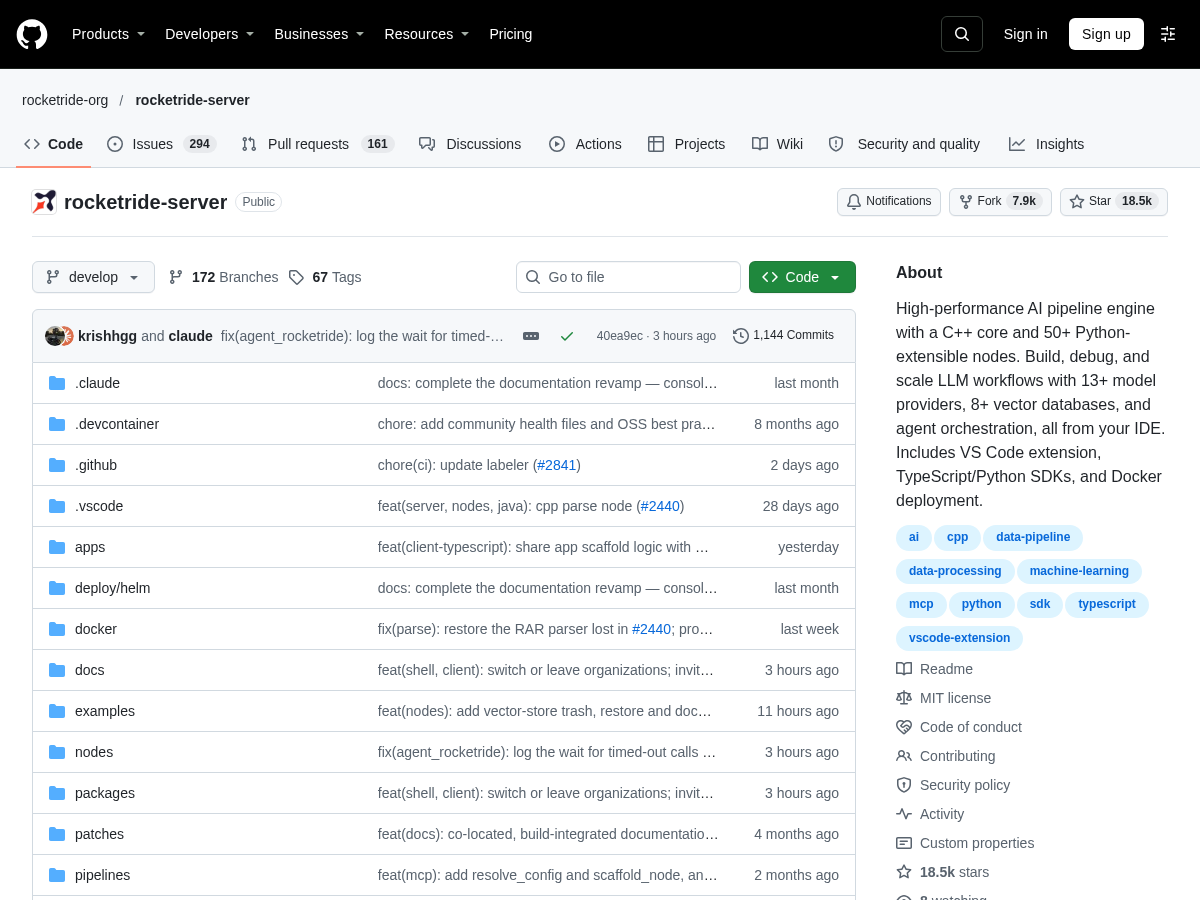
Screenshot of Rocketride Server
Rocketride Server
LLM Open Source

Rocketride Server is a high-performance AI pipeline engine that enables users to build, debug, and scale LLM workflows with ease. It features a C++ core and 50+ Python-extensible nodes, allowing for flexibility and customization. The engine supports 13+ model providers, 8+ vector databases, and agent orchestration, making it a comprehensive solution for AI pipeline management. Additionally, it includes a VS Code extension, TypeScript/Python SDKs, and Docker deployment, providing a seamless development experience. With its robust architecture and extensive features, Rocketride Server is an ideal choice for developers and organizations looking to streamline their AI workflows. The project is open-source, allowing users to contribute and modify the code to suit their specific needs. Overall, Rocketride Server is a powerful tool that simplifies the process of building and deploying AI pipelines, enabling users to focus on developing innovative AI solutions. The engine's scalability and flexibility make it an excellent choice for a wide range of applications, from small-scale projects to large-scale enterprise deployments. By leveraging Rocketride Server, users can accelerate their AI development and deployment, achieving faster time-to-market and improved overall efficiency. Furthermore, the project's active community and extensive documentation provide users with the support and resources they need to get started and stay up-to-date with the latest developments. With its impressive feature set and commitment to open-source principles, Rocketride Server is poised to become a leading solution in the AI pipeline management landscape.

Solves

Developers and organizations often struggle with building, debugging, and scaling AI pipelines, which can be a time-consuming and complex process. Rocketride Server solves this problem by providing a high-performance AI pipeline engine that simplifies the process of building, debugging, and scaling LLM workflows. With its comprehensive feature set and flexible architecture, Rocketride Server enables users to streamline their AI workflows, reducing the time and effort required to develop and deploy AI solutions. By leveraging Rocketride Server, users can overcome the challenges associated with AI pipeline management, achieving faster development, deployment, and iteration of their AI models.

Screenshot of Agent Zero
Agent Zero
AI Agents Open Source

Agent Zero is an open-source AI framework designed for building autonomous AI agents. It provides foundational components and abstractions for creating agents that can perceive, reason, and act in digital environments. The framework aims to simplify the development of agent-based applications, offering tools for memory, planning, and tool integration. As an emerging project, it focuses on modularity and ease of use for developers experimenting with AI agents.

Solves

It addresses the complexity of constructing AI agents from scratch by providing a reusable, extensible framework that handles common agent functionalities like state management, tool calling, and decision-making loops.

Screenshot of Deepwiki Open
Deepwiki Open
Open Source Open Source

Deepwiki Open is an open-source, AI-powered wiki generator designed for GitHub, Gitlab, and Bitbucket repositories. It utilizes artificial intelligence to generate wiki content, making it easier for developers to document their projects. The tool is available on GitHub and has gained significant attention, with over 18,000 stars and 2,000 forks. Deepwiki Open supports various features, including chat streaming, codemap generation, and deep research continuations. It also integrates with other tools and services, such as Ollama and Anthropic. The project is actively maintained, with regular updates and contributions from the community. Deepwiki Open can be used for a wide range of applications, from generating documentation for open-source projects to creating knowledge bases for businesses. Its AI-powered capabilities make it an innovative solution for automating wiki content generation, saving time and effort for developers and teams.

Solves

Developers and teams often struggle with generating and maintaining high-quality wiki content for their projects. This can be a time-consuming and labor-intensive process, taking away from other important tasks. Deepwiki Open solves this problem by providing an AI-powered wiki generator that can automatically create and update wiki content, reducing the workload and improving the overall quality of documentation. By leveraging artificial intelligence, Deepwiki Open enables developers to focus on their core work, while also ensuring that their projects have accurate and up-to-date documentation.

Screenshot of Open Generative AI
Open Generative AI
Open Source Free

Open Generative AI is an open-source, self-hosted studio for AI image and video generation. It provides a unified interface to access over 500 generative models, including Flux, Midjourney, Kling, Sora, and Veo, enabling users to create content without content restrictions. The project is licensed under the MIT license, making it free to use, modify, and distribute. It is designed as an unrestricted alternative to commercial AI video platforms, offering no content filters and full control over deployment. Users can run the software on their own infrastructure, ensuring privacy and no usage limits. The tool aggregates multiple state-of-the-art generative models, allowing users to experiment with different models for both image and video synthesis. It is hosted on GitHub and actively maintained by the open-source community. The self-hosted nature makes it suitable for developers, researchers, and hobbyists who need flexible and unfiltered AI generation capabilities.

Solves

Open Generative AI addresses the limited availability of unrestricted, affordable AI image and video generation tools by providing a free, open-source, self-hosted platform with a wide range of models and no content filters, enabling users to generate content without censorship or subscription costs.

Screenshot of Articos
Articos
Product research Unknown

Articos is an AI-powered user research platform that runs synthetic user interviews to generate audience insights. It is designed to help teams validate messaging, landing pages, product ideas, and other product-related decisions with simulated respondents. According to the company, the method is grounded in behavioral science and, as of the latest published validation, claims 86% human accuracy across 46 studies. The platform aims to deliver full research reports in under 30 minutes, compared to traditional research projects that may take weeks and cost thousands of dollars. Articos addresses the common gap in decision-making where teams skip research because it is too expensive, slow, or logistically complex. Instead of sourcing and scheduling human participants, Articos uses AI-generated personas that are interviewed in isolation and remain hypothesis-blind. This approach is intended to reduce interviewer bias and produce candid, structured insights about jobs-to-be-done, pain points, and attitudes. Pricing on the platform starts at $8 per research on a monthly plan, with on-demand packs going for $14.50 per research, and a free trial is available. The service supports a range of use cases including audience discovery, ICP (ideal customer profile) definition, positioning validation, messaging and copy testing, A/B testing for landing pages, and ad campaign evaluation. Articos is positioned for industries such as B2B SaaS, agencies, consultants, healthcare, consumer goods, and creator teams. Its goal is to make user research accessible for every meaningful decision rather than only for high-budget projects.

Solves

Traditional user research typically costs $5,000–$15,000 per study and takes 4–8 weeks, causing many teams to decide without evidence. Articos provides on-demand synthetic user interviews that produce a structured research report in under 30 minutes at a fraction of the cost, allowing businesses to validate audience assumptions, messaging, and product ideas quickly and affordably.