Tool discovery

What type of AI tool
are you looking for?

Search the active catalog with LambdaBase AI Search, or keep browsing the popularity-ordered directory below.

Submitted search queries and interaction metrics may be analyzed to improve result quality. Do not include personal or confidential information

Browse popular tools.

Screenshot of UniMusic AI
UniMusic AI
Music Freemium

UniMusic AI is an AI-powered music generation platform that enables users to create professional, royalty-free songs with vocals in seconds. The service supports both text-to-music and lyrics-to-music workflows, allowing users to input a simple prompt, a mood, a detailed scene, or their own lyrics to generate a complete track with melody, arrangement, and vocals. It offers multiple AI models, including the Uni V4.5 and earlier versions, to produce tracks across a wide range of genres such as pop, rock, hip-hop, jazz, classical, EDM, and more. Users can also specify instruments, ambiance, and style preferences to tailor the output to their needs. The platform includes a built-in showcase where users can explore music created by others, and it provides sample works to demonstrate the quality and variety of generated tracks. UniMusic AI operates on a freemium model, with free tier usage limited in features such as download formats and commercial licensing. Paid plans unlock higher quality generation, MP3/WAV downloads, and a commercial license with a PDF certificate, making it suitable for both personal and business use.

Solves

UniMusic AI solves the problem of creating professional, royalty-free music quickly without requiring any musical skills or expensive production equipment. It eliminates the need to search for licensed tracks or hire composers by generating original songs with vocals from text descriptions or lyrics in seconds, providing users with commercially usable music.
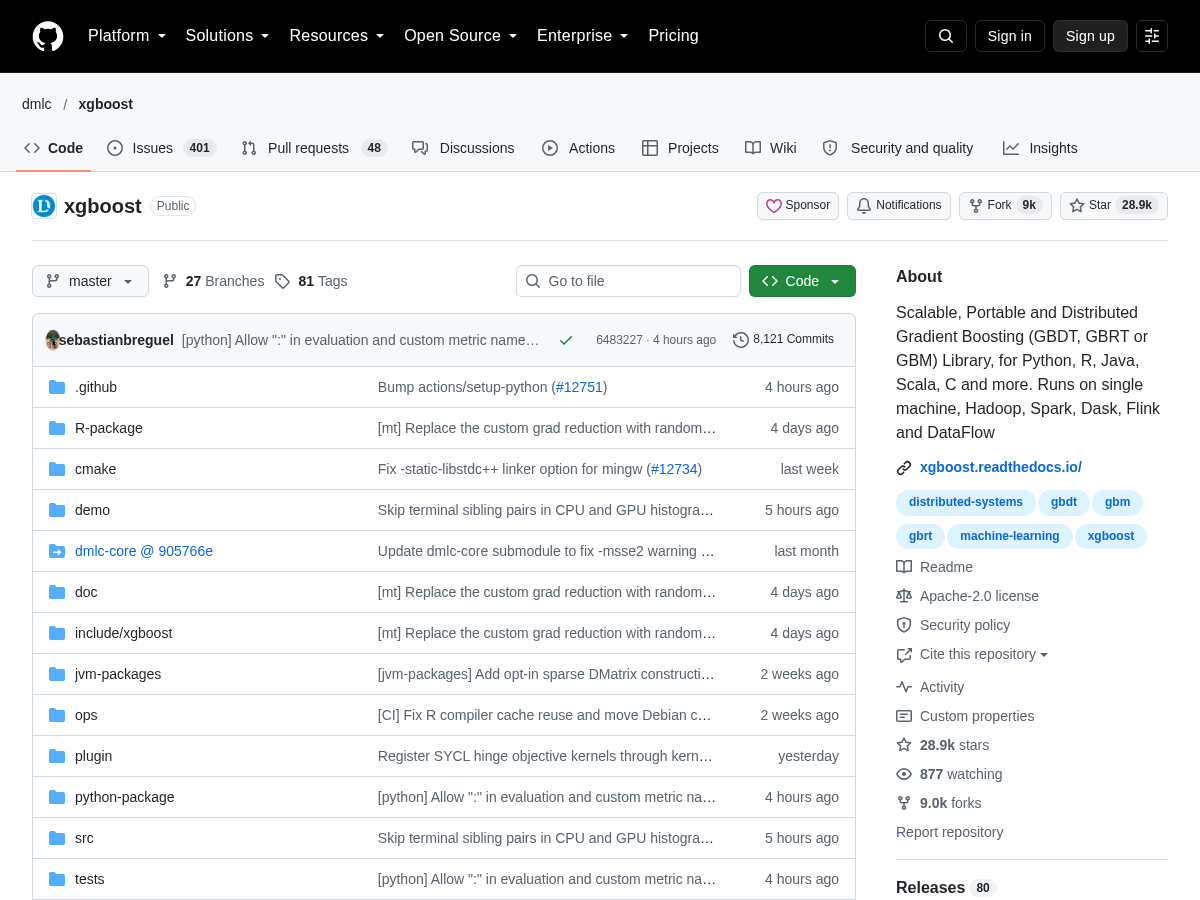
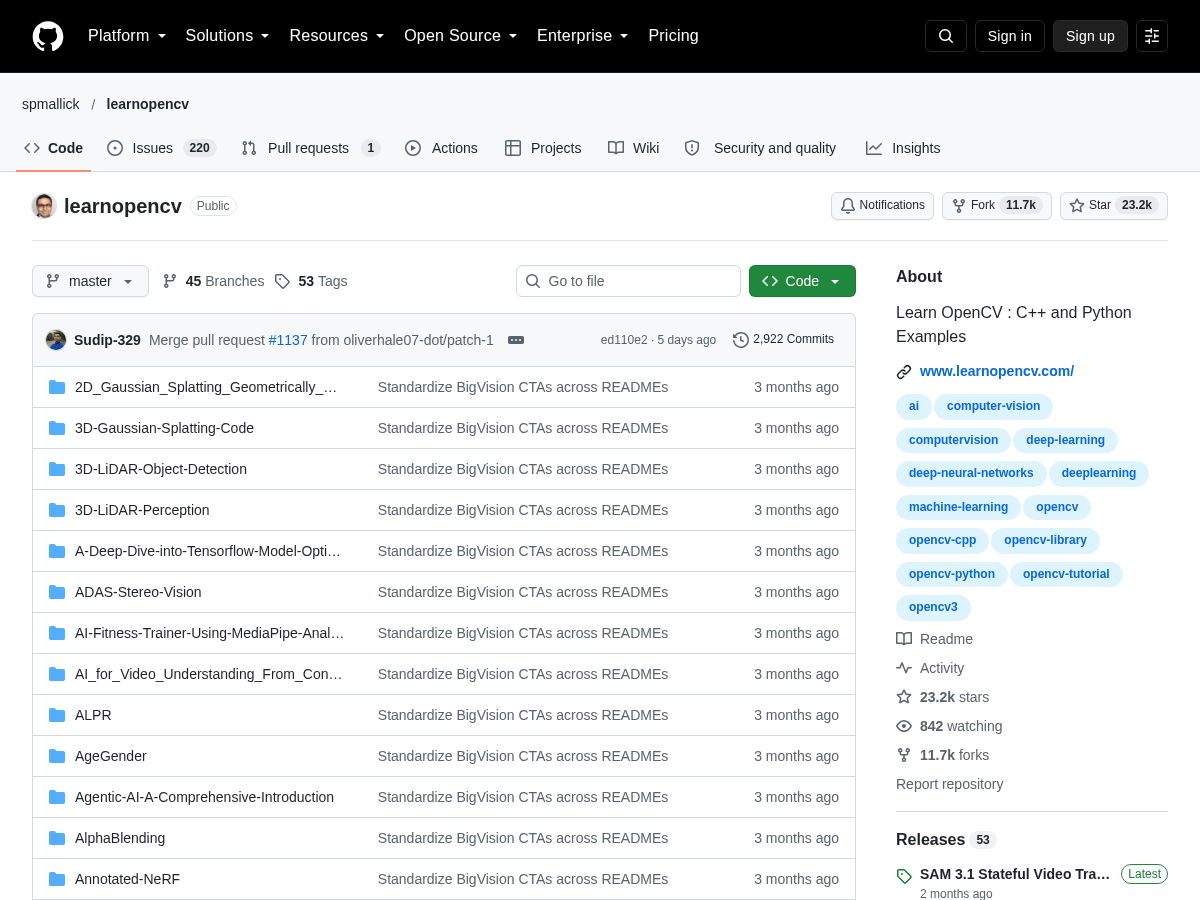
Screenshot of Xgboost
Xgboost
Framework Open Source

XGBoost is an optimized distributed gradient boosting library designed to be highly efficient, flexible, and portable. It implements machine learning algorithms under the Gradient Boosting framework. XGBoost provides a parallel tree boosting (also known as GBDT, GBM) that solves many data science problems in a fast and accurate way. The same code runs on major distributed environments (Kubernetes, Hadoop, SGE, Dask, Spark, PySpark) and can solve problems beyond billions of examples. XGBoost is scalable, portable, and distributed, making it a popular choice for data scientists and machine learning engineers. It supports multiple programming languages, including Python, R, Java, Scala, and C, and can run on single machines, Hadoop, Spark, Dask, Flink, and DataFlow. XGBoost has been widely used in various applications, including classification, regression, and ranking tasks. Its efficiency, flexibility, and portability make it a powerful tool for solving complex data science problems. XGBoost has been developed and used by a group of active community members, and its development is supported by various sponsors. The library is licensed under an Apache-2 license, and its documentation and contributor guidelines are available on the XGBoost website. XGBoost has been cited in various research papers and has been used in numerous projects, including those in the fields of computer vision, natural language processing, and recommender systems. Overall, XGBoost is a powerful and widely-used library for gradient boosting and other machine learning tasks.

Solves

XGBoost solves the problem of efficient and scalable machine learning, particularly for gradient boosting tasks. It provides a fast and accurate way to solve complex data science problems, making it a popular choice for data scientists and machine learning engineers. XGBoost addresses the challenges of traditional gradient boosting methods, which can be computationally expensive and difficult to parallelize. By providing a distributed and parallelized implementation of gradient boosting, XGBoost enables users to solve large-scale machine learning problems efficiently and effectively. Additionally, XGBoost provides a flexible and portable framework that can be used with multiple programming languages and distributed environments, making it a versatile tool for a wide range of applications.

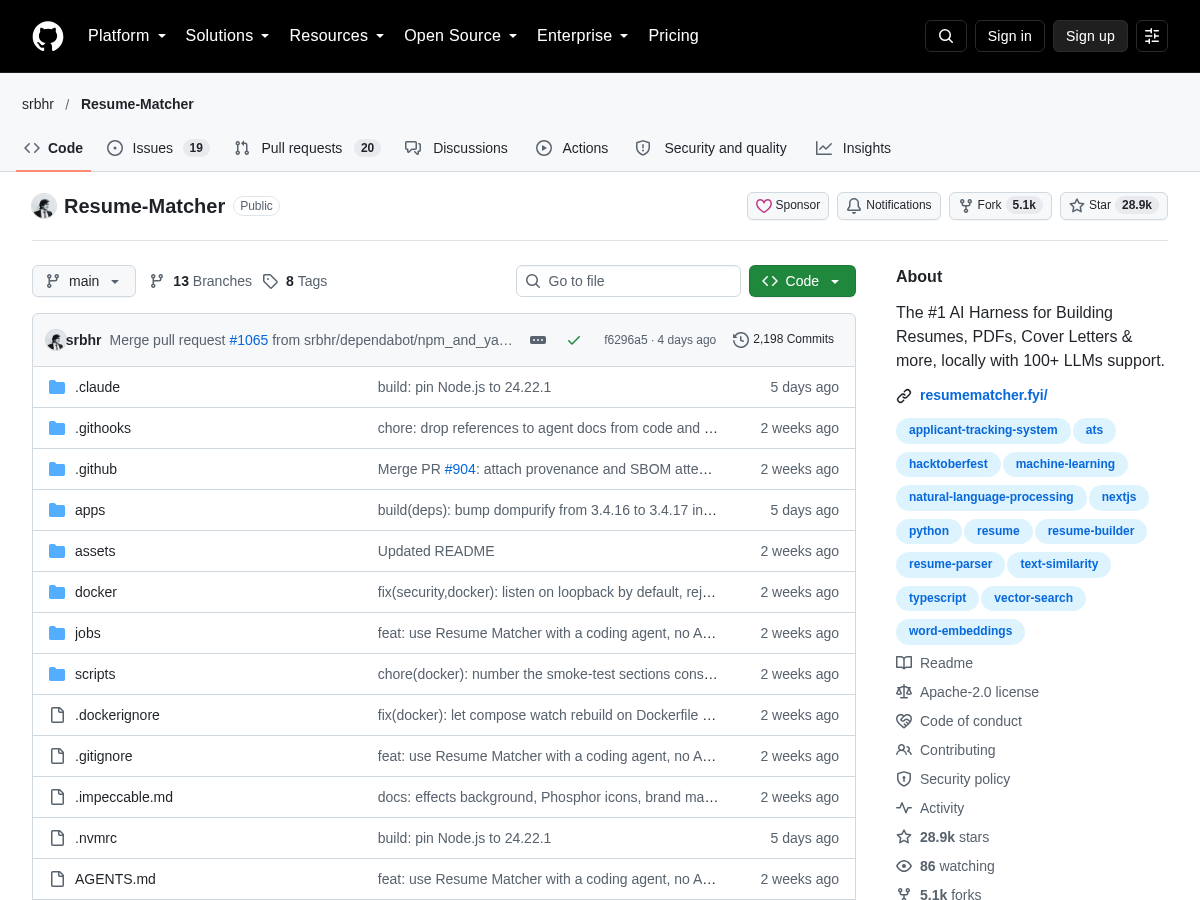
Screenshot of Resume Matcher
Resume Matcher
LLM Open Source

Resume Matcher is an open-source AI harness designed to help individuals build resumes, PDFs, cover letters, and more, locally with support for over 100 large language models (LLMs). The project utilizes natural language processing and machine learning to tailor resumes to each job description, providing a self-hosted solution for users. Resume Matcher includes features such as resume guides for software engineers, templates for exporting text-based PDFs in A4 or US Letter formats, and product screenshots showcasing its capabilities. The project is built using technologies like Next.js, Python, and TypeScript, and is available on GitHub with an Apache-2.0 license. With its focus on software engineers, Resume Matcher aims to provide a deterministic ATS score and ATS check, as well as Deedy/LaTeX-style templates, making it a valuable tool for those in the industry. The project has a strong community presence, with over 28,000 stars and 5,000 forks on GitHub, and is actively maintained with regular updates and contributions.

Solves

Resume Matcher solves the problem of creating tailored resumes for job applications, which can be a time-consuming and challenging task for individuals. By utilizing AI and machine learning, Resume Matcher streamlines the process, allowing users to create high-quality resumes that are tailored to each job description, increasing their chances of success in the job market. This tool is particularly useful for software engineers, who often face intense competition in the job market and require a precise and effective way to showcase their skills and experience.

Screenshot of Void
Void
Dev Tools Open Source

Void is an open-source code editor designed for software developers, providing a customizable and extensible environment for writing and managing code. Based on the repository structure, it appears to be built using web technologies and is likely an Electron-based application, similar to Visual Studio Code. It includes features such as an integrated CLI, support for extensions, remote development capabilities, and a .vscode configuration directory, suggesting VS Code compatibility. However, as the repository was archived on June 2, 2026, the project is no longer actively maintained. The available information is limited, so specific features and design goals beyond typical code editor functionality are uncertain.

Solves

Developers need a free, extensible, and high-performance code editor that can be tailored to various programming languages and workflows. Void offered an open-source alternative to proprietary editors, aiming to provide a customizable development environment with community-driven extensions and cross-platform support. With its archival, this solution is no longer evolving but may still be used by those with existing setups.

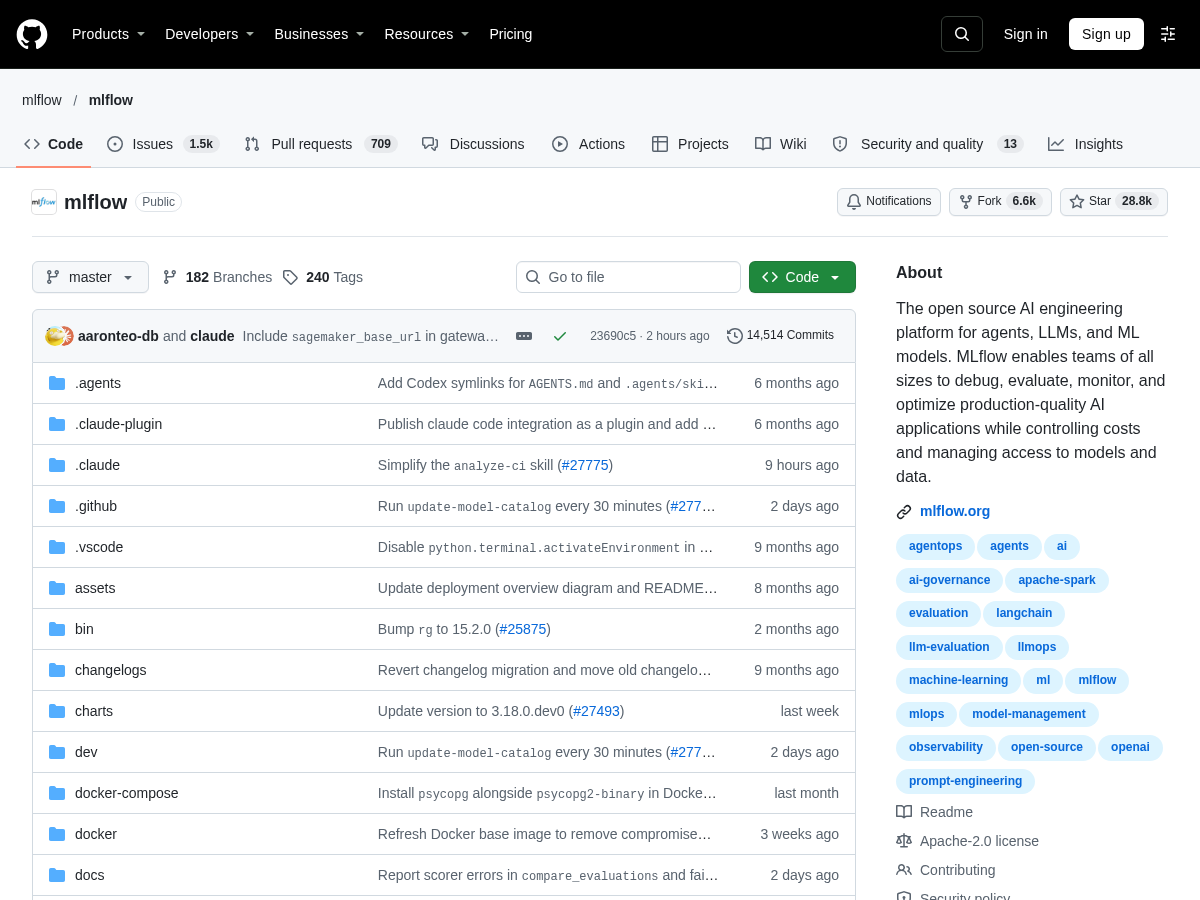
Screenshot of Mlflow
Mlflow
Evaluation Open Source

MLflow is an open-source AI engineering platform designed to help teams of all sizes debug, evaluate, monitor, and optimize production-quality AI applications. It provides a comprehensive set of tools to manage the entire machine learning lifecycle, from data preparation to model deployment. With MLflow, teams can control costs, manage access to models and data, and ensure the reliability and scalability of their AI applications. The platform supports a wide range of machine learning frameworks and libraries, including Apache Spark, and provides a simple and intuitive API for integrating with existing workflows. MLflow also includes a range of features for collaboration, versioning, and reproducibility, making it an ideal choice for teams working on complex AI projects. Additionally, MLflow provides a range of tools for evaluating and optimizing AI models, including automated testing, validation, and hyperparameter tuning. Overall, MLflow is a powerful and flexible platform that can help teams to streamline their AI development workflows, improve the quality and reliability of their AI applications, and reduce the time and cost of deploying AI models to production. MLflow is widely used in the industry and has a large community of users and contributors, which ensures that it is constantly evolving and improving. The platform is also highly customizable, allowing teams to tailor it to their specific needs and workflows. Furthermore, MLflow provides a range of integrations with other popular AI and data science tools, making it easy to incorporate into existing workflows. In summary, MLflow is a comprehensive and powerful AI engineering platform that can help teams to develop, deploy, and manage AI applications more efficiently and effectively. It provides a wide range of features and tools for managing the machine learning lifecycle, and its flexibility, customizability, and large community of users and contributors make it an ideal choice for teams working on complex AI projects.

Solves

MLflow solves the problem of managing the complex machine learning lifecycle, from data preparation to model deployment. Many teams struggle with the challenges of developing, deploying, and managing AI applications, including issues with data quality, model reliability, and scalability. MLflow provides a comprehensive set of tools to address these challenges, making it easier for teams to develop, deploy, and manage AI applications. By providing a simple and intuitive API, automated testing and validation, and collaboration features, MLflow helps teams to streamline their AI development workflows, improve the quality and reliability of their AI applications, and reduce the time and cost of deploying AI models to production.

Screenshot of Sim
Sim
AI Agents Open Source

Sim is an open-source collaborative workspace designed for building, deploying, and monitoring AI agents and workflows. It provides a central intelligence layer to manage an AI workforce, allowing teams to create and orchestrate autonomous agents that can perform complex tasks. The platform emphasizes collaboration, enabling multiple builders to work together on agent development. With a focus on visual building and orchestration, Sim likely offers a user-friendly interface to design agent workflows without deep coding. It supports deployment of agents to various environments and provides monitoring capabilities to track performance, debug issues, and ensure reliability. The tool has gained traction with over 100,000 builders, indicating a growing community. Sim integrates with popular AI models and services, allowing agents to leverage large language models, tools, and APIs. It aims to simplify the creation of multi-agent systems, enabling coordination between specialized agents to solve complex problems. The open-source nature encourages customization and self-hosting, giving users full control over their AI infrastructure.

Solves

Managing multiple AI agents and workflows is challenging due to fragmentation, lack of observability, and complex orchestration. Sim solves this by providing a unified workspace to build, deploy, and monitor agents, enabling teams to collaborate effectively and maintain central control over their AI workforce.

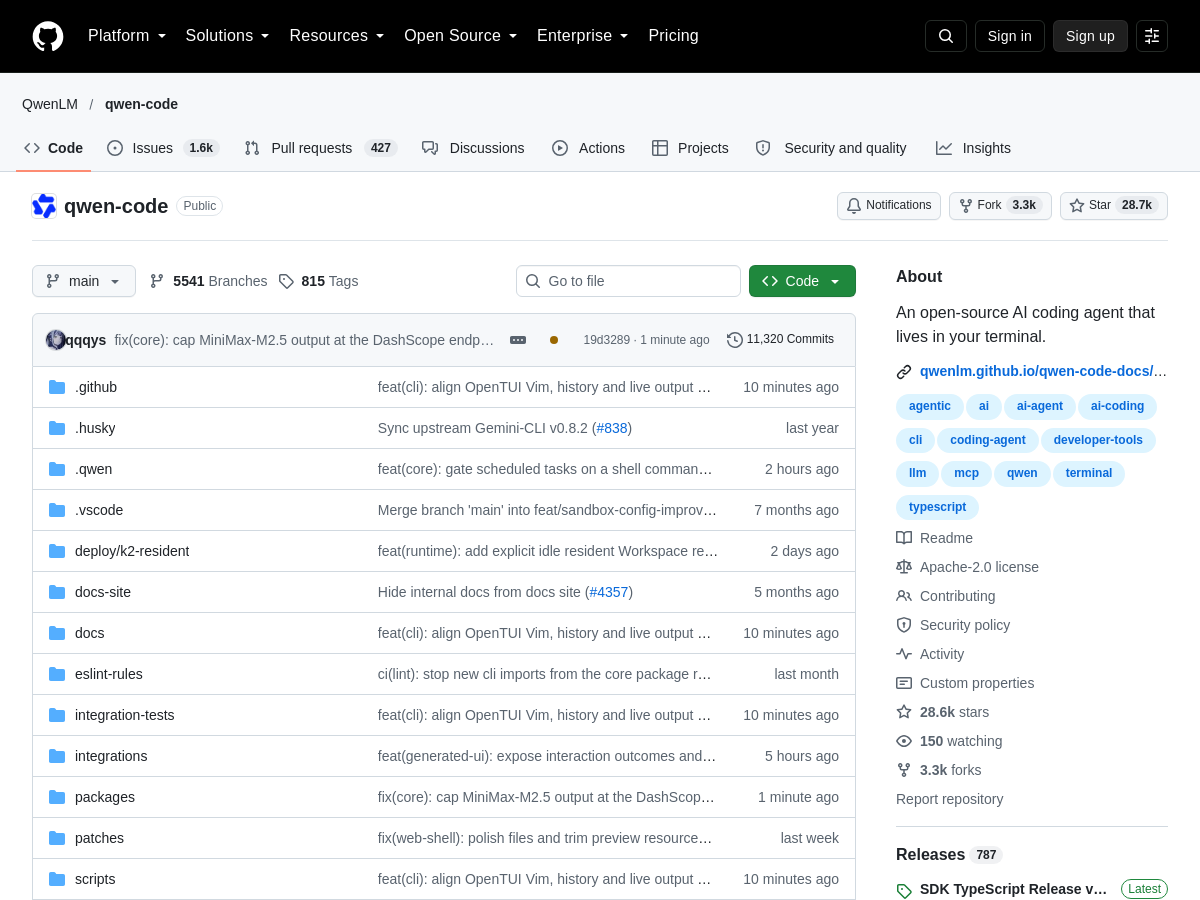
Screenshot of Qwen Code
Qwen Code
Dev Tools Open Source

Qwen Code is an open-source AI coding agent that lives in your terminal. It is designed to assist developers with coding tasks, providing features such as code completion, code review, and project management. The tool is built using TypeScript and utilizes the Apache-2.0 license. Qwen Code has a strong focus on community involvement, with over 28,000 stars on GitHub and an active community of contributors. The tool is highly customizable, allowing users to tailor it to their specific needs and workflows. Qwen Code also integrates with other popular development tools, such as GitHub Copilot and GitHub Actions. With its robust feature set and active community, Qwen Code is a powerful tool for developers looking to streamline their coding workflow. Qwen Code's documentation is available at qwenlm.github.io/qwen-code-docs/en/users/overview, providing users with a comprehensive guide to getting started with the tool. The tool's GitHub repository is located at github.com/QwenLM/qwen-code, where users can find the latest releases, issues, and pull requests. Overall, Qwen Code is a versatile and powerful tool that can help developers improve their productivity and efficiency. The tool's AI-powered features and customizable interface make it an ideal choice for developers looking to take their coding skills to the next level. With its strong community support and continuous development, Qwen Code is a tool that is sure to continue evolving and improving over time.

Solves

Qwen Code solves the problem of inefficient coding workflows, providing developers with a powerful tool to streamline their coding tasks. By leveraging AI-powered features and integrating with other popular development tools, Qwen Code helps developers to work more efficiently and effectively. The tool is particularly useful for developers who spend a lot of time writing code, as it can help to reduce the time and effort required to complete coding tasks. Additionally, Qwen Code's customizable interface and robust feature set make it an ideal choice for developers who want to tailor their coding workflow to their specific needs and preferences.

Screenshot of Composio
Composio
AI Agents Open Source

Composio is an open-source platform that provides over 1000 toolkits for AI agents, enabling them to interact with external services and turn intent into action. It offers tool search, context management, authentication, and a sandboxed workbench to streamline the development of AI agents. Developers can integrate Composio with popular agent frameworks such as OpenAI, LangChain, and CrewAI to connect their agents to applications like GitHub, Slack, Gmail, and many others. The platform handles authentication flows, including OAuth, and provides managed execution environments to safely run agent actions. Composio aims to reduce the complexity of building agents that can take real-world actions by unifying tool integrations, credential management, and execution monitoring. It is available both as an open-source project and as a cloud service.

Solves

Building AI agents that can act on external tools is challenging due to API integration, authentication, and execution safety. Composio solves this by providing a unified interface to thousands of tools, managing credentials, and offering a sandboxed workbench, allowing developers to focus on agent logic rather than infrastructure.

Screenshot of Reflex
Reflex
Dev Tools Open Source

Reflex is an open-source, full-stack web framework that enables developers to build, deploy, and host web applications using only Python. It abstracts away frontend complexities by providing a declarative, component-based model where UI elements are defined as Python classes and composable functions. Under the hood, Reflex compiles the Python code into a React frontend and a FastAPI backend, handling the entire communication via WebSockets for reactive state updates. This means developers can write both client-side and server-side logic in a single language, with automatic synchronization between the UI and state. Key features include a growing library of over 60 built-in components (such as buttons, forms, charts, and data tables), a powerful state management system that tracks variable changes and re-renders only affected parts of the UI, and a built-in routing mechanism for multi-page applications. Reflex also supports custom components, theming, and integration with popular Python libraries like Pandas, Matplotlib, and Plotly for data visualization. The framework includes a development server with hot-reload, enabling rapid iteration, and production-ready deployment options via Docker, Kubernetes, or the Reflex hosting service. Reflex is designed to be approachable for Python developers who want to create modern, interactive web apps without learning JavaScript, HTML, or CSS. It emphasizes developer experience with type hints, a CLI for scaffolding and management, and extensive documentation. The project is actively maintained with frequent releases, a large community, and over 28,000 GitHub stars. By unifying the stack around Python, Reflex reduces context switching and accelerates development of internal tools, dashboards, data applications, and even customer-facing web apps. Its architecture is extensible, allowing advanced users to drop down to JavaScript or customize the build pipeline when needed.

Solves

Python developers often struggle to build modern, interactive web applications because they must also learn JavaScript frameworks, handle state management across client-server boundaries, and set up complex build toolchains. Reflex solves this by providing a pure-Python abstraction where the entire application logic, from UI components to backend services, is written in Python. It automatically generates the required frontend and backend code, manages real-time state synchronization via WebSockets, and offers a simple, familiar development workflow—empowering Python developers to quickly create full-stack web apps without leaving their language of choice.

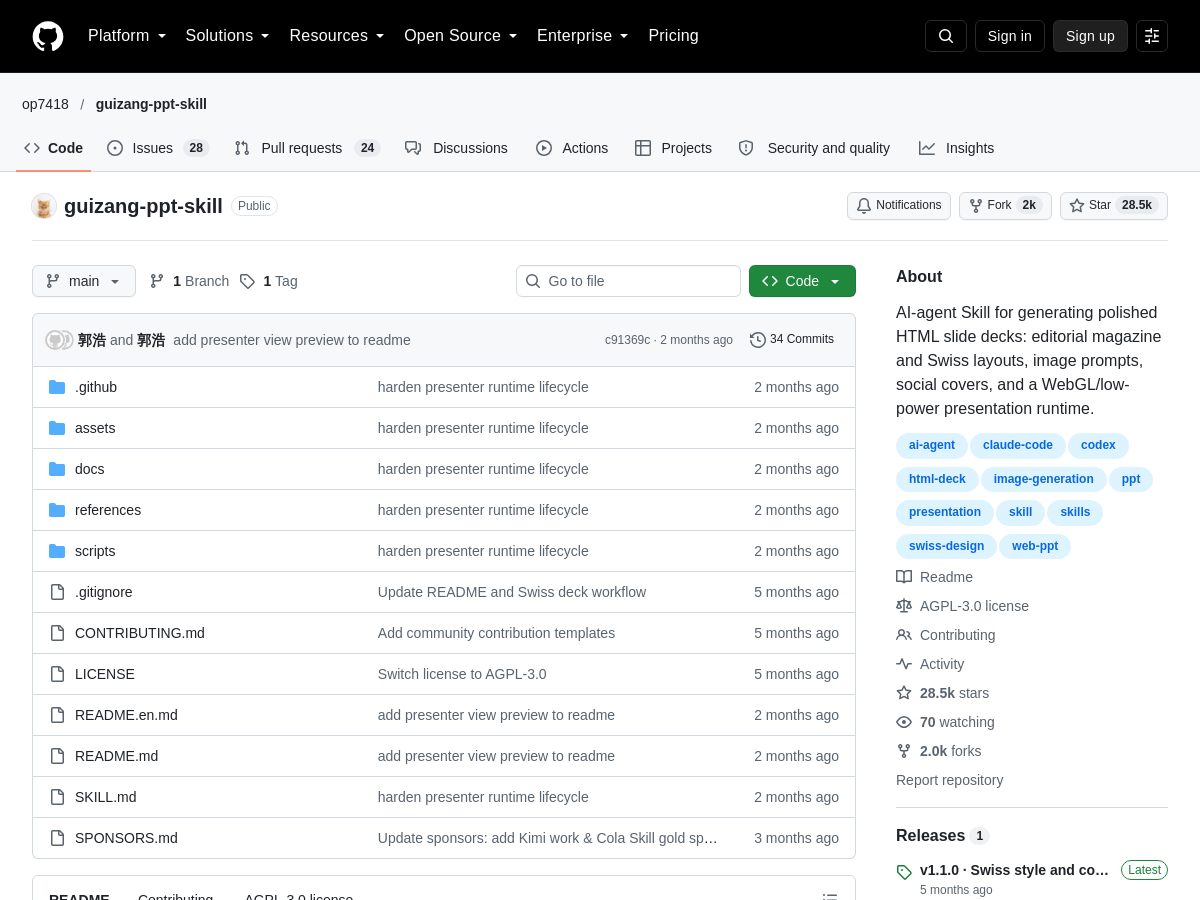
Screenshot of Guizang Ppt Skill
Guizang Ppt Skill
Image Gen Open Source

Guizang PPT Skill is an AI-agent skill designed to generate polished HTML slide decks. It supports various layouts, including editorial magazine and Swiss layouts, and allows for image prompts, social covers, and a WebGL/low-power presentation runtime. The tool is open-source and available on GitHub, with a large community of contributors and users. It has gained significant popularity, with over 28,000 stars and 2,000 forks on GitHub. The project is actively maintained, with regular updates and new features being added. Guizang PPT Skill is a valuable resource for anyone looking to create professional-looking presentations quickly and easily. It can be used for a variety of purposes, including business presentations, educational materials, and personal projects. The tool is highly customizable, allowing users to tailor their presentations to their specific needs. Overall, Guizang PPT Skill is a powerful and versatile tool that can help users create high-quality presentations with minimal effort. The project's documentation and community support make it easy for users to get started and troubleshoot any issues that may arise. With its robust feature set and active community, Guizang PPT Skill is an excellent choice for anyone looking to create professional-looking presentations. The tool's ability to generate polished HTML slide decks makes it an ideal solution for users who want to create engaging and interactive presentations. Additionally, the tool's support for various layouts and image prompts makes it a great option for users who want to add visual interest to their presentations. The project's open-source nature and large community of contributors ensure that the tool will continue to evolve and improve over time, providing users with access to the latest features and technologies.

Solves

Guizang PPT Skill solves the problem of creating professional-looking presentations quickly and easily. Many users struggle with designing and building presentations, especially those who are not experienced in graphic design or programming. Guizang PPT Skill provides a solution to this problem by offering a range of pre-designed templates and a user-friendly interface for customizing presentations. With Guizang PPT Skill, users can create high-quality presentations without needing to have extensive design or programming knowledge. This makes it an ideal tool for business professionals, educators, and individuals who want to create engaging and effective presentations without spending a lot of time and effort.

Screenshot of Chroma
Chroma
AI Agents Open Source

Chroma is an open-source vector database purpose-built for AI applications. It provides a simple and developer-friendly interface for storing, indexing, and querying high-dimensional embeddings—numerical representations of data like text, images, or audio—along with associated metadata. Chroma is designed to be the memory engine for large language model (LLM) apps, chatbots, and AI agents, enabling semantic search and retrieval-augmented generation (RAG). Under the hood, Chroma uses efficient approximate nearest neighbor (ANN) algorithms to deliver fast query performance. It supports multiple distance metrics such as cosine similarity, Euclidean distance, and inner product, allowing users to tune relevance. The database can be run in two modes: an ephemeral, in-memory mode ideal for rapid prototyping and testing, and a persistent client-server mode that stores data on disk and serves multiple clients over HTTP, suitable for production deployments. Chroma's API is available in Python and JavaScript, making it accessible to a wide range of developers. It seamlessly integrates with popular embedding providers like OpenAI, Cohere, and Hugging Face, as well as any custom embedding function. Collections organize vectors into groups, and metadata filtering enables combining semantic search with traditional constraints. The system handles scaling across multiple nodes and includes features like multi-tenancy for isolation. The project is actively maintained by a large community on GitHub (over 28k stars) and has frequent releases. Chroma can be deployed locally via pip or Docker, or consumed as a managed cloud service. It is Apache 2.0 licensed, fostering broad adoption and contribution. Whether you are building a single-user demo or a enterprise-grade AI system, Chroma aims to make vector search simple and scalable.

Solves

Developers building AI applications struggle to give models long-term memory and the ability to retrieve relevant context from large datasets. Traditional databases cannot efficiently search by semantic similarity, and ad-hoc vector search implementations are complex. Chroma solves this by providing a dedicated vector database that stores embeddings and performs fast approximate nearest neighbor searches, turning raw data into a queryable knowledge base. It enables AI agents and LLMs to recall past information, ground responses in factual data, and power retrieval-augmented generation pipelines, all through a straightforward API.

Screenshot of Pounce
Pounce
AI/ML Unknown

Pounce is a social media engagement and lead generation tool that monitors X (formerly Twitter) and Reddit in real-time to help businesses, creators, and marketers find and engage with high-intent leads. Instead of manually scrolling through feeds, Pounce uses AI to filter thousands of posts and surface only the conversations relevant to your product or niche. Users set up search rules and filters based on their target audience, and Pounce streams matching posts into a dedicated inbox. Within 15-minute 'lightning round' sessions, users can quickly review items, and with one click, generate AI-assisted replies drafted in their own voice. This allows them to send more thoughtful replies, build connections, and gain distribution far faster than traditional social media management. The tool learns from user interactions to refine filters over time, making each session more focused and effective. Pounce also tracks session stats, including replies sent, leads surfaced, and daily goals, providing tangible proof of progress. It positions itself as a productivity assistant for social engagement, emphasizing consistency and speed over sporadic viral attempts.

Solves

Social media users, particularly founders, marketers, and creators, struggle to cut through noise on X and Reddit to find potential customers or followers. Manual scrolling is time-consuming and often yields low-intent interactions. Pounce solves this by automating monitoring and filtering, presenting only high-value posts, and accelerating reply drafting, enabling users to achieve meaningful engagement in just 15 minutes a day.

Screenshot of Fastai
Fastai
Framework Open Source

Fastai is an open-source deep learning library that provides high-level components for quickly and easily building and training neural networks. It is built on top of PyTorch and aims to make deep learning accessible to both beginners and experienced practitioners through a layered architecture that includes pre-defined high-level APIs as well as lower-level building blocks. Fastai incorporates many best practices and modern techniques such as transfer learning, learning rate scheduling, data augmentation, and discriminative fine-tuning, allowing users to achieve state-of-the-art results with minimal code. The library supports a wide range of tasks including image classification, text analysis, tabular data modeling, and collaborative filtering, and comes with comprehensive documentation, Jupyter notebook examples, and a free course. Fastai is designed with a "batteries-included" philosophy, offering sensible defaults that work well out-of-the-box while still providing flexibility for custom model architectures and training loops.

Solves

Fastai addresses the steep learning curve and boilerplate code typically associated with deep learning. Beginners and experts often struggle with implementing modern training techniques and achieving high performance quickly. Fastai abstracts away these complexities by providing a high-level, consistent interface built on top of PyTorch, enabling users to train state-of-the-art models in just a few lines of code. It empowers a wide audience—from students to researchers—to focus on the problem domain rather than implementation details, dramatically reducing the time from idea to working model.

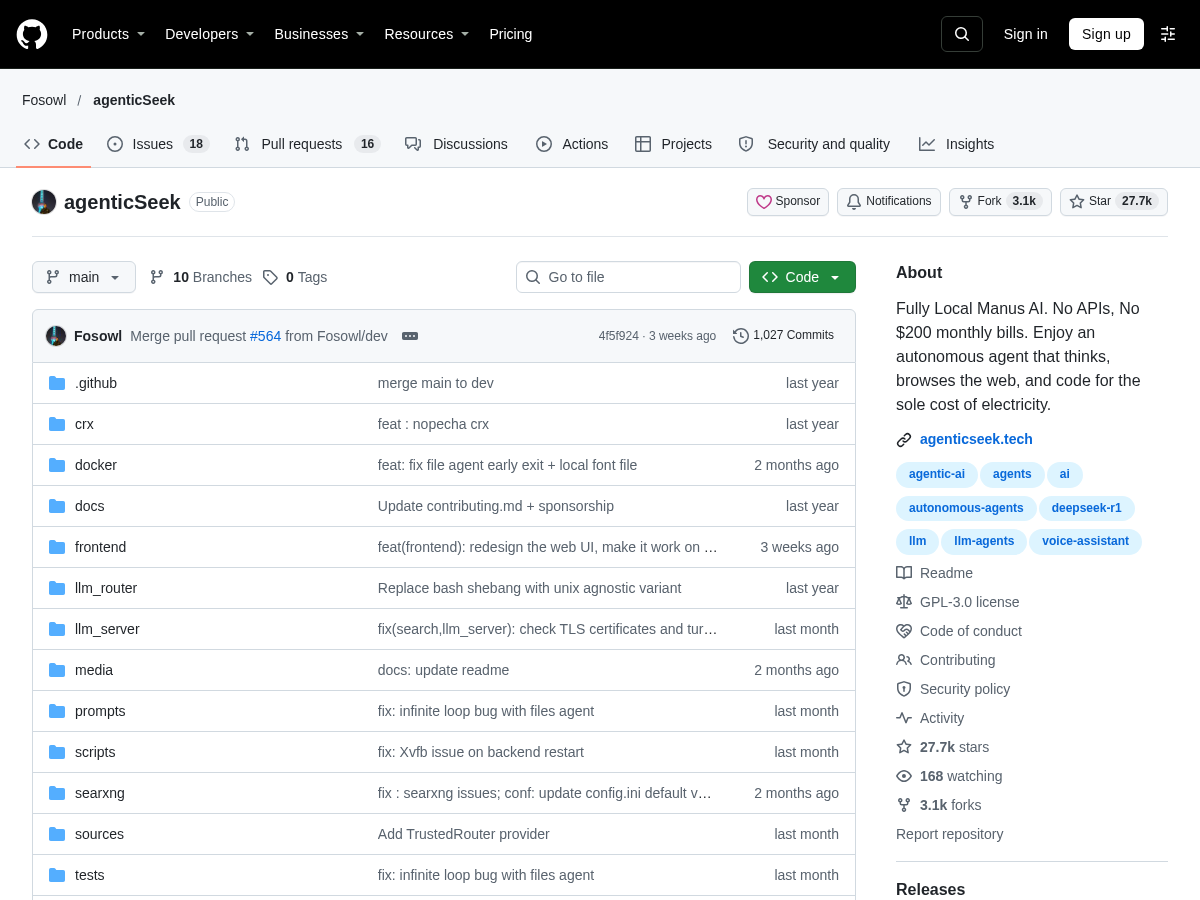
Screenshot of AgenticSeek
AgenticSeek
LLM Open Source

AgenticSeek is a fully local, open-source, autonomous AI agent that can think, browse the web, and code without relying on external APIs or incurring significant monthly costs. The project aims to provide a self-sustaining AI solution that runs solely on the user's local machine, utilizing the power of large language models (LLMs) to perform various tasks. AgenticSeek's capabilities include browsing the web, coding, and interacting with users through a chat interface. The project is actively maintained, with a large community of contributors and a transparent development process. AgenticSeek is designed to be highly customizable, with a modular architecture that allows users to extend its functionality through plugins and custom scripts. The project's goal is to create a versatile and powerful AI tool that can assist users in a wide range of tasks, from simple queries to complex coding projects. With its focus on autonomy, customizability, and cost-effectiveness, AgenticSeek has the potential to revolutionize the way we interact with AI systems. The project's documentation and community resources provide a comprehensive guide for users to get started with AgenticSeek, from installation and configuration to advanced customization and development. Overall, AgenticSeek represents a significant step forward in the development of autonomous AI systems, offering a unique combination of power, flexibility, and affordability.

Solves

AgenticSeek solves the problem of relying on external APIs and incurring significant monthly costs for AI services. Many users and organizations are looking for a self-sustaining AI solution that can run locally, without depending on cloud services or external providers. AgenticSeek addresses this need by providing a fully local, autonomous AI agent that can perform a wide range of tasks, from simple queries to complex coding projects. By eliminating the need for external APIs and monthly subscription fees, AgenticSeek offers a cost-effective and customizable AI solution that can be tailored to meet the specific needs of its users.

Screenshot of Awesome Generative Ai Guide
Awesome Generative Ai Guide
Code Open Source

The Awesome Generative AI Guide is an open-source GitHub repository curated by Aishwarya Nair (aishwaryanr) that serves as a centralized hub for generative AI resources. It aggregates research updates, interview preparation materials, notebooks, and other educational content, aiming to be a one-stop reference for anyone interested in generative AI. The repository is organized to help learners and practitioners keep up with the rapid advancements in generative AI. It includes links to recent papers, summaries of key developments, and collections of hands-on notebooks that demonstrate models and techniques. The guide also focuses on interview resources, making it useful for those preparing for roles in machine learning and AI. As an open-source project, the content is community-driven and freely accessible. Users can explore the curated lists, contribute new resources, and benefit from the collective knowledge of the community. The guide is suitable for both beginners seeking an overview and experienced professionals looking for specific references.

Solves

The Awesome Generative AI Guide addresses the challenge of scattered and rapidly changing generative AI information by providing a single, curated repository where users can find research updates, interview prep, and notebooks in one place.

Screenshot of BidHelm
BidHelm
Google Ads Freemium

BidHelm is a SaaS platform positioned as a fully autonomous AI marketing department for Google Ads. It continuously watches every campaign around the clock and adjusts bids, budgets, and ads as performance numbers move. All actions are logged with plain-language reasons, giving users a transparent audit trail of what was changed and why. The system captures issues like wasted spend, broken conversion tags, ad fatigue, and budget exhaustion early, often before manual review would catch them. Automation in BidHelm runs on configurable guardrails. Users can set account-level rules such as "never touch Brand" or "keep weekends light," and the system remembers these preferences. Every suggested change starts as a draft with an explanation, and users decide which change types can be auto-shipped and which must wait for approval. A conversational chat interface lets users ask questions in plain English, such as how performance has been over the last three weeks or which keywords are not converting, and receive direct, actionable answers. The platform also provides deep weekly reports that focus on gaps and opportunities rather than raw data dumps. It drafts ad copy, identifies new search opportunities, and suggests budget reallocations. User testimonials highlight its ability to spot broken conversion tags on day one, find high-performing searches a team had missed, and reduce cost per demo by double-digit percentages. BidHelm is designed to act like a proactive, always-on marketing analyst for small and mid-sized teams. BidHelm offers a freemium model, and the homepage describes integration by simply connecting a Google Ads account. It positions itself as a replacement for an in-house marketer or agency for day-to-day optimization while maintaining that no big changes happen without the user's say-so.

Solves

Managing Google Ads accounts requires constant monitoring and rapid optimization to prevent wasted spend and capture winning opportunities. BidHelm solves this by providing an always-on AI assistant that watches campaigns around the clock, adjusts bids, budgets, and ads under user-defined rules, and keeps full transparency through draft approvals and logged reasons.

Screenshot of Merchant Floor | Product Images
Merchant Floor | Product Images
Product images Freemium

Merchant Floor is a freemium AI toolkit designed to help online retailers create and promote product listings much faster. This specific tool, Product Images, is a lifestyle image generator that allows e-commerce sellers to turn simple product shots into realistic lifestyle images using artificial intelligence. Instead of organizing photoshoots or relying on stock photography, retailers can place their products into a variety of contexts and settings, such as a living room, kitchen, or outdoors, to better illustrate the use and benefits of the item. The platform is built for speed and accessibility, targeting small businesses and non-designers. Users can upload a product photo and, within moments, receive multiple AI-generated variations that look like professional lifestyle photos. This removes the need for expensive equipment, models, or location scouting. The tool also integrates with Merchant Floor's broader listing toolkit, which includes background removal, image resizing, product description writing, and social media post creation, enabling seamless workflow from image generation to final product page. Since it is a cloud-based SaaS product, there is no installation or specialized hardware required. The freemium model allows users to try basic functionality at no cost, with paid tiers available for higher volumes or advanced features. This makes it particularly suitable for independent sellers, marketplace merchants, and marketing teams looking to improve product imagery at scale without a large creative budget.

Solves

Professional product photography is costly, time-consuming, and often inaccessible for small online retailers. Merchant Floor's Product Images tool solves this by using AI to generate realistic lifestyle product images from basic photos, enabling merchants to create attractive listings quickly and affordably, without the need for a photo studio.

Screenshot of Obsess AI
Obsess AI
E-commerce content Freemium

Obsess AI is an AI marketing team for Shopify stores. It analyzes your store's theme, products, copy, and Search Console history to understand your brand voice and catalog. Then it automatically creates marketing assets, including designed collection and landing pages, blog articles, rewritten product descriptions, and social media videos. Obsess AI works inside the Shopify admin. It produces drafts that appear on your real storefront at real URLs, so you can review them just as customers would. You can publish or discard everything. Every published job is measured against a day-28 baseline, giving you a clear verdict on whether the content improved performance — even when it didn't work. The platform also identifies keyword conflicts and offers one-click fixes, supports content creation in 10 languages, and lets you set a cadence for new articles. Pricing is freemium, with 100 free credits and no credit card required, and paid plans start at $9 per month. Obsess AI is positioned as an alternative to expensive marketing agencies and generic AI tools that lack store-specific context.

Solves

Shopify store owners often lack the time, team, or budget to execute effective marketing. ObsessAI acts like an in-house AI marketer that studies the store and delivers high-effort work such as on-theme page design, daily blog writing, product copy optimization, social video creation, and SEO improvements — all with measurable results and the ability to undo everything.

Screenshot of Graphiti
Graphiti
AI Agents Open Source

Graphiti is an open-source Python library that enables AI agents to build and maintain real-time knowledge graphs. It ingests unstructured and structured data, extracts entities and relationships using language models, and incrementally updates a graph structure to reflect evolving information. The library is designed to integrate seamlessly with AI agent frameworks, providing persistent, queryable memory that enhances reasoning and decision-making. At its core, Graphiti processes incoming data streams—such as chat conversations, documents, or API responses—and converts them into nodes and edges in a graph database. It supports incremental updates, meaning new information is merged without requiring complete reprocessing of existing data. This real-time capability allows agents to stay up-to-date with minimal latency. Graphiti offers a developer-friendly API, likely installable via pip, and includes examples for common use cases. It abstracts away the complexity of entity extraction, relation classification, and graph management, letting developers focus on agent logic. The library is backed by a strong open-source community, evidenced by over 26,000 GitHub stars and frequent contributions. Given its focus on real-time knowledge graph construction, Graphiti is particularly suited for applications requiring dynamic memory, such as conversational AI, research assistants, and enterprise knowledge management. It aims to bridge the gap between raw data and structured knowledge, empowering AI agents with context-rich, interconnected information.

Solves

AI agents often struggle with maintaining a coherent, up-to-date understanding of context over time, leading to inconsistent responses and limited reasoning. Graphiti solves this by providing a real-time knowledge graph layer that agents can use to store and retrieve structured facts, relationships, and historical context as they interact with data, improving accuracy and personalization.

Screenshot of CL4R1T4S
CL4R1T4S
Prompt Engineering Open Source

CL4R1T4S is an open-source GitHub repository that aggregates systematically leaked system prompts from major AI assistant platforms, including ChatGPT, Claude, Gemini, Grok, Perplexity, Cursor, Lovable, and Replit. The repository aims to provide transparency into the hidden initial instructions that govern the behavior of these AI systems. The repository contains text files or documentation that expose the system prompts used by these AI models, which are typically not disclosed by their providers. By collecting these leaked prompts, CL4R1T4S allows researchers, developers, and enthusiasts to study the underlying rules, constraints, and ethical guidelines embedded in commercial AI assistants. The project is maintained by the user elder-plinius and is presented as a resource for AI systems transparency. It highlights the importance of open access to information about how AI models are instructed and controlled, fostering discussions about accountability, bias, and the hidden design choices in AI products. Although the repository primarily serves as a dataset of leaked prompts, it has become a reference point for prompt engineering research and for understanding the differences and similarities between AI assistant configurations across various platforms.

Solves

CL4R1T4S addresses the lack of transparency in AI systems by exposing the system prompts that control their responses. This enables researchers and developers to understand underlying biases, restrictions, and design choices, contributing to more informed discussions about AI ethics and accountability.

Screenshot of Repomix
Repomix
LLM Open Source

Repomix is an open-source command-line tool that bundles an entire code repository into a single, AI-friendly text file. It intelligently includes file contents with clear separators, respects .gitignore, and automatically excludes binary files. The output is optimized for consumption by large language models (LLMs) such as Claude, ChatGPT, DeepSeek, Gemini, and others, making it easy to provide full codebase context. Repomix supports multiple output formats including plain text, XML, and Markdown, and it can apply token-aware minification to compress the output for better fit within LLM context windows. It can be run locally via npx or installed globally, and it integrates well with CI/CD pipelines for automated repository processing. The tool is implemented in TypeScript and distributed under the MIT license. It is actively maintained and widely used by developers who need to share codebases with AI assistants, create training data, or generate comprehensive code documentation.

Solves

When working with large language models, providing the entire codebase as context is challenging due to token limits and the need to manually copy multiple files. Repomix solves this by consolidating all relevant source files into a single structured file, reducing manual effort and improving AI comprehension.

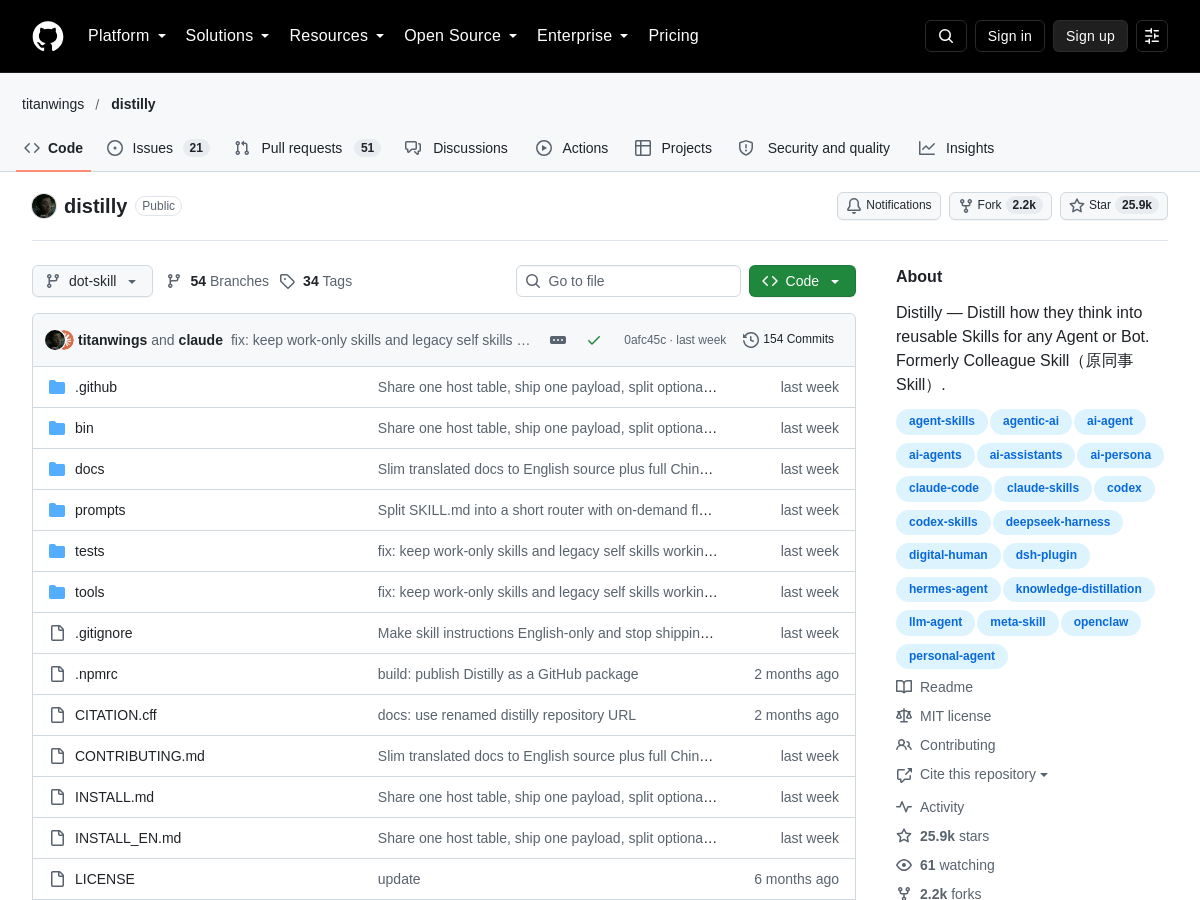
Screenshot of Distilly
Distilly
AI Agents Open Source

Distilly is an open-source project that enables the distillation of skills for any agent or bot. It allows users to create reusable skills that can be applied to various agents, making it a versatile tool for developers and researchers. The project is hosted on GitHub and has gained significant attention, with over 25,000 stars and 2,000 forks. Distilly's primary goal is to provide a platform for creating and sharing skills that can be used across different agents and bots, promoting collaboration and innovation in the field of artificial intelligence. The project's documentation and code are openly available, allowing developers to contribute and build upon the existing work. With its focus on knowledge distillation and skill sharing, Distilly has the potential to revolutionize the way agents and bots are developed and interact with each other. The project's community is active, with regular updates and contributions from developers, ensuring that Distilly remains a cutting-edge tool in the AI landscape. Distilly's architecture is designed to be modular and extensible, allowing developers to easily integrate new skills and agents into the platform. The project's use of open standards and protocols enables seamless communication between different agents and bots, making it an ideal choice for developers looking to create interoperable AI systems. Overall, Distilly is a powerful tool that has the potential to transform the way we develop and interact with AI agents and bots.

Solves

Developers and researchers often face the challenge of creating skills that can be applied to multiple agents and bots. This can be a time-consuming and labor-intensive process, requiring significant expertise and resources. Distilly solves this problem by providing a platform for creating and sharing reusable skills that can be applied to various agents and bots. By leveraging Distilly, developers can focus on creating high-quality skills that can be easily integrated into different agents and bots, reducing the complexity and cost associated with developing AI systems.

Screenshot of Pumpkin Book
Pumpkin Book
AI/ML Open Source

Pumpkin Book is an open-source companion guide to the popular Chinese machine learning textbook 'Machine Learning' (often called the Watermelon Book) by Zhou Zhihua. It provides detailed, step-by-step derivations and explanations of the mathematical formulas and equations found in the textbook, helping readers overcome the mathematical barriers commonly encountered when studying machine learning theory. The project is maintained by Datawhale, an open-source learning community, and hosted on GitHub. The content is primarily written in LaTeX and Markdown, and organized by chapters corresponding to the original book. It covers a wide range of topics including linear models, decision trees, neural networks, support vector machines, Bayesian classifiers, clustering, and more. The guide is intended for students, researchers, and practitioners who are using the Watermelon Book as their primary learning resource. It aims to make complex derivations accessible by breaking down each formula into smaller steps, adding annotations, and referencing additional materials where necessary. Because the original textbook is in Chinese, the Pumpkin Book is also primarily in Chinese, which may limit its audience to Chinese-speaking learners. As an open-source project, the Pumpkin Book encourages community contributions, corrections, and discussions. It has become a popular reference among Chinese-speaking machine learning learners and is often used in conjunction with university courses and self-study.

Solves

The Pumpkin Book addresses the common challenge of understanding the rigorous mathematical derivations in Zhou Zhihua's 'Machine Learning' textbook. By providing detailed formula explanations and step-by-step derivations, it helps readers who are stuck on complex equations to grasp the underlying principles and proceed with their learning.

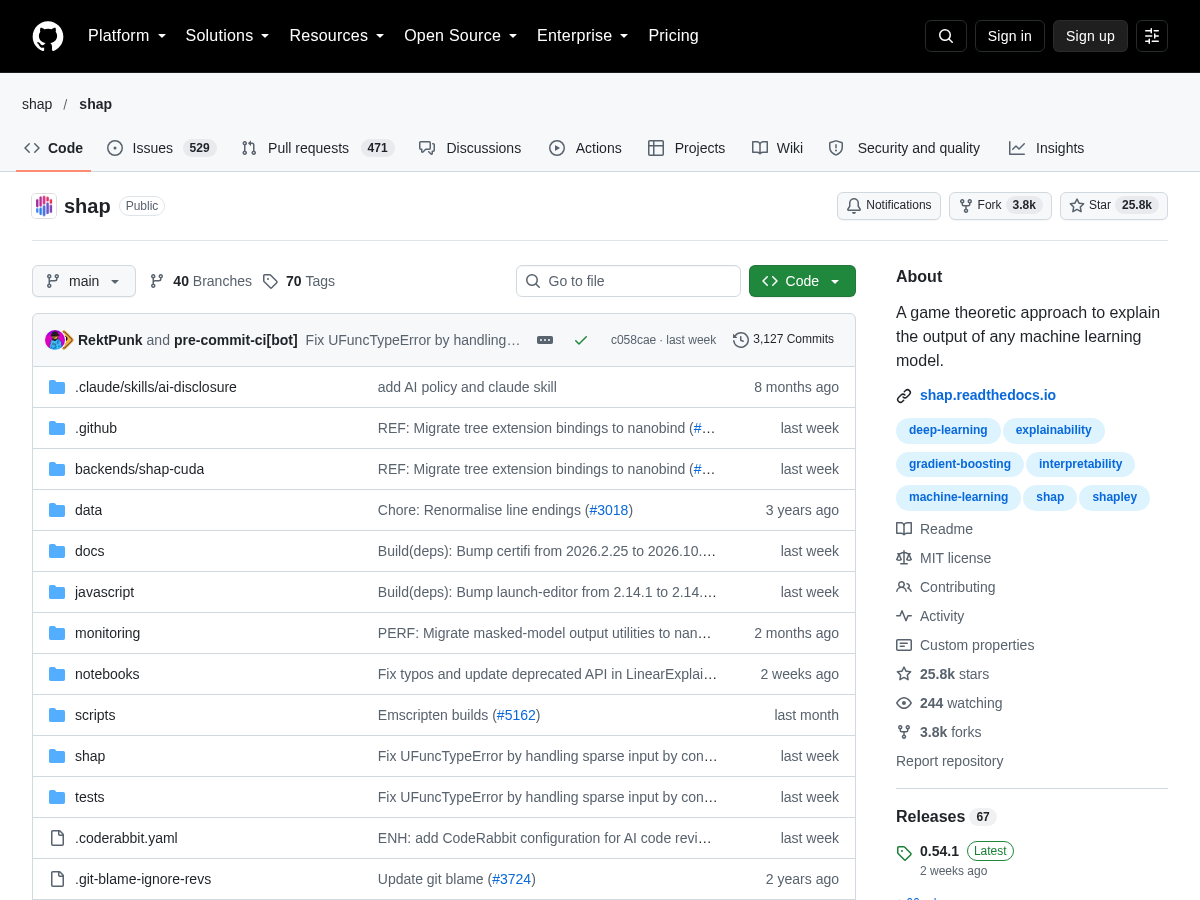
Screenshot of Shap
Shap
AI/ML Open Source

SHAP (SHapley Additive exPlanations) is a game theoretic approach to explain the output of any machine learning model. It connects optimal credit allocation with local explanations using the classic Shapley values from game theory and their related extensions. SHAP is a unified approach to explain the output of any machine learning model, uniting several previous methods and representing the only possible consistent and locally accurate additive feature attribution method based on expectations. SHAP has specific support for natural language models like those in the Hugging Face transformers library and can be used to explain predictions from models such as XGBoost, LightGBM, CatBoost, scikit-learn, and more. The library provides various explainers, including TreeExplainer, DeepExplainer, GradientExplainer, LinearExplainer, and KernelExplainer, each suited for different types of models and use cases. SHAP also includes a range of visualization tools, such as waterfall plots, force plots, and dependence plots, to help understand the explanations. The library is widely used in industry and academia for model interpretability and has been cited in numerous research papers.

Solves

Machine learning models can be complex and difficult to interpret, making it challenging to understand why a particular prediction was made. SHAP solves this problem by providing a game theoretic approach to explain the output of any machine learning model, allowing users to understand the contribution of each feature to the predicted outcome. This is particularly useful in high-stakes applications, such as healthcare and finance, where model interpretability is crucial.

Screenshot of Blender Mcp
Blender Mcp
LLM Open Source

Blender MCP is an open-source tool that bridges large language models (LLMs) and Blender, the popular 3D creation suite. By acting as a Model Context Protocol (MCP) server, it enables any compatible LLM to directly control Blender's 3D environment through natural language commands. This allows users to generate, modify, and animate 3D scenes using conversational AI. The project integrates seamlessly with Blender, providing a set of tools that an LLM can invoke to perform operations like creating objects, setting materials, and rendering. Built with Python, Blender MCP uses the MCP standard to expose Blender's functionality as tool calls, making it easy to set up and use. It works with any LLM client that supports MCP, such as Claude Desktop, enabling a hands-free 3D modeling experience. Blender MCP lowers the entry barrier for 3D content creation, allowing artists, developers, and hobbyists to iterate quickly by describing their intentions rather than manually navigating Blender's complex UI. The server runs locally, ensuring low-latency interaction while leveraging the power of modern LLMs.

Solves

Blender MCP addresses the challenge of interfacing language models with professional 3D software, enabling non-expert users or automated pipelines to create and edit complex 3D scenes via natural language, thus lowering the barrier to 3D content creation.

Screenshot of Handson Ml
Handson Ml
AI/ML Open Source

Handson Ml is the official code repository for the first edition of the book 'Hands-On Machine Learning with Scikit-Learn and TensorFlow' by Aurélien Géron. It contains a comprehensive set of Jupyter notebooks that cover fundamental machine learning concepts, including classification, regression, support vector machines, decision trees, ensemble methods, dimensionality reduction, and an introduction to neural networks with TensorFlow. The repository is now deprecated and should not be used for new learning; users are directed to the newer repositories handson-ml3 and handson-mlp for updated content.

Solves

It provides a practical, code-driven complement to the textbook, allowing readers to experiment with and understand machine learning algorithms by running the same examples used in the book.

Screenshot of Fastmcp
Fastmcp
Model Serving Open Source

Fastmcp is a Python library that provides a fast, Pythonic way to build Model Context Protocol (MCP) servers and clients. It abstracts away the low-level protocol details, allowing developers to define tools, resources, and prompts as simple Python functions using decorators and type hints. The library handles communication transports (such as stdio and HTTP) and provides a clean API for both server and client implementations. Fastmcp is designed for speed and minimal boilerplate, making it easy to integrate AI models with external tools and data sources. It includes features like automatic schema generation, async support, and built-in tool composition. The project is actively maintained by PrefectHQ and has a growing community with extensive documentation and examples.

Solves

AI application developers need to expose tools, resources, and prompts to language models using the standardized Model Context Protocol (MCP), but implementing the protocol from scratch is complex and time-consuming. Fastmcp solves this by providing a high-level, Pythonic framework that simplifies server and client creation, reducing boilerplate and enabling rapid integration of AI models with external capabilities.

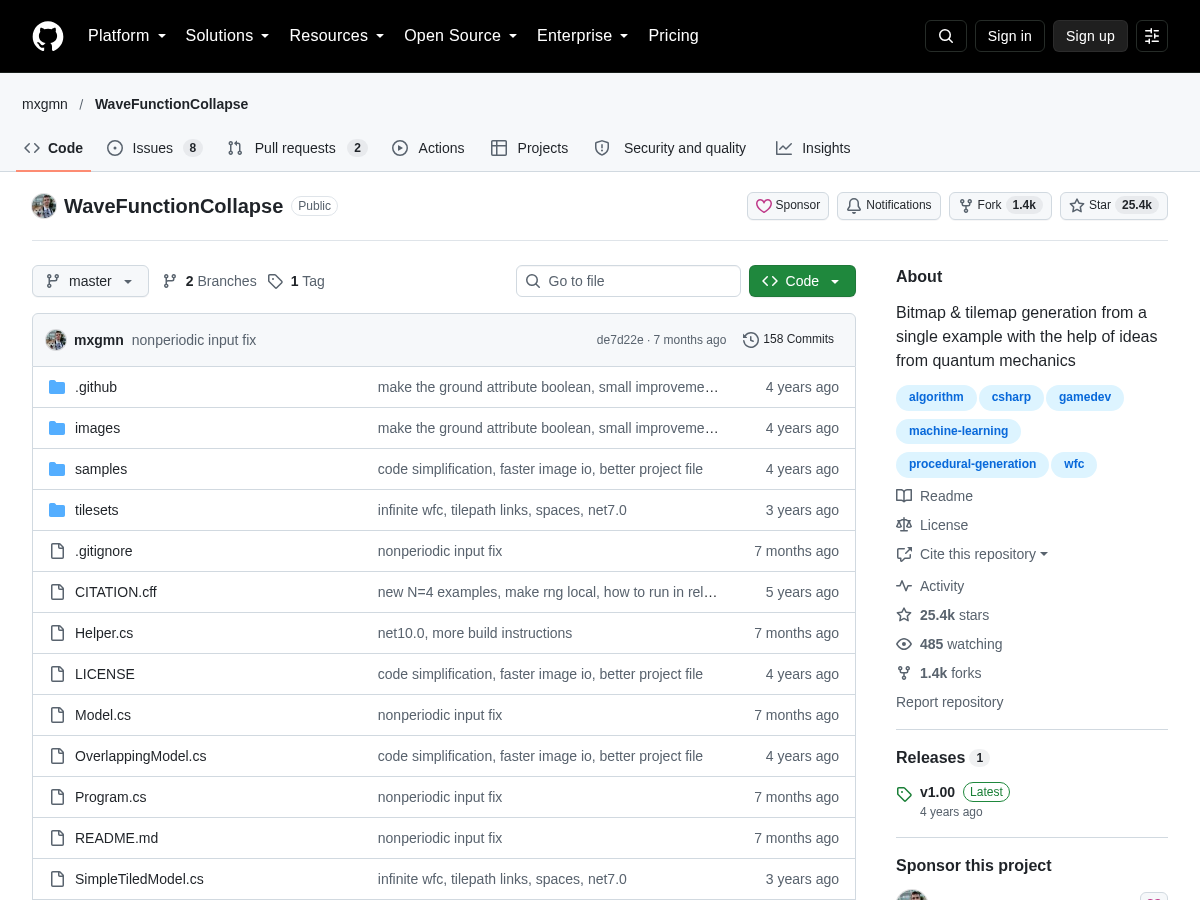
Screenshot of WaveFunctionCollapse
WaveFunctionCollapse
Code Open Source

WaveFunctionCollapse is an open-source program that generates bitmaps and tilemaps from a single example, utilizing ideas from quantum mechanics. The program achieves local similarity between the input and output bitmaps, meaning the output contains only patterns of pixels present in the input, and the distribution of these patterns is similar to the input. The program initializes the output bitmap in a completely unobserved state, where each pixel value is in a superposition of colors from the input bitmap. It then observes the pixels one by one, collapsing the superposition into a single color. This process is inspired by quantum mechanics, but it does not perform actual quantum computations. The program is written in C# and has various features, including support for non-periodic inputs, infinite WFC, and tilepath links. It also includes examples and a README file with instructions on how to use the program. The WaveFunctionCollapse program has a wide range of applications, including procedural generation, game development, and data analysis. The program's ability to generate locally similar bitmaps makes it a useful tool for creating realistic and diverse outputs. The program's code is well-structured and easy to follow, making it a great resource for developers and researchers. The WaveFunctionCollapse program is a unique and innovative tool that combines ideas from quantum mechanics and computer science to generate interesting and useful outputs. The program's features and applications make it a valuable resource for anyone interested in procedural generation, game development, or data analysis. The program's code and examples are well-documented, making it easy to understand and use. Overall, the WaveFunctionCollapse program is a powerful and versatile tool that has a wide range of applications and uses.

Solves

The problem that WaveFunctionCollapse solves is the generation of bitmaps and tilemaps that are locally similar to a given input. This is a challenging problem because it requires the program to analyze the input and generate an output that contains only patterns of pixels present in the input, while also maintaining a similar distribution of these patterns. The program solves this problem by utilizing ideas from quantum mechanics, such as superposition and observation, to generate the output bitmap. This approach allows the program to create realistic and diverse outputs that are similar to the input, making it a useful tool for procedural generation, game development, and data analysis.

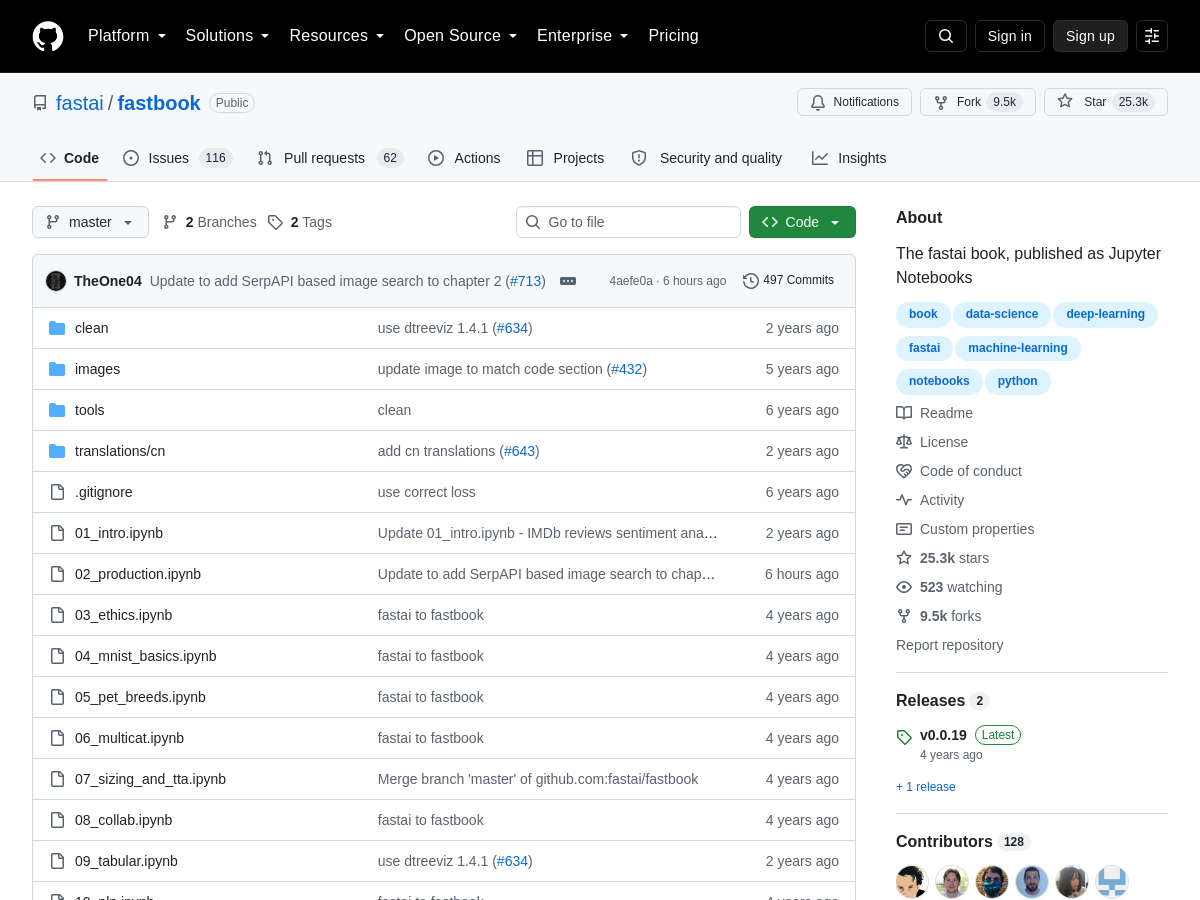
Screenshot of Fastbook
Fastbook
AI/ML Open Source

Fastbook is the official GitHub repository containing the full set of Jupyter notebooks for the book "Deep Learning for Coders with fastai and PyTorch: AI Applications Without a PhD" by Jeremy Howard and Sylvain Gugger, published by O'Reilly Media. The notebooks mirror the chapters of the printed book, walking readers from training a state-of-the-art image classifier in the first chapter through to deeper topics such as stochastic gradient descent from scratch, neural network foundations, NLP, tabular data, collaborative filtering, and model deployment. Each notebook is self-contained and runnable in Jupyter, Google Colab, or Kaggle Notebooks, and relies on the fastai library built on top of PyTorch. The repository is intended as a practical, code-first learning resource: readers execute and modify the code rather than only reading theory. Markdown cells in the notebooks summarize explanation and point back to the corresponding book chapters. The project is maintained by the fastai organization and is released as open source, with the notebooks freely available on GitHub alongside the commercial book. It is frequently used in study groups, university courses, and self-directed machine learning curricula, and the community files corrections and improvements via issues and pull requests. Because it is a teaching resource rather than a packaged library, Fastbook does not ship installable software of its own; users install the fastai library and PyTorch separately and then run the notebooks locally or in a hosted notebook environment.

Solves

Fastbook addresses the difficulty of learning modern deep learning in a practical, top-down way. Many learners find theory-first courses hard to apply or lack GPU-ready, runnable code. Fastbook solves this by pairing a complete, freely available set of executable notebooks with an accompanying book, so readers can train real models on real datasets from the first chapter without needing a PhD-level mathematical background.

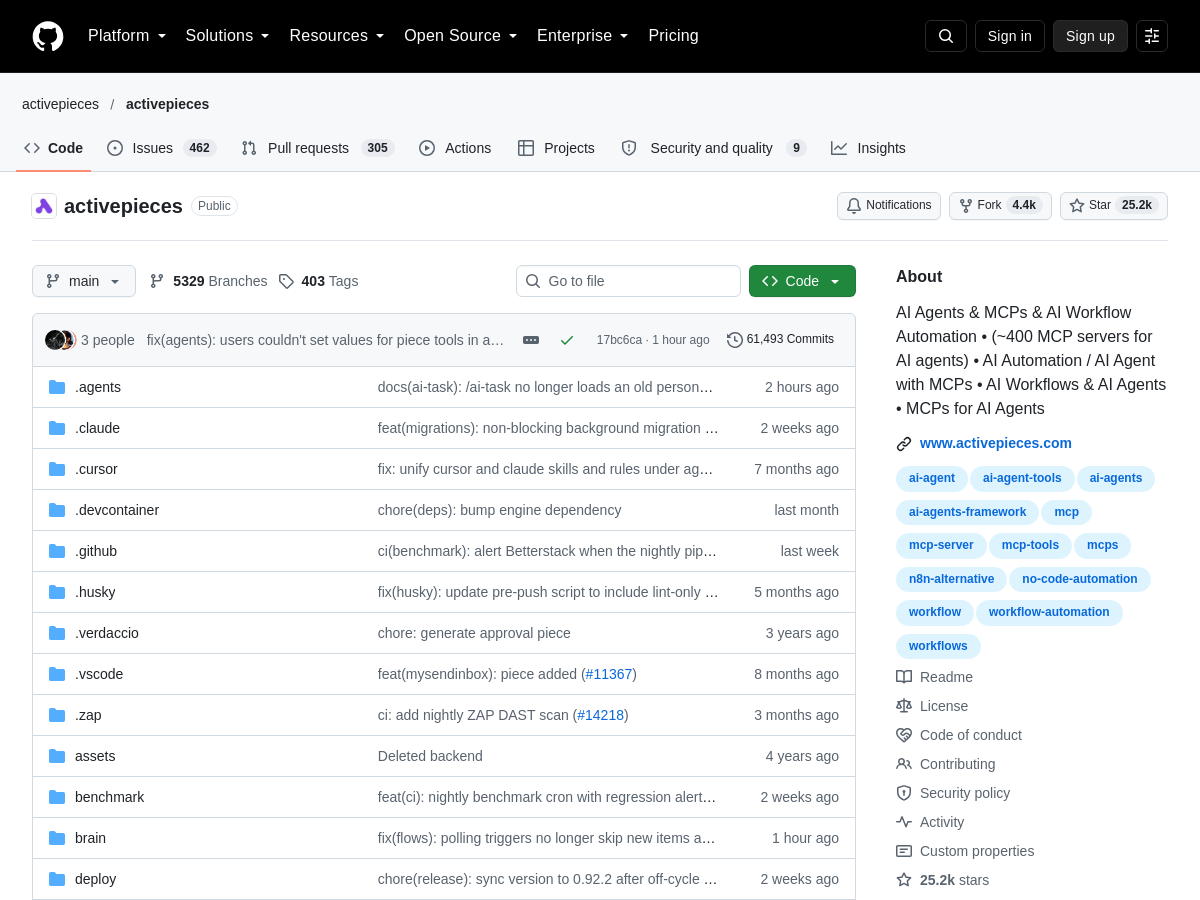
Screenshot of Activepieces
Activepieces
AI Agents Open Source

Activepieces is an open-source project that provides AI agents and workflow automation capabilities. It allows users to create and manage AI agents, as well as automate workflows using a variety of tools and integrations. The project includes a range of features, such as support for multiple AI agents, workflow automation, and integration with other tools and services. Activepieces is designed to be highly customizable and extensible, making it a popular choice among developers and organizations looking to automate and streamline their workflows. With its open-source nature, Activepieces is constantly evolving and improving, with new features and updates being added regularly. The project has a strong focus on community involvement and collaboration, with a large and active community of contributors and users. Overall, Activepieces is a powerful and flexible tool for automating and streamlining workflows, and its open-source nature makes it an attractive choice for organizations and developers looking for a customizable and extensible solution. Activepieces also provides a range of tools and features for managing and optimizing AI agents, including support for multiple AI models and algorithms, as well as tools for monitoring and analyzing agent performance. The project also includes a range of integrations with other tools and services, making it easy to incorporate Activepieces into existing workflows and systems. With its strong focus on automation and streamlining, Activepieces is an ideal choice for organizations and developers looking to improve efficiency and productivity. The project is highly scalable and can be used in a variety of contexts, from small-scale workflows to large-scale enterprise deployments. Activepieces is also highly secure, with a range of features and tools for ensuring the security and integrity of workflows and data. Overall, Activepieces is a powerful and flexible tool for automating and streamlining workflows, and its open-source nature makes it an attractive choice for organizations and developers looking for a customizable and extensible solution.

Solves

Activepieces solves the problem of workflow automation and AI agent management for organizations and developers. Many organizations and developers struggle with automating and streamlining their workflows, which can lead to inefficiencies and productivity losses. Activepieces provides a solution to this problem by offering a range of tools and features for automating and streamlining workflows, as well as managing and optimizing AI agents. With Activepieces, users can easily create and manage AI agents, automate workflows, and integrate with other tools and services, making it an ideal choice for organizations and developers looking to improve efficiency and productivity.

Screenshot of Responsively App
Responsively App
Dev Tools Open Source

Responsively App is an open-source desktop application designed to streamline responsive web development. It provides a modified browser environment where developers can preview a website across multiple simulated device viewports simultaneously, such as phones, tablets, and desktops. The tool offers synchronized interactions, so actions like scrolling, clicking, or navigating are mirrored across all devices in real time, reducing the need for manual repeated testing. Built with web technologies and available for Windows, macOS, and Linux, Responsively App includes features like custom device profiles, screenshot capture, and an integrated device inspector. It is actively maintained on GitHub and distributed free of charge under an open-source license. The application is aimed at web developers, UI/UX designers, and anyone who needs to ensure a consistent user experience across different screen sizes.

Solves

Testing a website's responsive design typically requires resizing browser windows or using separate device emulators, which is time-consuming and error-prone. Responsively App solves this by showing many device frames at once and mirroring user interactions, letting developers quickly identify layout issues across breakpoints without switching between tools.

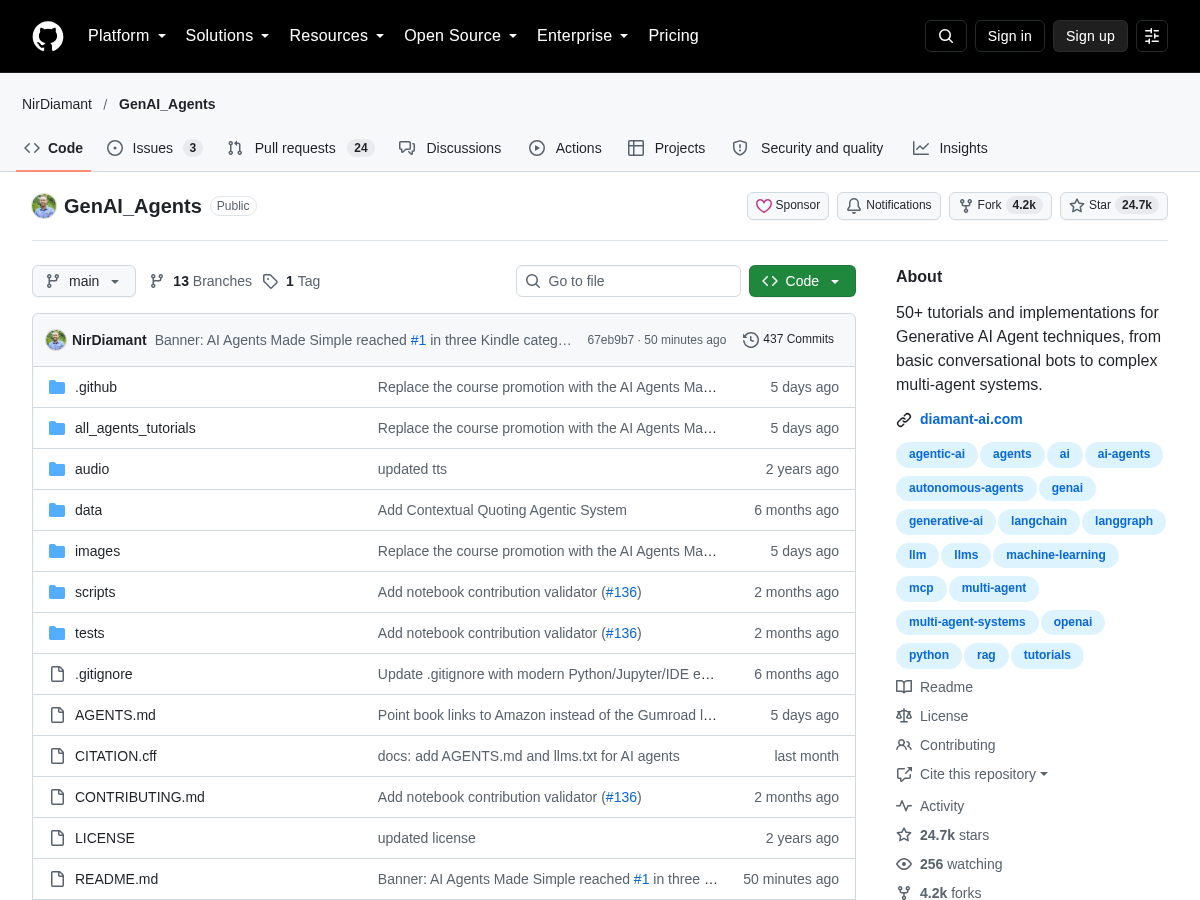
Screenshot of GenAI_Agents
GenAI_Agents
AI Agents Open Source

GenAI_Agents is an open-source repository that provides 50+ tutorials and implementations for Generative AI Agent techniques. The repository covers a wide range of topics, from basic conversational bots to complex multi-agent systems. It includes tutorials on various aspects of AI agents, such as agentic-ai, agents, ai, ai-agents, autonomous-agents, genai, generative-ai, langchain, langgraph, llm, llms, machine-learning, mcp, multi-agent, and multi-agent-systems. The repository is designed to help developers and researchers learn and implement AI agent techniques, and it provides a comprehensive set of resources, including code, notebooks, and documentation. The repository is actively maintained, with regular updates and new additions, and it has gained significant attention and popularity in the AI community, with over 24.7k stars and 4.2k forks on GitHub.

Solves

The problem that GenAI_Agents solves is the lack of resources and tutorials for developers and researchers who want to learn and implement AI agent techniques. The repository provides a comprehensive set of tutorials and implementations that can help users learn and apply AI agent techniques, from basic conversational bots to complex multi-agent systems. By providing a wide range of resources and tutorials, GenAI_Agents helps to bridge the gap between the theory and practice of AI agents, and it enables users to develop and deploy AI-powered systems that can interact with humans and other agents in a more natural and effective way.

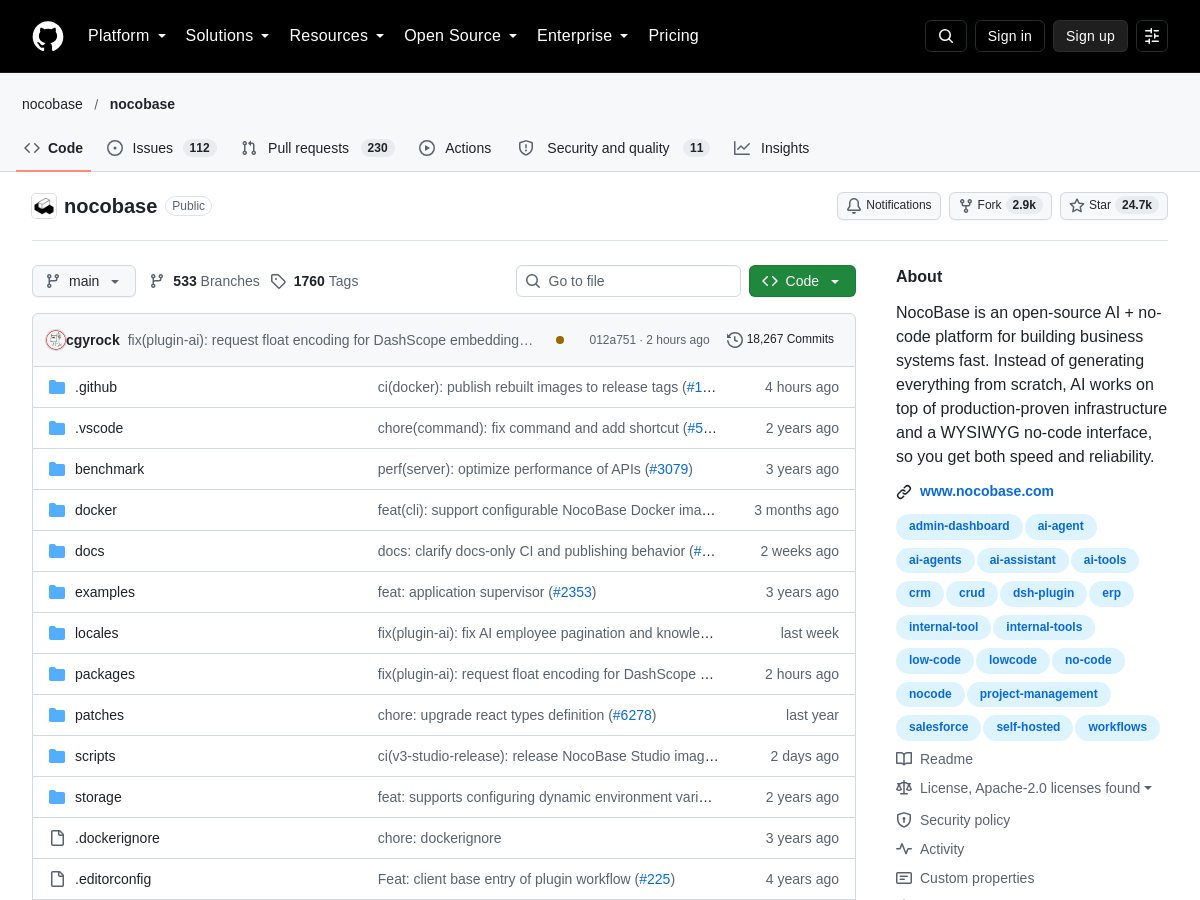
Screenshot of Nocobase
Nocobase
AI Agents Open Source

NocoBase is an open-source AI + no-code platform for building business systems fast. Instead of generating everything from scratch, AI works on top of production-proven infrastructure and a WYSIWYG no-code interface, so you get both speed and reliability. The platform provides a range of features, including a visual interface for building and managing business systems, AI-powered automation, and integration with various tools and services. NocoBase is designed to be highly customizable and extensible, with a large community of developers and users contributing to its growth and development. The platform is suitable for a wide range of use cases, from simple business applications to complex enterprise systems. With its open-source nature, NocoBase provides a high degree of transparency and flexibility, allowing users to modify and extend the platform to meet their specific needs. Overall, NocoBase is a powerful and versatile platform for building and managing business systems, with a strong focus on AI, no-code development, and community-driven development. NocoBase has a large number of commits, with 18,267 commits in total, and a significant number of stars, with 24.7k stars, indicating a high level of interest and engagement from the developer community. The platform also has a large number of forks, with 2.9k forks, and a significant number of watchers, with 174 watching, further demonstrating its popularity and influence in the open-source community.

Solves

NocoBase solves the problem of building and managing business systems, which can be a complex and time-consuming task, especially for non-technical users. By providing a no-code interface and AI-powered automation, NocoBase makes it possible for users to build and manage business systems quickly and easily, without requiring extensive technical expertise. This can be particularly beneficial for small and medium-sized businesses, which may not have the resources or expertise to develop and maintain complex business systems. Additionally, NocoBase's open-source nature and large community of developers and users provide a high degree of transparency and flexibility, allowing users to modify and extend the platform to meet their specific needs.

Screenshot of Ai
Ai
AI Agents Open Source

Vercel AI SDK is an open-source TypeScript toolkit designed to simplify the development of AI-powered applications and agents. Created by the team behind Next.js, it provides a unified interface for interacting with multiple large language model providers, including OpenAI, Anthropic, Google, Mistral, and many others. The SDK abstracts away provider-specific APIs, enabling developers to switch between models without significant code changes. Key features include first-class streaming support, React and Next.js hooks for building chat and completion UIs, generative UI components, and robust tool calling for agent workflows. The library also includes utilities for handling structured outputs, managing conversation state, and orchestrating multi-step agent reasoning. It is framework-agnostic at its core but offers deep integrations with React, Vue, Svelte, and Node.js. The AI SDK is distributed via npm and is licensed under Apache 2.0. It has a large and active community, with contributions from Vercel and the broader open-source ecosystem. The project continues to evolve rapidly, adding support for new providers and agentic patterns as the AI landscape changes.

Solves

Building AI applications in TypeScript often requires integrating multiple proprietary SDKs, handling streaming and state management manually, and dealing with provider-specific quirks. Vercel AI SDK solves this by offering a single, provider-agnostic API that standardizes streaming, tool calling, and UI integration, significantly reducing development time and complexity for AI-powered web and server-side applications.

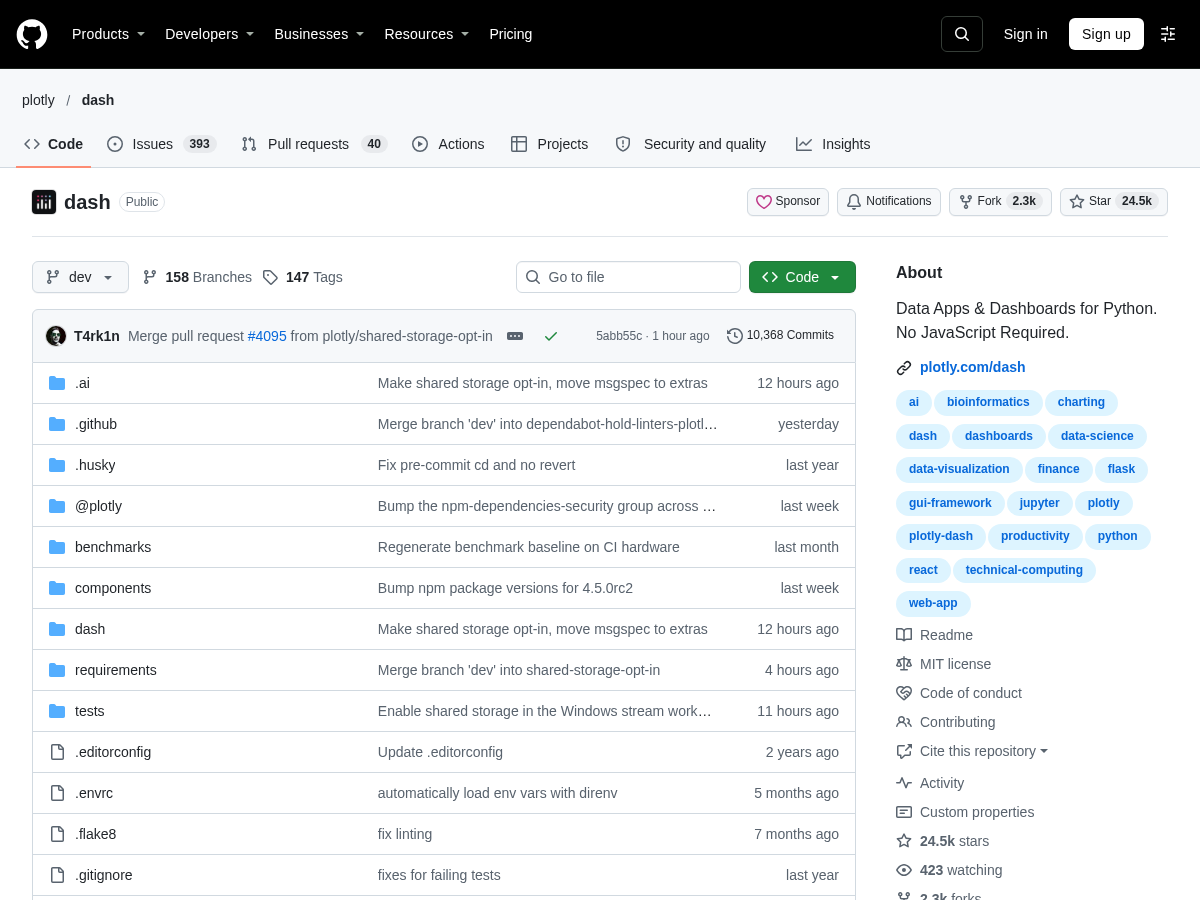
Screenshot of Dash
Dash
Productivity Open Source

In addition to its core functionality, Dash also provides a range of features and tools that make it easy to build and deploy data applications. For example, it includes a range of pre-built components and templates, making it easy to get started and build custom applications quickly. It also provides a range of tools and features for customizing and extending the library, such as support for custom CSS and JavaScript code. Furthermore, Dash has a large and active community of users and developers, which means that there are many resources available for learning and troubleshooting. Overall, Dash is a powerful and flexible library that makes it easy to create web-based data applications and dashboards, and it has become a popular choice among data scientists and analysts. Dash is also highly customizable, allowing users to tailor the look and feel of their applications to meet their specific needs. It also provides a range of tools and features for deploying and managing applications, such as support for Docker and Kubernetes. With its ease of use, flexibility, and customizability, Dash is an ideal tool for anyone looking to create web-based data applications and dashboards.

Solves

Data scientists and analysts often struggle to create interactive and dynamic visualizations of their data, which can make it difficult to communicate insights and findings to stakeholders. Dash solves this problem by providing a simple and intuitive way to build and deploy web-based data applications and dashboards, without requiring any JavaScript knowledge. With Dash, users can create a wide range of applications, from simple dashboards to complex data analytics platforms, and deploy them quickly and easily. This makes it an ideal tool for anyone looking to create interactive and dynamic visualizations of their data, and to communicate insights and findings to stakeholders in a clear and effective way.

Screenshot of Beads
Beads
AI Agents Open Source

Beads is an open-source memory upgrade designed for coding agents, enabling them to retain and recall contextual information across interactions. It aims to solve the problem of stateless AI agents by providing persistent memory that can be queried and updated programmatically. The project is hosted on GitHub and is intended to be integrated into agent workflows to improve continuity and efficiency in coding tasks. The tool offers a lightweight, flexible approach to augmenting coding agents with long-term memory, allowing developers to store code-related facts, user preferences, and project-specific details. By leveraging Beads, agents can accumulate knowledge over time, reducing repetitive explanations and enabling more personalized assistance. Beads is suited for developers and teams building AI-powered coding assistants or autonomous agents that require persistent state beyond a single session. Its open-source nature allows customization and self-hosting, providing control over data and integration with existing toolchains.

Solves

Coding agents lack memory between sessions, causing repetitive context loss and inefficient assistance. Beads provides a memory backend that agents can read from and write to, enabling persistent recall of project-specific information and user interactions.

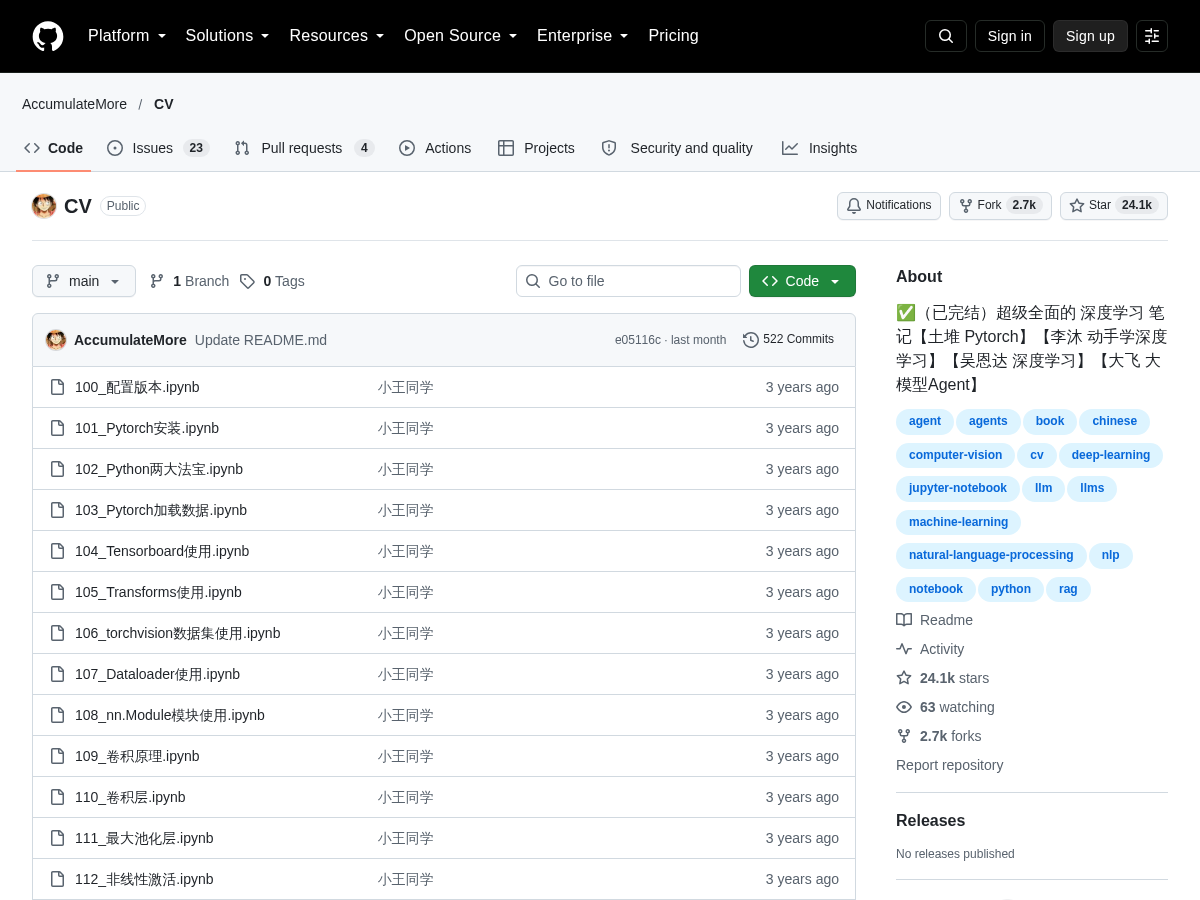
Screenshot of CV
CV
AI Agents Free

The CV project on GitHub is a comprehensive collection of deep learning notes and resources. It covers a wide range of topics, including PyTorch, computer vision, natural language processing, and more. The project is designed to provide a thorough understanding of deep learning concepts and techniques, with a focus on practical applications and hands-on experience. The repository contains numerous Jupyter notebooks, each covering a specific topic or technique, such as PyTorch installation, data loading, convolutional neural networks, and optimization methods. The project is well-organized and easy to navigate, making it an excellent resource for developers, researchers, and students interested in deep learning.

Solves

The CV project solves the problem of providing a comprehensive and accessible resource for learning deep learning concepts and techniques. It addresses the needs of developers, researchers, and students who want to gain hands-on experience with deep learning frameworks and tools, such as PyTorch, and apply them to real-world problems. By providing a thorough and well-organized collection of notes and resources, the CV project helps to bridge the gap between theoretical knowledge and practical application, making it easier for individuals to get started with deep learning and achieve their goals.

Screenshot of A2A
A2A
AI Agents Open Source

A2A (Agent2Agent) is an open protocol designed to enable communication and interoperability between opaque agentic applications. It provides a standardized framework for different AI agents to discover each other, exchange messages, share capabilities, and coordinate tasks without requiring knowledge of each other's internal implementations. The protocol abstracts agent internals behind a common interface, allowing heterogeneous agents built on different platforms or by different vendors to collaborate seamlessly. The project is hosted on GitHub under the a2aproject organization and is released as open source, with the goal of fostering a multi-agent ecosystem where agents can be composed into larger systems. A2A defines message formats, capability advertisement, and negotiation mechanisms, reducing integration complexity and promoting composability in agent-based systems.

Solves

Agentic applications are often designed as opaque silos, making it difficult to integrate them into larger workflows or enable collaboration between agents from different sources. A2A addresses this fragmentation by providing an open protocol that standardizes agent-to-agent communication, allowing heterogeneous agents to interoperate without requiring custom adapters or deep integration.

Screenshot of D2
D2
Dev Tools Open Source

D2 is a modern, open-source diagram scripting language that enables users to define diagrams using a simple, readable text syntax. It is designed to be easy to learn while providing the power to create professional-quality diagrams for software architecture, network topology, flowcharts, and more. D2 compiles text into SVG or PNG images, making it suitable for both interactive viewing and static export. The language emphasizes clarity and expressiveness, with features like automatic layout, themes, and support for complex nested structures. D2 is written in Go and is distributed as a single binary, making it lightweight and easy to install across platforms. It also includes a language server protocol (LSP) implementation for editor integration. D2 is open source and community-driven, hosted on GitHub under the Terrastruct organization. It aims to provide a better alternative to existing tools by offering a balance of simplicity, performance, and visual quality. The project is actively maintained and has gained popularity among developers for creating diagrams as code.

Solves

Creating diagrams manually with drag-and-drop tools is time-consuming and difficult to version control. D2 solves this by allowing users to define diagrams as code, enabling automation, reuse, and consistency across documentation and system designs.

Screenshot of Paddle
Paddle
Framework Open Source

PaddlePaddle (PArallel Distributed Deep LEarning) is an open-source deep learning framework developed by Baidu, originating from industrial practice. It provides a complete ecosystem for building, training, and deploying machine learning models at scale, covering a wide range of domains such as computer vision, natural language processing, speech recognition, and recommendation systems. PaddlePaddle supports both dynamic and static computational graphs, allowing flexibility and performance optimization, and includes high-performance operators for efficient computation on various hardware accelerators like GPUs and specialized AI chips. PaddlePaddle excels in distributed training scenarios with its efficient communication strategies and scalability to thousands of nodes, making it suitable for large-scale industrial applications. The framework integrates a variety of tools and components, including PaddleDetection, PaddleSeg, PaddleOCR, and PaddleSpeech, which offer state-of-the-art pre-trained models and pipelines. For deployment, it provides Paddle Inference for server-side deployment, Paddle Lite for mobile and IoT devices, and Paddle Serving for flexible model serving, along with model compression techniques to optimize model size and speed. The framework is designed to bridge the gap between research and production, emphasizing usability and performance. It features a rich API set similar to PyTorch but also inherits the static graph advantages from the earlier PaddlePaddle versions. PaddlePaddle's ecosystem supports both academic researchers and industry practitioners with comprehensive documentation, tutorials, and community resources, although primarily in Chinese. It is a key alternative to TensorFlow and PyTorch, especially within Chinese enterprises and AI communities.

Solves

PaddlePaddle addresses the need for an efficient, scalable, and production-ready deep learning platform that can handle massive industrial datasets and support seamless deployment across servers, mobile devices, and edge environments, reducing the complexity of building and deploying AI solutions at scale.

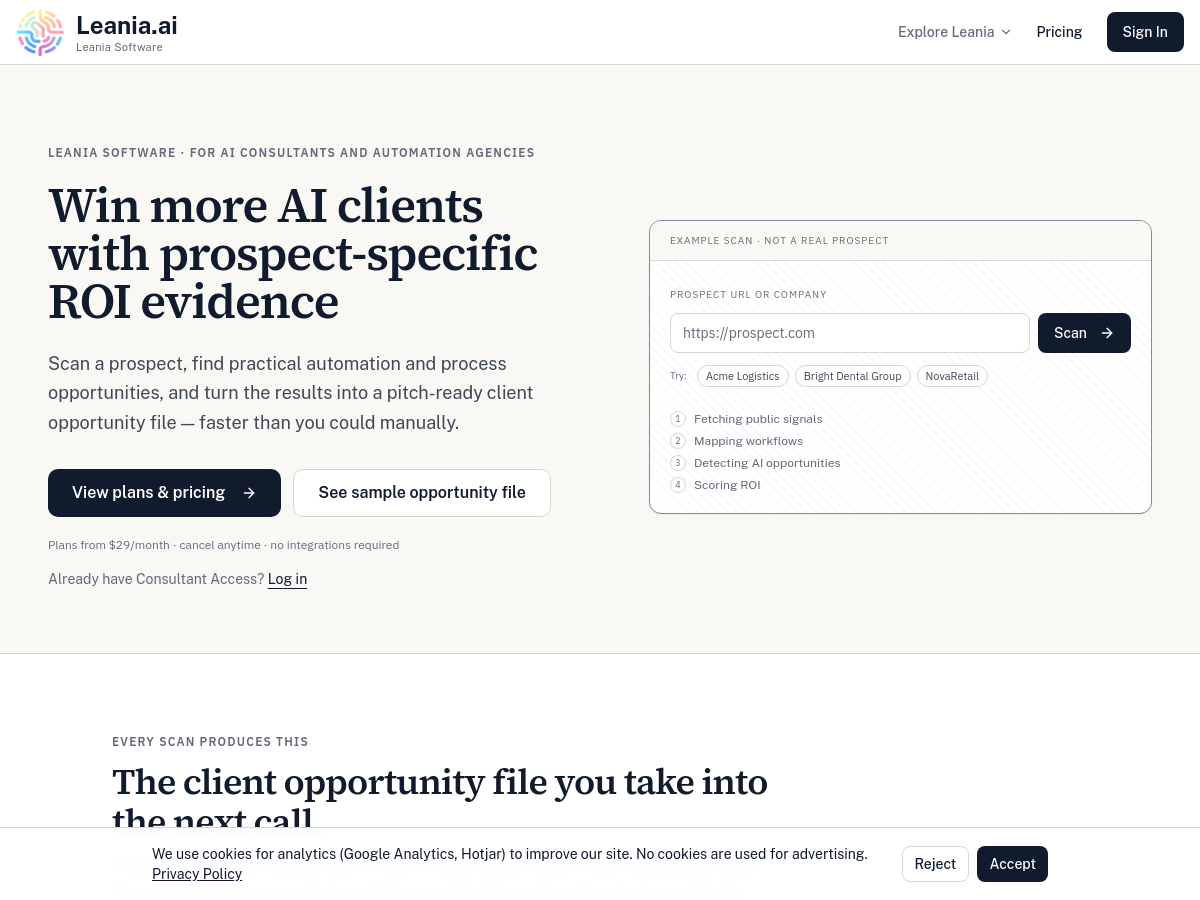
Screenshot of AI agency Copilot
AI agency Copilot
B2B sales Unknown

AI agency Copilot is a SaaS product from Leania.ai designed for AI consultants and automation agencies that want to win clients with evidence-backed recommendations. It scans a prospect's website and public signals to map workflows, tools, and bottlenecks, then identifies practical automation and process opportunities. The output is a client opportunity file containing a top issue, pitch angle, ROI ranges, discovery questions, and next steps, which consultants can take directly into sales conversations. Leania.ai positions the tool as a way to move beyond generic AI pitches. Instead of saying 'we help businesses adopt AI,' consultants can show a prospect specific workflow inefficiencies and estimated time savings. The platform uses a fixed verdict vocabulary — Keep, Cut, Replace, Validate — so reports remain consistent across prospects. Optional add-ons include a pitch deck builder, ROI evidence pack, and proposal builder, each priced per client. The product is offered as a subscription with plans starting at $29 per month, and it requires no integrations. It also includes free growth tools: an opportunity widget for a consultant's website to capture inbound leads, and a Chrome extension for evaluating SaaS tool fit while browsing. The tool is aimed at B2B sales for AI services, helping consultants qualify prospects and prepare proposal-ready materials faster.

Solves

AI consultants and automation agencies often struggle to differentiate themselves with generic pitches. AI agency Copilot solves this by scanning a prospect's public signals, mapping workflows and tools, and producing evidence-backed ROI estimates and opportunity files that consultants can use in discovery calls, pitches, and proposals.

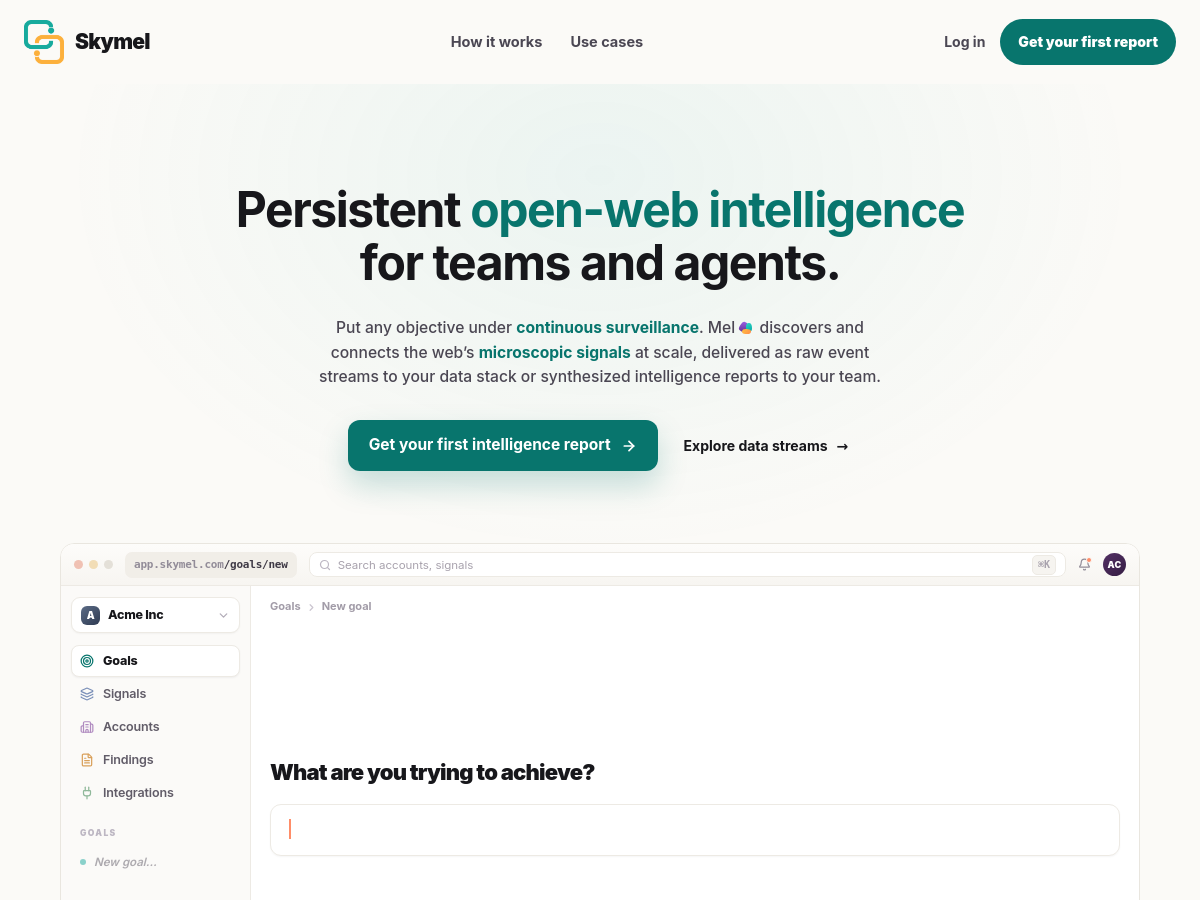
Screenshot of Mel by Skymel- Persistent Open-Web intelligence Infra

Skymel is a persistent open-web intelligence infrastructure that continuously monitors public sources to track any objective. It ingests microscopic signals from sources such as LinkedIn, GitHub, Reddit, Hacker News, Stack Overflow, Glassdoor, YouTube, Medium, Crunchbase, Discord, and G2, then connects fragments into a live knowledge graph. The platform delivers changes either as raw event streams for data stacks and agents or as synthesized intelligence reports for teams.

Solves

Teams and agents lack persistent, automated visibility into the open web's weak signals relevant to their goals. Skymel solves this by continuously monitoring fragmented public information, connecting it into a live knowledge graph, and delivering actionable changes as raw event streams or synthesized intelligence reports.

Screenshot of Best Of Ml Python
Best Of Ml Python
AI/ML Open Source

Best of ML Python is a curated, ranked list of popular machine learning Python libraries hosted on GitHub. It is generated automatically using a best-of generator that collects metadata from GitHub and PyPI, computing a quality score based on metrics like stars, forks, activity, and documentation. The list is updated weekly via scheduled GitHub Actions, ensuring it reflects current trends in the ML ecosystem. It covers a wide range of categories such as computer vision, natural language processing, reinforcement learning, and model interpretability, making it a comprehensive resource for discovering top-tier tools. The project serves as a starting point for developers and researchers looking to navigate the vast landscape of Python ML libraries without manual scouring.

Solves

Best of ML Python solves the challenge of discovering, comparing, and selecting high-quality machine learning Python libraries by providing an automatically curated, ranked list that aggregates community metrics and project metadata, saving practitioners time and effort.

Screenshot of WebsitePublisher AI
WebsitePublisher AI
AI/ML Freemium

WebsitePublisher AI is a platform that bridges conversational AI assistants like ChatGPT, Claude, and Mistral with live web publishing. Users describe the website or application they want in natural language, and the AI constructs and deploys it instantly using WebsitePublisher’s structured building blocks and hosting infrastructure. Unlike generating raw HTML code, the platform provides a full end-to-end solution: hosting on a real URL, built-in integrations for forms, payments (Stripe, Mollie), email, and spam protection, professional image handling, and secure API key storage. It includes a visual editor for post-generation refinements and a persistent task history that maintains context across different AI models and sessions. With 92 integrations, no lock-in, and live publishing in minutes, it abstracts away the entire technical stack of CMS, hosting, DNS, and backend configuration.

Solves

Non-technical creators and small businesses often struggle to turn a website idea into a live, functional site. Even using AI to generate HTML leaves them with the burden of self-hosting, setting up forms, payment gateways, and ongoing maintenance. WebsitePublisher AI solves this by enabling any AI assistant to act as a full-stack publisher: the user simply describes their need, and the AI uses the platform’s infrastructure to create, host, and integrate everything in one conversation. This eliminates hosting, DNS, backend coding, and platform lock-in, making professional web publishing accessible through natural chat.

Screenshot of Deepface
Deepface
Video Open Source

Deepface is a lightweight face recognition and facial attribute analysis library for Python. It provides a simple and easy-to-use interface for analyzing faces in images and videos. The library can detect faces, predict age, gender, emotion, and race, and perform face recognition. Deepface uses deep learning models to achieve high accuracy and is suitable for a wide range of applications, including security, surveillance, and social media analysis. The library is open-source and has a large community of contributors, making it a popular choice for developers and researchers. Deepface supports multiple deep learning models, including VGGFace, FaceNet, and OpenFace, and provides a simple API for integrating face recognition into applications. The library is highly customizable and can be used for a variety of tasks, such as face detection, facial attribute analysis, and face verification. Overall, Deepface is a powerful and flexible library for face recognition and facial attribute analysis, and is a valuable tool for anyone working with computer vision or machine learning. Deepface has a strong focus on performance and accuracy, and is designed to be highly efficient and scalable. The library is well-documented and has a large collection of examples and tutorials, making it easy to get started with face recognition and facial attribute analysis. Deepface is widely used in industry and academia, and has been used in a variety of applications, including security systems, social media platforms, and marketing campaigns. The library is constantly evolving, with new features and models being added regularly, making it a great choice for anyone looking to stay up-to-date with the latest developments in face recognition and facial attribute analysis.

Solves

Deepface solves the problem of face recognition and facial attribute analysis, which is a critical task in many applications, including security, surveillance, and social media analysis. The library provides a simple and accurate way to detect faces, predict age, gender, emotion, and race, and perform face recognition, making it a valuable tool for developers and researchers. By using Deepface, users can build applications that can analyze faces in images and videos, and make decisions based on the results, such as verifying identities, detecting emotions, and predicting demographics. The library is particularly useful for applications where face recognition and facial attribute analysis are critical, such as security systems, social media platforms, and marketing campaigns.

Screenshot of Skyvern
Skyvern
LLM Open Source

Skyvern is an open-source project that enables users to automate browser-based workflows using AI. The project utilizes various technologies such as Playwright, Puppeteer, and Selenium to interact with web browsers and automate tasks. Skyvern's primary goal is to simplify the process of automating workflows, making it more efficient and reducing the need for manual intervention. The project is highly customizable, allowing users to create their own workflows and integrate them with other tools and services. Skyvern's AI-powered automation capabilities make it an attractive solution for businesses and individuals looking to streamline their workflows and improve productivity. The project is actively maintained and has a large community of contributors, ensuring that it stays up-to-date with the latest technologies and best practices. Skyvern's documentation and community resources provide users with the necessary support to get started with the project and overcome any challenges they may encounter. Overall, Skyvern is a powerful tool for automating browser-based workflows, and its open-source nature makes it an excellent choice for those looking for a customizable and extensible solution. Skyvern's features include support for multiple browsers, customizable workflows, and integration with popular tools and services. The project's AI-powered automation capabilities make it an ideal solution for tasks such as data entry, web scraping, and automated testing. Skyvern's community-driven development ensures that the project stays relevant and effective, with new features and improvements being added regularly.

Solves

Skyvern solves the problem of manual workflow automation, which can be time-consuming and prone to errors. By using AI to automate browser-based workflows, Skyvern reduces the need for manual intervention, increasing productivity and efficiency. This is particularly useful for businesses and individuals who need to automate repetitive tasks, such as data entry or web scraping. Skyvern's automation capabilities also help to reduce the risk of human error, ensuring that workflows are executed accurately and consistently. Additionally, Skyvern's customizable nature allows users to create workflows tailored to their specific needs, making it an ideal solution for a wide range of use cases.

Screenshot of Learnopencv
Learnopencv
AI/ML Free

Learn OpenCV is an open-source project that provides C++ and Python examples for learning OpenCV, a computer vision library. The project includes a wide range of examples, from basic image processing to advanced computer vision techniques, such as object detection, tracking, and recognition. The project is designed to help developers and researchers learn and use OpenCV for various applications, including robotics, autonomous vehicles, and surveillance. The examples are well-documented and include code snippets, images, and videos to illustrate the concepts. The project also includes a wiki with tutorials, documentation, and other resources to help users get started with OpenCV. Learn OpenCV is a valuable resource for anyone interested in computer vision and machine learning. The project has a large community of contributors and users, and it is widely used in academia and industry. The project's GitHub repository includes a variety of folders and files, each containing examples and code for specific topics, such as 2D Gaussian splatting, 3D LiDAR object detection, and AI for video understanding. The project is constantly updated with new examples and features, making it a great resource for staying up-to-date with the latest developments in computer vision. Overall, Learn OpenCV is a comprehensive and well-maintained project that provides a wealth of information and resources for learning and using OpenCV. The project's examples and documentation are clear and concise, making it easy for users to get started with OpenCV and to learn advanced computer vision techniques. The project's community is active and supportive, and the project's GitHub repository is well-organized and easy to navigate.

Solves

The problem that Learn OpenCV solves is the lack of resources and documentation for learning and using OpenCV, a computer vision library. OpenCV is a powerful tool for computer vision tasks, but it can be difficult to learn and use, especially for beginners. Learn OpenCV provides a comprehensive set of examples, documentation, and resources to help users learn and use OpenCV, making it easier for developers and researchers to get started with computer vision and to achieve their goals. The project solves the problem of limited resources and documentation for OpenCV, and it provides a valuable resource for the computer vision community.

Screenshot of Planning With Files
Planning With Files
AI Agents Open Source

Planning With Files is an open-source framework that provides persistent, file-based planning for AI coding agents and long-running agentic tasks. It addresses the challenge of context loss in LLM-based agents by storing agent plans as markdown files on disk, ensuring that progress survives crashes, context windows resets, or commands like /clear. The core idea is to give an agent a structured set of files (typically plan.md, status.md, and completion gates) that act as external memory, allowing deterministic recovery and continuation of complex multi-step tasks. The system implements a deterministic completion gate using JSON files with check-fields that must be explicitly passed to mark a task as done, preventing false completions. This makes the agent's workflow auditable and reliable. The framework is designed to be agent-agnostic via the SKILL.md standard, which has been adopted by over 60 different AI coding assistants including Claude Code, Codex, OpenCode, and Continue.dev. It includes plugins and skill definitions for seamless integration into various coding environments. Key technical features include non-blocking stop signals, PreCompact parity to optimize context usage before compactions, and robust handling of control characters in gate JSON. Version 3.1.0 introduced significant stability improvements such as stop_hook_active detection and refusal of unattested plan injection in autonomous modes. The project is actively maintained with a large community (23.2k GitHub stars, 2k forks) and receives frequent updates. The framework is particularly suited for autonomous coding agents that need to execute long sequences of operations—such as refactoring, code generation, or multi-file edits—without human intervention. It also supports multi-agent coordination by providing a shared, file-based planning layer that agents can read and update, enabling complex orchestrations of agentic workflows.

Solves

AI coding agents frequently lose their context when sessions are reset, leading to incomplete tasks or repetitive work. This is especially problematic for autonomous agents that must operate over extended periods without human oversight. Planning With Files solves this by providing a crash-proof, file-based planning mechanism. The agent's plan, progress, and completion state are stored in simple markdown and JSON files, which survive context clears, crashes, and even agent restarts. A deterministic completion gate ensures that tasks are not mistakenly marked as finished, making long-running agentic workflows robust and trustworthy.