Tool discovery

What type of AI tool
are you looking for?

Search the active catalog with LambdaBase AI Search, or keep browsing the popularity-ordered directory below.

Submitted search queries and interaction metrics may be analyzed to improve result quality. Do not include personal or confidential information

Browse popular tools.

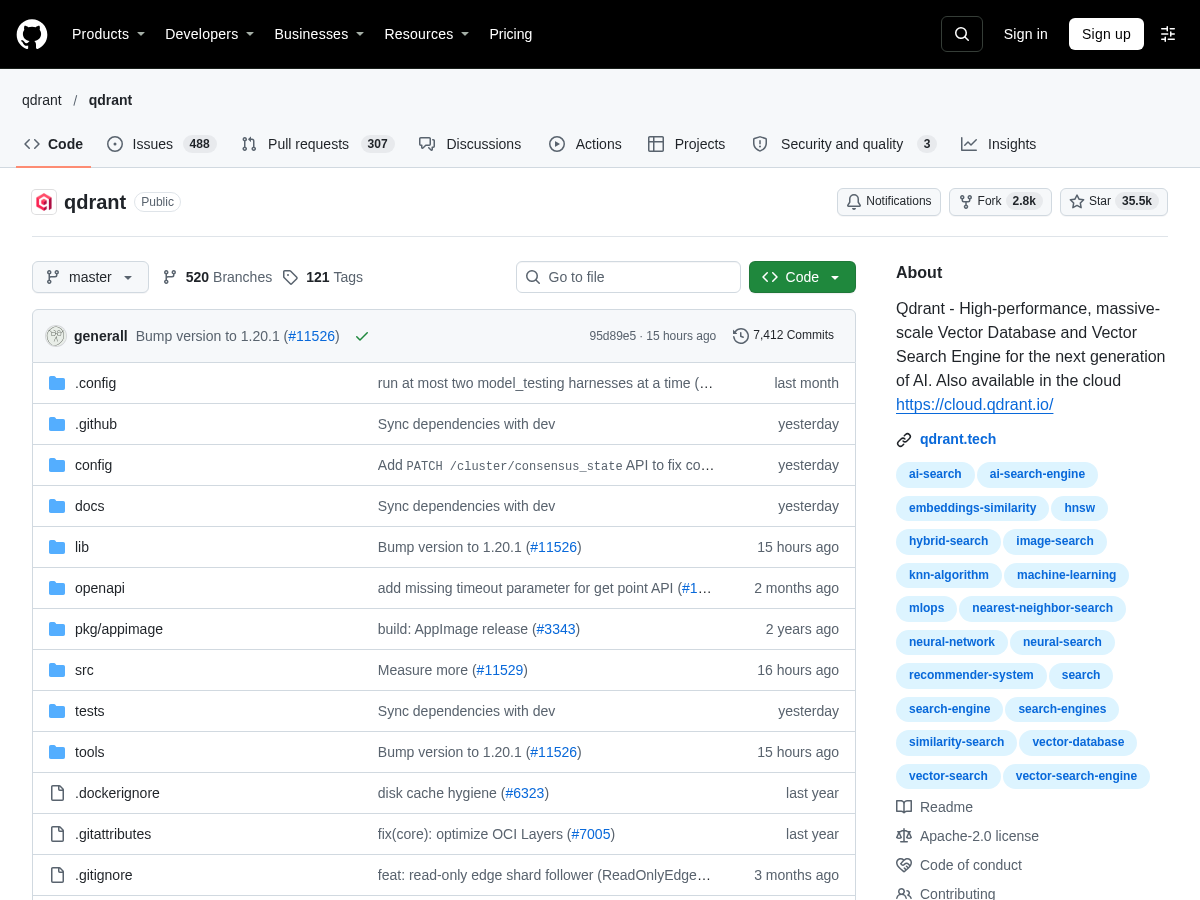
Screenshot of Qdrant
Qdrant
Vector DB Open Source

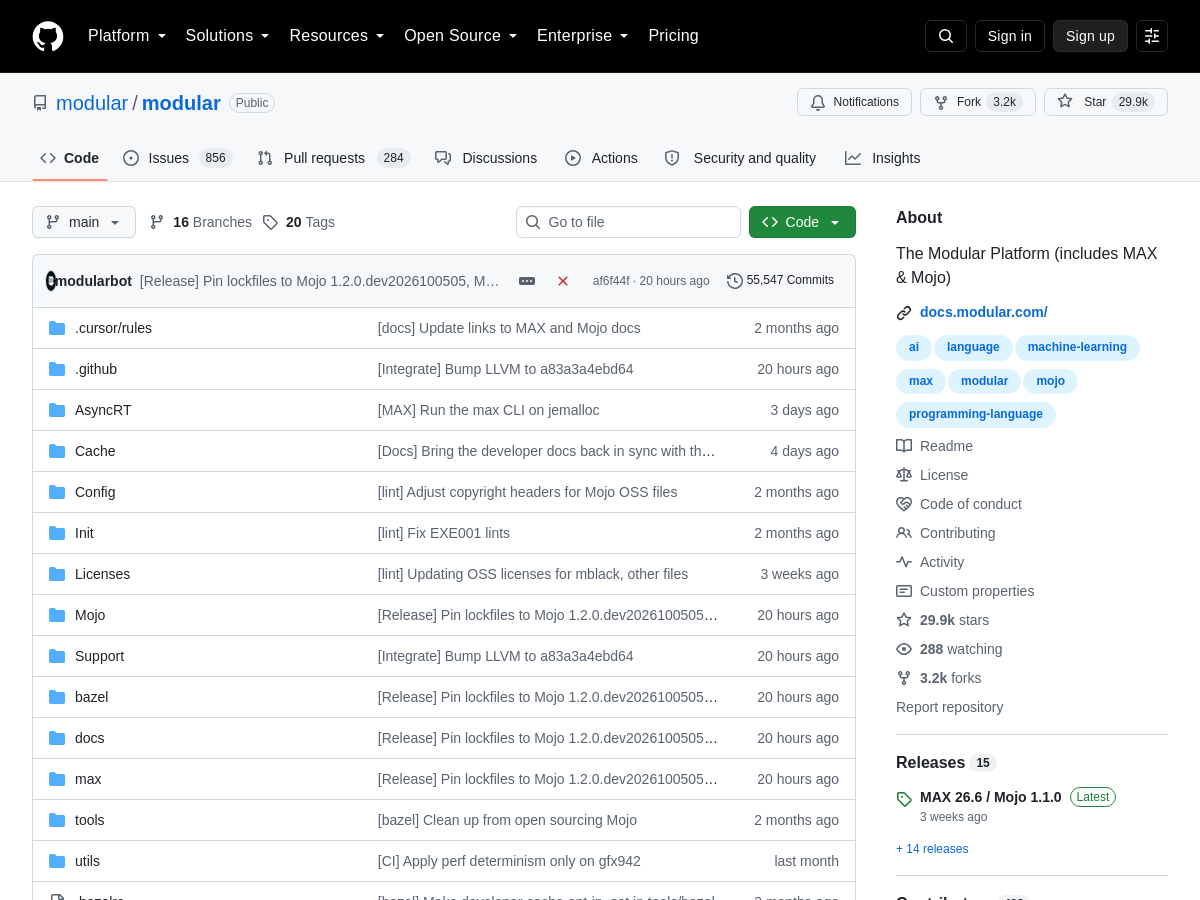
Qdrant is a high-performance, massive-scale Vector Database and Vector Search Engine designed for the next generation of AI. It is available in the cloud at https://cloud.qdrant.io/. Qdrant is built to handle large-scale vector data and provides a robust search engine for finding similar vectors. The project is open-source and has a large community of contributors. Qdrant supports various features such as hybrid search, image search, and nearest neighbor search, making it a versatile tool for machine learning and AI applications. The project is actively maintained, with regular updates and new features being added. Qdrant is written in Python and is licensed under the Apache-2.0 license. The project has a strong focus on performance, scalability, and reliability, making it a popular choice among developers and researchers. Qdrant also provides a range of tools and APIs for integrating with other machine learning frameworks and libraries. Overall, Qdrant is a powerful and flexible vector database and search engine that is well-suited for a wide range of AI and machine learning applications.

Solves

Developers and researchers working with large-scale vector data often face the challenge of efficiently searching and managing their data. Qdrant solves this problem by providing a high-performance, scalable, and reliable vector database and search engine. With Qdrant, users can easily store, search, and manage their vector data, making it an ideal solution for applications such as image and video search, recommendation systems, and natural language processing. By using Qdrant, developers and researchers can focus on building and improving their AI and machine learning models, rather than spending time and resources on building and maintaining their own vector database and search engine.

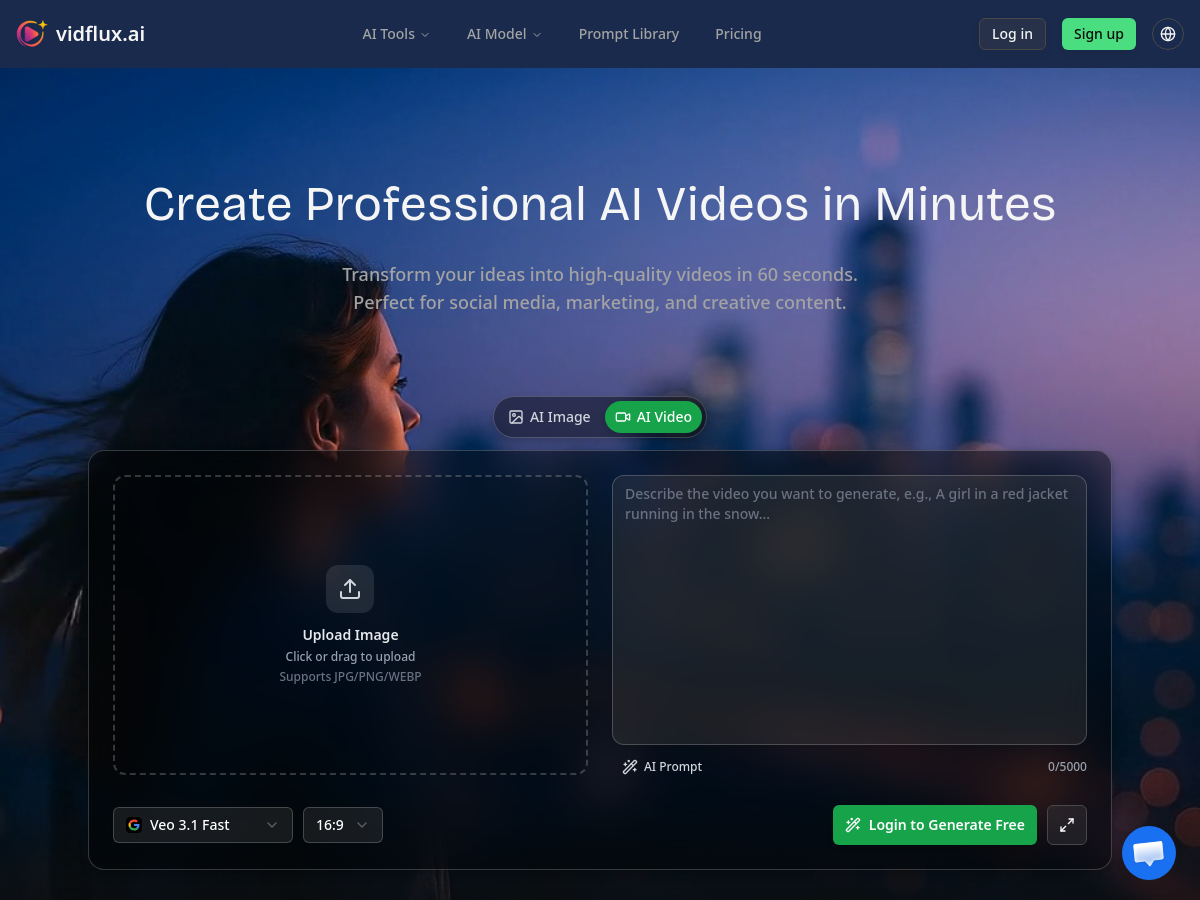
Screenshot of VidFlux - Image to Video AI

VidFlux.ai is an all-in-one AI platform that transforms static images into dynamic, professional-quality videos. It aggregates over six industry-leading image-to-video models—including Google Veo 3, Sora 2, Kling AI, Runway, Seedance, Wan AI, and Grok Imagine—into a single, unified interface. Users can upload an image (JPG, PNG, WEBP up to 10MB, minimum 300px), optionally provide a text prompt describing desired motion or scene, select an AI model, choose aspect ratio (16:9 or 9:16), and generate a video with audio. The platform supports processing up to three images simultaneously, and aims to eliminate the need to juggle multiple tools by providing centralized access to top-tier video generation AI. The platform caters to a variety of visual styles and use cases. It can animate portraits with natural facial expressions and subtle gestures, bring illustrations and digital art to life while preserving original style, add cinematic camera movements like pans, zooms, and depth-of-field effects to still photos, and generate themed or seasonal videos from holiday or festive images. The generated videos include audio, enhancing the final output for social media, marketing, or personal projects. VidFlux offers a pay-per-use credit system (e.g., 120 credits for a generation), and includes a free tier that allows users to test the service. Models are available in different versions (e.g., Veo 3.1 standard and fast), giving users control over quality and speed. The web-based platform requires no software installation and is designed for ease of use, guiding users through a three-step process: upload, prompt, generate. By consolidating multiple AI engines, VidFlux provides versatility and convenience, but the output quality and behavior depend on the underlying third-party models. The platform is continually updated with new models and features, positioning itself as a comprehensive solution for anyone needing to convert images to video quickly and creatively.

Solves

Content creators, marketers, and designers often want to turn static images into engaging video content but face fragmentation across multiple AI tools, each with its own interface, pricing, and learning curve. VidFlux solves this by offering a single platform that integrates many of the best image-to-video AI models, allowing users to generate professional videos from images without technical expertise or the need to switch between different services. This streamlines the workflow, reduces costs of managing multiple subscriptions, and lowers the barrier to creating high-quality video content from simple images.

Screenshot of Obsidian Skills
Obsidian Skills
AI Agents Open Source

Obsidian Skills is a collection of agent skills that teach AI agents (like Claude Code, Codex, and Open Code) how to interact with Obsidian vaults using its native CLI and open formats. It follows the Agent Skills specification, making it compatible with any skills-compatible agent. The repository includes skills for Obsidian Flavored Markdown (creating and editing .md files with wiki-links, tags, and other Obsidian-specific syntax), Obsidian Bases (querying and manipulating .base files, which are database-like tables within Obsidian), JSON Canvas (building and editing visual knowledge graphs in .canvas format), and the Obsidian CLI (automating tasks via the command-line interface). Installation is flexible: via a plugin marketplace command, using npx, or manually copying files into the agent's skills directory. Once installed, the agent can understand and execute complex operations like generating daily notes, summarizing Base queries, creating Canvas visualizations, and batch-updating metadata. The skills are defined as structured Markdown prompts, providing clear instructions to the agent on how to leverage Obsidian's open formats and tools.

Solves

Obsidian users, especially knowledge workers, researchers, and developers, often want to automate or enhance their note-taking workflows using AI. However, generic AI agents lack the specific knowledge to interface with Obsidian's unique file formats (Flavored Markdown, Bases, Canvas) and its CLI. Obsidian Skills solves this by providing ready-made skill definitions that teach agents how to read, write, and manipulate Obsidian data, enabling seamless AI-assisted vault management without users having to craft complex prompts or write custom integration code.

Screenshot of Refine
Refine
Dev Tools Open Source

Refine is a React-based framework designed to accelerate the development of internal tools, admin panels, dashboards, and B2B applications. It provides a set of headless hooks and components that handle common data-driven tasks such as CRUD operations, authentication, access control, and routing, allowing developers to focus on business logic rather than boilerplate code.

Solves

Building internal tools and admin panels often involves repetitive implementation of data fetching, form handling, and user management. Refine solves this by providing a unified, hook-based abstraction over these concerns, significantly reducing development time and complexity.

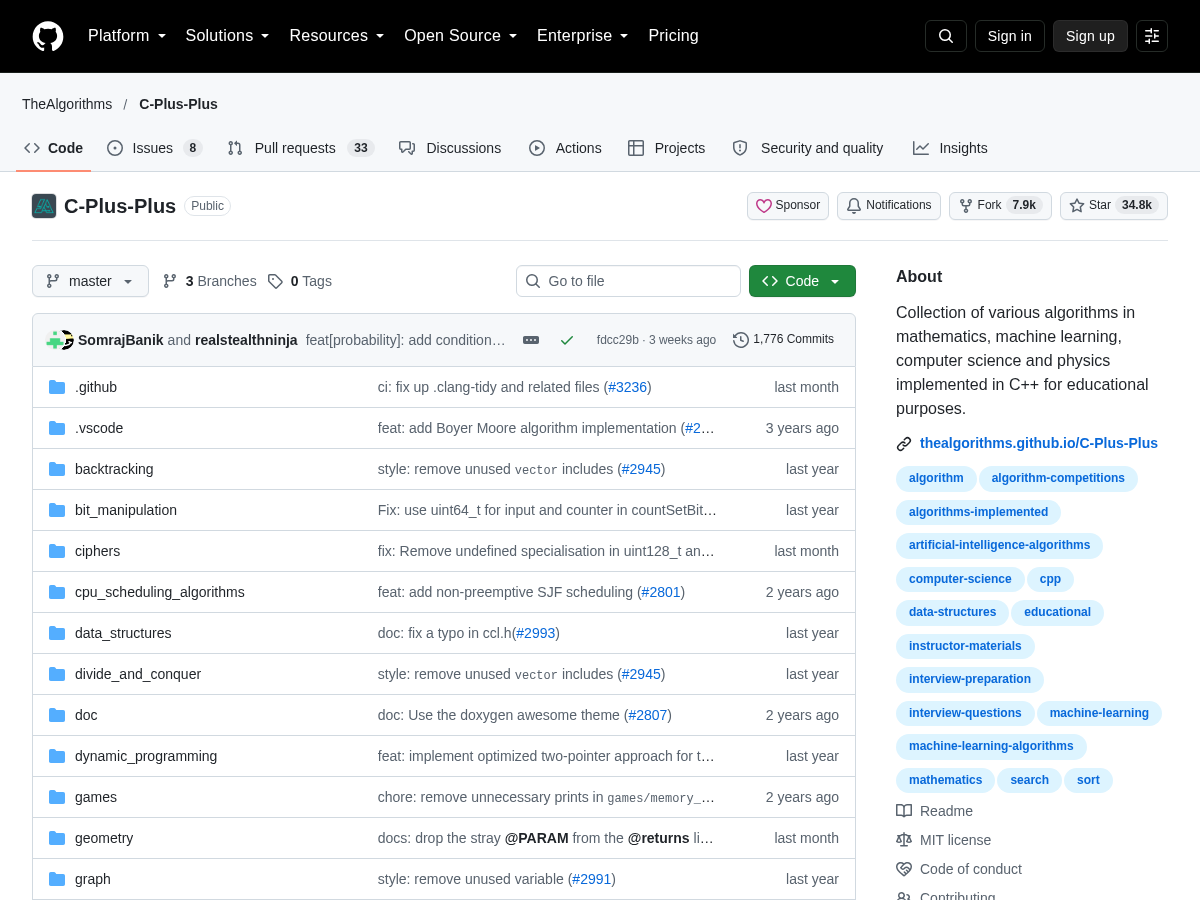
Screenshot of C Plus Plus
C Plus Plus
AI/ML Open Source

The C-Plus-Plus repository is a collection of open-source implementations of various algorithms in C++. The algorithms span a range of topics, including computer science, mathematics, statistics, data science, machine learning, and engineering. The repository provides well-documented source code with detailed explanations, making it a valuable resource for educators and students. Each source code is atomic, using STL classes and requiring no external libraries for compilation and execution. The code is compiled and tested for every commit on the latest versions of Windows, MacOS, and Ubuntu (Linux) using MSVC 19 2022, AppleClang 15.0.15, and GNU 13.3.0 respectively. The repository adheres to the C++17 standard, ensuring portability of the code to embedded systems with little to no changes. The repository also includes self-checks within programs to ensure correct implementations with confidence. Modular implementations and OpenSource licensing enable the functions to be utilized conveniently in other applications. Online documentation is generated from the repository source codes directly and contains all resources, including source code snippets, details on execution of the programs, diagrammatic representation of program flow, and links to external resources where necessary.

Solves

The C-Plus-Plus repository solves the problem of providing a comprehensive collection of algorithms in C++ for educational purposes. It addresses the need for a reliable and well-documented resource for students and educators to learn and teach various algorithms in computer science, mathematics, and related fields. By providing a wide range of algorithms implemented in C++, the repository helps to fill the gap in the availability of high-quality, open-source algorithm implementations.

Screenshot of Awesome Copilot
Awesome Copilot
Prompt Engineering Open Source

Awesome Copilot is a community-curated repository hosted by GitHub that aggregates instructions, agent configurations, skills, and other resources to enhance the GitHub Copilot coding assistant. It serves as a central hub where developers can discover and share effective ways to interact with Copilot, from simple prompt templates to complex, task-specific agent setups. The project is structured as a 'cookbook' of recipes, each providing a proven set of prompts and configurations to accomplish common development tasks like code generation, testing, documentation, and refactoring. The repository includes schemas for validating contributions, ensuring consistency and usability. Users can browse recipes by categories, languages, and tags, and apply them directly in their IDEs like VS Code. The project encourages community participation, allowing anyone to submit new recipes or improve existing ones via pull requests. It also supports external recipes from other repositories, enabling a broader ecosystem. Recent commits show active maintenance, with features like a website rendering for the cookbook and integration of community samples. By leveraging Awesome Copilot, developers can accelerate their workflow, reduce trial-and-error in prompt engineering, and adopt best practices from experienced Copilot users. It is an essential resource for both newcomers seeking to learn effective Copilot usage and advanced users looking to push the boundaries with custom agents and skills.

Solves

Many developers find it challenging to craft prompts that consistently yield accurate and useful code from GitHub Copilot. Without guidance, they waste time on ineffective interactions and may not realize the full capabilities of the tool. Awesome Copilot addresses this by providing a vetted collection of prompt templates, agent configurations, and usage patterns. It lowers the barrier to effective Copilot usage, enabling developers to quickly adopt proven strategies and focus on building software rather than experimenting with prompts.

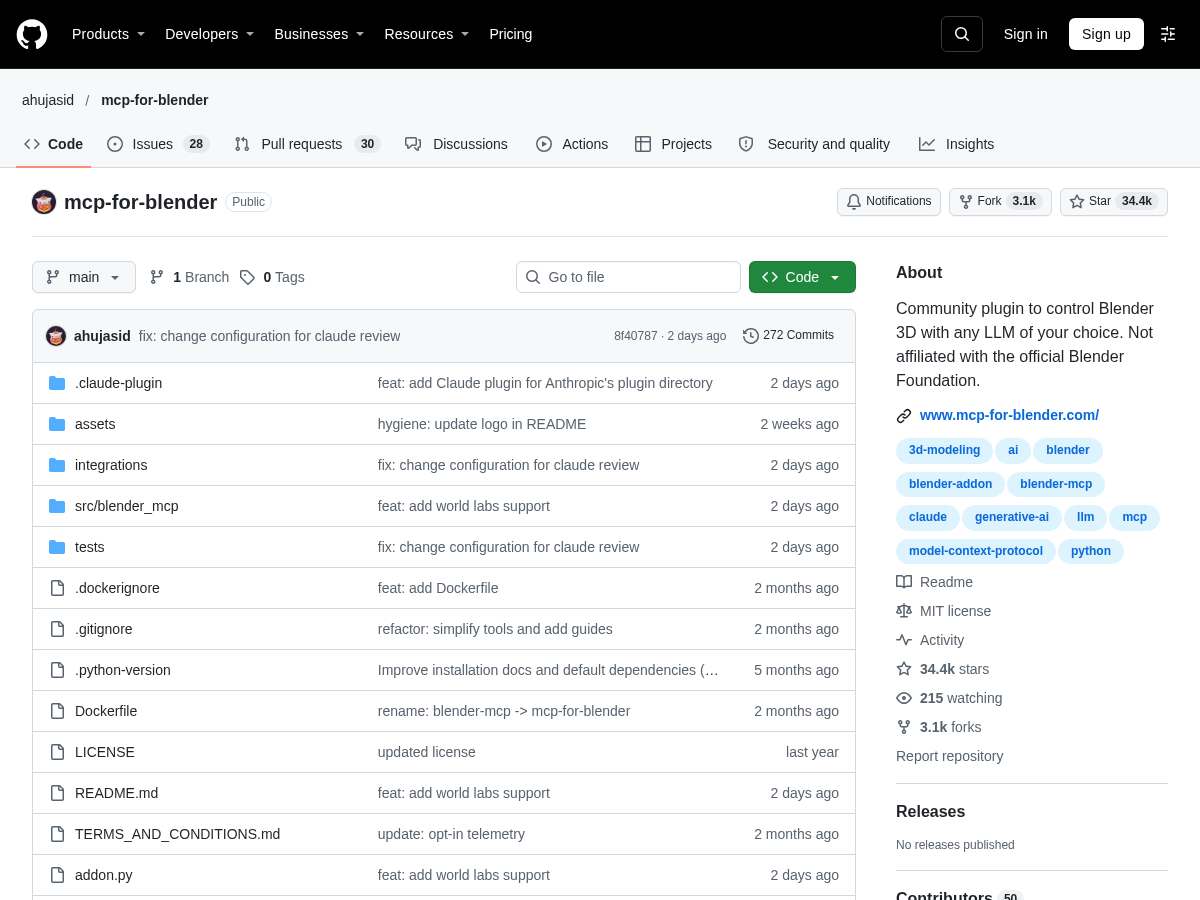
Screenshot of Mcp For Blender
Mcp For Blender
LLM Open Source

Mcp For Blender is a community-driven plugin that enables users to control Blender 3D with any Large Language Model (LLM) of their choice. The plugin is not affiliated with the official Blender Foundation. It provides a flexible and customizable way to integrate LLMs with Blender, allowing users to leverage the power of AI in their 3D modeling and animation workflows. The plugin is built using Python and is available under the MIT license. It has gained significant popularity, with over 34,000 stars on GitHub and a large community of contributors and users. The plugin's functionality is extensive, with features such as world labs support, Claude plugin integration, and a user-friendly interface. The plugin is actively maintained, with regular updates and commits from the development team. Overall, Mcp For Blender is a powerful tool for anyone looking to integrate AI with their 3D modeling and animation workflows.

Solves

Mcp For Blender solves the problem of limited AI integration in 3D modeling and animation software. By providing a flexible and customizable way to integrate LLMs with Blender, the plugin enables users to leverage the power of AI in their workflows, streamlining tasks and improving productivity. This is particularly useful for developers, data scientists, and 3D artists who need to automate repetitive tasks, generate new ideas, or explore new creative possibilities.

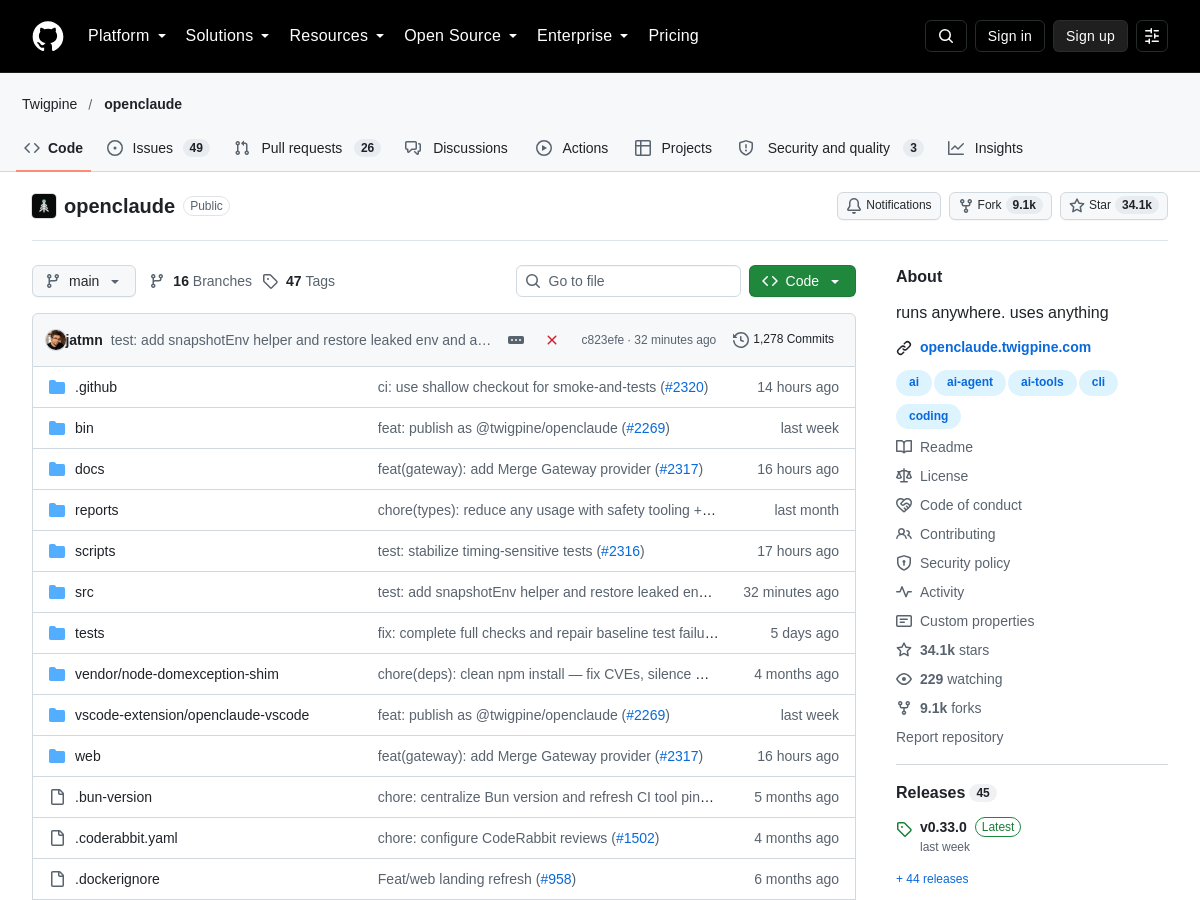
Screenshot of Openclaude
Openclaude
LLM Open Source

Openclaude is an open-source project that appears to be related to AI and coding. The project's description on GitHub is 'runs anywhere. uses anything', suggesting that it is a versatile tool that can be used in various environments. The project has a significant number of stars (34.1k) and forks (9.1k), indicating a substantial interest and contribution from the developer community. The project's topics include AI, AI agents, AI tools, CLI, and coding, which further suggests its focus on artificial intelligence and coding. The project's code is written in various languages, and it has a large number of commits (1,278), indicating active development and maintenance. The project's contributors include individuals and organizations, and it has a code of conduct and security policy in place, which suggests a commitment to community and security. Overall, Openclaude appears to be a significant open-source project in the AI and coding space, with a strong community and active development. The project's documentation and website provide more information about its features, usage, and contribution guidelines. Openclaude's versatility and customizability make it a valuable tool for developers and organizations working with AI and coding. The project's large community and active development ensure that it stays up-to-date with the latest technologies and best practices. Openclaude's focus on AI and coding also makes it a valuable resource for researchers and students in these fields. The project's open-source nature allows for transparency, collaboration, and customization, which are essential for advancing AI and coding research and development. Openclaude's contributors and maintainers are committed to ensuring the project's quality, security, and usability, which is reflected in its extensive documentation, testing, and validation processes.

Solves

Openclaude solves the problem of providing a versatile and customizable AI and coding tool that can be used in various environments. It addresses the needs of developers, organizations, and researchers who require a flexible and scalable tool for AI and coding tasks. By providing a open-source solution, Openclaude democratizes access to AI and coding technologies, allowing a broader range of users to contribute to and benefit from its development. The project's focus on community and security also ensures that it is a reliable and trustworthy tool for users.

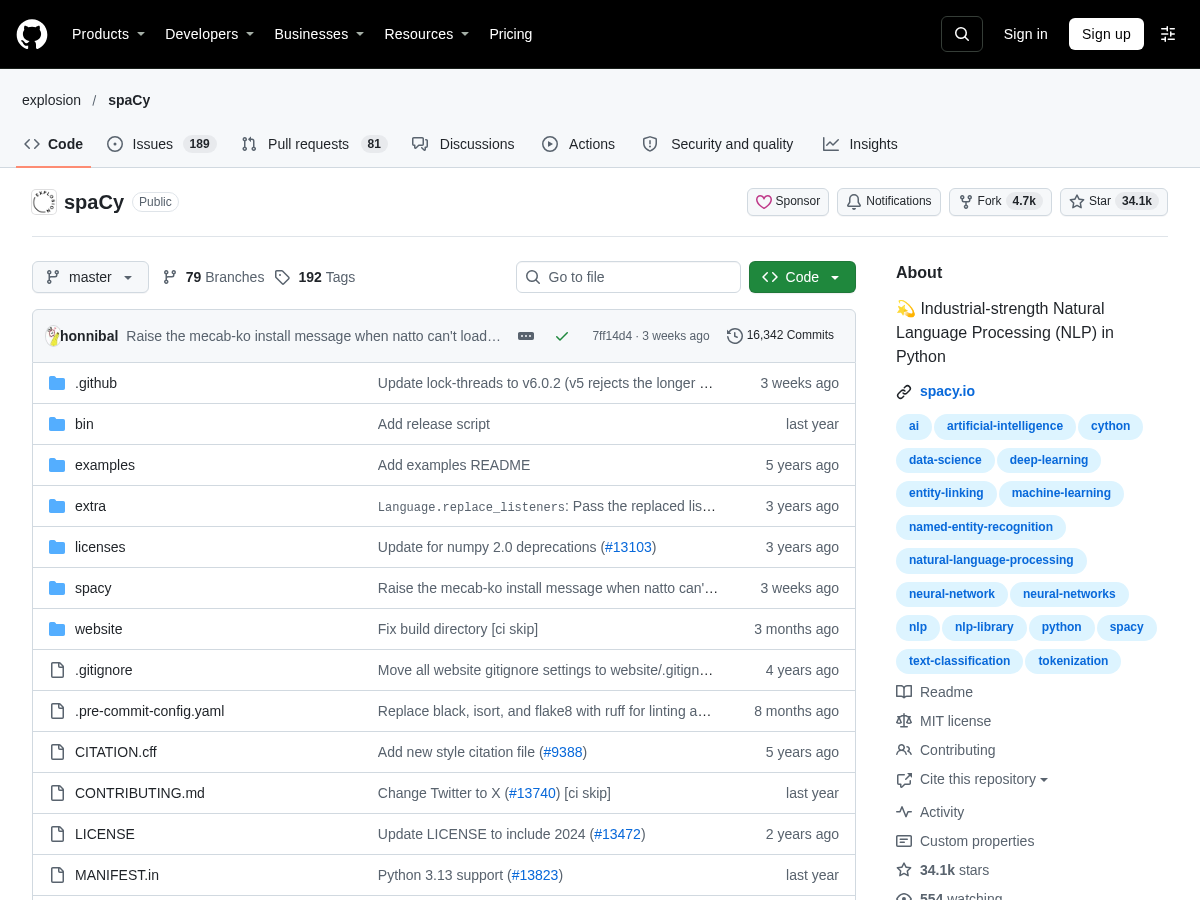
Screenshot of SpaCy
SpaCy
AI/ML Open Source

SpaCy is a modern natural language processing (NLP) library for Python. It is designed to be highly efficient and flexible, allowing developers to easily integrate NLP capabilities into their applications. SpaCy includes high-performance, streamlined processing of text data, including tokenization, entity recognition, language modeling, and more. The library is built on top of modern Python and Cython, making it highly efficient and scalable. SpaCy also includes pre-trained models for many languages, allowing developers to get started with NLP tasks quickly. The library has a simple and intuitive API, making it easy to use for developers of all skill levels. SpaCy is widely used in industry and academia for a variety of NLP tasks, including text classification, sentiment analysis, and information extraction. The library is highly customizable, allowing developers to fine-tune models and integrate them with other machine learning frameworks. Overall, SpaCy is a powerful and flexible NLP library that makes it easy to build high-performance NLP applications. SpaCy's capabilities include tokenization, entity recognition, language modeling, and text classification, among others. The library is designed to be highly efficient and scalable, making it suitable for large-scale NLP applications. SpaCy's pre-trained models and simple API make it easy to get started with NLP tasks, even for developers without extensive NLP experience. The library's high customizability also makes it a popular choice among researchers and developers who need to fine-tune models for specific tasks. With its high-performance capabilities and ease of use, SpaCy is an ideal choice for developers who need to integrate NLP capabilities into their applications.

Solves

SpaCy solves the problem of natural language processing for developers and researchers who need to analyze and understand human language. Many applications, such as chatbots, virtual assistants, and text analysis tools, require NLP capabilities to function effectively. However, building NLP capabilities from scratch can be time-consuming and require significant expertise. SpaCy provides a pre-built NLP library that makes it easy to integrate NLP capabilities into applications, saving developers time and effort. With SpaCy, developers can quickly and easily perform tasks such as text classification, sentiment analysis, and entity recognition, allowing them to focus on building their applications rather than building NLP capabilities from scratch.

Screenshot of Format Magic - The Automated Document Formatter

Format Magic is a web-based AI document formatter that turns plain text, AI-generated output, and existing Word or PDF files into polished, professionally laid out documents. The service provides templates for proposals, reports, résumés, and other business documents, and lets users paste text or upload files for reformatting. It is designed for desktop browsers and also works on mobile. Users can choose a base, designed, or formal template; paste raw text or extract text from DOCX, PDF, or text files; and optionally preserve source emphasis such as bold, italic, underline, headings, lists, and tables. Format Magic does not change the content itself—it transforms presentation by applying styles to headings, lists, paragraphs, and tables. Output can be downloaded as Word or PDF, with PDF described as a legacy feature that will not receive new updates. Formatting options include cover pages, table of contents, page numbers, portrait or landscape orientation, and page size. The platform can automatically extract images from documents and place them into the final output, with free sign-up permitting extraction of the first five images and paid plans up to 100. Usage limits are tracked through a dashboard, and the homepage indicates a free tier with premium paid plans.

Solves

Format Magic addresses the time-consuming and error-prone work of manual document formatting in word processors. It helps users fix inconsistent styles, reformat messy or unstructured AI output, and turn plain text into clean, professional documents without hand-editing every heading, list, table, or page element.

Screenshot of Gpt Pilot
Gpt Pilot
Dev Tools Open Source

GPT Pilot is an open-source AI developer tool designed to automate the process of building software applications. It leverages large language models (LLMs) such as GPT-4 and Claude to generate code, debug issues, and refactor existing codebases. Unlike simple code completion tools, GPT Pilot aims to function as a full-fledged AI developer that can take a high-level project description and produce a working application through iterative interaction with the user. The tool operates by breaking down the development process into smaller tasks, asking clarifying questions when necessary, and then generating and testing code. It supports multiple programming languages and frameworks, and can be extended with custom prompts and integrations. GPT Pilot runs locally via a command-line interface, giving developers full control over the generated code and the ability to review and modify it at any stage. As an open-source project, GPT Pilot encourages community contributions and customization. It is particularly useful for rapid prototyping, MVP development, and automating repetitive coding tasks. While it is not a replacement for human developers, it significantly reduces the time and effort required to go from idea to functional software.

Solves

GPT Pilot solves the challenge of manual software development by automating code generation and application building. It reduces the time and cost associated with writing boilerplate code, debugging, and iterating on features, allowing developers to focus on higher-level design and problem-solving.

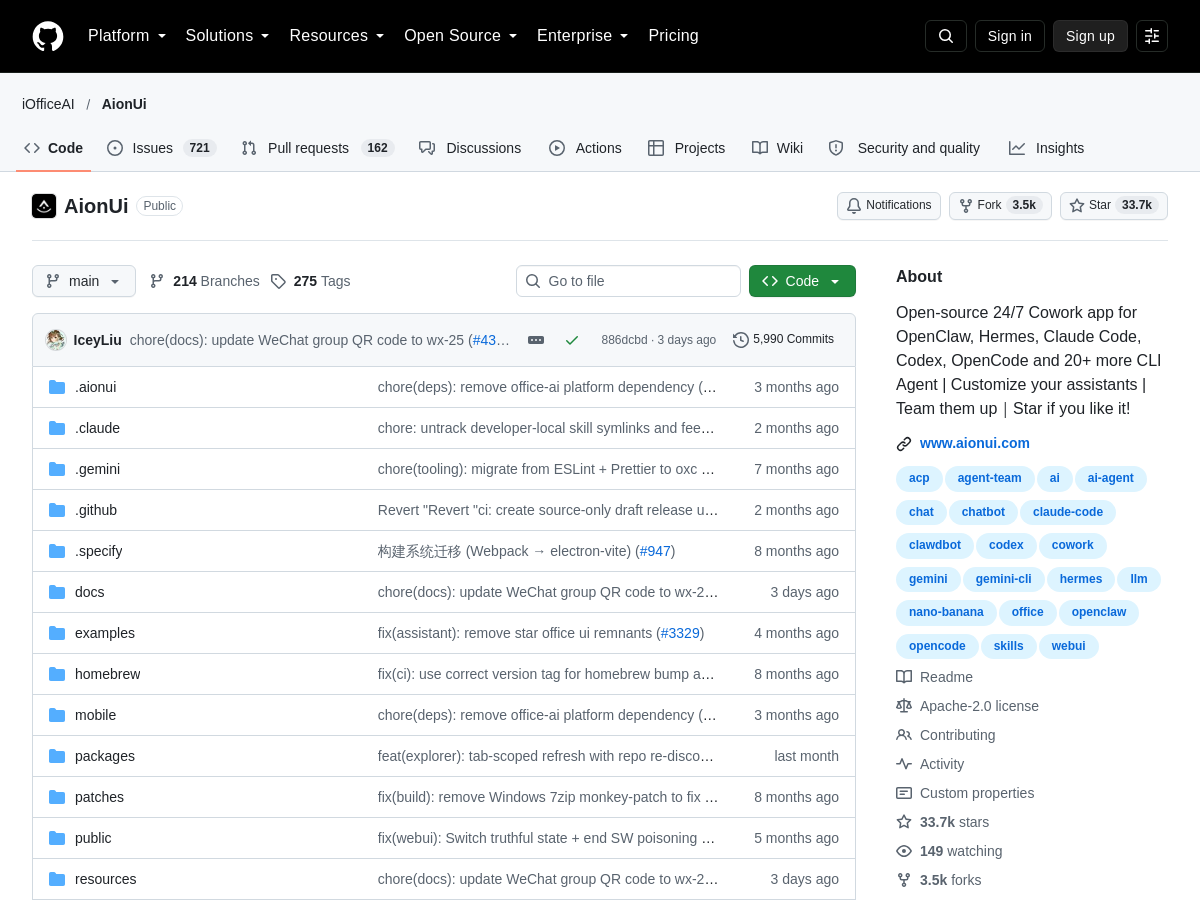
Screenshot of AionUi
AionUi
LLM Open Source

AionUi is an open-source 24/7 Cowork app designed for various CLI agents, including OpenClaw, Hermes, Claude Code, Codex, OpenCode, and over 20 more. It allows users to customize their assistants and team them up. The project is hosted on GitHub and has gained significant attention, with over 33,700 stars and 3,500 forks. AionUi provides a platform for users to create and manage their own AI-powered assistants, enabling them to automate tasks and improve productivity. The project is constantly evolving, with regular updates and contributions from the community. AionUi's features include support for multiple CLI agents, customizable assistants, and team collaboration. The project is licensed under the Apache-2.0 license, ensuring that it remains open and accessible to the community. With its growing popularity and active development, AionUi has the potential to become a leading platform for AI-powered productivity and automation. The project's documentation and resources are available on GitHub, providing users with a comprehensive guide to getting started and contributing to the project. Overall, AionUi is an innovative open-source project that has the potential to revolutionize the way we work and interact with AI-powered assistants.

Solves

AionUi solves the problem of managing and customizing AI-powered assistants for individuals and teams. By providing a platform for users to create and manage their own assistants, AionUi enables users to automate tasks, improve productivity, and enhance their overall work experience. The project addresses the need for a flexible and customizable solution for AI-powered productivity, allowing users to tailor their assistants to their specific needs and workflows. With AionUi, users can overcome the limitations of traditional AI-powered tools and create a more personalized and efficient work environment.

Screenshot of CLIP
CLIP
Image Gen Open Source

CLIP (Contrastive Language-Image Pre-Training) is a neural network trained on a variety of (image, text) pairs. It can be instructed in natural language to predict the most relevant text snippet given an image, without directly optimizing for the task, similarly to GPT-2 and 3. CLIP uses a ViT-L/14 or ResNet-50x64 architecture to jointly train an image encoder and a text encoder to maximize cosine similarity between correct pairs. This enables zero-shot transfer to downstream tasks like image classification, object detection, and visual reasoning. The model is publicly available via a GitHub repository with pre-trained weights and a Python package for easy integration.

Solves

Traditional computer vision models require large amounts of task-specific labeled data and struggle to generalize to new tasks. CLIP addresses this by learning visual concepts from natural language descriptions, enabling zero-shot transfer to a wide range of visual tasks without additional training data. It closes the gap between images and language, allowing users to classify or search images using free-form text.

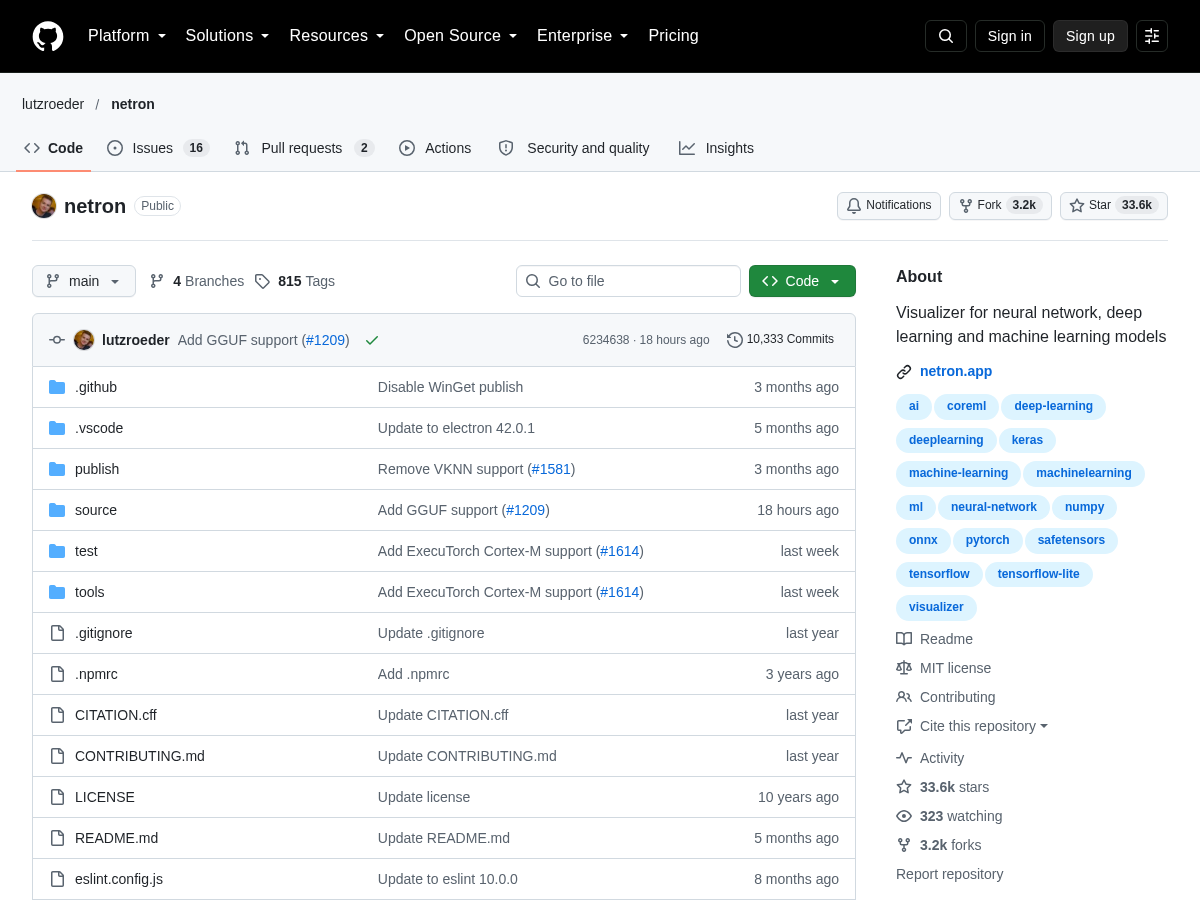
Screenshot of Netron
Netron
AI/ML Open Source

Netron is a viewer for neural network, deep learning, and machine learning models. It supports a wide range of formats, including ONNX, TensorFlow Lite, PyTorch, and many others. Netron provides an easy-to-use interface for visualizing and exploring the architecture of machine learning models, making it a valuable tool for developers, researchers, and data scientists. The project is open-source and has a large community of contributors, with over 33,000 stars on GitHub. Netron has experimental support for several other formats, including MLIR, JAX, and scikit-learn. The tool is highly customizable and can be extended with plugins and scripts. Netron is available on GitHub and can be installed using pip or by downloading the source code. The project is actively maintained, with regular updates and new features being added. Overall, Netron is a powerful and flexible tool for working with machine learning models, and its open-source nature makes it a great resource for the community. Netron's features include support for multiple formats, a user-friendly interface, and customization options. The tool is widely used in the machine learning community and has a strong reputation for its ease of use and flexibility. Netron is a valuable resource for anyone working with machine learning models, from researchers and developers to data scientists and students.

Solves

Netron solves the problem of visualizing and exploring the architecture of machine learning models, making it easier for developers, researchers, and data scientists to understand and work with these models. By providing a user-friendly interface and supporting a wide range of formats, Netron makes it possible to easily visualize and compare different models, which can be a challenging task without the right tools. This can help to improve the development and deployment of machine learning models, and can also facilitate collaboration and knowledge sharing among researchers and practitioners.

Screenshot of Tabby
Tabby
Dev Tools Open Source

Tabby is an open-source, self-hosted AI coding assistant designed as an alternative to cloud-based tools like GitHub Copilot. It provides code completions, chat, and other AI-powered features directly within integrated development environments (IDEs). By running on your own infrastructure, Tabby gives organizations full control over their code and data, addressing privacy and compliance concerns. Built with Rust for performance and reliability, Tabby supports a variety of large language models (LLMs) through backends like llama.cpp, Ollama, and others, allowing users to choose models that fit their hardware and quality requirements. It integrates with popular editors such as VS Code, JetBrains IDEs, and Vim/Neovim via extensions, and offers an OpenAI-compatible API for custom integrations. The project is actively developed on GitHub, with a focus on ease of deployment via Docker and Kubernetes. Tabby is released under the Apache 2.0 license, making it free to use and modify. It is suitable for individual developers, teams, and enterprises seeking a self-hosted AI assistant that can be customized and scaled as needed.

Solves

Tabby solves the problem of relying on third-party cloud AI coding assistants that may expose proprietary source code and create compliance risks. It enables developers and organizations to benefit from AI-powered code completion and chat while keeping all code and data within their own infrastructure, ensuring privacy, security, and control over the AI models used.

Screenshot of Graphrag
Graphrag
LLM Open Source

Graphrag is a modular, graph-based Retrieval-Augmented Generation (RAG) system developed by Microsoft. It leverages knowledge graphs to enhance the retrieval capabilities of large language models (LLMs) by extracting entities, relationships, and key claims from unstructured text and organizing them into a graph structure. The system then uses community detection algorithms to identify thematic clusters and generate summaries, enabling more accurate and context-rich responses to complex queries. Its modular architecture allows users to customize components such as entity extraction, graph construction, and retrieval strategies, making it adaptable to various domains and data scales. Graphrag is particularly effective for tasks that require reasoning over entire document collections, such as global summarization, dataset exploration, and question answering across large corpora.

Solves

Traditional RAG systems often treat each text chunk in isolation, limiting their ability to capture overarching themes and relationships across large document sets. Graphrag solves this by constructing a knowledge graph from the documents, modeling entities and their connections to support global sensemaking. This graph-based approach enables the LLM to consider structured context, improving the quality of answers for multi-step reasoning and holistic analysis, even when the information is spread across many sources.

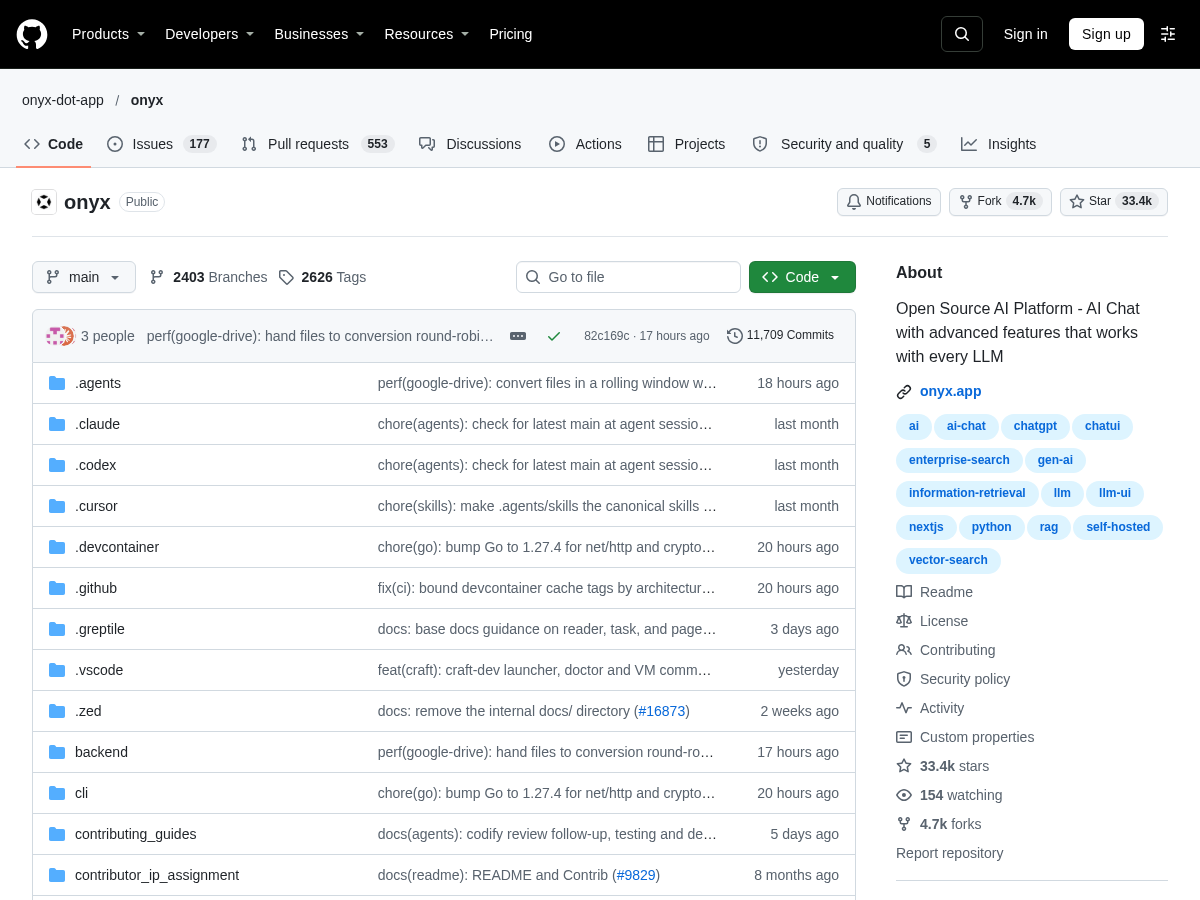
Screenshot of Onyx
Onyx
LLM Open Source

Onyx is an open-source AI platform that provides advanced features for AI chat, compatible with every Large Language Model (LLM). It is designed to work seamlessly with various LLMs, allowing users to leverage the capabilities of these models in a flexible and customizable manner. The platform is built using Next.js and Python, and it utilizes vector search and information retrieval techniques to provide efficient and accurate results. Onyx also features a self-hosted option, enabling users to deploy the platform on their own infrastructure. The project is actively maintained, with a large community of contributors and a strong focus on security and performance. Onyx has a wide range of applications, including chatbots, virtual assistants, and language translation systems. Its advanced features and compatibility with multiple LLMs make it a popular choice among developers and researchers. The platform is highly customizable, allowing users to tailor it to their specific needs and use cases. Overall, Onyx is a powerful and versatile AI platform that has the potential to revolutionize the way we interact with language models.

Solves

Onyx solves the problem of limited flexibility and customization options in AI chat platforms. Many existing platforms are proprietary and restrictive, making it difficult for users to adapt them to their specific needs. Onyx addresses this issue by providing an open-source and highly customizable platform that can be tailored to meet the requirements of various applications and use cases. By leveraging the capabilities of multiple LLMs, Onyx enables users to create more accurate and efficient AI chat systems, which can be used in a wide range of industries and domains.

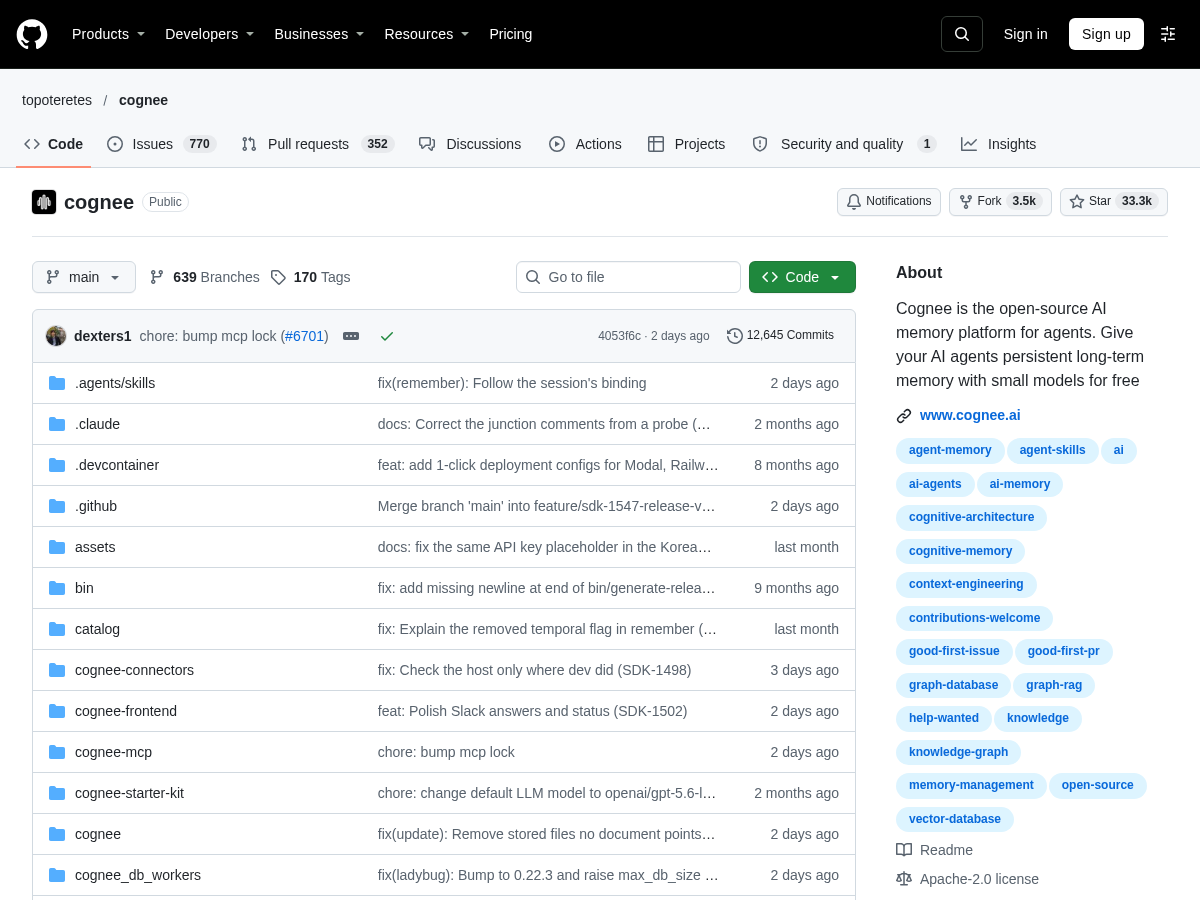
Screenshot of Cognee
Cognee
AI Agents Open Source

Cognee is an open-source AI memory platform designed for agents, providing them with persistent long-term memory using small models at no cost. This platform aims to enhance the capabilities of AI agents by allowing them to retain and utilize memory over extended periods, which is crucial for complex tasks and decision-making processes. The use of small models ensures that the memory footprint is minimized, making it efficient for deployment in various environments. Cognee's architecture is based on cognitive principles, incorporating elements such as graph databases and vector databases to manage and query knowledge effectively. The project is actively maintained on GitHub, with a significant number of stars and forks, indicating a strong community interest and contribution. Cognee supports multiple deployment configurations, including Modal, Railway, Fly.io, Render, and Daytona/Codespaces, making it versatile for different use cases and development environments. The documentation and contributing guidelines are well-documented, encouraging collaboration and further development of the platform. Overall, Cognee represents a significant advancement in AI agent technology, offering a unique solution for memory management and knowledge retention.

Solves

Developers and researchers working with AI agents often face the challenge of providing these agents with persistent and efficient memory solutions. Traditional methods may require large models or complex architectures, which can be cumbersome and inefficient. Cognee solves this problem by offering a lightweight, open-source platform that enables AI agents to have long-term memory, thereby enhancing their performance and capability to handle complex tasks. This solution is particularly beneficial for applications where knowledge retention and recall are critical, such as in cognitive architectures, chatbots, and decision support systems.

Screenshot of Exmergo Viz
Exmergo Viz
Database Freemium

Exmergo Viz is a data visualization tool that enables users to transform messy data into beautiful dashboards within minutes. It offers a freemium pricing model, allowing individuals and teams to start for free and upgrade for additional features and capacity. The tool is designed to simplify the process of creating insightful visualizations from complex datasets, making it accessible to users with varying levels of technical expertise. With its focus on speed and ease of use, Exmergo Viz helps users quickly derive actionable insights from their data without the need for extensive data preparation or coding skills.

Solves

Exmergo Viz solves the challenge of turning messy, unstructured data into visually appealing and informative dashboards quickly. It eliminates the need for complex data modeling or design skills, enabling users to focus on analysis and decision-making rather than data wrangling and visualization setup.

Screenshot of VidFlux AI
VidFlux AI
Videos Unknown

VidFlux AI is an online platform that enables rapid AI video content creation. Users can convert text prompts, images, or reference videos into polished videos in about a minute. The platform aggregates multiple leading generative video models, including Google Veo 3.1, Kling 2.6/3.0, and Seedance, to balance realism, motion consistency, and creative stylization. Through a simple browser-based interface, users upload media, write a prompt, and choose an aspect ratio (e.g., 16:9), making video production accessible without manual editing skills. Beyond baseline generation, VidFlux supports video-to-video motion transfer with character animation, letting a static portrait mimic movements from a reference clip while preserving the subject's identity. Image-to-video animation turns still photos into dynamic scenes with optional audio. The tool also advertises advanced capabilities such as HD and 4K output, batch processing, custom watermarking and branding, and commercial usage rights — positioning it for both casual creators and professional teams. Additional use cases include social media clips, marketing ads, educational materials, real estate showcases, game cinematics, and corporate communications.

Solves

VidFlux AI solves the problem of time-consuming and technically complex video production by providing an automated, prompt-driven workflow. It eliminates the need for expensive cameras, actors, or manual editing, enabling individuals and businesses to generate professional-looking visuals for social media, marketing, and storytelling from simple text instructions or images in under a minute.

Screenshot of PhotoMentor
PhotoMentor
Image analysis Free

PhotoMentor is a free-to-try AI-powered photo analysis tool that gives photographers instant, objective feedback on their images. Users upload a photo and receive a score out of 10, a written critique, genre detection, mood assessment, and actionable recommendations. The analysis highlights specific regions in the frame—such as distractions, visual dead zones, or composition issues—with bounding boxes, helping photographers see exactly what weakens or strengthens the image. The platform supports multiple genres including portrait, landscape, street, wildlife, and abstract photography. It also offers a Composition Debugger that checks framing against rules like the Rule of Thirds, Leading Lines, and Balance, and provides a verdict on whether the photographer's intentional break works. PhotoMentor includes a personal progress dashboard, history tracking, and weekly stats on popular genres and recurring critique themes. PhotoMentor is available as a web app, a Chrome extension for rating photos directly in Google Photos, a Telegram bot, and an API for custom integrations. It also provides AI bulk culling to help photographers quickly select finalists from large shoots. The service has analyzed over 6,000 photos and offers a free tier with no registration, plus paid Pro and Pro Workflow plans for unlimited analyses, faster AI models, and advanced bulk culling.

Solves

Photographers often lack immediate, objective feedback on their images, relying on vague likes or delayed critiques. PhotoMentor solves this by providing instant AI-generated photo analysis with a score out of 10, visual region highlights, composition checks, and actionable recommendations, helping users understand why a photo works or fails and what to fix next.

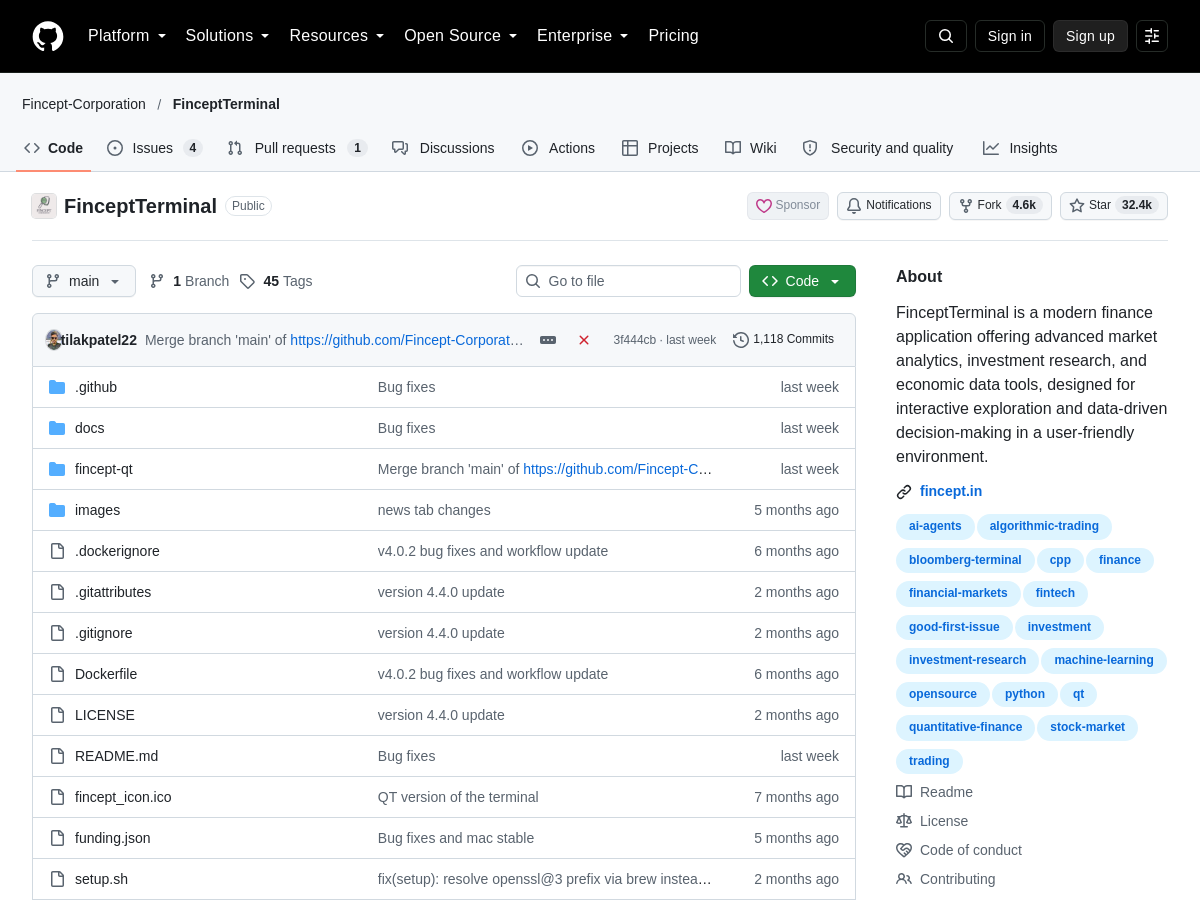
Screenshot of FinceptTerminal
FinceptTerminal
AI Agents Open Source

FinceptTerminal is a modern finance application that offers advanced market analytics, investment research, and economic data tools. It is designed for interactive exploration and data-driven decision-making in a user-friendly environment. The application utilizes AI and machine learning to provide users with valuable insights and information. FinceptTerminal is built using a variety of technologies, including Python, QT, and C++. It has a strong focus on open-source development and has a large community of contributors. The application is highly customizable and can be tailored to meet the specific needs of individual users. FinceptTerminal is a powerful tool for anyone looking to gain a deeper understanding of financial markets and make informed investment decisions. It provides a wide range of features, including real-time data feeds, advanced charting and analysis tools, and integration with popular financial platforms. Overall, FinceptTerminal is a comprehensive and user-friendly finance application that is well-suited for both individual investors and professional financial analysts. The application is constantly being updated and improved, with new features and functionalities being added on a regular basis. This ensures that users have access to the latest tools and technologies, and can stay ahead of the curve in the rapidly evolving world of finance. FinceptTerminal is a valuable resource for anyone looking to navigate the complex world of finance and make informed investment decisions. With its advanced analytics and data visualization capabilities, it is an essential tool for anyone looking to gain a deeper understanding of financial markets and stay ahead of the competition. The application's open-source nature and large community of contributors ensure that it is constantly evolving and improving, and that users have access to the latest tools and technologies. Overall, FinceptTerminal is a powerful and user-friendly finance application that is well-suited for a wide range of users, from individual investors to professional financial analysts.

Solves

FinceptTerminal solves the problem of providing users with a comprehensive and user-friendly finance application that offers advanced market analytics, investment research, and economic data tools. It helps users to make informed investment decisions by providing them with valuable insights and information. The application is particularly useful for individual investors and professional financial analysts who need to stay up-to-date with the latest market trends and developments. By providing a wide range of features and functionalities, FinceptTerminal helps users to navigate the complex world of finance and make informed investment decisions. It also helps users to save time and effort by automating many tasks and providing real-time data feeds and analysis tools.

Screenshot of Surrealdb
Surrealdb
Dev Tools Open Source

SurrealDB is a multi-model database that combines the flexibility of document stores with the relational power of graph databases, enabling developers to model complex data relationships without sacrificing query performance. It supports schemafull and schemaless data, ACID transactions, and a rich query language called SurrealQL that simplifies data manipulation across multiple paradigms. Designed for the realtime web, SurrealDB provides built-in live queries that push real-time updates to connected clients whenever data changes, making it ideal for collaborative applications, dashboards, and interactive experiences. Its distributed architecture allows horizontal scaling across multiple nodes with automatic sharding and replication, ensuring high availability and fault tolerance. SurrealDB can be self-hosted on-premises or in the cloud, with official Docker images and support for Kubernetes. It offers client libraries for various programming languages and integrates with existing tooling, reducing the complexity of building modern, data-intensive applications.

Solves

SurrealDB addresses the challenge of building real-time, collaborative applications that require flexible data modeling and horizontal scalability. By unifying document and graph database features with live query subscriptions, it eliminates the need for separate databases, caching layers, and synchronization mechanisms, streamlining development and reducing operational overhead.

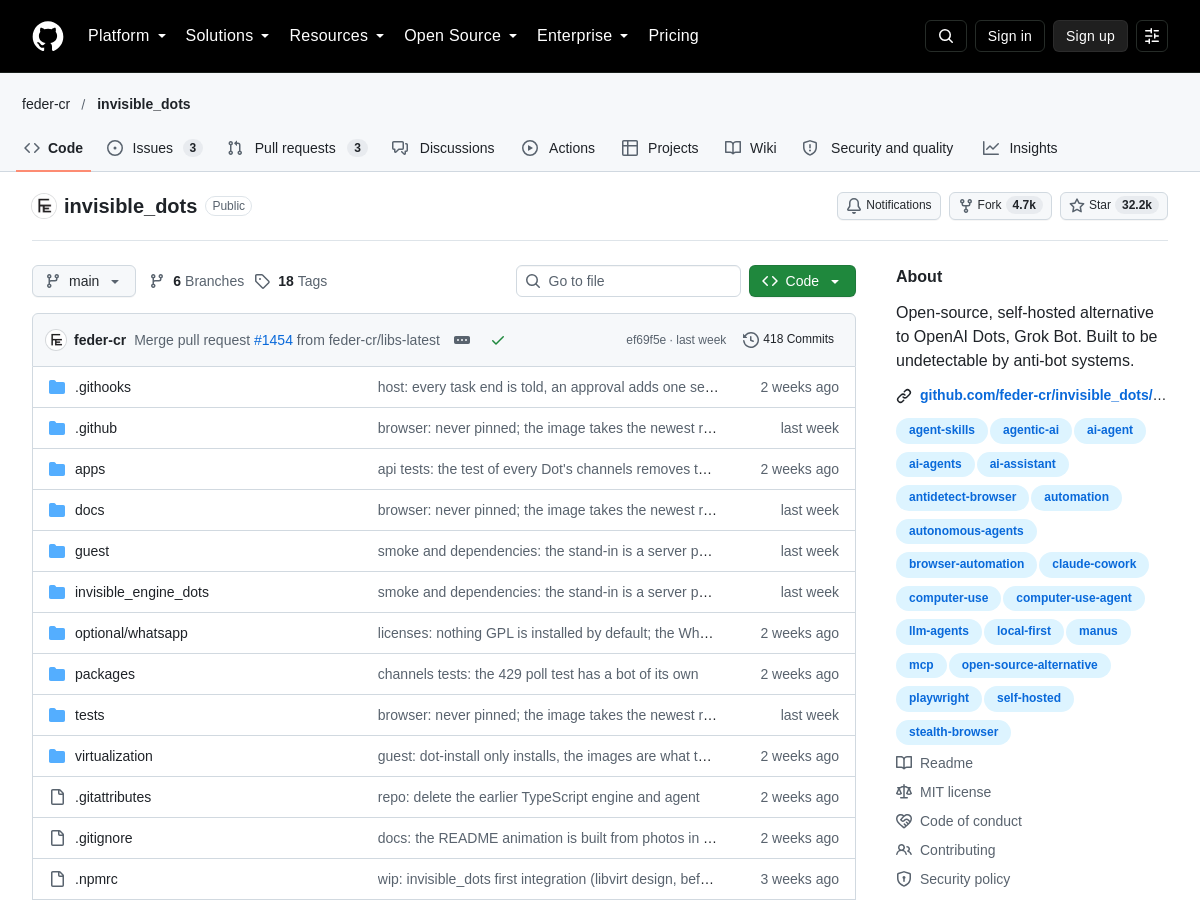
Screenshot of Invisible_dots
Invisible_dots
AI Agents Open Source

Invisible_dots is an open-source, self-hosted alternative to OpenAI Dots and Grok Bot. It is designed to be undetectable by anti-bot systems, making it a unique solution for users who require a high level of anonymity. The project is built using a variety of technologies, including Playwright and MCP, and is designed to be highly customizable and flexible. With its self-hosted architecture, Invisible_dots allows users to have full control over their data and deployment, making it an attractive option for those who value privacy and security. The project has a strong focus on community involvement, with a large number of contributors and a active discussion forum. Overall, Invisible_dots is a powerful and flexible tool that is well-suited for a wide range of applications, from automation and scripting to research and development. The project's documentation is extensive and well-maintained, making it easy for new users to get started and for experienced users to dive deeper into the project's capabilities. With its strong community and flexible architecture, Invisible_dots is a great option for anyone looking for a customizable and private automation solution. The project's use of AI and machine learning technologies also makes it an interesting option for those looking to explore the possibilities of artificial intelligence. As an open-source project, Invisible_dots is constantly evolving and improving, with new features and updates being added regularly. This makes it an exciting and dynamic project to be a part of, with a wide range of opportunities for contributors and users to get involved and make a difference. Whether you're looking for a powerful automation tool, a customizable scripting solution, or a platform for exploring the possibilities of AI, Invisible_dots is definitely worth checking out.

Solves

Invisible_dots solves the problem of users who require a high level of anonymity and control over their automation and scripting tasks. Many existing solutions, such as OpenAI Dots and Grok Bot, are cloud-based and may not offer the level of privacy and security that some users require. Invisible_dots provides a self-hosted alternative that allows users to have full control over their data and deployment, making it an attractive option for those who value privacy and security. Additionally, Invisible_dots is highly customizable and flexible, making it a great option for users who have specific requirements or need to integrate the tool with other systems or applications.

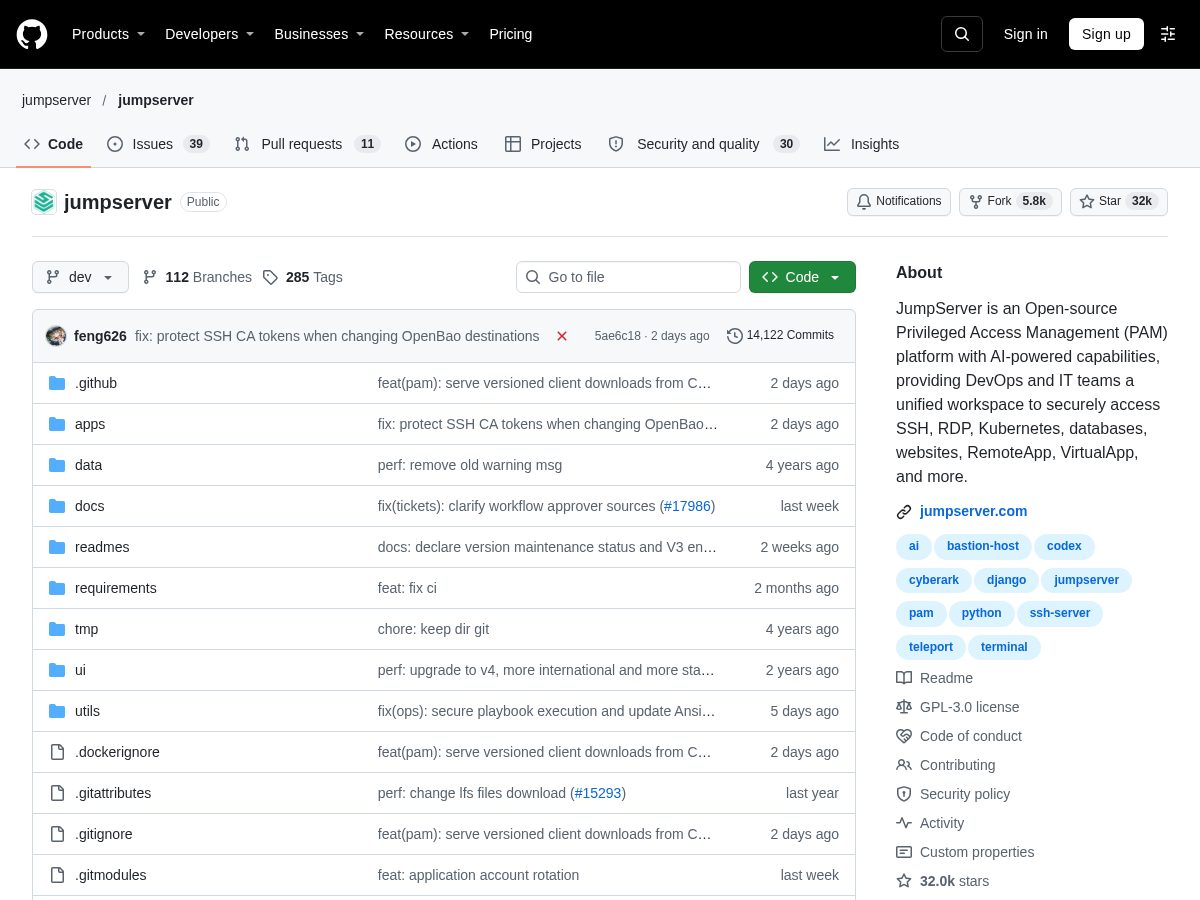
Screenshot of Jumpserver
Jumpserver
Model Serving Open Source

JumpServer is an open-source Privileged Access Management (PAM) platform with AI-powered capabilities. It provides DevOps and IT teams a unified workspace to securely access SSH, RDP, Kubernetes, databases, websites, RemoteApp, VirtualApp, and more. The platform consists of several components, including Core projects, Enterprise components, Supporting services, and Deployment & Tooling. Core projects include JumpServer, Lina, Luna, KoKo, Chen, and Kael, which provide the platform, web interface, terminal, protocol connections, and AI capabilities. Enterprise components extend application and protocol access, while Supporting services handle session recordings and host operations. Deployment & Tooling includes the Installer and Docker Web, which simplify installation and web delivery. JumpServer is licensed under the GNU General Public License version 3 (GPLv3) and is actively maintained, with version 5.x being the latest release. The platform has a large community of users and contributors, with over 32,000 stars on GitHub. JumpServer provides a secure and unified way for teams to access and manage their infrastructure, making it an ideal solution for organizations of all sizes.

Solves

JumpServer solves the problem of secure access and management of infrastructure for DevOps and IT teams. Many organizations struggle with providing secure access to their infrastructure, which can lead to security breaches and other issues. JumpServer provides a unified workspace for secure access to various protocols and applications, making it easier for teams to manage their infrastructure while maintaining security and compliance. By using JumpServer, organizations can reduce the risk of security breaches and improve their overall security posture.

Screenshot of Cli
Cli
AI Agents Open Source

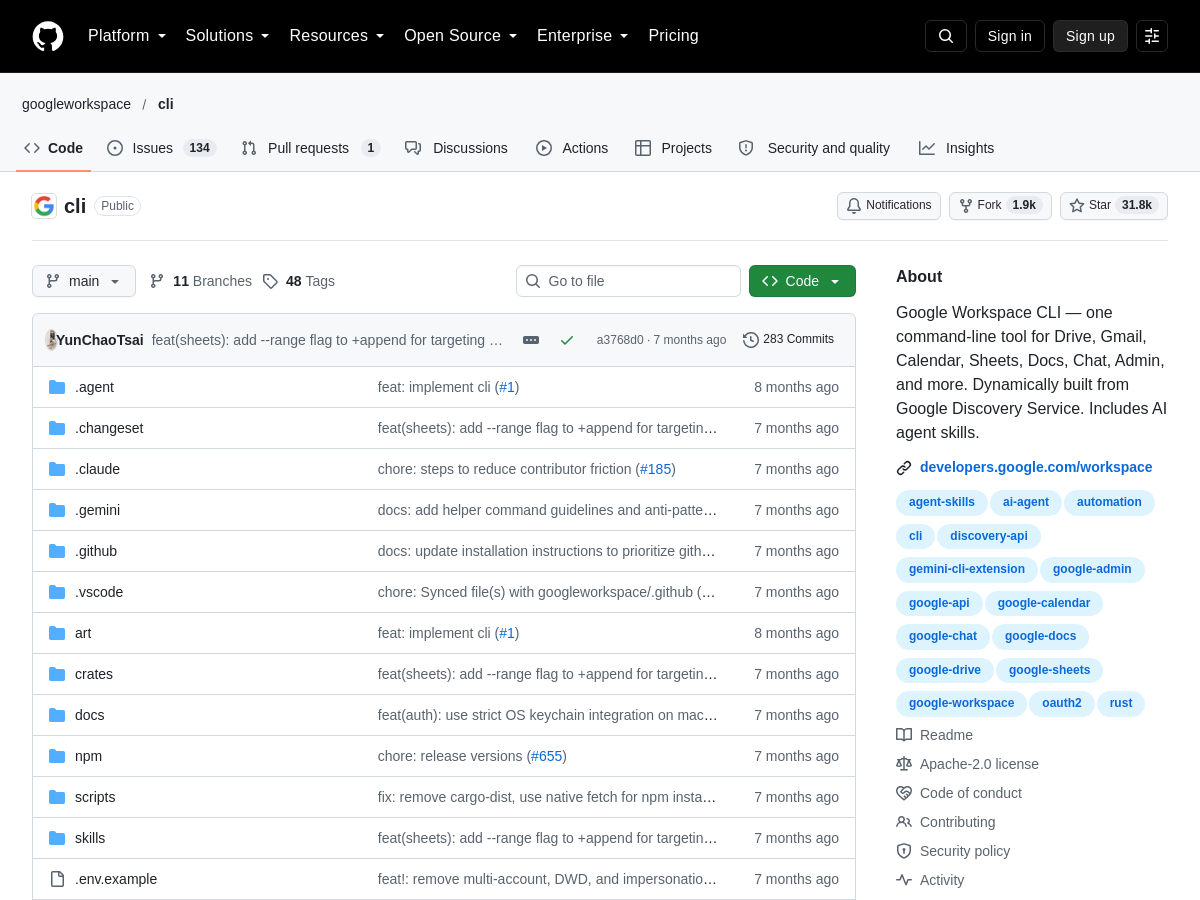
The Google Workspace CLI is a command-line tool that provides a unified interface for interacting with various Google Workspace services, including Drive, Gmail, Calendar, Sheets, Docs, Chat, and Admin. The tool is dynamically built from the Google Discovery Service and includes AI agent skills. It allows users to perform a wide range of tasks, such as managing files, sending emails, scheduling events, and more. The CLI is designed to be flexible and customizable, with features like automated workflows and integration with other Google services. The tool is open-source and has a large community of contributors, with over 31,000 stars on GitHub. The CLI is written in Rust and uses the Apache-2.0 license. It has a wide range of features, including support for multiple Google services, automated workflows, and customizable commands. The tool is well-maintained, with regular updates and a strong focus on security and quality. Overall, the Google Workspace CLI is a powerful and flexible tool that can help users streamline their workflow and increase productivity. It is a valuable resource for anyone who uses Google Workspace services regularly. The CLI has a simple and intuitive syntax, making it easy to use for both beginners and experienced users. It also has a comprehensive documentation, with detailed instructions and examples to help users get started. The tool is highly customizable, with a wide range of options and settings that can be tailored to meet the needs of individual users. The Google Workspace CLI is a valuable tool for anyone who wants to automate their workflow, increase productivity, and get the most out of their Google Workspace services.

Solves

The Google Workspace CLI solves the problem of having to use multiple separate tools and interfaces to manage different Google Workspace services. It provides a unified interface that allows users to perform a wide range of tasks from a single command-line tool, making it easier to manage and automate workflows. This can be particularly useful for developers, administrators, and power users who need to perform complex tasks and workflows on a regular basis. By providing a single, unified interface for Google Workspace services, the CLI can help reduce the complexity and overhead of managing multiple tools and interfaces, making it easier to get work done efficiently and effectively.

Screenshot of AirMusic
AirMusic
Video Freemium

AirMusic is an AI-powered platform that democratizes music and video creation, allowing anyone to produce original songs and synchronized music videos in seconds. It provides two core modules: an AI Music Generator that creates complete tracks from text prompts, lyrics, or style selections, and an AI Music Video Generator that transforms existing audio into visually engaging music videos by building scenes automatically. The platform supports a wide range of genres and moods, from lo-fi hip hop and cinematic orchestral to pop and electronic. Additional tools include AI Music Extender, which lengthens tracks while preserving stylistic consistency, and AI Cover, which applies AI voice transformation to any song. With over 15,000 creators already using it, AirMusic streamlines content production for social media, marketing, and personal projects, making professional-quality audio and video accessible without technical expertise or expensive tools.

Solves

Creating original music and music videos traditionally demands specialized skills, costly software, and time-intensive effort. AirMusic solves this by enabling users—regardless of musical background—to generate full songs and videos from simple inputs like text descriptions or uploaded audio. It removes barriers to entry for content creation, empowering marketers, social media influencers, and hobbyists to produce unique, royalty-free audio-visual content instantly.

Screenshot of Invisible_playwright_mcp
Invisible_playwright_mcp
Productivity Open Source

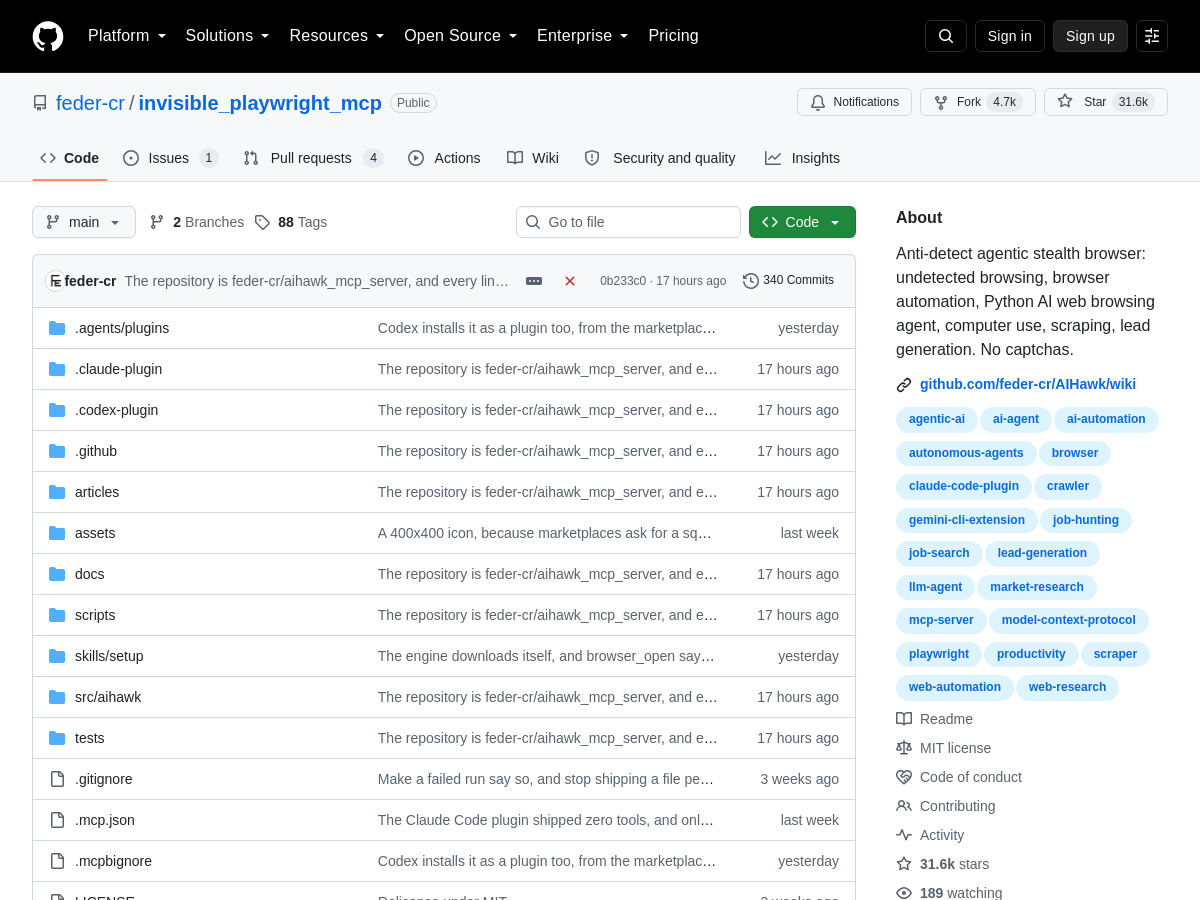
Invisible_playwright_mcp is an open-source Model Context Protocol (MCP) server that exposes an anti-detect, "stealth" browser to AI agents and automation scripts. It pairs the Playwright automation API with browser fingerprint patching so that automated sessions look like ordinary human browsing, reducing the frequency of bot-detection challenges and CAPTCHA interstitials encountered during scripted navigation. The project is positioned as an "agentic stealth browser": an MCP-compatible tool layer that LLM clients and Python agents can call to drive a real browser. Typical operations include navigating to URLs, reading rendered page content, clicking and filling forms, extracting structured data, and following multi-step workflows, all through the standardized MCP tool interface rather than bespoke glue code. Because it is delivered as an MCP server, it is designed to plug into MCP-capable clients (such as AI coding assistants and agent frameworks) with minimal configuration. The underlying automation is Python-based, so it also fits naturally into existing Python data, scraping, and research pipelines. The repository markets the tool around undetected browsing, browser automation, computer-use style agents, web scraping, and lead generation, with the stated benefit of encountering fewer CAPTCHAs. License, star count, and release cadence are not asserted here because they were not verifiable from the supplied metadata.

Solves

Standard headless browser automation is easily fingerprinted, so scrapers and AI browsing agents frequently hit bot-detection walls, CAPTCHAs, and blocked sessions. This project wraps Playwright in stealth/anti-detect behavior and exposes it through MCP, letting agents drive a browser that more closely resembles normal human traffic and reducing the engineering effort needed to keep automated browsing sessions unblocked.

Screenshot of Aihawk_mcp_server
Aihawk_mcp_server
Productivity Open Source

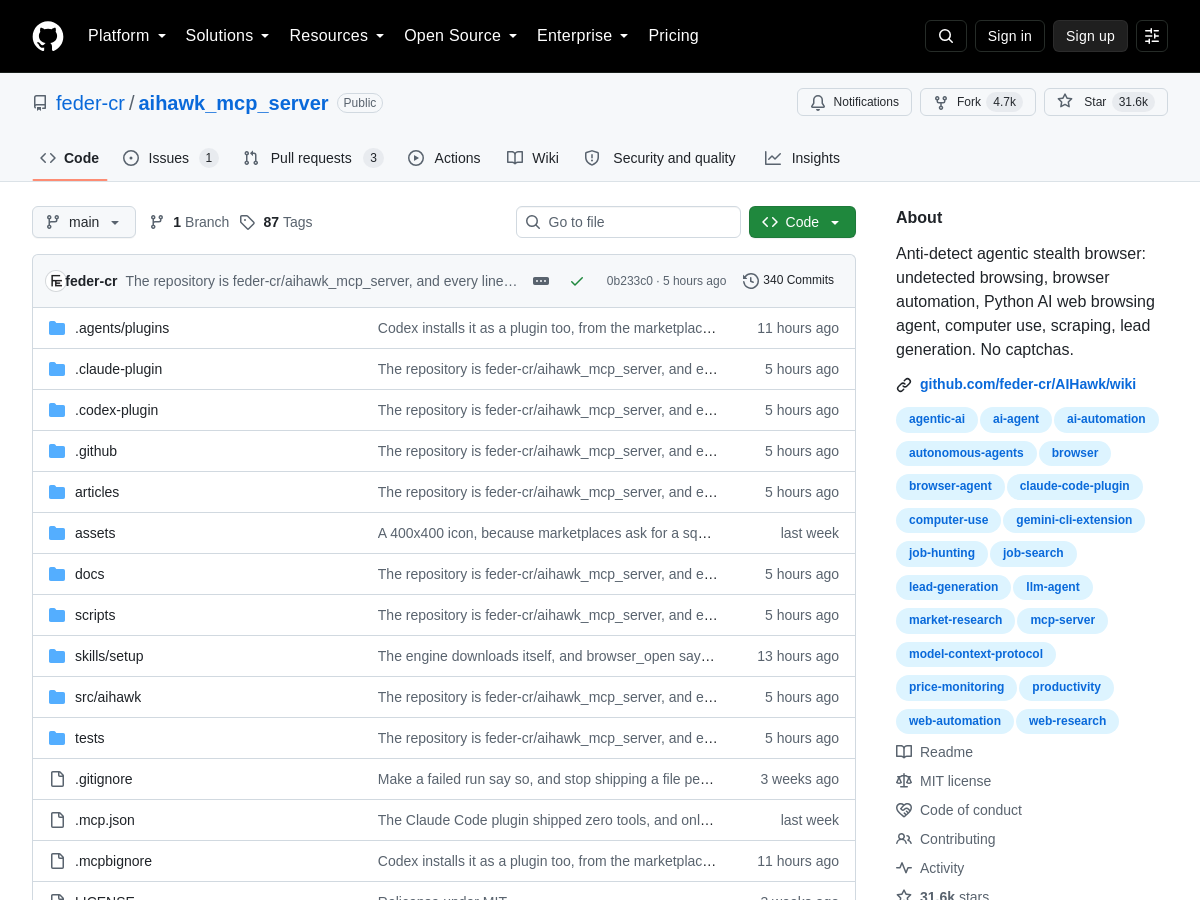
Aihawk MCP Server is an open-source Model Context Protocol (MCP) server that exposes an anti-detect, stealth browser to AI agents and large language models. Written in Python and published by feder-cr on GitHub as aihawk_mcp_server, it positions itself as an "agentic stealth browser" for undetected browsing. By implementing the MCP interface, the project lets MCP-compatible clients drive a real browser session through tool calls. The repository describes capabilities including undetected browsing, browser automation, computer-use style interaction, web scraping, and lead generation, and claims the stealth configuration helps avoid CAPTCHA challenges on many sites. The design goal is to combine an AI-driven browsing agent with anti-bot-detection techniques, so automated navigation, form filling, and data extraction behave more like a human user. That makes it relevant to workflows where ordinary headless automation is blocked, such as scraping protected pages, enriching leads, or letting an agent complete multi-step tasks on the open web. Because it is distributed as source code, users install and run the server locally or on their own infrastructure and connect it to whichever MCP client or LLM they prefer. License, release cadence, and community size are not confirmed here and should be verified directly on the repository.

Solves

Traditional headless browser automation is frequently blocked by anti-bot systems, CAPTCHA challenges, and fingerprinting, which breaks AI agents and scraping pipelines that need to interact with real websites. Aihawk MCP Server addresses this by providing an anti-detect stealth browser exposed over the Model Context Protocol, so language-model agents can browse, navigate, and extract data from sites that would otherwise reject automated traffic.

Screenshot of Pytorch Lightning
Pytorch Lightning
Code Open Source

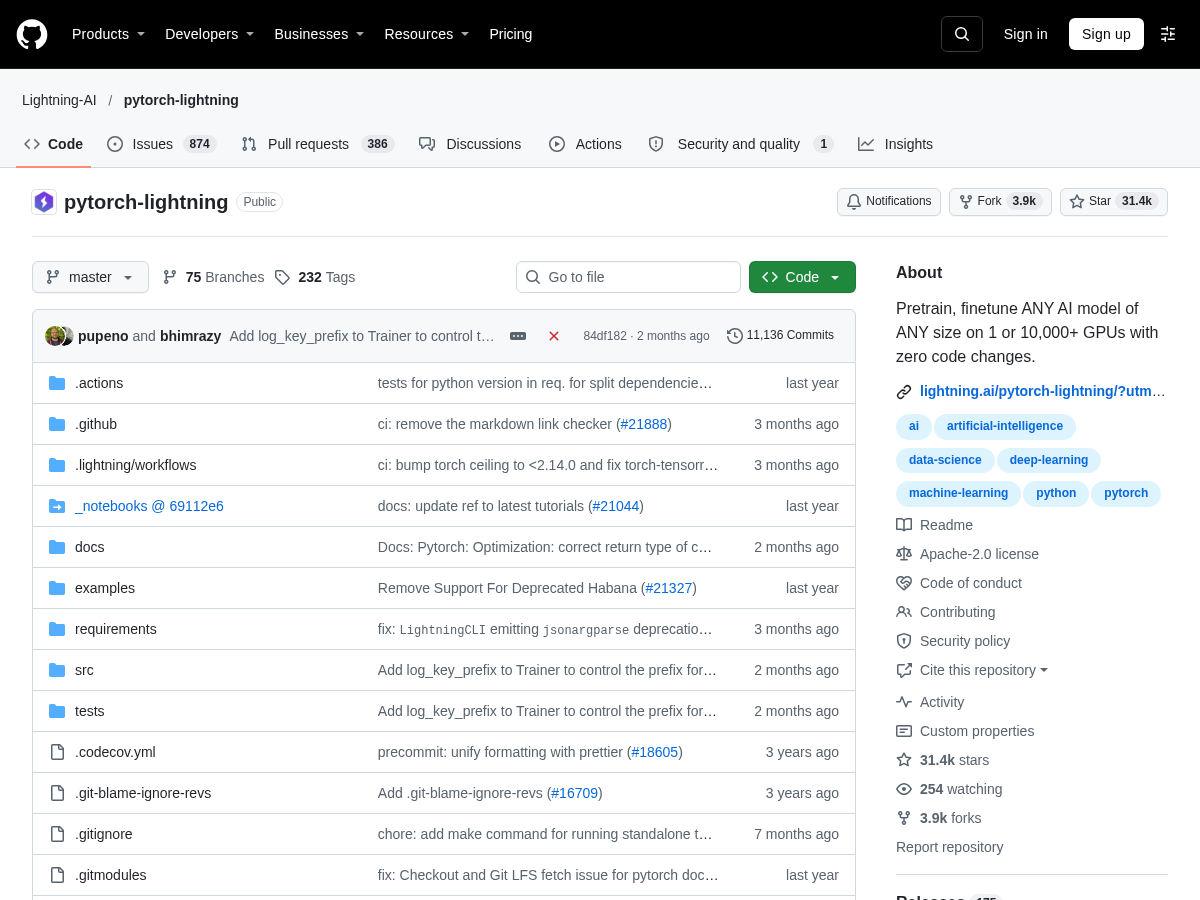
PyTorch Lightning is a lightweight PyTorch wrapper that helps researchers and practitioners get state-of-the-art results with minimal code changes. It provides a simple and intuitive API for building, training, and testing deep learning models. With PyTorch Lightning, users can pretrain and finetune any AI model of any size on 1 or 10,000+ GPUs with zero code changes. The library is designed to be highly scalable and flexible, making it suitable for a wide range of applications, from computer vision and natural language processing to reinforcement learning and more. PyTorch Lightning also provides a range of features and tools for tasks such as data loading, model checkpointing, and hyperparameter tuning, making it a popular choice among researchers and practitioners in the field of deep learning. The library is highly customizable and can be easily integrated with other popular deep learning frameworks and libraries. PyTorch Lightning is also actively maintained and updated, with a strong focus on community engagement and support. Overall, PyTorch Lightning is a powerful and flexible library that can help users achieve state-of-the-art results in deep learning with minimal code changes. The library's scalability, flexibility, and customizability make it a popular choice among researchers and practitioners, and its active maintenance and community support ensure that it remains a cutting-edge tool in the field of deep learning. PyTorch Lightning's ability to handle large-scale deep learning models and its support for a wide range of applications make it an ideal choice for users who need to build, train, and test complex deep learning models. The library's simplicity and intuitiveness also make it accessible to users who are new to deep learning, providing a gentle learning curve and a comprehensive set of documentation and tutorials. By providing a simple and intuitive API for building, training, and testing deep learning models, PyTorch Lightning helps users to focus on the development of their models, rather than the underlying infrastructure. This allows users to quickly and easily build, train, and test complex deep learning models, and to achieve state-of-the-art results with minimal code changes.

Solves

PyTorch Lightning solves the problem of building, training, and testing deep learning models in a scalable and flexible way. Many researchers and practitioners struggle with the complexity and inflexibility of traditional deep learning frameworks, which can make it difficult to build, train, and test large-scale deep learning models. PyTorch Lightning provides a simple and intuitive API that makes it easy to build, train, and test deep learning models, without requiring significant code changes or infrastructure investments. By providing a scalable and flexible framework for deep learning, PyTorch Lightning helps users to overcome the challenges of building, training, and testing complex deep learning models, and to achieve state-of-the-art results in a wide range of applications.

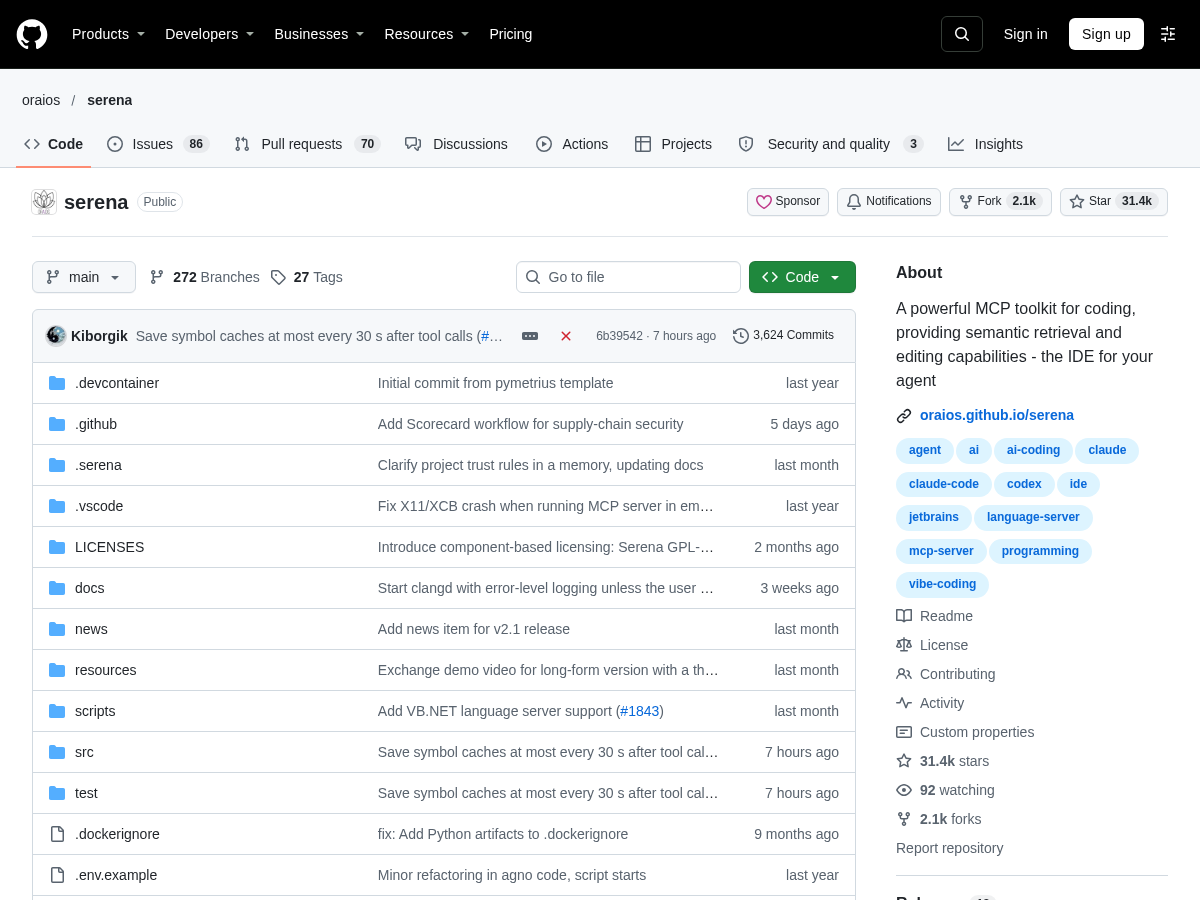
Screenshot of Serena
Serena
AI Agents Open Source

Serena is a powerful MCP toolkit for coding, providing semantic retrieval and editing capabilities. It is designed to be an Integrated Development Environment (IDE) for AI agents, allowing developers to create and manage their AI-powered projects efficiently. Serena offers a range of features, including semantic retrieval and editing capabilities, making it an ideal tool for developers working with AI and machine learning. The toolkit is open-source, allowing developers to contribute to its development and customize it according to their needs. Serena is built using a component-based architecture, with different components licensed under different terms, including GPL-3.0-or-later and MIT. The project has a strong focus on community involvement, with a contributor license agreement in place to ensure that contributors retain copyright and grant a perpetual, irrevocable license for their contributions. Serena's documentation is extensive, with a dedicated documentation section and a contributing guide to help new developers get started. The project is actively maintained, with regular updates and a strong focus on security and quality. Overall, Serena is a powerful tool for developers working with AI and machine learning, offering a range of features and a strong focus on community involvement and security. Serena's semantic retrieval and editing capabilities make it an ideal choice for developers who need to work with complex AI-powered projects. The toolkit's open-source nature and component-based architecture make it highly customizable, allowing developers to tailor it to their specific needs. With its strong focus on community involvement and security, Serena is an excellent choice for developers who want to create and manage their AI-powered projects efficiently and securely. Serena's documentation and contributing guide make it easy for new developers to get started, and its regular updates ensure that it stays up-to-date with the latest developments in AI and machine learning.

Solves

Serena solves the problem of inefficient AI-powered project development by providing a powerful MCP toolkit for coding, semantic retrieval, and editing capabilities. It helps developers to create and manage their AI-powered projects efficiently, reducing the time and effort required to develop and deploy AI models. Serena's IDE for AI agents allows developers to work with complex AI-powered projects, making it an ideal tool for developers who need to create and manage large-scale AI projects. By providing a range of features, including semantic retrieval and editing capabilities, Serena makes it easier for developers to work with AI and machine learning, reducing the complexity and difficulty associated with these technologies.

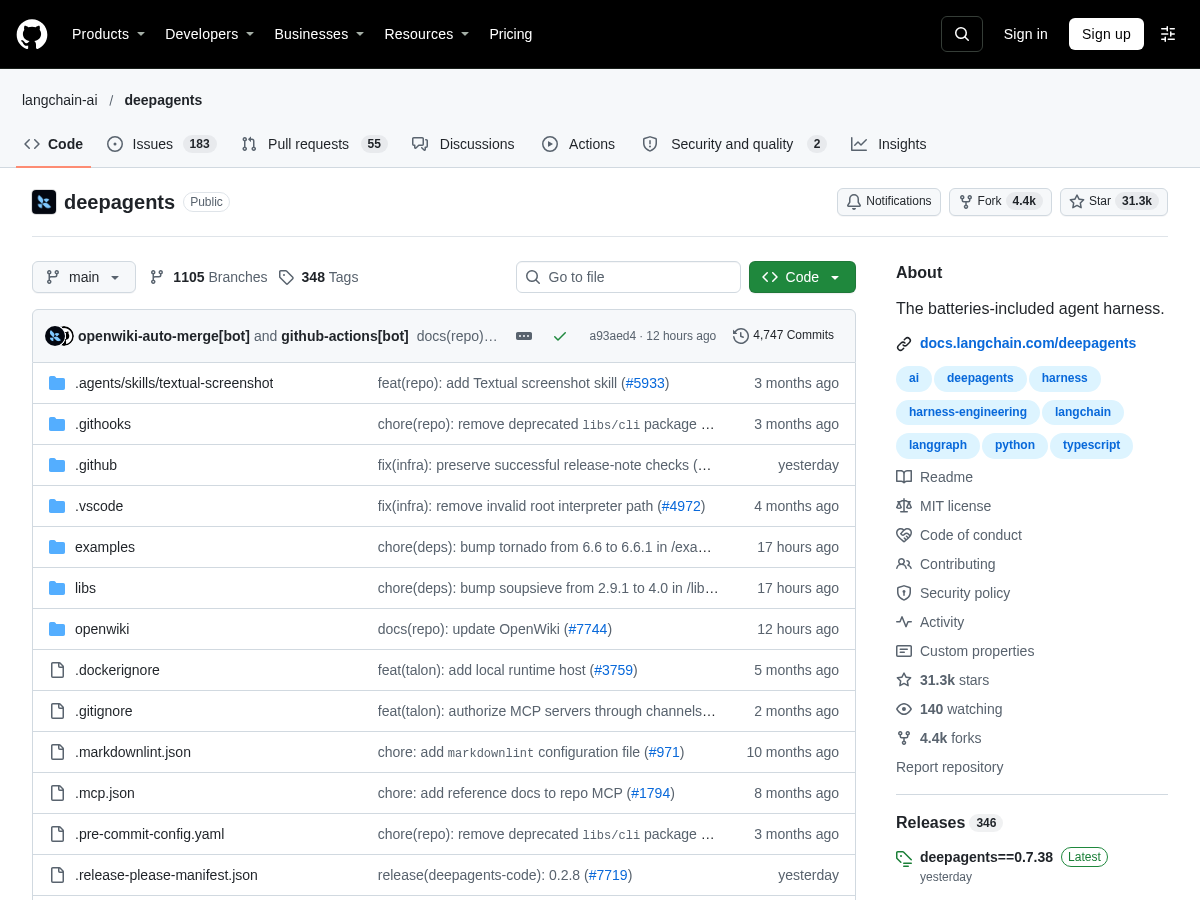
Screenshot of Deepagents
Deepagents
AI Agents Open Source

Deepagents is an open-source agent harness that provides an opinionated agent that runs out of the box. It is designed to be extensible, model-agnostic, and production-ready. The project is built on top of LangGraph and provides features such as sub-agents, filesystem, context management, shell access, persistent memory, human-in-the-loop, skills, and tools. Deepagents is available as a JavaScript/TypeScript library and can be used with any LLM that supports tool calling. The project has a comprehensive documentation and provides examples, guides, and API references for developers. Deepagents is designed to be used in production and provides a full harness for planning, context management, and delegation out of the box. The project is part of the LangChain ecosystem, which includes LangGraph, LangChain, and LangSmith. Deepagents can be used with LangChain's create_agent and LangGraph's CompiledStateGraph to provide a custom agent loop. The project has a strong focus on security and follows a 'trust the LLM' model, where the agent can do anything its tools allow, and boundaries are enforced at the tool/sandbox level.

Solves

Deepagents solves the problem of creating a general-purpose agent that can be used in various applications, such as research, development, and production. It provides a flexible and extensible framework for building agents that can interact with their environment, manage context, and make decisions. Deepagents addresses the need for a production-ready agent harness that can be used with any LLM, providing a scalable and reliable solution for developers and organizations.

Screenshot of Image3D.io
Image3D.io
3D objects Free

Image3D.io is a web-based AI 3D modeling tool that converts images and text prompts into 3D meshes. It is positioned as an image-to-STL generator for 3D printing, letting users upload a photo or AI-generated image, generate a mesh in the browser, preview it, and export STL for slicer software like Cura, PrusaSlicer, Bambu Studio, or OrcaSlicer. The platform offers a free Standard preview tier and paid credit packs or plans for higher-detail generations and file downloads. The workflow is straightforward: upload a PNG or JPG up to 20 MB, choose Standard, Pro, or Ultra generation quality, and wait for the AI to produce a 3D model. Once generated, users can inspect the result in a browser preview and export STL, GLB, OBJ, or PLY. Image3D also provides an API and documentation for developers who want to integrate image-to-3D generation into their own applications. Image3D is designed for practical 3D printing use cases such as figurines, badges, props, tabletop terrain, and product form studies. The service works best with a single object, clean silhouette, and simple background; complex scenes, text-heavy images, and human portraits may require cleanup or higher-tier generation. All exported STL files should be inspected in a slicer for wall thickness, disconnected islands, supports, and orientation before printing.

Solves

Image3D removes the barrier between 2D images and 3D printing by using AI to generate a printable mesh from a single photo or concept image. It provides a browser-based preview and STL export so users can quickly create first-pass 3D print files without manual 3D modeling software.

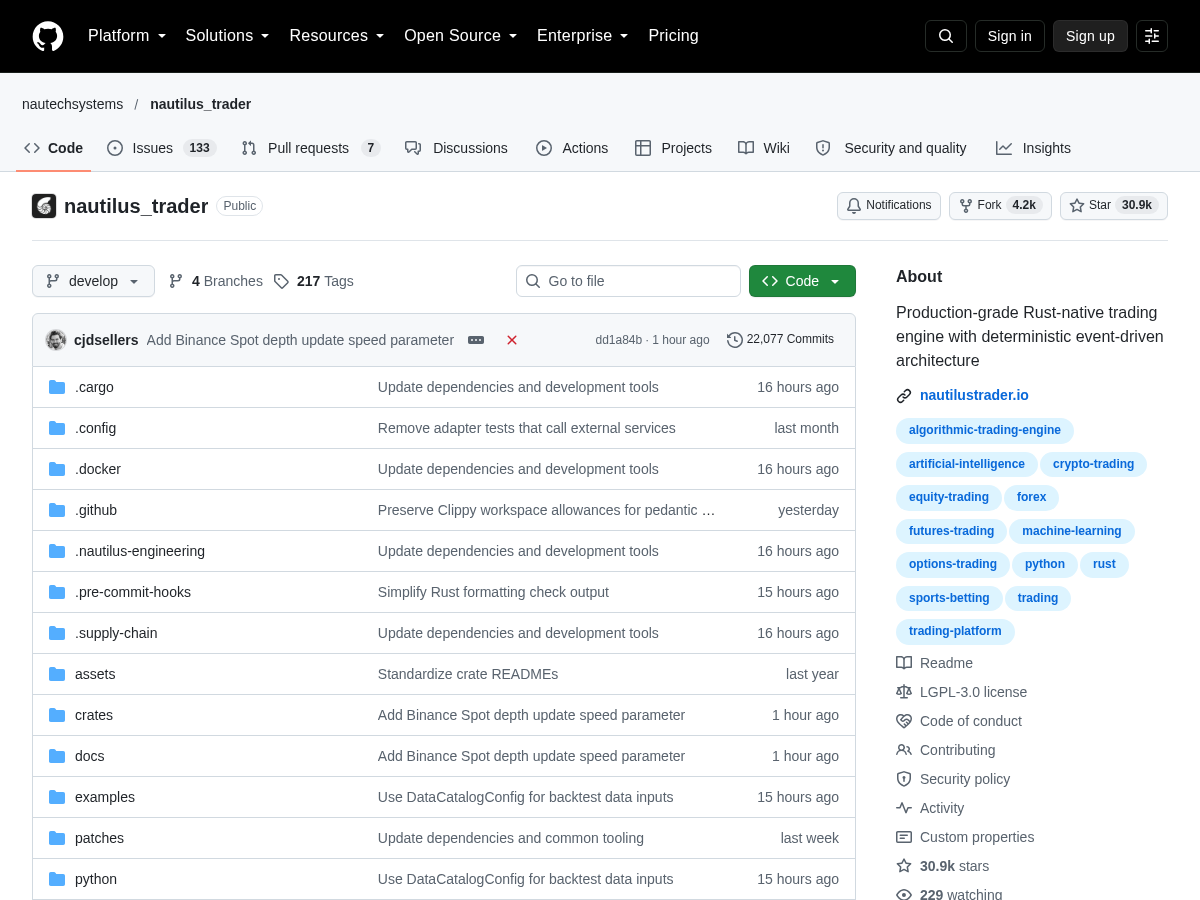
Screenshot of Nautilus_trader
Nautilus_trader
AI/ML Open Source

Nautilus Trader is a production-grade, Rust-native trading engine that utilizes a deterministic event-driven architecture. It is designed to provide a robust and efficient platform for trading various financial instruments, including cryptocurrencies, equities, forex, futures, and options. The engine is built with a focus on performance, reliability, and scalability, making it suitable for high-frequency trading and other demanding applications. Nautilus Trader is open-source, allowing developers to modify and extend the code to suit their specific needs. The project has a strong focus on community involvement, with a large number of contributors and a well-documented codebase. The engine supports multiple programming languages, including Rust and Python, and provides a range of features such as backtesting, strategy optimization, and risk management. Overall, Nautilus Trader is a powerful and flexible trading engine that can be used by traders, researchers, and institutions to develop and execute complex trading strategies. The project is constantly evolving, with new features and improvements being added regularly. The engine's deterministic event-driven architecture ensures that trades are executed consistently and accurately, even in high-pressure trading environments. The project's open-source nature and large community of contributors ensure that any issues or bugs are quickly identified and resolved, making it a reliable choice for traders and institutions. The engine's support for multiple programming languages and its extensive documentation make it accessible to developers of all levels, from beginners to experienced professionals.

Solves

Nautilus Trader solves the problem of providing a reliable, efficient, and scalable trading engine for traders, researchers, and institutions. It addresses the need for a platform that can handle high-frequency trading, backtesting, and strategy optimization, while also providing a flexible and customizable framework for developing and executing complex trading strategies. By utilizing a deterministic event-driven architecture, Nautilus Trader ensures that trades are executed consistently and accurately, even in high-pressure trading environments. This makes it an ideal solution for traders and institutions that require a robust and reliable trading engine.

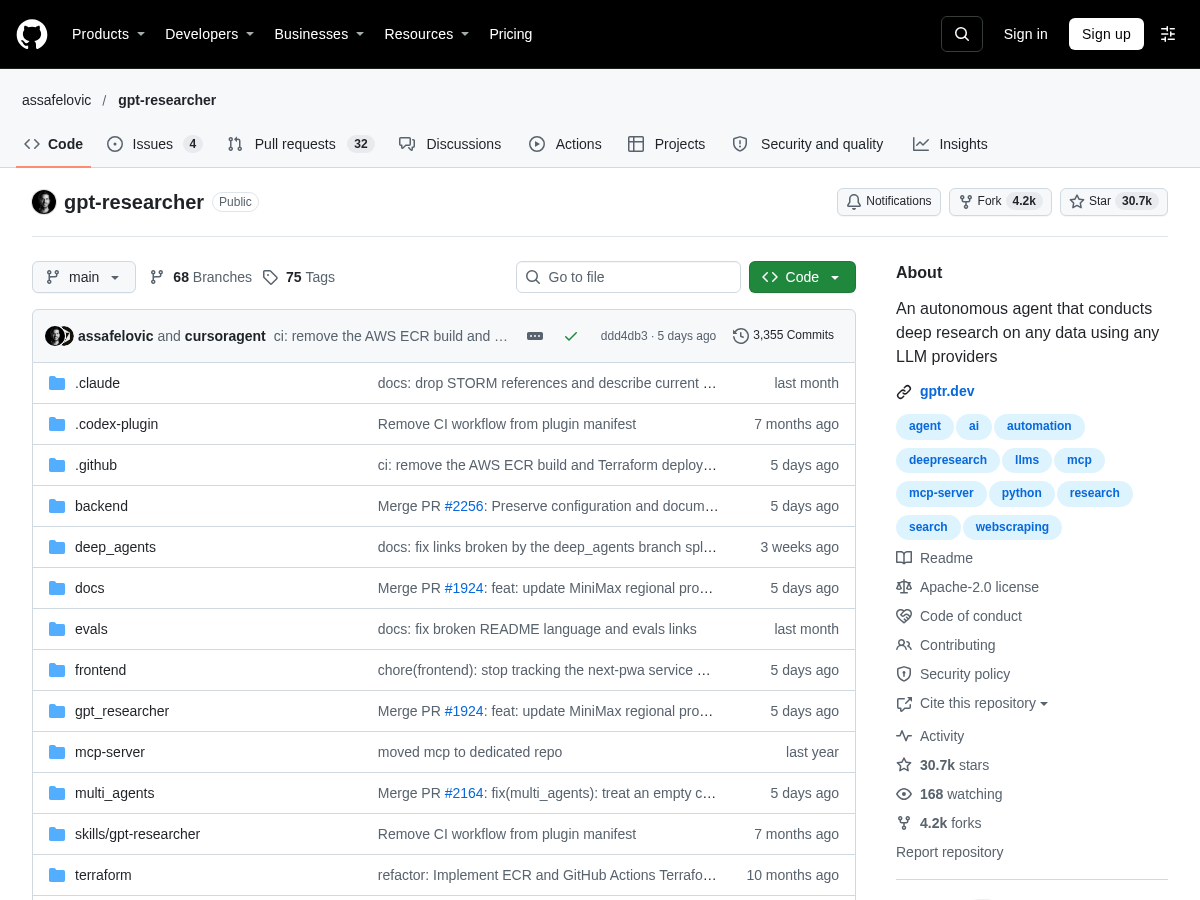
Screenshot of Gpt Researcher
Gpt Researcher
Search Open Source

Gpt Researcher is an autonomous agent designed to conduct deep research on any data using various Large Language Model (LLM) providers. It is an open-source project hosted on GitHub, where it has garnered significant attention with over 30,000 stars and 4,000 forks. The project utilizes Python and is licensed under the Apache-2.0 license. Gpt Researcher's capabilities include planner and execution agents, decision models for context selection, multi-agent workflows, and recursive deep research. It aims to simplify and automate the research process by leveraging AI technologies. The project is actively maintained, with recent commits and updates indicating ongoing development and improvement. Gpt Researcher can be used for a wide range of research tasks, from simple queries to complex, in-depth analyses, making it a valuable tool for researchers, developers, and anyone looking to harness the power of LLMs for knowledge discovery.

Solves

Researchers and developers often face the challenge of conducting thorough and efficient research, especially when dealing with large datasets or complex topics. Gpt Researcher solves this problem by providing an autonomous agent that can conduct deep research using any LLM provider, thereby automating the research process and making it more accessible and efficient. This tool is particularly useful for those who need to analyze vast amounts of data or explore new areas of research without the burden of manual searching and analysis.

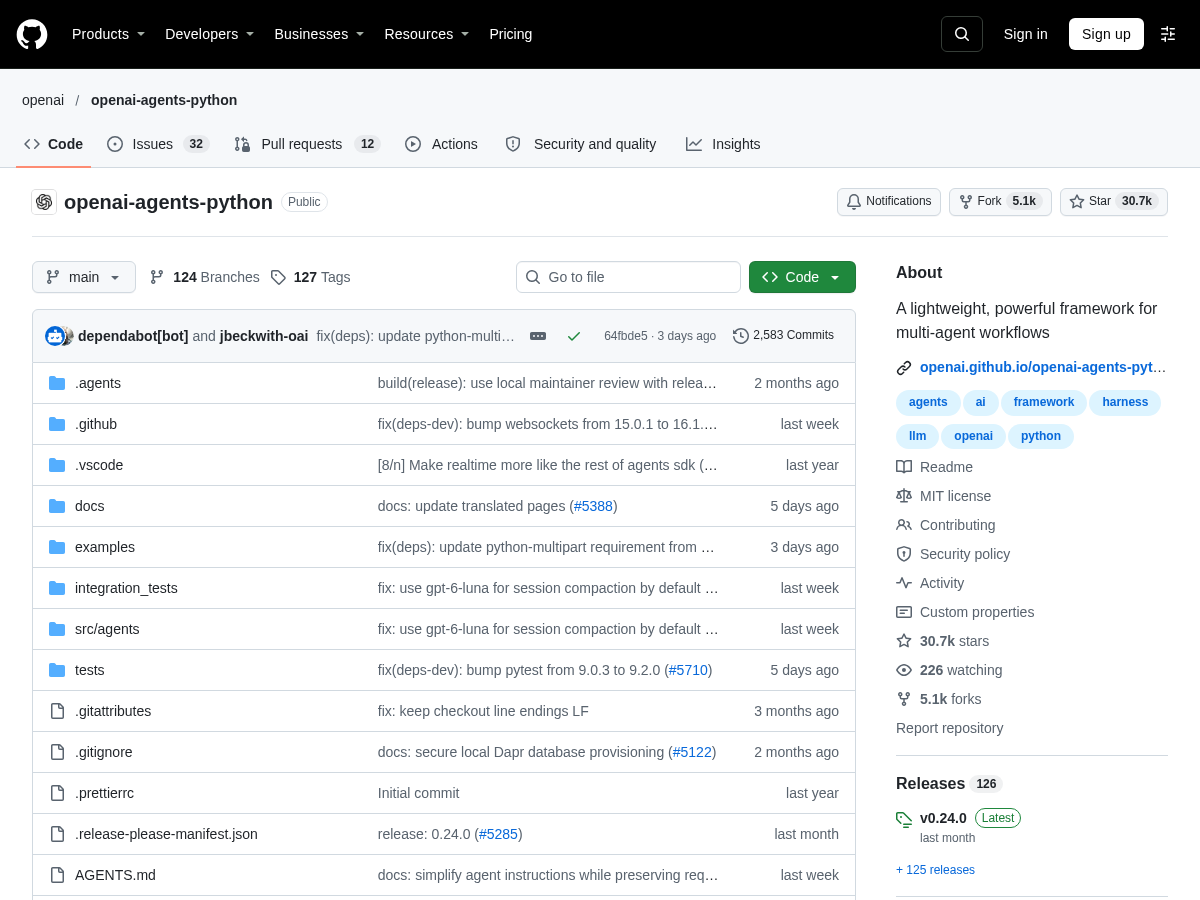
Screenshot of Openai Agents Python
Openai Agents Python
LLM Open Source

Openai Agents Python is a lightweight, powerful framework for multi-agent workflows. It is designed to provide a flexible and scalable way to build and manage multi-agent systems. The framework includes a range of features such as agent management, workflow management, and integration with other OpenAI tools. Openai Agents Python is built on top of the OpenAI platform and provides a Python-based interface for building and interacting with multi-agent systems. The framework is highly customizable and can be used to build a wide range of applications, from simple chatbots to complex autonomous systems. Openai Agents Python is also highly extensible, with a range of APIs and interfaces available for integrating with other tools and platforms. Overall, Openai Agents Python provides a powerful and flexible framework for building and managing multi-agent systems, and is a valuable tool for anyone looking to build complex autonomous systems. The library is well-maintained, with regular updates and a strong focus on community engagement. The documentation is also comprehensive, with a range of tutorials, examples, and API references available to help users get started. In terms of technical details, Openai Agents Python is built using Python and utilizes a range of dependencies, including websockets and python-multipart. The library is also highly customizable, with a range of configuration options and settings available to tailor the framework to specific use cases. Additionally, the library has a strong focus on security, with a range of features and tools available to help users secure their multi-agent systems. The framework is widely used in a range of applications, including chatbots, virtual assistants, and autonomous vehicles. Overall, Openai Agents Python is a powerful and flexible framework for building and managing multi-agent systems, and is a valuable tool for anyone looking to build complex autonomous systems.

Solves

The problem that Openai Agents Python solves is the need for a flexible and scalable framework for building and managing multi-agent systems. Many applications, such as chatbots and virtual assistants, require the ability to manage and interact with multiple agents, and Openai Agents Python provides a powerful and customizable framework for doing so. By providing a range of features and tools for building and managing multi-agent systems, Openai Agents Python helps to simplify the development process and reduce the complexity of building complex autonomous systems. This is particularly useful for developers and researchers who are looking to build complex autonomous systems, but may not have the expertise or resources to build a custom framework from scratch.

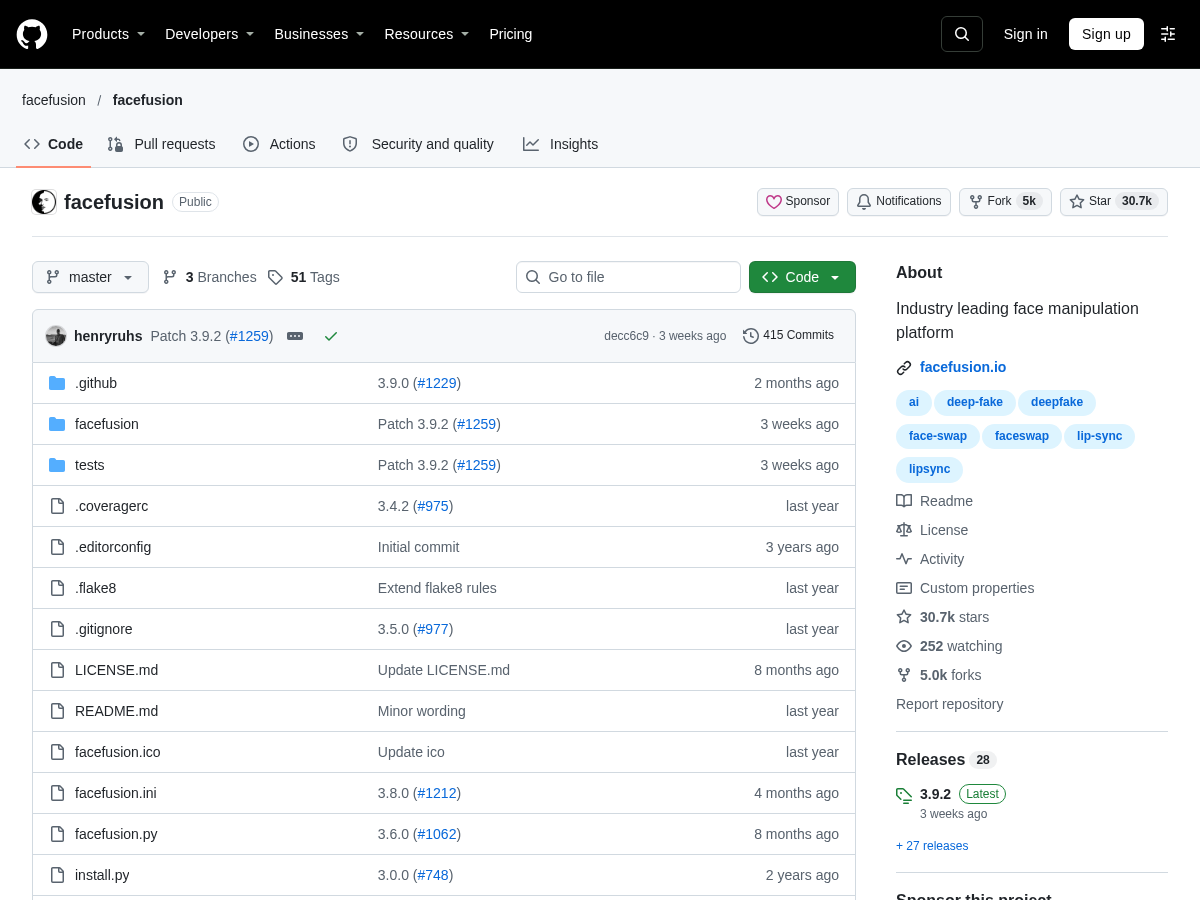
Screenshot of Facefusion
Facefusion
AI/ML Open Source

Facefusion is an industry-leading face manipulation platform that utilizes AI and machine learning to enable advanced face editing and manipulation capabilities. The platform is designed to provide users with a robust and efficient way to edit and manipulate faces in images and videos, with features such as face swapping, lip syncing, and more. Facefusion is built on top of a range of cutting-edge technologies, including deep learning and computer vision, and is designed to be highly customizable and extensible. The platform is open-source, which means that it is free to use and modify, and is supported by a community of developers and users who contribute to its development and maintenance. Facefusion has a wide range of potential applications, including in the fields of entertainment, advertising, and education, and is suitable for use by both professionals and hobbyists. The platform is highly configurable and can be integrated with a range of other tools and technologies, making it a versatile and powerful tool for anyone looking to edit and manipulate faces in images and videos. Facefusion is constantly evolving, with new features and updates being added regularly, and is supported by a range of documentation and resources, including tutorials, guides, and community forums. Overall, Facefusion is a powerful and flexible face manipulation platform that is suitable for a wide range of applications and use cases. It is designed to be easy to use and highly customizable, and is supported by a community of developers and users who are passionate about face manipulation and editing. With its advanced features and capabilities, Facefusion is an ideal choice for anyone looking to take their face editing and manipulation skills to the next level. The platform's open-source nature also means that it is highly extensible and can be modified and customized to meet the specific needs of individual users. Whether you are a professional or a hobbyist, Facefusion is a powerful tool that can help you to achieve your face editing and manipulation goals. Facefusion's features include face swapping, lip syncing, and more, making it a versatile tool for a wide range of applications. The platform's community-driven development and maintenance ensure that it is constantly evolving and improving, with new features and updates being added regularly. Facefusion is also highly configurable and can be integrated with a range of other tools and technologies, making it a powerful and flexible face manipulation platform.

Solves

Facefusion solves the problem of face editing and manipulation in images and videos, which can be a time-consuming and labor-intensive process. The platform provides a range of advanced features and capabilities that make it easy to edit and manipulate faces, including face swapping, lip syncing, and more. Facefusion is designed to be highly customizable and extensible, making it suitable for use by both professionals and hobbyists. The platform's open-source nature also means that it is free to use and modify, which can be a major advantage for users who are looking for a cost-effective solution. Overall, Facefusion provides a powerful and flexible solution for face editing and manipulation, and is an ideal choice for anyone looking to take their skills to the next level.

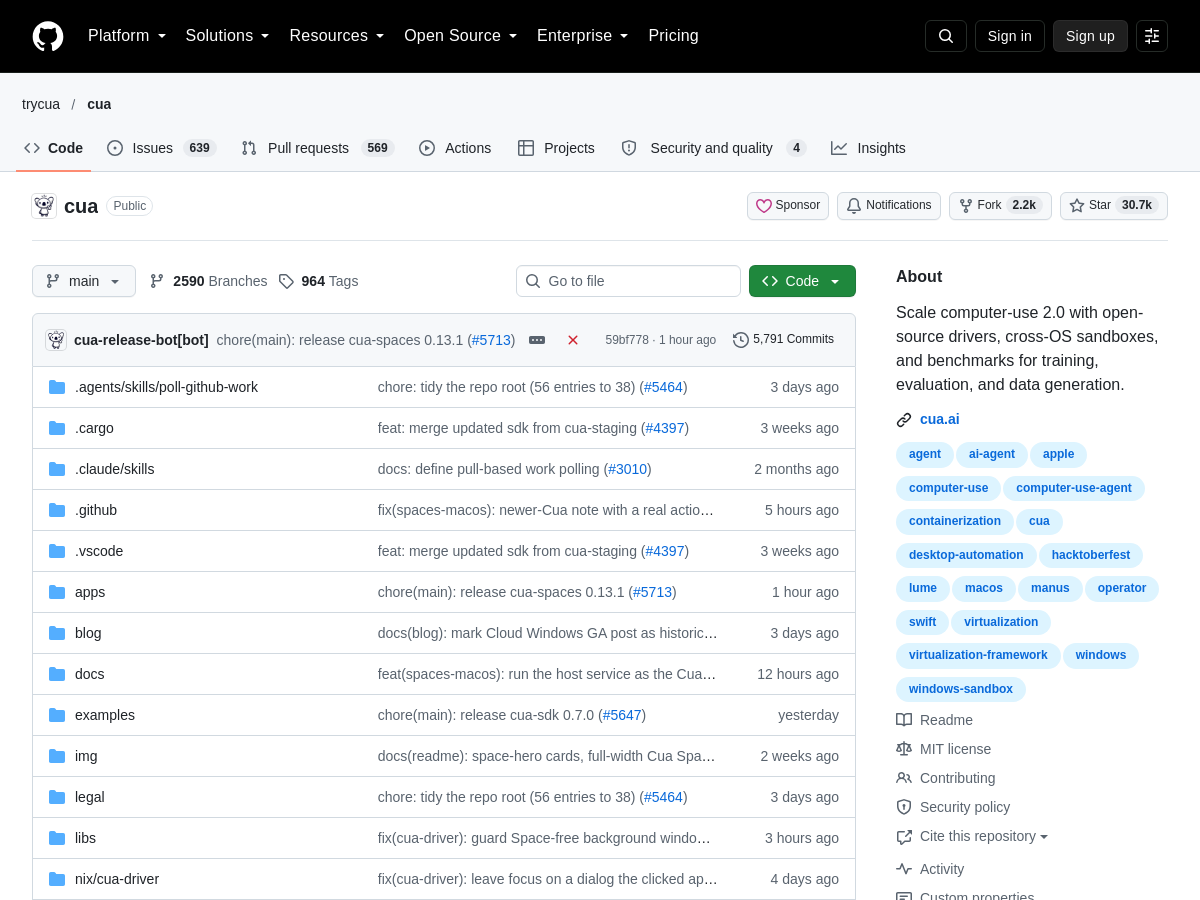
Screenshot of Cua
Cua
Fine-tuning Open Source

Cua is an open-source project that enables the scaling of computer-use 2.0 with open-source drivers, cross-OS sandboxes, and benchmarks for training, evaluation, and data generation. The project provides a range of features, including virtualization, containerization, and desktop automation, making it a versatile tool for developers and researchers. Cua's architecture is designed to support multiple operating systems, including macOS and Windows, and provides a sandboxed environment for testing and training AI models. The project is actively maintained, with a large community of contributors and a strong focus on security and quality. Cua's documentation is extensive, with a comprehensive README and contributing guide, making it easy for new users to get started. The project's codebase is well-organized, with a clear structure and modular design, allowing developers to easily navigate and contribute to the code. Overall, Cua is a powerful tool for anyone looking to scale computer-use 2.0 and take advantage of the latest advancements in AI and machine learning. Cua's open-source nature and large community of contributors ensure that the project will continue to evolve and improve over time, making it a valuable resource for developers and researchers. The project's focus on security and quality also ensures that users can trust the code and rely on it for their critical applications. With its extensive documentation and well-organized codebase, Cua is an ideal choice for anyone looking to get started with computer-use 2.0 and AI development.

Solves

Cua solves the problem of scaling computer-use 2.0 by providing a range of features and tools that enable developers and researchers to easily test, train, and deploy AI models. The project's open-source drivers, cross-OS sandboxes, and benchmarks provide a comprehensive solution for computer-use 2.0, making it easier for users to take advantage of the latest advancements in AI and machine learning. By providing a sandboxed environment for testing and training AI models, Cua reduces the risk of errors and security breaches, making it a valuable resource for developers and researchers who need to ensure the reliability and security of their applications.

Screenshot of OpenCLI
OpenCLI
AI Agents Open Source

OpenCLI is a command-line interface (CLI) tool that utilizes an AI agent to convert any website into a CLI, allowing users to interact with the website using their logged-in browser. This tool enables users to automate tasks, access website data, and perform various actions using the command line. OpenCLI is built on top of the Playwright browser automation framework and provides a range of features, including support for multiple browsers, automated login, and data extraction. The tool is designed to be extensible, with a modular architecture that allows developers to add new features and functionality. OpenCLI is open-source and has a large community of contributors, with over 30,000 stars on GitHub. The tool has a wide range of applications, including web scraping, automation, and data analysis. Overall, OpenCLI provides a powerful and flexible way to interact with websites using the command line, making it a valuable tool for developers, researchers, and anyone looking to automate tasks or extract data from websites.
Solves

OpenCLI solves the problem of interacting with websites using the command line, providing a more efficient and automated way to access website data and perform tasks. For developers, researchers, and anyone looking to automate tasks or extract data from websites, OpenCLI provides a powerful and flexible solution. By converting any website into a CLI, OpenCLI enables users to automate tasks, access website data, and perform various actions using the command line, making it a valuable tool for anyone looking to streamline their workflow or extract data from websites.

Screenshot of AIHawk
AIHawk
AI Agents Open Source

AIHawk is an open-source AI browser agent that lets users describe tasks in plain English and then autonomously execute them on real websites. Instead of scripting browser interactions, a user can simply tell the agent what to do, and it will browse, click, type, and read content to accomplish the objective. This positions AIHawk as a computer-use assistant for the web rather than a traditional browser automation framework. The project includes a standalone user interface, making it accessible to non-programmers who want to delegate routine web tasks, while also offering a browser Model Context Protocol (MCP) for developers who use coding assistants such as VS Code, Codex, and Gemini CLI. Through MCP, these development environments gain the ability to control a browser through natural language, enabling agentic workflows that traverse websites, extract information, and interact with web applications directly. As an open-source solution, AIHawk is designed to be self-hosted and customized, giving users control over model configuration, browser behavior, and data handling. Its dual nature as both a UI application and an MCP server makes it flexible for individual automation, team productivity tools, or embedded agent infrastructure. However, like all web automation tools that rely on real site structure and AI reasoning, results may vary depending on page changes, site defenses, and the underlying language model used.
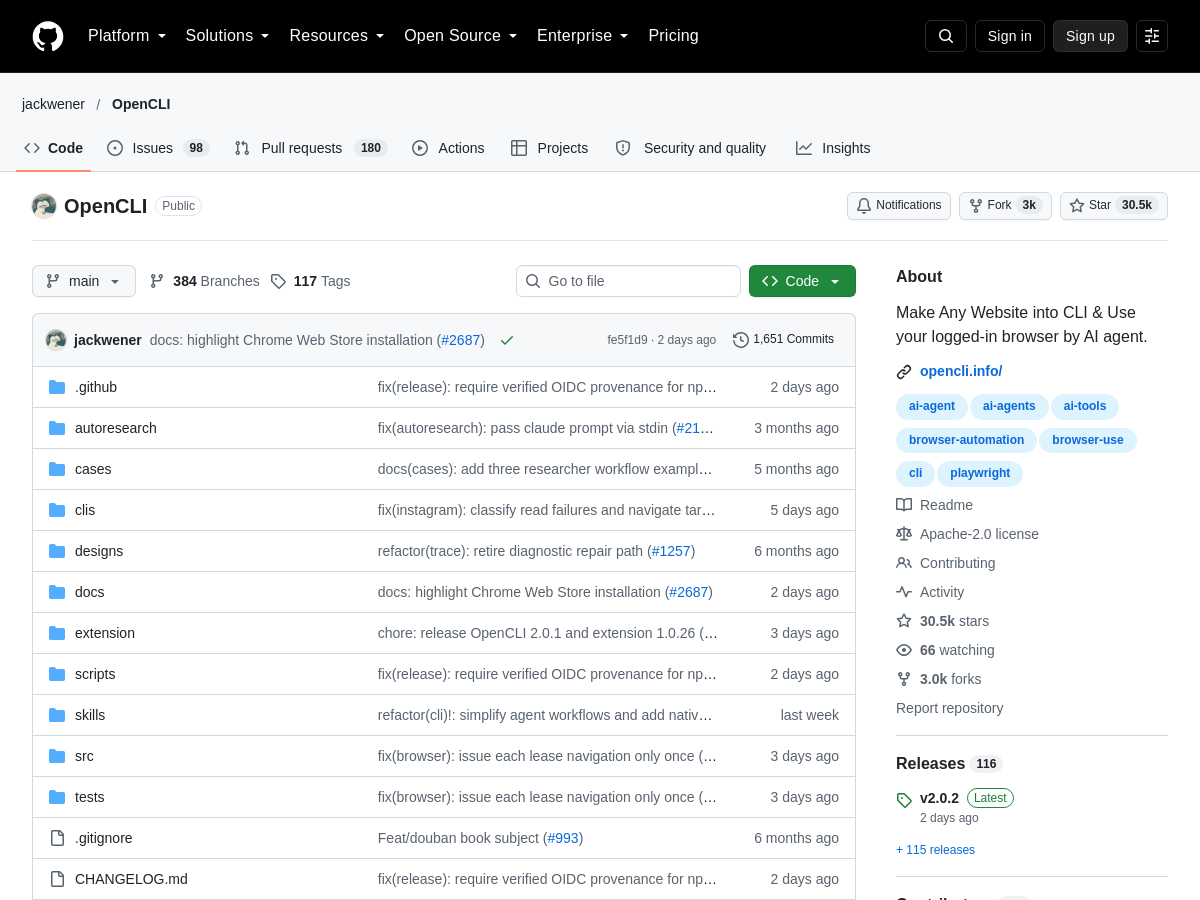
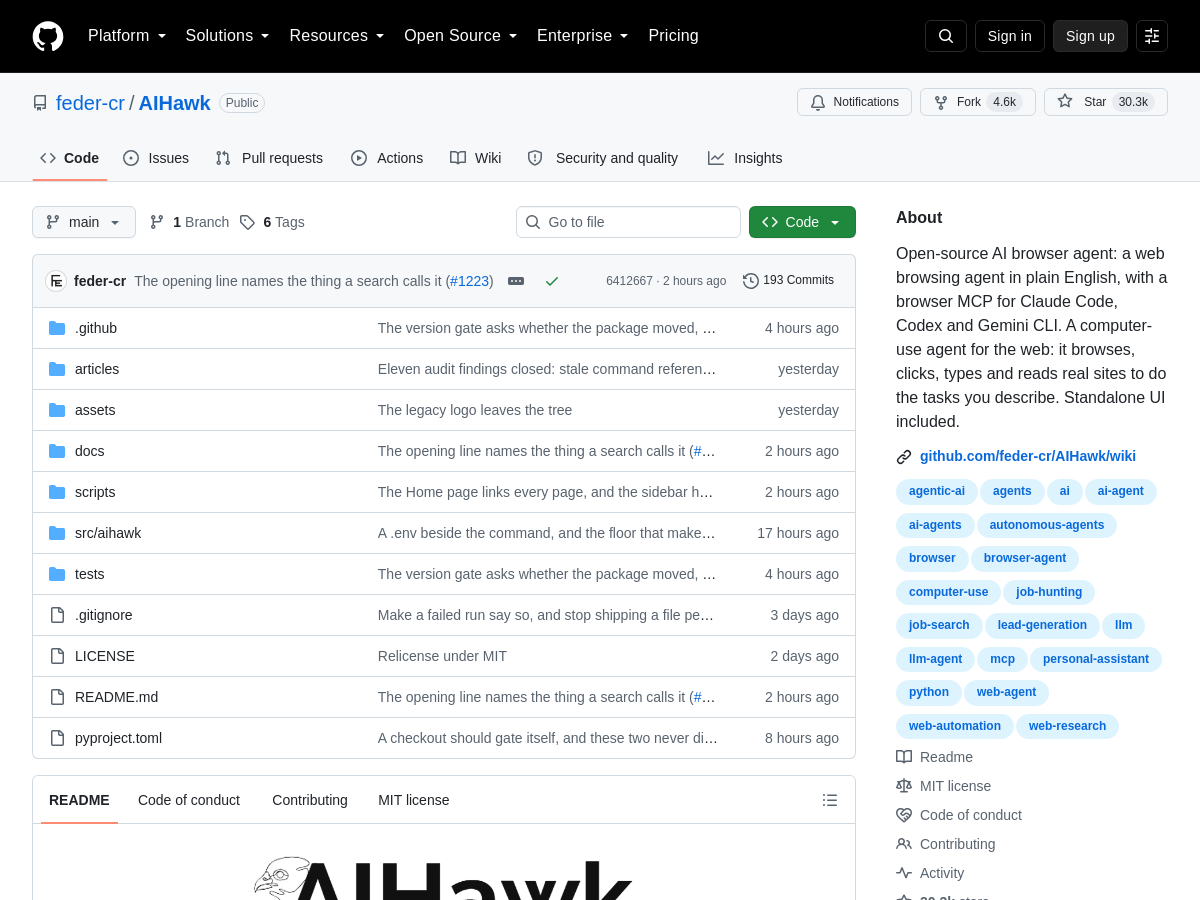
Solves

AIHawk solves the problem of manually performing repetitive or multi-step web tasks by allowing users to delegate them to an AI agent through natural language. It replaces brittle scripting with an adaptive browser agent that can operate real websites, complete forms, and retrieve information autonomously.

Screenshot of Lighthouse
Lighthouse
Dev Tools Open Source

Lighthouse is an open-source automated tool developed by Google for improving the quality of web pages. It runs audits for performance, accessibility, progressive web apps, SEO, and more, then generates a report with scores and suggestions. It can be run from the command line, as a Node module, or within Chrome DevTools. The tool collects modern web performance metrics such as First Contentful Paint, Largest Contentful Paint, Cumulative Layout Shift, Time to Interactive, and Speed Index, providing actionable insights to optimize loading experiences. It also checks best practices including HTTPS usage, correct image aspect ratios, and avoiding deprecated APIs. Lighthouse is highly configurable, supporting custom audits, throttling settings, and integration with continuous integration systems. It is widely adopted by developers and site owners to monitor and improve site quality over time. The project is maintained by the Google Chrome team and has a large community of contributors, ensuring regular updates and alignment with evolving web standards.

Solves

Lighthouse automates web page quality auditing by running a battery of tests covering performance, accessibility, best practices, SEO, and progressive web app criteria, producing a detailed report with scores and recommendations, eliminating the need for manual testing across multiple tools.

Screenshot of Awesome Datascience
Awesome Datascience
Database Open Source

Awesome Datascience is an open-source Data Science repository designed to help individuals learn and apply Data Science concepts to solve real-world problems. The repository provides a comprehensive collection of resources, including tutorials, articles, and projects, to aid in the study and application of Data Science. It covers various topics such as data mining, data visualization, deep learning, and machine learning, making it a valuable resource for those looking to start or advance their careers in Data Science. The repository is constantly updated with new content and contributions from the community, ensuring that users have access to the latest information and best practices in the field. With its extensive range of resources and active community, Awesome Datascience is an ideal starting point for anyone looking to explore and learn about Data Science.

Solves

Data Science enthusiasts and professionals often face the challenge of finding reliable and comprehensive resources to learn and apply Data Science concepts. Awesome Datascience solves this problem by providing a curated collection of resources, including tutorials, articles, and projects, that cater to different skill levels and interests. By leveraging this repository, individuals can overcome the hurdle of finding relevant and trustworthy information, and instead focus on developing their skills and knowledge in Data Science.

Screenshot of RAG_Techniques
RAG_Techniques
LLM Open Source

RAG_Techniques is an open-source repository that showcases various advanced techniques for Retrieval-Augmented Generation (RAG) systems. Each technique has a detailed notebook tutorial, providing a comprehensive understanding of how to implement and utilize these techniques in real-world applications. The repository is designed to help developers, researchers, and enthusiasts explore the capabilities of RAG systems and develop new applications. With a focus on providing detailed tutorials and examples, RAG_Techniques aims to make it easier for users to get started with RAG systems and to advance the state-of-the-art in this field. The repository includes a range of topics, such as agentic-rag, ai, embeddings, generative-ai, gpt, langchain, llama-index, llm, llms, machine-learning, nlp, openai, python, rag, retrieval-augmented-generation, semantic-search, tutorials, and vector-database. By providing a comprehensive set of tutorials and examples, RAG_Techniques enables users to develop a deeper understanding of RAG systems and to apply this knowledge in a variety of applications. The repository is actively maintained, with regular updates and new additions, ensuring that users have access to the latest techniques and developments in the field. Overall, RAG_Techniques is a valuable resource for anyone interested in RAG systems and their applications. The repository's detailed tutorials and examples make it an ideal starting point for those new to the field, while its comprehensive coverage of advanced techniques makes it a useful resource for experienced researchers and developers. By leveraging the knowledge and expertise shared in RAG_Techniques, users can develop new and innovative applications of RAG systems, advancing the state-of-the-art in this exciting and rapidly evolving field. The repository's focus on providing detailed tutorials and examples also makes it an excellent resource for educational purposes, allowing students and educators to explore the capabilities of RAG systems in a hands-on and interactive way.

Solves

Developers, researchers, and enthusiasts working with Retrieval-Augmented Generation (RAG) systems often face the challenge of finding comprehensive and detailed tutorials and examples to help them get started and advance their knowledge in this field. RAG_Techniques solves this problem by providing a repository of advanced techniques for RAG systems, each with a detailed notebook tutorial, making it easier for users to develop a deeper understanding of RAG systems and to apply this knowledge in a variety of applications.

Screenshot of Modular
Modular
AI/ML Open Source

The Modular Platform is an open-source project that includes MAX and Mojo. It appears to be a collection of tools and libraries for building and managing AI and machine learning models. The project has a large number of commits and contributors, indicating a high level of activity and community engagement. The platform includes various components such as AsyncRT, Cache, Config, Init, Licenses, Mojo, and Support, each with its own set of features and functionalities. The project uses a variety of technologies, including LLVM, Bazel, and Python. The Modular Platform is designed to provide a flexible and scalable framework for building and deploying AI models, and it has a strong focus on performance, security, and reliability. The project's documentation and community resources are also well-maintained, making it easier for new users to get started and contribute to the project.

Solves

The Modular Platform solves the problem of building and managing complex AI and machine learning models by providing a flexible and scalable framework for developers and researchers. It addresses the challenges of integrating multiple tools and libraries, managing dependencies, and optimizing performance, allowing users to focus on building and deploying their models. The platform's open-source nature and large community of contributors also ensure that it is constantly evolving and improving, making it a reliable choice for users.

Screenshot of TencentDB Agent Memory
TencentDB Agent Memory
LLM Open Source

TencentDB Agent Memory is a team-level memory hub for AI Agents that turns conversations, documents, and code into four reusable memory assets: Chat Memory, Skill, LLM-Wiki, and Code-Graph. These assets are governed, shared, and equipped across agents and frameworks, enabling efficient collaboration and knowledge sharing. The project is designed to provide a centralized memory management system for AI agents, allowing them to learn from and build upon each other's experiences. With its open-source nature, TencentDB Agent Memory encourages community involvement and contributions to further enhance its capabilities. The project's architecture is modular, with separate components for memory core, knowledge, and other functionalities, making it easier to maintain and extend. Overall, TencentDB Agent Memory has the potential to revolutionize the way AI agents interact and learn from each other, leading to significant advancements in the field of artificial intelligence.

Solves

The problem of inefficient knowledge sharing and collaboration among AI agents is solved by TencentDB Agent Memory. Previously, AI agents had to rely on individual learning and memory, which led to redundant efforts and limited knowledge sharing. With TencentDB Agent Memory, AI agents can now share and build upon each other's experiences, enabling more efficient collaboration and faster learning. This solution is particularly useful in applications where multiple AI agents need to work together to achieve a common goal, such as in chatbots, virtual assistants, or other conversational AI systems.

Screenshot of Cs249r_book
Cs249r_book
AI Agents Open Source

The Cs249r_book is an open-source project that provides a comprehensive textbook series on Machine Learning Systems, covering foundations, scaling, agentic AI, and physical AI. The project is hosted on GitHub and consists of four volumes, with the first two volumes already published. The textbook series is designed for students and practitioners in the field of machine learning and provides a thorough introduction to the subject. The project also includes additional resources such as code, datasets, and course materials. The Cs249r_book project is actively maintained and updated by its contributors, with new commits and releases being added regularly. The project has gained significant attention and popularity, with over 29,000 stars on GitHub. The textbook series is widely used in academic and industry settings, and its open-source nature allows for community contributions and feedback.

Solves

The Cs249r_book project solves the problem of providing a comprehensive and up-to-date textbook series on Machine Learning Systems. The project addresses the need for a thorough and accessible introduction to the subject, which is essential for students and practitioners in the field. By providing a free and open-source textbook series, the project makes it possible for anyone to access and learn from the material, regardless of their financial or institutional background. The project also facilitates community engagement and contributions, which helps to ensure that the material is accurate, relevant, and effective.

Screenshot of Claude Seo
Claude Seo
Open Source Open Source

Claude Seo is an open-source SEO skill for Claude Code, providing 26 sub-skills and 19 sub-agents to cover various aspects of technical SEO, E-E-A-T, schema, GEO/AEO, agent readiness, backlinks, local SEO, e-commerce, international SEO, Google APIs, and PDF/Excel reporting. The project includes 9 optional extensions for live SEO data and is designed to be a comprehensive solution for SEO needs. With its extensive range of features and capabilities, Claude Seo aims to assist users in improving their website's search engine ranking and overall online presence. The project is actively maintained, with regular updates and contributions from the community. Claude Seo is built using a variety of technologies and tools, including JavaScript, HTML, and CSS, and is designed to be highly customizable and extensible. The project's documentation and code are openly available, making it easy for developers to contribute and modify the code to suit their specific needs. Overall, Claude Seo is a powerful and flexible SEO solution that can help users achieve their online marketing goals. The project's focus on technical SEO, E-E-A-T, and schema makes it an ideal choice for users looking to improve their website's structure and content. Additionally, the project's support for Google APIs and PDF/Excel reporting makes it easy to track and analyze SEO performance. With its comprehensive feature set and active community, Claude Seo is a great choice for anyone looking to improve their website's SEO. The project's code is well-organized and easy to navigate, making it easy for developers to get started and contribute to the project. The project's documentation is also extensive, providing detailed information on how to use and customize the project. Overall, Claude Seo is a well-designed and well-maintained project that can help users achieve their SEO goals.

Solves

Claude Seo solves the problem of optimizing website content for search engines, which is a critical task for businesses and individuals looking to increase their online visibility and reach their target audience. By providing a comprehensive set of SEO tools and features, Claude Seo helps users improve their website's search engine ranking, drive more traffic to their site, and ultimately increase their online presence and revenue. The project's focus on technical SEO, E-E-A-T, and schema makes it an ideal choice for users looking to improve their website's structure and content, while its support for Google APIs and PDF/Excel reporting makes it easy to track and analyze SEO performance.

Screenshot of Agents Course
Agents Course
AI Agents Open Source

The Hugging Face Agents Course is a comprehensive, free online curriculum designed to teach the fundamentals of AI agents. Hosted on GitHub and the Hugging Face learning platform, it provides a structured path from basic concepts to advanced agent design. The course is divided into four main units: an introduction, core agent architectures, tool usage and integration, and a final assignment where learners build and benchmark an agent. Each unit includes detailed explanations, hands-on code examples using Hugging Face libraries (like Transformers and Smolagents), interactive quizzes, and practical exercises. Learners are guided through creating agents that can reason, use tools, and interact with external APIs. The repository contains all course materials, including scripts, quizzes, and unit content, enabling both self-paced online learning and local study. With over 29,000 stars and 1,700+ commits, it is actively maintained by the Hugging Face community and contributors.

Solves

Many developers, machine learning engineers, and data scientists want to explore the emerging field of AI agents but lack a clear, structured, and practical learning path. Existing resources are often fragmented, too theoretical, or outdated. This course solves that by offering a free, open-source, step-by-step guide that combines conceptual explanations with real code, enabling learners to quickly grasp agent concepts and apply them using popular open-source tools.